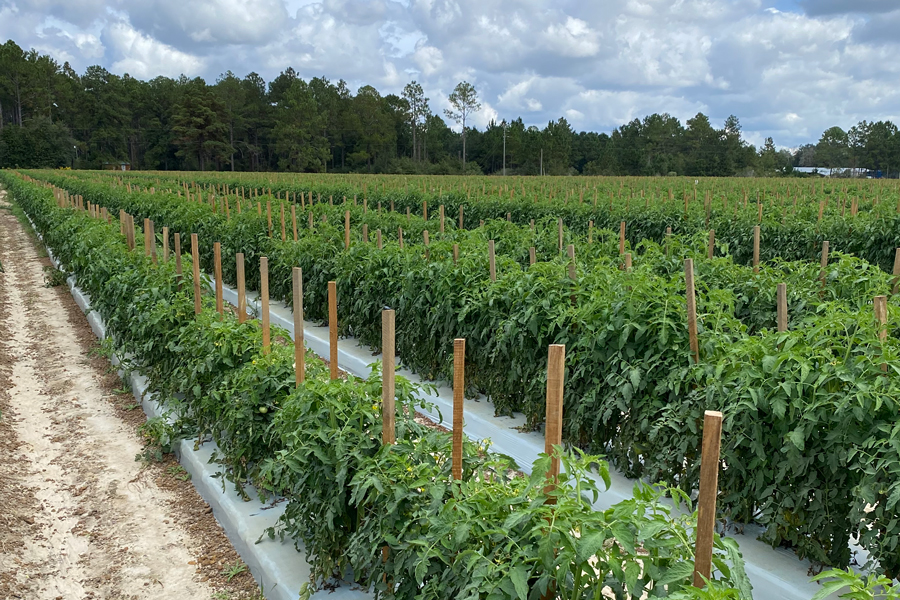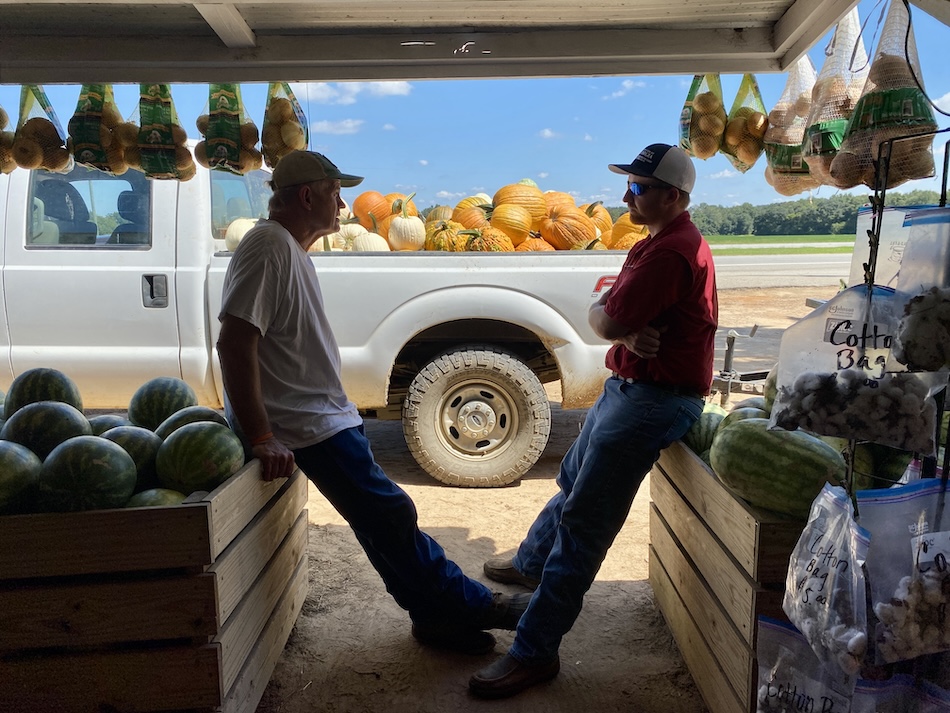

Watermelon is a major commercial vegetable crop in Georgia, and selecting the right variety is crucial for achieving high yields, excellent fruit quality, and disease resistance. Georgia’s warm climate supports excellent watermelon production; however, disease pressure, environmental variability, and market expectations make variety selection a critical decision for growers.
Related Content
The recommendations in this resource are based on our 2022, 2023, and 2025 research trials and associated research publications, which evaluated performance of seedless large, mini, and specialty watermelon types. These results provide growers with current, research-based guidance for selecting adapted and reliable varieties for commercial production in the near future.
Large Triploid (Seedless)
| Variety | Days to mat.† | % yield at first harvest | Avg. weight (lb) | Size distribution of total marketable yield (%)* | Brix (%) | Shape | Rind color | Flesh (red) | Disease resist.† | |||
|---|---|---|---|---|---|---|---|---|---|---|---|---|
| 60-ct | 45-ct | 36-ct | 30-ct | |||||||||
| Large Triploid (Seedless) “Crimson Stripe” Rind Type Watermelons | ||||||||||||
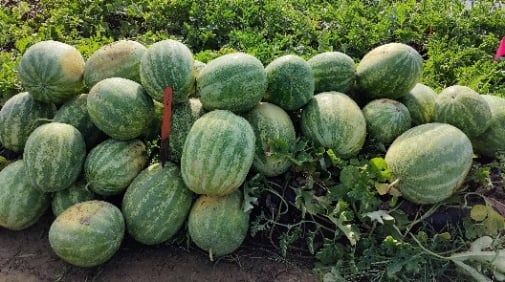
| 7197 HQ | 88 | 43.2 | 16.0 | 22 | 36 | 30 | 12 | 13.3 | Oval | Light | Dark | n/a |
| Cracker Jack | 80 | 50.7 | 16.4 | 16 | 36 | 35 | 13 | 13.8 | Oval | Dark | Dark | anthracnose, fusarium wilt |
| El Capitan | 85–90 | 43.6 | 15.9 | 22 | 41 | 24 | 13 | 11.8 | Oval | Dark | Dark | fusarium wilt |
| Excursion | 83 | 55.1 | 18.1 | 10 | 25 | 33 | 31 | 12.0 | Blocky | Light | Dark | anthracnose, fusarium wilt |
| Jetski | 78 | 51.8 | 15.6 | 24 | 44 | 23 | 9 | 13.6 | Oval | Light | Dark | fusarium wilt |
| Miramonte | 90 | 46.3 | 15.1 | 28 | 39 | 23 | 10 | 11.4 | Blocky | Medium | Dark | fusarium wilt |
| Sierra Nevada | 85–90 | 34.6 | 16.7 | 14 | 47 | 22 | 17 | 12.4 | Oval | Medium | Dark | fusarium wilt |
| Troubadour | 82 | 26.7 | 13.4 | 33 | 41 | 19 | 7 | 12.6 | Oval | Medium | Dark | anthracnose |
| Valor | 79 | 62.3 | 16.8 | 11 | 26 | 44 | 19 | 12.9 | Oval | Medium | Dark | anthracnose, fusarium wilt |
| Large Solid “Black” Rind Triploid (Seedless) Watermelons | ||||||||||||
| Blackjack | 78 | 54.3 | 16.9 | 14 | 37 | 32 | 17 | 13.7 | Oval | Very dark | Bright | anthracnose, fusarium wilt, powdery mildew |
| Dark Knight | 80 | 22.0 | 15.6 | 18 | 53 | 16 | 13 | 11.6 | Globe | Very dark | Dark | anthracnose, fusarium wilt, powdery mildew |
| *60 count: 9–13.5 lb, 45 count: 13.6–17.5 lb, 36 count: 17.6–21.4 lb, 30 count: > 21.5 lb. †Days to maturity and disease resistance sourced from seed catalogs/websites; all other data from UGA field trials. | ||||||||||||
Mini Triploid (Seedless)

| Variety | Days to mat.† | % yield at first harvest | Avg. weight (lb) | Size distribution of total marketable yield (%) | Brix (%) | Shape | Rind color | Flesh | Disease resistance† | |||
|---|---|---|---|---|---|---|---|---|---|---|---|---|
| 3–5 lb | 5–7 lb | 7–9 lb | > 9 lb | |||||||||
| Mini Triploid (Seedless) “Crimson Stripe” Rind Type Watermelons | ||||||||||||
| Bolita | — | 87.3 | 7.7 | 2 | 28 | 38 | 32 | 12.4 | Round | Dark | Med. red | fusarium wilt |
| Excite | 84 | 57.5 | 7.5 | 6 | 25 | 40 | 29 | 12.2 | Round | Dark | Dark red | powdery mildew |
| Proxima | — | 76.3 | 7.4 | 4 | 32 | 41 | 23 | 11.7 | Round | Dark | Med. red | anthracnose, fusarium wilt |
| Non-harvestable Pollinizer | ||||||||||||
| SP-7 | — | — | — | — | Round | Medium | Med. yellow | anthracnose, fusarium wilt, powdery mildew | ||||
| †Days to maturity and disease resistance sourced from seed catalogs/websites; all other data from UGA field trials. | ||||||||||||
References
Kemble, J. M. (Ed.). (2024). Southeastern U.S. vegetable crop handbook. Southeastern Vegetable Extension Workers Group. http://www.vegcrophandbook.com/
Kumari, M., Deltsidis, A., Luo, X., McAvoy, C., & McAvoy, T. (2025). Assessment of triploid watermelon cultivars grown in Georgia for yield and quality parameters. HortTechnology, 35(1), 81–89. https://doi.org/10.21273/HORTTECH05561-24
Owolanke, T., Kumari, M., Acharya, N., McAvoy, C., Deltsidis, A., & McAvoy, T. (2026). Performance of Georgia grown mini triploid watermelon cultivars: Assessment of yield, fruit size distribution, and postharvest quality. HortTechnology, 36(4), 706–714. https://doi.org/10.21273/HORTTECH05879-26
Seedway, LLC. (2024). Vegetable seed catalog. https://www.seedway.com/vegetable-seed/
The Georgia Watermelon Association collaborated with the authors on this publication.