Takeaways
- Mentorship legacy: On June 1, CAES alum Jamie Ellis will succeed his former mentor, Keith Delaplane, as director of the UGA Bee Program.
- Proven track record: During his tenure at the University of Florida, Ellis built a program that secured over $9.3 million in grants and produced nearly 1,000 publications.
- Comprehensive leadership: His goal is to make the UGA Bee Program preeminent in research, instruction and Extension to improve the sustainability of beekeeping.
On the first day of his undergraduate career at the University of Georgia, Jamie Ellis did not head to orientation or wander the quad. He reported for work in the lab of Keith Delaplane, the bee scientist who had called Ellis the spring before to personally recruit him.
That morning set the tone for everything that followed.
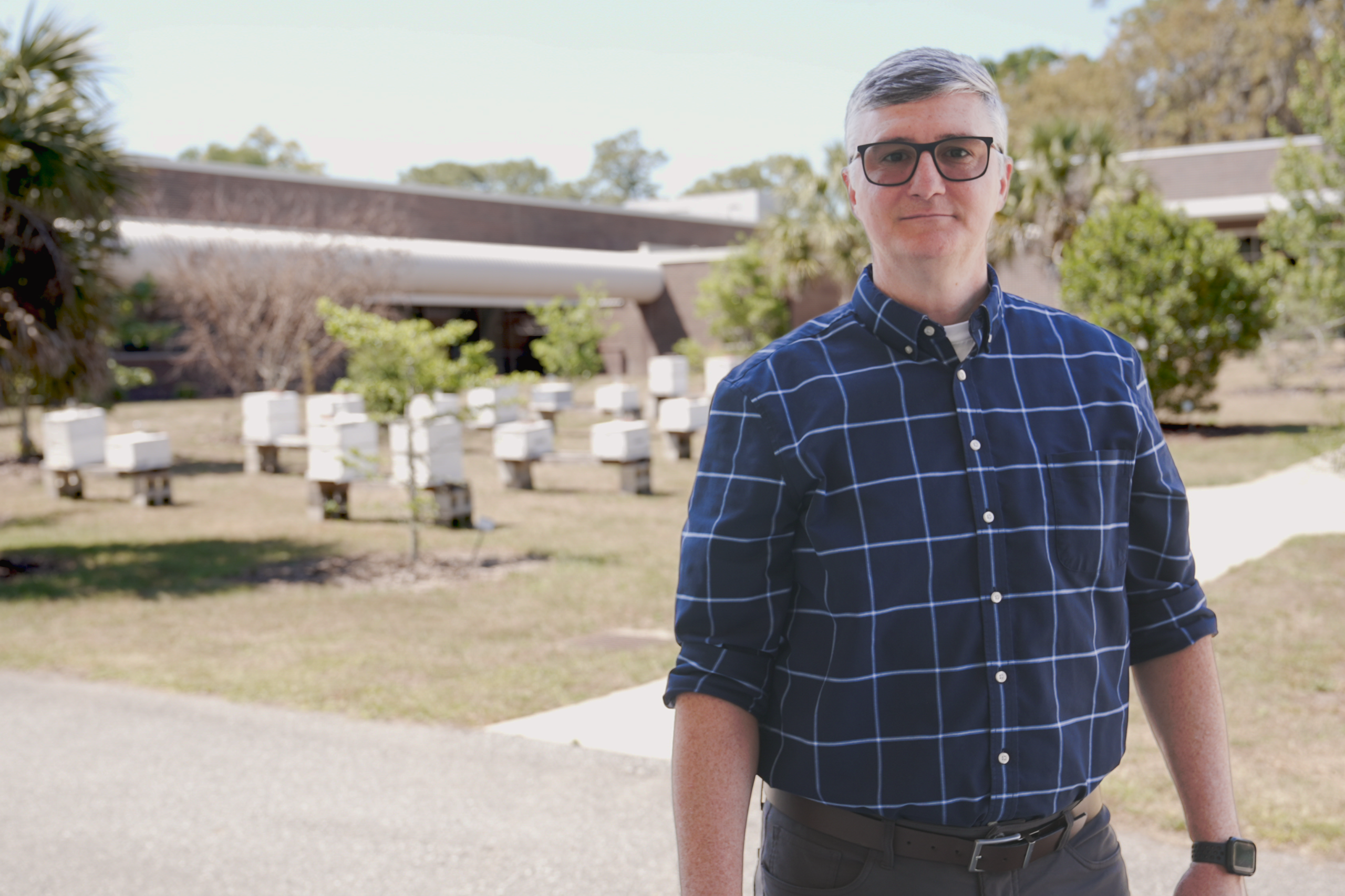
More than two decades later, Ellis is walking back through those same doors — this time as the new director of UGA’s Bee Program. He arrives trailing an extraordinary record built at the University of Florida, where he helped build a highly successful honey bee program — one that generated nearly 1,000 publications, attracted more than $9.3 million in grants and contracts, and earned him national recognition as the top Extension specialist in his field. Now he is coming home.
“There is a bittersweet feeling associated with leaving something I built at UF,” Ellis said. “But this feels right. UGA has made a tremendous investment in its honey bee program, and I genuinely believe we can make it preeminent.”
A small town start to global stages
It started with a middle school science teacher in Glascock County who saw something in Ellis before he saw it in himself — and pushed him toward science with the kind of stubborn conviction that can change lives.
It continued with Joseph Miller, a beekeeper and coworker of Ellis’s father, who gave him his first colony and became his first mentor in the craft. And it found institutional shape through Holly Hadden, a high school science teacher and mentor, and David Spade, a Georgia 4-H leader in Glascock County, whose investment in Ellis’s science fair projects and academic interests opened doors Ellis didn’t yet know existed.
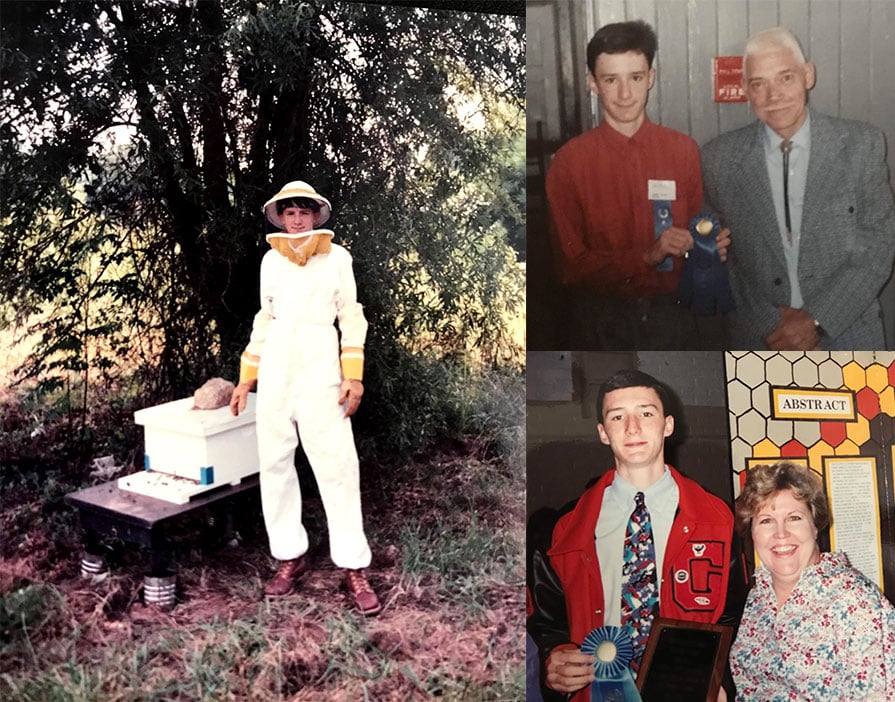
“Those individuals essentially would not let me fail,” Ellis said. “They just poured into me. And of course, I credit my parents for supporting my beekeeping dream.”
What Ellis learned through 4-H turned out to matter in ways that went beyond ribbons and science fairs. It taught Ellis to speak in public, a skill he has since deployed in more than 1,200 talks across dozens of countries. It also instilled a sense of belonging beyond the small-town environment where he was raised.
Delaplane, then a professor of entomology at UGA, came into Ellis’s orbit through science fair and 4-H. Ellis, who knew of Delaplane’s work, asked him to review his science fair project. Delaplane offered feedback. And then, when Ellis graduated from high school in 1996, Delaplane gave him a call.
“He called my house and said he wanted me to come work for him,” Ellis recalls. “I started as his undergraduate laboratory assistant on my first day at UGA.”
South Africa and a different kind of education
Ellis spent four years in Delaplane’s lab as a pre-med biology major in the way that many college students are pre-med — because medicine seemed like the thing science was supposed to lead to. Delaplane helped him see different paths.
“Around my junior or senior year, it became clear to me that bees and science belonged together,” Ellis said. “I needed someone to tell me, and Dr. Delaplane did. He pivoted me toward a Ph.D.”
When Ellis graduated with his bachelor’s degree in biology in 2000, the advice Delaplane offered was equally direct: Go somewhere unfamiliar. Delaplane pointed Ellis toward programs in Canada, England and South Africa. Rhodes University in Makhanda, South Africa, won.
The decision shaped him as much as any laboratory work. Ellis arrived in South Africa not knowing the birds, the lizards, the plants, the exchange rate or how to navigate the grocery store. He learned everything at once, and he learned it because he had to.
“I wasn’t just learning about bees. I was learning in everything I did,” he said. “I wouldn’t have had that in the UK or anywhere more familiar.”
His doctoral research centered on African honey bee subspecies and small hive beetles — experience that proved fortuitous. When he returned to UGA for a postdoctoral stint with Delaplane from 2004 to 2006, and then applied for a faculty position in Florida, it was precisely that African fieldwork that set him apart.
“Those experiences really prepared me to take on the job at the University of Florida,” he said.

Building a bee program in Florida
Ellis joined UF’s Entomology and Nematology Department in 2006 and built a program that reached beekeepers across the country and around the globe, developed a high-demand undergraduate course that eventually ballooned past 200 students per semester, created a podcast that attracted listeners in more than 70 countries, and built an Extension model that answered important industry questions.
The beekeeping teaching load grew organically at UF. What started as a single beekeeping course — added in 2011 to help reduce the student-to-faculty ratio — became five courses taught by a new faculty member UF hired to meet the demand. The podcast became one of the most-followed in apiculture, with nearly 200 episodes and listeners in more than 70 countries. Extension talks multiplied until Ellis had given more than 1,200 across five continents, reaching roughly 73,000 individuals in formal Extension settings alone.
“A university will not punish you for doing more than they ask,” he said. “I love research. We have 30 active research projects at any given time.”
His research is organized into two broad areas: honey bee husbandry — nutrition, disease and pest management, toxicology, health and productivity — and honey bee conservation and ecology. The first accounts for roughly 80 to 85% of his program; the second, a more basic scientific itch, examines native honey bee species and their role in supporting healthy ecosystems. He has sent graduate students to South Africa and Thailand to study wild honey bee populations in situ.
The recognition that followed reflects how broadly his influence has been felt. Ellis has received the National Excellence in Extension Award from the American Association for Public Land-Grant Universities — the highest such honor in his field — along with the Roger Hoopingarner Award from the American Beekeeping Federation, the Roger E. Morse Award for Teaching/Extension from the Eastern Apicultural Society, and the University of Florida Research Foundation Professorship, among others.

Leadership, he said, was the piece he had to learn deliberately. A program led by UGA — LEAD21 — reframed the way he thought about mentorship.
“When I was a new faculty member, I felt like I was struggling to survive,” Ellis said. “As I’ve gotten older, I’ve realized that investing in the people around me is legacy-defining. It’s literally changed my life.”
Coming home to Georgia
The UGA position opened when Delaplane retired. Ellis admitted that he’d always kept an eye on his mentor’s job, and when the college reached out, he let himself get excited.
“UGA has done a lot for honey bees and apiculture. The College of Agricultural and Environmental Sciences administration is investing in the honey bee program,” he said. “They’re remodeling a facility, creating positions, allocating resources for cutting-edge equipment. That’s a tremendous statement of belief.”
Ellis arrives on June 1 with specific ambitions and a deliberate approach to the first phase.
“I need to come in, gather and talk with stakeholders and discuss what is needed. I have things I think will translate well from Florida, but I want to hear from Georgia beekeepers first,” he said.
One thing he is committing to: bringing a beekeeping institute back to Georgia. UGA’s Young Harris Beekeeping Institute — a model that grew, in part, from an idea Delaplane encountered when he was invited to speak at a similar program at Florida — shaped a generation of Georgia beekeepers before it was discontinued in 2022. It inspired Ellis to create the Bee College at UF, which he describes as the “son and grandson” of that lineage. He wants to bring the great-grandchild home to Athens.
He is clear about his ambitions for UGA’s Bee Program.
“I want our program to be preeminent in all missions of the land grant university,” Ellis said. “Not just in research, but also in Extension and instruction. In all of it. I want people to find us, our content, and our programs everywhere they look. Our goal will be to improve the health and productivity of honey bee colonies and the sustainability of beekeeping.”