Takeaways
- UGA conference highlights hospitality trends: Industry leaders emphasized profitability, data analytics, AI and luxury experiences shaping the future of hospitality.
- Human connection remains central in hospitality industry: Speakers stressed balancing technology and innovation with personalized service and guest experience.
- Georgia tourism and UGA program growth drive impact: Record $82B visitor economy and expanded UGA hospitality program underscore workforce development and industry leadership.
As 200 hospitality students and professionals gathered at the University of Georgia Center for Continuing Education and Hotel for UGA’s fifth annual Hospitality and Tourism Summit, the language of the day leaned heavily toward profit margins, data analytics, luxury experiences and artificial intelligence.
Yet across every session and keynote, one message cut through the buzzwords: Hospitality remains deeply human, even as technology and large-scale innovation reshape the industry.
Hosted by the UGA College of Agricultural and Environmental Sciences and its Hospitality and Food Industry Management (HFIM) program, the summit brought together industry leaders, operators, educators and students to examine hospitality through both art and science, emphasizing a shift from intuition to intentional, data-driven decision-making — while maintaining the essential human touch.
A growing hospitality program
In his opening remarks, John Salazar, professor and HFIM director, expressed pride in the program’s progress over the past year.
This past academic year has been truly transformational for our program. We proudly returned to the No. 1 Niche ranking, reaffirming our position as a national leader in hospitality education,” Salazar said. “More importantly, that recognition reflects our mission in action — supporting Georgia’s workforce, strengthening communities and partnering directly with industry leaders like many of you in this room.”
Salazar also touched on the $10.39 million HFIM campaign and renovation that will provide a state‑of‑the‑art teaching kitchen, event laboratory and beverage laboratory within the Georgia Center, a unit of Public Service and Outreach where students take classes and many participate in internships.
The new spaces are intentionally designed to elevate hands‑on learning and enrich student experiential planning.
“These facilities will allow our students to move beyond theory and into immersive, real‑world application, preparing them to lead with confidence the moment they step into your organizations,” Salazar said, addressing the industry professionals in the room.
Before transitioning to an update on Georgia’s visitor economy, Salazar shared one final point of pride.
In 2023-24, HFIM ranked 11th nationally in the number of students selected for Marriott’s Voyage program, a prestigious management development program that places recent graduates in hotel operations and management roles to prepare them for long-term careers with Marriott International.
The program climbed to sixth in 2024-25 and, this year, HFIM students ranked second nationally out of more than 280 programs across the country.
“We’re proud of that trajectory, but not because of a ranking,” Salazar said. “We’re proud because it reflects something deeper: students who are confident, prepared and ready to lead.”
Understanding the visitor economy
Travel Georgia Executive Director Jay Markwalter set the stage for the day with an Explore Georgia update, framing tourism as a “visitor economy” shaped by the community and the strength of a destination’s brand.

He emphasized that travelers are drawn to Georgia for a wide range of experiences, from culinary tourism and historic attractions to coastal amenities and outdoor recreation, making hospitality a broad and interconnected ecosystem.
Markwalter highlighted 2024 as a record-breaking year for Georgia tourism, with $82 billion in total economic impact, 174.2 million total visitations, $45.2 billion in visitor spending, and 470,570 jobs supported statewide.
Looking ahead, Markwalter pointed to the 2026 FIFA World Cup as a once-in-a-generation opportunity, with an expected economic impact exceeding $500 million and more than 520,000 spectators projected to visit the state. He emphasized that Georgia’s readiness, from infrastructure to workforce talent, positions it as a national leader in hosting large-scale, global events.
Four masterclass panels, from profit to purpose
Across the four core conference sessions, panelists explored hospitality as both a business discipline and a human craft. In the first session, “The Physics of Profit,” industry leaders challenged educators and operators to better prepare students for the financial realities behind great service.
“We have the hotel business, and then we have the business of hotels,” said panelist Greg Winey, founder, principal and CEO of NorthPointe Hospitality Management. “We need to teach the distinction between the two.”

The session also included the return of HFIM alum Jon McGavin, area general manager of JW Marriott and Ritz-Carlton Grande Lakes Orlando and a 1991 UGA graduate in hotel and restaurant management.
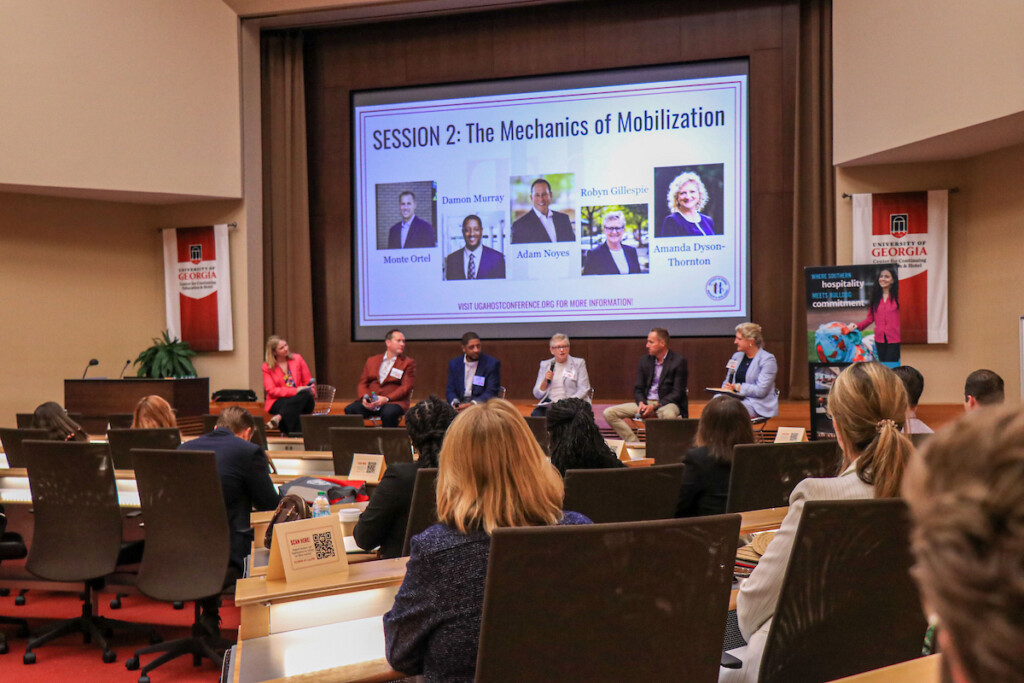
“The Mechanics of Mobilization” switched the focus to large-scale operations, examining how destinations and venues can move thousands of people through a space without sacrificing experience. Speakers highlighted the importance of long-range planning, data-informed decision-making and community partnership when hosting major events.
While technology and AI are reshaping operations, panelists stressed that success still hinges on people — from frontline staff to trusted partners — and the ability to anticipate the unexpected.
In “The Chemistry of Community,” the conversation turned toward culture and service excellence in luxury and lifestyle hospitality. Leaders from iconic destinations, including Augusta National, emphasized hiring for kindness, attitude and cultural fit, then reinforcing those values through immersive training.
The fourth core session, “The Biology of Brand,” explored how hospitality brands are built and protected in an era of rising costs and changing consumer expectations. Operators expressed the importance of core values, trusted partnerships with educators and producers, and transparency with guests whether running a restaurant, resort, or multi-unit brand.

Alton Brown talks hospitality and humanity
The summit ended with an intimate fireside chat with none other than television personality Alton Brown.
Brown and Salazar discussed the importance of storytelling and memory-making in the food and hospitality spaces — and took a quick trip down memory lane of Brown’s time at UGA and in Athens.
“Almost the whole time I was here, I delivered pizzas. In 1986, I could have drawn a map of Athens perfectly because there was no GPS, there were no cell phones,” Brown said. “I knew this city like the absolute back of my hand.”
Turning back to the industry, Brown reinforced the conference’s main message: While technology enables service, it should never replace human connection.
“We can automate as many processes as we want; that is only going to make the human connectivity part worth more and more sought out,” Brown said. “Making people feel welcomed, seen and cared for remains the industry’s highest calling.”