
Takeaways
- Over $6 million in combined funding from the Gates Foundation and Mars Inc. is advancing a decades-long breeding effort to deliver disease-resistant peanuts in sub-Saharan Africa and protect peanut production in the Southeast.
- UGA researchers are using wild peanut relatives to build disease and pest resistance into cultivated varieties, reducing chemical reliance for farmers on both continents.
- By testing breeding lines where key diseases already exist, the team can identify resistance genes before those threats reach U.S. fields, giving Georgia growers a critical head start.
A single change in a plant’s genetic code can alter the future of an industry, but it can take years of patient research to bring that change to life in farmers’ fields.
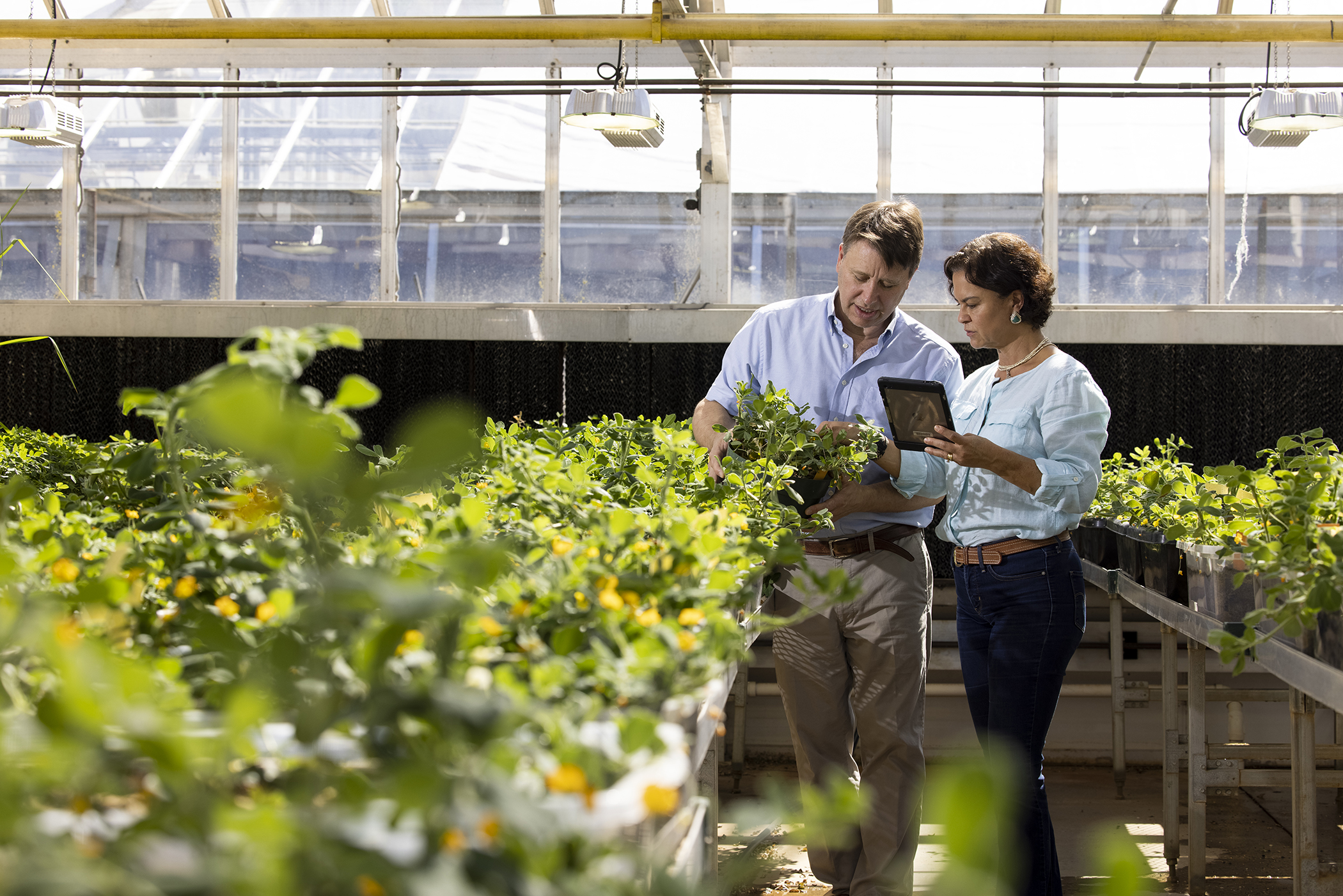
For David Bertioli and Soraya Leal-Bertioli, those years have added up to decades. Now, backed by over $6 million in new funding, the husband-and-wife research team are pressing further into work that spans continents, crops and generations of farmers.
Bertioli is a professor in the University of Georgia Department of Crop and Soil Sciences and a Georgia Research Alliance/Georgia Seed Development Distinguished Investigator. Leal-Bertioli is a senior research scientist in the Department of Plant Pathology.
Both are faculty members in the College of Agricultural and Environmental Sciences and co-direct the Wild Peanut Lab at UGA’s Institute of Plant Breeding, Genetics and Genomics.
Their shared focus is tapping the genetic diversity found in wild peanut relatives to strengthen cultivated varieties, reducing growers’ dependence on chemical inputs while building long-term resilience into the crop.
From the wild into the field
Two recent awards will advance that effort on parallel tracks. A nearly $5 million grant from the Gates Foundation supports breeding disease-resistant groundnuts for smallholder farmers across East and West Africa, building on more than two decades of international collaboration. A complementary $1.2 million award from Mars Inc. applies the same wild-species pipeline to challenges facing peanut growers in the Southeastern U.S.
At the core of both projects is a carefully staged breeding process. Wild peanut species are first crossed and adapted so they can reproduce with cultivated peanut. Researchers then identify the specific genomic regions responsible for resistance to diseases and pests — including leaf spot, rust and nematodes — and use genetic markers to track those beneficial traits as they repeatedly breed the plants back with high-performing peanut varieties. This process helps scientists keep the yield and quality farmers expect while gaining durable, built-in resistance.

A staple crop and the stakes behind it
In sub-Saharan Africa, groundnuts — as peanuts are known across much of the continent — are far more than a commodity. They are a dietary keystone, a source of affordable protein for millions of smallholder families and the foundation for rural economies where entire communities depend on a healthy harvest.
When disease sweeps through a crop, it doesn’t just affect a farm’s bottom line — it can destabilize a household’s food supply for an entire season.
That urgency is not lost on the research team. The Gates Foundation project builds on collaborations stretching back more than 20 years and spanning breeding programs in multiple African nations, with the goal of delivering resistant varieties directly into the hands of small-scale farmers who have the most to lose and the most to gain.
THE NEW YORK TIMES
Preparing for what’s coming
The global scope of the work reflects the simple reality that pests and diseases rarely stay put. As international trade routes expand and climate patterns shift, threats that emerge in one part of the world inevitably arrive elsewhere, and often faster than farmers or industry can respond.
That preparedness logic extends to diseases not yet present in the U.S. By sending hundreds of peanut breeding lines to partner programs in Africa, where threats like groundnut rosette virus are already established, the team can test for resistance without ever importing a dangerous pathogen. When African collaborators identify which lines hold up, the Wild Peanut Lab already has those seeds, already knows where the resistance lives in the genome and can begin breeding immediately.
what is groundnut rosette disease?
Groundnut rosette disease is one of the most devastating threats to peanut production in sub-Saharan Africa. The disease, spread by aphids and caused by a complex of viruses working together, can stunt plants and destroy entire crops.
“We already saved five years of breeding effort” by working where the diseases are, Leal-Bertioli said. If groundnut rosette or a similar threat were to arrive in Georgia — and given global travel and trade, she considers it less a question of if than when — growers wouldn’t be starting from scratch.
For the Southeastern U.S., that preparedness argument is particularly pointed. Georgia is the nation’s largest peanut-producing state, with a crop worth hundreds of millions of dollars annually. The Mars-funded project targets diseases and pests of concern in the region, working to ensure that the same wild genetic toolkit being deployed in Africa can deliver protection closer to home as well.
Peanut breeding for the long game
Breeding work of this kind does not move quickly. It takes years, sometimes a decade or more, to move a trait from a wild relative through the crossing and selection process and into a stable, high-performing cultivar. The work is not for the faint of heart. What drives the Bertiolis forward is a combination of scientific ambition and a clear-eyed view of what’s at stake.
In the years ahead, the team and collaborators in the U.S., Africa and Europe will continue advancing breeding lines tailored to regional needs, drawing from the same wild genetic foundation to address challenges that span continents and generations.

“The pipeline is the same, the methods are the same, the targets are just different,” Leal-Bertioli said of the two projects. “We start with a wild plant that we know is promising, but it hides gems: genes that can only be expressed later, in different places, under conditions we sometimes can’t even test here. We have to shape the wild material into it something a breeder or farmer can realistically use. That means removing undesirable agronomic traits and advancing it through multiple cycles of selection — a process that takes many years. Only then is it ready for each partner to evaluate under their own disease pressures and production priorities.”
“We often don’t know what we’ll come across when we start, but the more knowledge we have, the more fields this material is tested in, the more useful things we find,” Bertioli added. “The two projects are synergistic. If we find a piece of genetics that gives resistance against leaf spot in Georgia and then test that same genetics in East Africa and it also gives resistance there, that tells us something. If it doesn’t, that tells us something else.
That accumulation of knowledge really helps. And it helps the security of Georgia farmers against things we can’t fully foresee.”
The work, in a sense, is a form of long-range planning — planting seeds today so that farmers, wherever they are, have stronger options tomorrow.
Learn more about the UGA Wild Peanut Lab at wildpeanutlab.uga.edu.