Takeaways
- CAES strengthens industry partnerships for agricultural innovation: Under Tony Llano’s guidance, the University of Georgia College of Agricultural and Environmental Sciences is building bridges between academia and industry to drive research, technology adoption and student career readiness.
- Global agribusiness expertise fuels Georgia’s growth: With two decades of international experience at John Deere and AGCO, Llano brings a global perspective to advancing Georgia’s agricultural innovation, workforce development and economic impact.
- Connecting students, research and industry for real-world success: Llano’s people-first, results-driven approach is creating new opportunities for students to engage in hands-on learning while helping companies collaborate with UGA to solve real agricultural challenges.
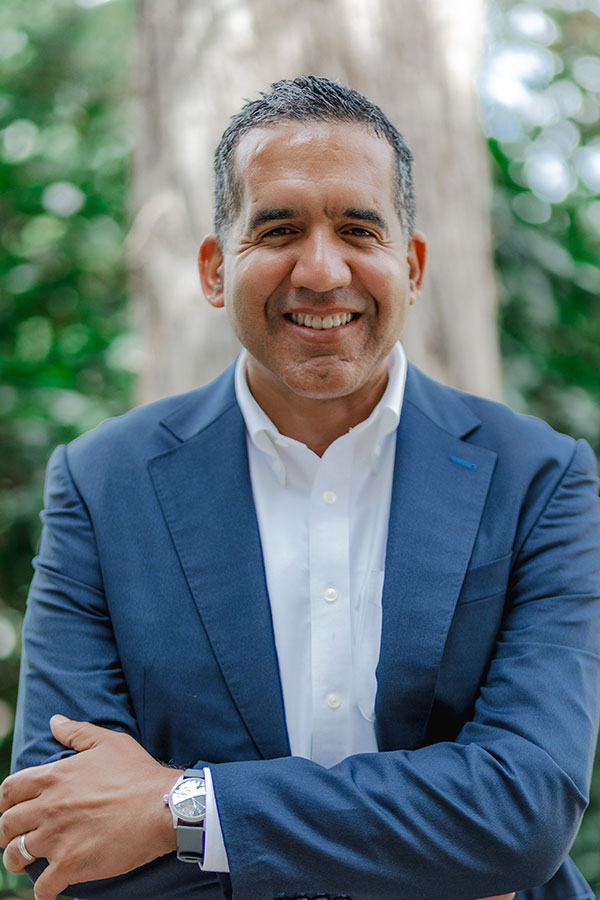
When Anthony “Tony” Llano looks at Georgia’s agricultural landscape, he sees possibility — not only in the fields and laboratories that anchor the state’s economy, but in the untapped connections between industry, research and education that can shape its future.
As the new director of industry partnerships and project-based learning at the University of Georgia College of Agricultural and Environmental Sciences, Llano brings two decades of global leadership experience across corporate, nonprofit and innovation sectors. His mission: make CAES the industry’s partner of choice for agricultural innovation.
“My vision is for CAES to be the first call companies make when they need innovation, talent or research expertise,” Llano said. “This college already has extraordinary strengths. My role is to connect those assets with the right partners and opportunities in order to transform potential into partnerships and partnerships into impact.”
Global experience, local mission
Llano’s career has spanned continents and industries. Before joining UGA, he served as director of international growth for AGCO Corporation’s precision planting division, leading commercial strategy across South America, Europe, Africa, Australia and China.
He spent nearly two decades with John Deere, holding senior roles in business development, mergers and acquisitions, precision agriculture and operations leadership, including managing $1 billion in parts sales and distribution for the company’s Western U.S. and Latin American markets.
Earlier in his career, Llano worked in strategic planning and marketing at JPMorgan Chase in New York City, completing the bank’s selective management development program.
A graduate of Skidmore College with a bachelor’s degree in economics and business management, Llano earned his Master of Business Administration from Dartmouth College’s Tuck School of Business.
The throughline of every chapter in his career has been “connecting people, ideas and institutions to achieve results,” he said.
“I’ve worked at the intersection of business development, operations and innovation ecosystems,” said Llano. “At CAES, I have the opportunity to bring those experiences together to build a framework for industry engagement that benefits Georgia agriculture and beyond.”
Creating pathways for innovation and students
Llano’s new role is both practical and visionary, to strengthen the bridge between academia and industry while expanding experiential opportunities for students to engage directly with real-world challenges.
That means working with faculty and researchers to translate discoveries into market-ready innovations, helping companies see CAES as a strategic problem-solving partner, and ensuring students gain experience that prepares them for meaningful, in-demand careers.
“Industry partnerships give our students exposure to real-world problems, help them build networks and equip them with the skills employers need,” Llano said. “Whether through internships, hackathons or capstone projects, these experiences make our students career-ready while delivering value back to industry.”

Among his early priorities are advancing signature initiatives like the UGA Grand Farm, strengthening ties with the Innovation District and Innovation Gateway, and expanding project-based learning through programs such as FABricate.
Llano also sees potential in leveraging statewide assets, including UGA Cooperative Extension and Georgia’s agricultural technology ecosystem, to position CAES at the forefront of agricultural innovation and economic development.
“Georgia is already a powerhouse in agriculture, logistics and business,” he said. “By connecting CAES more intentionally with state agencies, economic development groups and industry associations, we can help make Georgia not only a leader in production, but a leader in innovation.”
A people-first approach to leadership
Trained in Six Sigma and NeuroLeadership brain-based leadership, Llano combines process discipline with people-centered collaboration.
He describes his leadership style as “collaborative, adaptive and outcome-driven”: He listens first, connects the right people, and focuses on accomplishments grounded in trust and mutual respect.
“You build trust by demonstrating competence, serving others and maintaining the highest integrity,” Llano said. “When partnerships are built on those principles, everyone wins — industry gains innovation and talent, CAES gains relevance and resources, and Georgia gains economic and community impact.”
His diverse background in business, from running manufacturing operations to leading mergers and acquisitions and global philanthropy efforts, gives him a systems view that helps him link strategy, implementation and talent across vastly different environments.
“Understanding cultural values is essential,” he said. “There’s a reason the word ‘culture’ is in ‘agriculture.’ Building relationships of trust and meaningful change starts with that awareness.”

Looking ahead to a culture of innovation
Llano’s long-term vision is to help CAES build a national reputation for agricultural innovation and collaboration, a place where companies, researchers and students work side by side to advance sustainability and technology.
He is energized by the rapidly developing agricultural technology arena, including artificial intelligence, robotics, remote sensing, data analytics and climate-smart solutions.
“We’re at a moment of incredible convergence between digital technology and agriculture,” Llano said. “CAES has the expertise and infrastructure to lead that transformation, not just for Georgia, but for the world.”
Ultimately, Llano measures success in innovations brought to market, students who are ready to lead and communities strengthened through collaboration.
“My motivation has always been impact,” he said. “When academia and industry work together effectively, the results ripple outward into stronger companies, better-prepared students and a more resilient agricultural economy. That’s the work I’m proud to be part of.”