Takeaways
- The E. Broadus Browne Research Awards recognize top graduate research at UGA each year.
- This year’s winners focused on improving food quality, livestock production and renewable energy through innovative science.
- Their work shows how research creates practical solutions that impact both consumers and the environment.
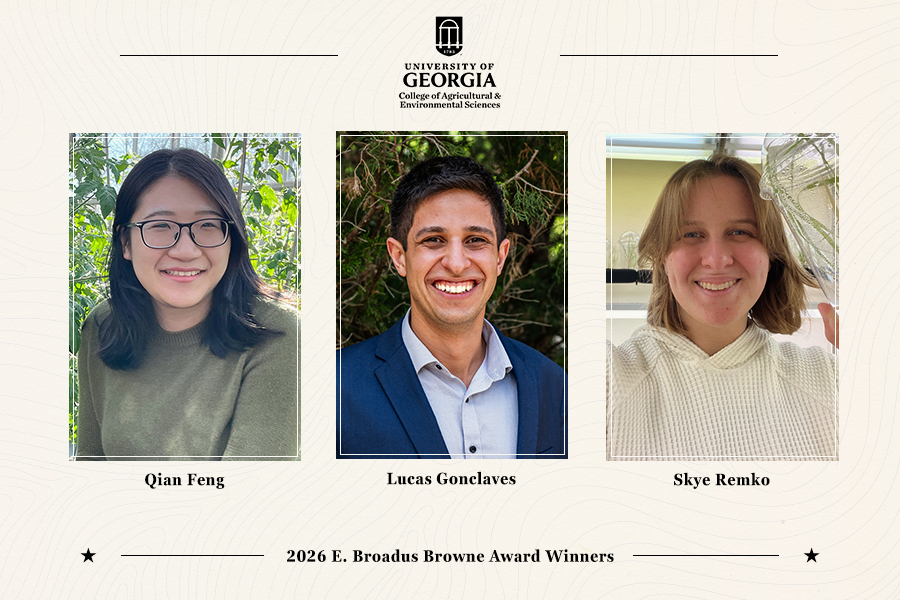
For the 21st consecutive year, the University of Georgia College of Agricultural and Environmental Sciences (CAES) hosted the prestigious E. Broadus Browne Research Awards competition, recognizing graduate students for excellence in research and communication.
Award-winning doctoral research

Leading this year’s doctoral competition, Qian Feng, a doctoral student in the Institute of Plant Breeding, Genetics and Genomics (IPBGG), earned the first-place award for research focused on restoring flavor to modern tomatoes.
“Over the past several decades, tomatoes have been bred primarily for traits like yield, shelf life and uniformity,” Feng said. “However, that has often come at the expense of flavor, especially aroma.”
Feng’s research explores naturally occurring genetic variation in tomatoes, including wild relatives, to identify the genes responsible for aroma compounds. By understanding these genetic factors, her work aims to improve flavor while maintaining the qualities needed for large-scale production.
“By identifying the genes responsible for aroma, we can help bring flavor back into modern tomato varieties,” she said.
Unlike some crop improvement methods, Feng’s approach relies on genetic variation that already exists in nature, making it more compatible with traditional breeding programs.
“If successful, this research could help reconnect consumers with the flavor they expect from tomatoes,” Feng explained. “It also allows growers to develop varieties that combine strong flavor with important traits like yield and shelf life.”
Doctoral research in animal science

Rounding out the doctoral competition, Department of Animal and Dairy Science doctoral student Lucas Gonclaves came in second place for his research focused on improving pregnancy success in beef cattle through more precise evaluation of embryo transfer recipients.
“One of the main challenges in embryo transfer programs is selecting the right recipient cow,” Gonclaves said. “Even when we transfer high-quality embryos, pregnancy success can still be inconsistent because not all cows are equally prepared to support early pregnancy.”
The research centers on the corpus luteum, a structure that plays a critical role in maintaining pregnancy. While traditional evaluations often focus on size, Gonclaves’ research highlights the importance of blood flow.
“We found that blood perfusion, rather than just size, is more closely linked to pregnancy success,” he explained. “The goal is to give producers a more reliable way to identify cows with a greater chance of becoming pregnant at the time of embryo transfer.”
To improve how this information is used in practice, the project combines color Doppler ultrasonography with computer vision technology. “Color Doppler ultrasonography allows us to visualize blood flow in the corpus luteum, which gives insight into how functional it is,” Gonclaves said. “This goes beyond conventional ultrasound, which mainly shows size and structure.”
Because image interpretation can vary with the operator, the research incorporates deep learning to analyze images automatically.
“This approach helps standardize the evaluation, reduce variation between operators, and make the information easier to use in real-world settings,” he said. “The automated system produced results comparable to trained personnel while maintaining biological relevance.”
If adopted more widely, the technology could help producers improve efficiency in embryo transfer programs.
“That means transferring embryos into cows with a greater probability of pregnancy, improving efficiency and reducing costs per pregnancy,” said Gonclaves. “The goal is not to replace the veterinarian or technician, but to provide a tool that supports decision-making and improves outcomes under practical conditions.”
Top master’s research
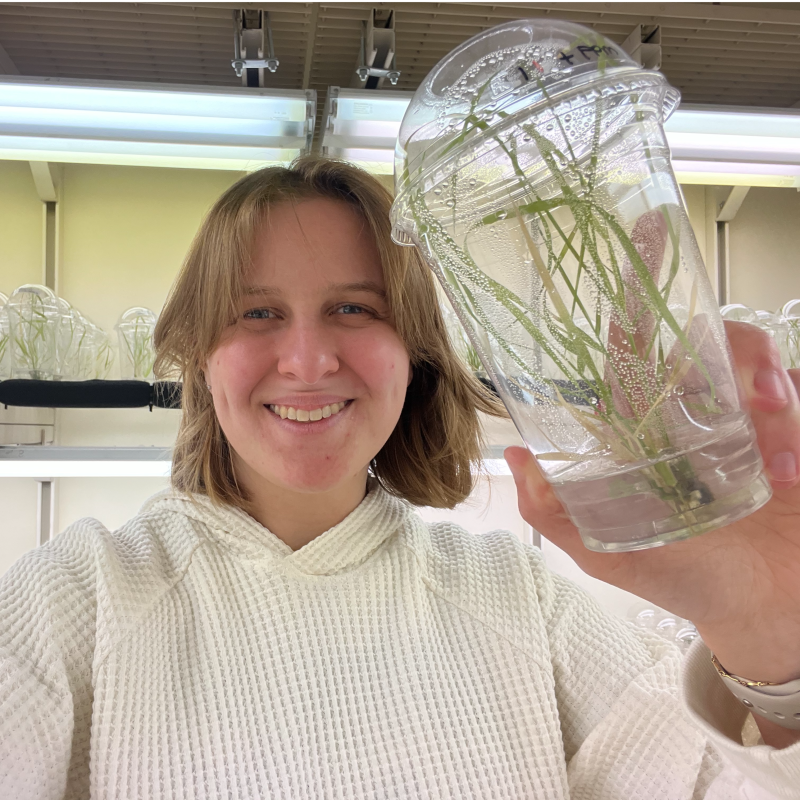
Leading the master’s division, IPBGG master’s student Skye Remko earned the top research award for her work on developing switchgrass as a sustainable source of jet fuel.
“In the broadest sense, my research aims to enable the production of sustainable jet fuel using switchgrass as a starting material,” Remko said.
Switchgrass, a native and fast-growing plant, has strong potential as a renewable energy source, but it is not yet optimized for fuel production. To meet future energy demands, including a national goal of producing 35 billion gallons of sustainable jet fuel annually by 2050, researchers are working to accelerate improvements in the crop.
“Traditional breeding is effective, but it’s slow,” Remko said. “Biotechnology offers a faster way to improve crops, but it doesn’t work reliably across all switchgrass varieties.”
A key challenge lies in the plant’s ability to regenerate after new DNA is introduced. In laboratory settings, small pieces of switchgrass are placed into a nutrient-rich gel, where cells may either continue developing as plant tissue or, in successful cases, form embryos that can grow into full plants.
“If DNA is introduced into a cell that becomes an embryo, the resulting plant will carry that DNA in every cell,” she explained.
However, most switchgrass varieties do not naturally produce these embryos, limiting the effectiveness of biotechnology. To address this, Remko is studying genes known as morphogenic regulators, which control embryo development.
“By activating these genes, we can essentially program plant cells to form embryos and improve the success of biotechnology,” Remko said.
One of the most promising developments so far has been the testing of a novel morphogenic regulator found naturally in switchgrass, which shows potential for improving the efficiency of this process.
If successful, the research could accelerate the development of switchgrass as a viable renewable fuel source, contributing to broader sustainability efforts.
Legacy competition honors innovation in research excellence
For two decades, the E. Broadus Browne Research Awards have recognized graduate students in CAES for excellence in research and communication. Named in honor of former Georgia Agricultural Experiment Station Director Edmund Broadus Browne, the annual competition highlights innovative research across disciplines within the college and challenges participants to present their work to a broad audience.
Established following Browne’s death in 1987 and revitalized as an annual event in 2006, the competition has supported dozens of graduate students through financial awards and travel funding to advance their research and professional development. First-place doctoral recipients receive $2,000 and travel funding, while master’s winners receive $1,000 and additional support for professional development.