Takeaways
- Alfalfa could become a valuable forage option for Southern beef producers by supporting healthy cattle and productive pastures.
- Researchers are evaluating whether alfalfa makes economic sense for beef operations across Georgia and the Southeast.
- UGA researcher Jennifer Tucker combines research and Extension to deliver practical, science-based information producers can use on their farms.
If you’ve spent any time driving in rural Georgia, you’ve probably seen them: Big, round bales wrapped in white plastic sitting in open fields like oversized marshmallows.
Those empty fields are working pastures and hayfields, and the white bundles are baleage — forage baled at the right moisture and sealed in tight so it can ferment inside the plastic. That fermentation helps retain nutrients important for livestock feed.
What many motorists pass with only a glance represents years of fine-tuning research and production practices. And for University of Georgia researcher Jennifer Tucker, it’s what’s inside the plastic that matters.
A high-quality forage option for Georgia cattle producers
With support from a $750,000 grant from the U.S. Department of Agriculture’s National Institute of Food and Agriculture through the Alfalfa and Forage Research Program, Tucker is studying how alfalfa might serve beef producers across Georgia and the broader Southeast, helping them raise healthy animals while getting more out of their land and effort.
“Nationwide, alfalfa is known as the queen of forages because of its exceptional nutritional value,” said Tucker, a professor in UGA’s Department of Animal and Dairy Science in the College of Agricultural and Environmental Sciences.
🌱 Fast facts about alfalfa
- It’s a natural nitrogen fixer. As a legume, alfalfa teams up with beneficial soil bacteria to convert nitrogen from the air into forms plants can use, helping improve soil fertility.
- Its roots run remarkably deep. Mature alfalfa roots can extend 15 to 20 feet underground, helping the plant withstand drought while reducing soil erosion.
- A nutritional powerhouse. Rich in protein, digestible fiber and essential vitamins, alfalfa provides high-quality forage that helps cattle grow and thrive.
Balancing nutrition, profitability and pasture health
The research is part of a multistate effort, bringing together teams from UGA, Auburn University and Clemson University. They’re looking at alfalfa as a feed source for growing cattle to determine whether the economics make sense for producer adoption.
“The crop can do a lot of things, but if it doesn’t pencil out economically, it’s not going to matter,” Tucker said, pointing to the higher input costs that often come with establishing and maintaining alfalfa.

Rich in protein and energy, alfalfa has long been valued by dairy and equine producers. There’s not as much research for beef cattle, though, and Tucker’s group is trying to fill that gap.
Building on more than 10 years of work on how alfalfa can fit into Southeastern systems, Tucker’s work challenges a long-standing belief among some producers that alfalfa just won’t grow in the Deep South. Most alfalfa acreage and research are located in the Midwest and Western U.S.
Decades ago, the crop lost ground as cheap fertilizer became common and pests made alfalfa harder to keep up with than other forage options. Today, improved varieties and various economic pressures have revived interest in a plant that can provide high-quality feed while returning nitrogen to the soil.
“I work at what we call the plant-animal interface,” Tucker said. “I’m looking at the impact of the animal on the land and the impact of the plant on the animal.”
The real-world value of firsthand experience
That systems-based approach traces back to her childhood on a Kentucky beef farm. Although her first degree was in political science, she eventually found herself drawn back to the kinds of questions she grew up thinking about.
Many of the ideas she studies now connect directly to what she saw on her own family’s farm.
“I’ve always wanted to be able to tell producers something works because I’ve done it, or don’t do this because I’ve done it,” Tucker said. “I want to take that risk out for them. Agriculture is a unique community, and when people know you genuinely care about them and their success, you can make a real difference.”
Research and Extension working hand in hand
That practicality shows up not just in her research, but in how she shares it.
Through workshops, Extension programs and producer-led conversations, Tucker and her colleagues pass along what they’re learning and listen closely to the people testing those ideas on real farms. It’s a two-way flow that strengthens both the research and performance in the field.
The goal isn’t to push every producer to plant alfalfa. The goal is to give them research-based information to decide whether it fits their operation.
A crop with beauty and brawn

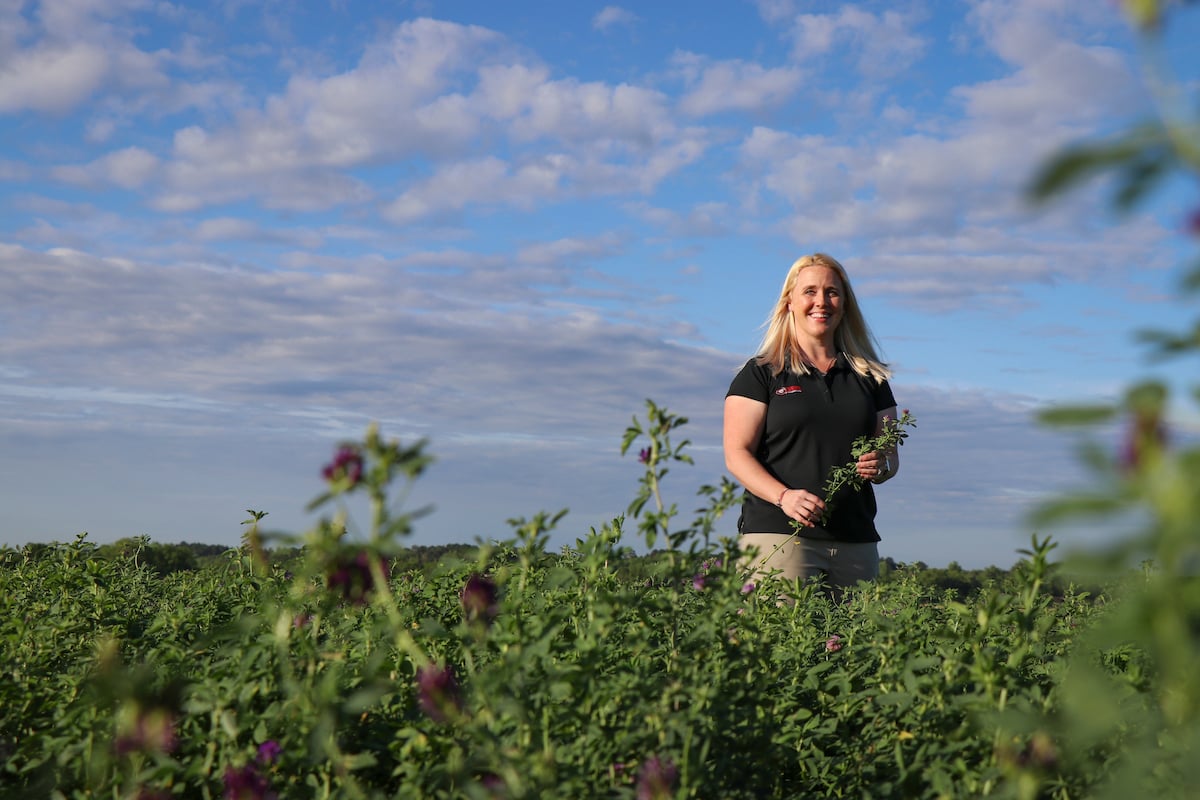
Before it’s cut and baled, alfalfa is stunning. When in bloom, delicate purple flowers pop against a thick green stand.
“Alfalfa is a very beautiful crop. If you let it reach full bloom, it produces these beautiful purple flowers and has a fragrance people love,” Tucker said. “I had a student who used to cut flowers from the edge of our fields and take them to his girlfriend because she loved them so much.”
But the flowers, while they are a pleasant bonus, are not why producers are paying attention to the crop’s southern potential. If managed properly, especially in the first year, alfalfa develops an impressive root system, which allows it to pull water from deep in the soil, giving it excellent drought resistance.
“There have been seasons when I’d drive around and everything else was brown, but my alfalfa fields were still green,” Tucker said. “That’s when the crop really stands out to me.”
For Tucker, that green field represents an opportunity to help producers build resilient operations for healthier cattle and better beef.