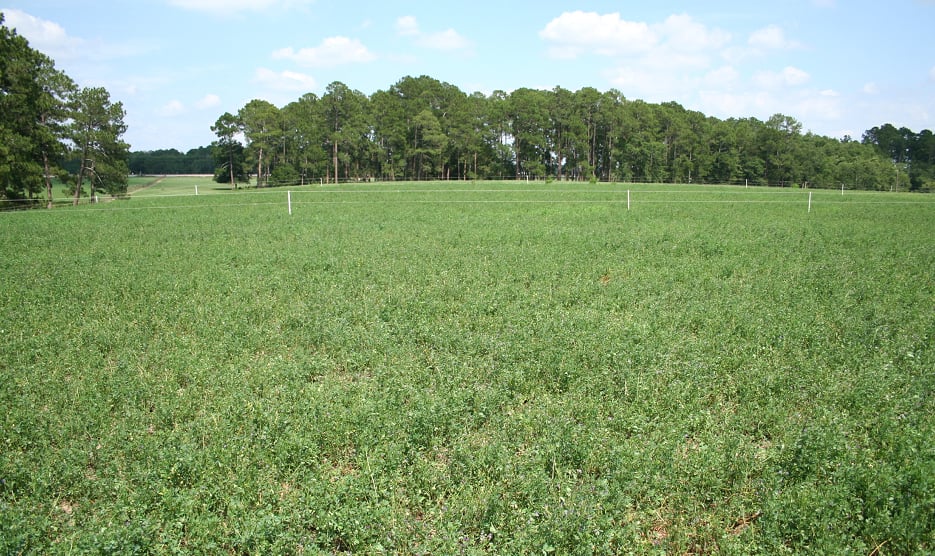

Bermudagrass (Cynodon spp.) is one of the primary forage species grown in Georgia and the Southeastern U.S. The bermudagrass stem maggot (BSM; Atherigona reversura Villeneuve) damages bermudagrass pastures and hayfields each summer growing season (Figure 1). The BSM can cause severe economic damage, especially to hayfields.

This resource will answer the most common questions about the bermudagrass stem maggot in Georgia pastures and hayfields. For more detailed information related to the BSM and associated research efforts, please review the article, Improved Management of the Bermudagrass Stem Maggot.
How Do I Know if I Have Bermudagrass Stem Maggot Damage?
Producers will often misidentify the BSM damage as drought stress, nutrient deficiency, leaf spot, or senescence (plant death). However, the yellowing or chlorosis will only be seen in the top two to three leaves of the damaged stem (Figure 2). The entire leaf or leaves will be affected. The damaged leaves can easily be pulled out of the central sheath or stem. You may notice signs of insect feeding and decay at the base of the leaf.

The damage is a direct result of feeding by the BSM larva inside the stem. This larva only feeds outward from the uppermost plant node near the top of the stem or tiller. If the damage appears elsewhere on the plant, it is likely another issue.
How Do I Identify the Bermudagrass Stem Maggot?
The BSM is most easily identified in the adult stage as a fly. The bermudagrass stem maggot fly has distinct coloration, with transparent wings, a gray thorax, and a yellow abdomen with at least one pair of black spots (Figure 3). The adult BSM flies are about 1/8-in. long, about the size of a pencil eraser. This is the only fly we are aware of that is this size with this coloration.

The BSM larvae are white, cylindrical, and about 1/8-in. long when fully grown. These can occasionally be found within infected stems. The BSM is rarely identified in other stages of the life cycle.
How Long Does a Bermudagrass Stem Maggot Live?
We estimate that each BSM lives for up to 30 days. The life cycle begins as an egg on the underside of the bermudagrass leaf. The larva will emerge from the egg and move into the stem for several days. From here, it enters the soil to pupate before emerging as a fly. The adult flies will live for 14 to 21 days.
How Do Flies Get in My Field?
We believe there are multiple generations of flies living in a field at any one time. The BSM flies you see in your hayfield can come from the following three sources:
- adult flies moving into the field from unmowed edges, tree lines, and neighboring areas;
- pupae emerging from the soil;
- eggs laid by adult flies from the first two sources.
If weather and forage conditions are ideal for the bermudagrass stem maggot, new flies are continuously moving into your field from these three sources. It is impossible to identify which generation a specific fly is from. Since pastures do not often have a defined harvest event, the BSM will continually exist in all life stages if forage and weather conditions are adequate for its survival.
Do the Flies Overwinter in My Field?
We do not know where the bermudagrass stem maggot overwinters. We know the population emerges from south to north across Georgia, but we do not know its source. One possibility is that the pupae overwinter in the soil and emerge when the conditions are suitable for them to continue the life cycle.
The other possibility is that the population overwinters in more tropical parts of Florida and then moves north through repeated generations each year. This is what occurs with fall armyworms (Spodoptera frugiperda). Both options would result in the northern spread of the pest that we see almost every season.
How Do I Scout for the Bermudagrass Stem Maggot?
University of Georgia Cooperative Extension recommends using an insect sweep net to detect low BSM populations before significant damage occurs. Some birds, such as geese, crows, and cattle egrets, may serve as indicators of insect activity. This is not always guaranteed since these birds are almost always present in pastures and hayfields.
Sweep samples should be collected near 11 a.m. or just as the dew has dried from the grass. This will be earlier in the day during periods of drought or extreme heat. The flies stay low in the canopy and rarely fly higher than 18 in. above the soil surface. You will need to swing the net down deep into the canopy, almost brushing the soil surface as you swing. Swing for at least 20 swings of the net to collect the sample before transferring the sweep sample to a plastic bag or portable insect cage.

Counting the flies can be a challenge. Put the sweep sample in a freezer for 5 to 10 min before pouring its contents over a solid working surface. This will make it easier to identify and count BSM flies. We have not been able to correlate sweep-net estimates to a damage threshold. However, if there are at least 20 BSM flies in the sample, then you should consider mitigation strategies.
Why is the Bermudagrass Stem Maggot Worse in Some Years?
We know that weather conditions and patterns affect the bermudagrass stem maggot population throughout Georgia. Unfortunately, we have not been able to specify the why, when, or how for many of these factors. Below is a summary of factors that have a positive and negative impact on the BSM.
Factors With a Positive Impact on the BSM
The BSM prefers warm and humid climates. As temperatures and relative humidity increase, so does the BSM population. Undergrazing or delayed harvest would also increase the BSM population since there is no mechanical disruption to the life cycle.
Factors With a Negative Impact on the BSM
The BSM population is lower or moves more slowly during drought, extreme heat, or other significant weather events. These events slow forage growth and reduce the resources available to the BSM across multiple life stages. Furthermore, any disruption to the canopy would decrease the BSM population. This can include mowing, harvesting, or intensive grazing events.
What Should I Do After I Find Bermudagrass Stem Maggot Damage?
Ultimately, this decision is based on the degree of damage observed, the number of BSM flies found in the sweep sample, and the height of the forage. The options are summarized in Table 1 and discussed in greater detail in the following sections.
| BSM damage level (% of stems) | BSM found in sweep sample1 | Forage height | Suppression options2 |
| 0% | None | Any height | Continue to scout for BSM and follow routine harvest management |
| Less than 25% | Less than 20 adult flies | Any height | Continue to scout for BSM and follow routine harvest management; prepare to implement chemical suppression after next harvest event |
| More than 20 adult flies | Recently harvested or up to 6 in. tall | Treat with insecticide | |
| 6 to 8 in. tall | Clip with rotary mower or graze if damage is present then treat with an insecticide | ||
| 8 to 12 in. tall | Harvest management will depend on exact forage height, hay equipment available, and skill level of the equipment operator; harvest is not recommended if the cut material is less than 9 to 10 in. | ||
| Ready to harvest or over 12 in. tall | Harvest hay or graze immediately then prepare to implement chemical suppression after next harvest event | ||
| More than 20% | Less than 20 adult flies | This situation is unlikely to occur except during extreme weather events; follow harvest management for the respective event. | |
| More than 20 adult flies | Recently harvested or up to 6 in. tall | Treat with insecticide | |
| 6 to 8 in. tall | Clip with rotary mower or graze if damage is present then treat with an insecticide | ||
| 8 to 12 in. tall | Harvest management will depend on exact forage height, hay equipment available, and skill level of the equipment operator; harvest is not recommended if the cut material is less than 9 to 10 in. | ||
| Ready to harvest or over 12 in. tall | Harvest hay or graze immediately then prepare to implement chemical suppression after next harvest event | ||
| 1A sweep sample is defined as a minimum of 20 swings of an insect sweep net into the forage canopy. 2Suppression is used instead of control since total control is unlikely because of multiple life stages found in the field. | |||
How Do I Decide Between Harvesting, Clipping, and Grazing?
Hay harvesting is only recommended if there is sufficient material to cut and bale. This will depend on the equipment available, but generally at least 12 in. of standing forage is required to ensure adequate pickup by a hay baler. Hay production can be expensive, so sufficient material must be standing in the field for it to be a viable option.
Clipping with a rotary mower is a good option if there is insufficient material for hay harvest and grazing is not an option. More farms would likely have access to a rotary mower than to hay harvesting equipment.
Grazing the damaged area is another good management option if there is existing infrastructure for grazing livestock and there is a large enough herd or flock. The infrastructure required for grazing should include fencing and access to water and shade, depending on the time spent in the field. The number of animals should be large enough to quickly graze down the damaged area. If these two things are not available, then clipping or harvesting is recommended.
How Do I Choose an Insecticide?
Currently, only adult bermudagrass stem maggot flies can be suppressed chemically. It is impossible to control the entire BSM population with the available chemical options, so suppression is the goal. There are no effective insecticide options for the BSM larva or pupa.
Pyrethroid insecticides are the only effective products on the market today. Any pyrethroid insecticide product labeled for use in pastures and hayfields will work at the labeled rate. These include products whose active ingredient name ends with “-thrin.” These most often include zeta-cypermethrin, cyfluthrin, beta-cyfluthrin, and lambda-cyhalothrin.
All other active ingredients available for use in pastures and hayfields have been tested and were not effective for suppressing the bermudagrass stem maggot.
Are There Residual Insecticide Options?
While there are residual options for fall armyworm and other insect pests, there are no residual products currently available for use on bermudagrass stem maggot in pastures and hayfields.
One active ingredient that currently causes a lot of confusion is chlorantraniliprole. This active ingredient is most often seen in combination with lambda-cyhalothrin and is currently marketed under the trade name Besiege. This product provides high residual against the fall armyworm (21 to 28 days) but has zero residual for the bermudagrass stem maggot.
When Should I Apply Insecticide in Hayfields?
Pyrethroids are contact insecticides, which means that the product must come in direct contact with the BSM fly, or it will not be effective. Therefore, we need to apply insecticide when the population of the bermudagrass stem maggot is most abundant and active.
The baseline insecticide recommendation is to apply the recommended rate of a labeled pyrethroid insecticide at 7 to 10 days after hay harvest and a second application 7 to 10 days after the first application. Applications should be made early in the day, before the dew dries. These days and times correspond to when the BSM population typically is most abundant in a hayfield.
How Can I Make My Insecticide Application Work Better?
Since the pyrethroid insecticide must come into direct contact with the BSM, you may need to adjust the timing of your application to be more effective. Below are a few points to consider.
Spray Earlier in the Morning
Insecticide should be applied early in the morning before the dew dries and when the flies are most active. This is typically any time before 10 to 11 in the morning. However, the dew dries off much earlier when we are under extreme heat advisories or a “heat dome.” In some of these instances, applying insecticide after 8 a.m. would be too late. If there is no dew, there are no bermudagrass stem maggot flies moving in your field.
In theory, you could also spray in the evening when the dew returns to achieve the same results. However, pyrethroids require a period of rainfast to ensure the chemical is effective. Our region is known for pop-up showers in the late afternoon and early evening. The risk of these rainfall events is simply too high for this to be a viable solution for Georgia.
Set Your Boom Height Lower
Set your sprayer’s boom height as low as you can while maintaining good coverage from the spray-pattern overlap. This will help the chemical penetrate the forage canopy since the BSM is most often found deep in the canopy and will not fly above 18 in.
Increase Your Spray Volume
Calibrate your boom sprayer to deliver at least 12 to 15 gallons of water per acre. This will help the chemical reach more adult BSM flies that are deep in the forage canopy. Adjust the amount of chemical needed per tank to your new spray volume.
There are several resources available to assist with boom sprayer calibration including Extension expert resource C683, Calibration Method for Sprayers and Other Liquid Applicators and our Boom Sprayer Calibration video.
Don’t Rule Out Waiting Until Tomorrow
Recent research at UGA’s Tifton Campus has shown that the time of day that the insecticide is applied is more important than the number of days after harvest. If the rain chances peak or the dew dries faster than you expected, consider delaying your insecticide application until the following day.
Although we have not yet identified the ideal amount of dew or temperature for applying the insecticide, it does seem that it is better to be a day late than an hour late when applying insecticide to suppress the bermudagrass stem maggot.
Can I Out-Manage the Bermudagrass Stem Maggot?
Any practice that improves regrowth rate and stand health of the bermudagrass should improve its tolerance to bermudagrass stem maggot in the stand. The bermudagrass is most vulnerable to the BSM in the early stages of vegetative regrowth following a harvest event. The faster the grass can get past this stage, the more competitive the bermudagrass will be against the BSM.
These management practices are collectively referred to as cultural management and would include:
- harvesting routinely based on forage availability
- leaving at least 3 in. of stubble height
- maintaining balanced fertility and near-neutral soil pH, and
- controlling other insects and weeds.
Cultural suppression cannot replace chemical suppression, but the additional tonnage generated from a healthy bermudagrass stand would help offset input costs associated with suppressing the bermudagrass stem maggot.
When Should I Apply Insecticide in Pastures?
Unfortunately, there is no definite strategy for chemically suppressing the bermudagrass stem maggot in grazed pastures. If grazing is intensive and includes multiple rotations each week, then you would need to spray somewhere on your farm almost every day to follow the protocol described for hayfields. That is simply not practical. On the other hand, continuously grazed fields would foster populations in all insect life stages, and effective suppression is unlikely.
Most grazing operations see little impact from the bermudagrass stem maggot relative to the neighboring hayfields. If the damage becomes severe to the point of impacting forage availability, mow or clip the field with a rotary mower and apply insecticide according to the protocol described for hayfields.
Should I Be Worried About Insecticide Resistance?
Overuse of pesticides of a single mode of action to combat a pest, especially one that can produce a large number of offspring, is likely to eventually result in a buildup of resistance to that pesticide’s mode of action. We should avoid using insecticides when the BSM is not present and avoid exceeding the number of applications or rates listed on the product label.
Do I Have to Spray for the BSM at Every Harvest?
The bermudagrass stem maggot will only reduce forage production in late July to September, which (in most years) generally corresponds to the third to fifth harvests of the year. Populations build slowly in early summer and will reach damaging levels in the southern part of the state before moving north.
While the BSM may be found in sweep net samples early in the season, it is usually not economical to automatically spray every cutting. Treatment decisions should be based on observed levels of bermudagrass stem maggot damage and scouting results from the previous cutting or early in the current cutting (Table 1).
Where Did the Bermudagrass Stem Maggot Come From?
We don’t know how the bermudagrass stem maggot was first introduced to the United States. It was first reported in the continental U.S. in California in 2009 and in Georgia in 2010 (Baxter et al., 2014). We suspect that the pest arrived via cargo ships from international shipments, as both states are home to large shipping ports. Regardless of how the BSM first arrived in Georgia, it is a recurrent pest each season.
Why Does the Bermudagrass Stem Maggot Damage Some Cultivars More Than Others?
Research has continuously shown that some bermudagrass varieties are more susceptible to bermudagrass stem maggot damage and yield loss (see Table 2, Figure 5). Cultivars with a higher number of stems also tend to have a smaller stem diameter, narrower leaves, and a lighter green color. These plant characteristics create a denser forage canopy, which is a preferred habitat for the BSM.
| Variety | Stem thickness category1 | Typical range in yield loss2 |
| Alicia | Fine | 30 to 60 |
| Coastal | Fine | 15 to 30 |
| Coastcross II | Coarse | 0 to 15 |
| Newell | Coarse | 0 to 10 |
| Russell | Intermediate | 20 to 40 |
| Tifton 44 | Fine | 15 to 30 |
| Tifton 85 | Coarse | 0 to 20 |
| Seeded varieties | Fine | 30 to 60 |
| 1Based on designations found in Defining Stem Diameter Categories for Forage-Type Bermudagrass. 2Adapted from existing literature, best summarized in Improved Management of the Bermudagrass Stem Maggot. | ||
In addition, the bermudagrass stem maggot larva can more easily penetrate the stem of fine-stemmed bermudagrass varieties. The coarser varieties that are hybrids of bermudagrass and stargrass (Cynodon nlemfuënsis Vanderyst) are much less susceptible to bermudagrass stem maggot damage and are preferred for new plantings.

Additional Resources
History of the Bermudagrass Stem Maggot Prior to 2014
Baxter, L. L., Hancock, D. W., & Hudson, W. G. (2014). The bermudagrass stem maggot (Atherigona reversura Villeneuve): A review of current knowledge. Forage & Grazinglands, 12(1), 1–8. https://doi.org/10.2134/fg-2013-0049-rv
Summary of Bermudagrass Stem Maggot Research Since 2014
Baxter, L. L., Anderson, W. F., Hudson, W. G., Rios, E. F., Bowling, C. H., Hancock, D. W., Gates, R. N., & Burt, J. C. (2024). Improved management of the bermudagrass stem maggot. Crop, Forage & Turfgrass Management, 10(1), e20269. https://doi.org/10.1002/cft2.20269
Funding Note
Much of the early work conducted on the BSM was funded by grants from the Georgia Beef Commission. Additional research was funded by USDA-NIFA 2022-67013-36252.
Acknowledgments
An earlier version of this manuscript was prepared by Lisa L. Baxter and Dennis W. Hancock, Department of Crop and Soil Sciences; Will G. Hudson, Department of Entomology; Bill Anderson, Plant Geneticist, United States Department of Agriculture–Agricultural Research Service, Coastal Plain Experiment Station; and Jennifer J. Tucker, Department of Animal and Dairy Sciences.