
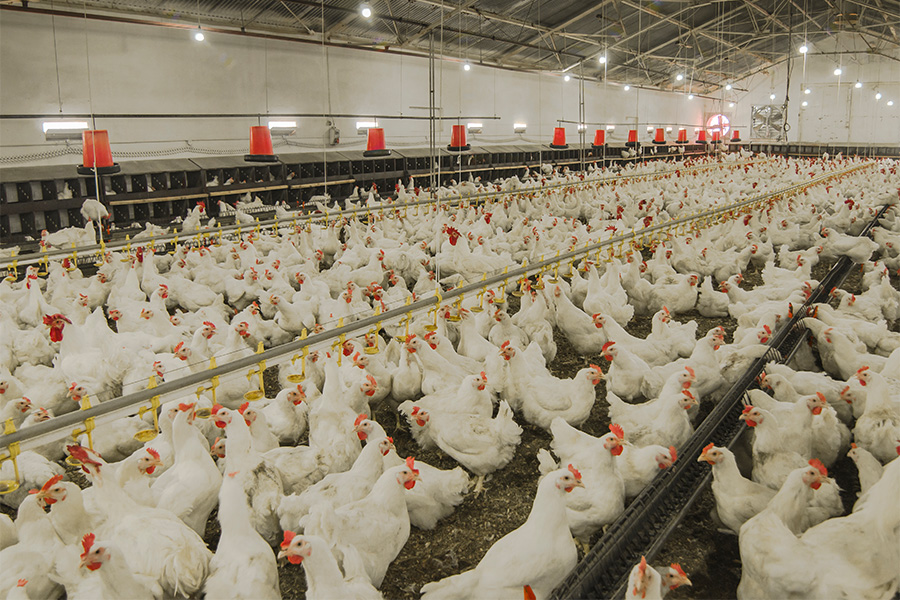

Dust concerns in poultry houses
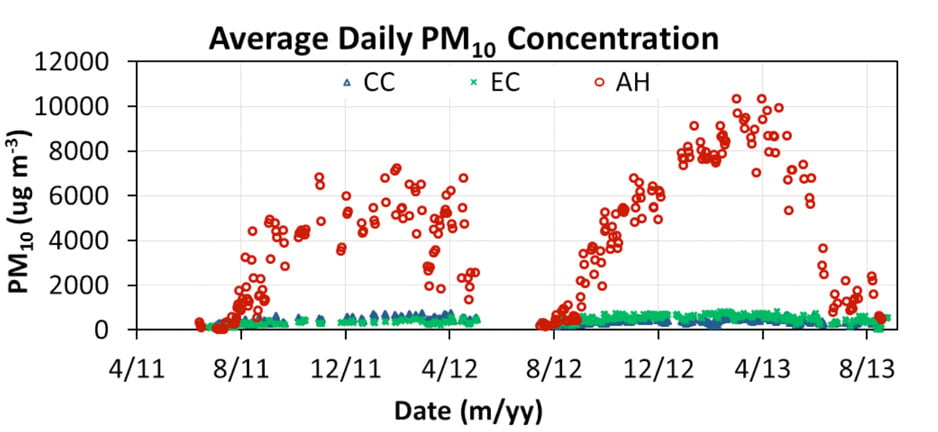
Confined animal feeding operations (CAFO) are sources of aerial pollutant emissions such as dust or particulate matter (PM). Dust levels can be high in poultry houses due to the accumulation of floor litter (a mixture of feed, manure, and bedding materials) and bird activities. Factors including housing systems, local climate conditions, manure handling methods, and ventilation affect air quality inside of poultry houses. For instance, cage-free hen houses offer birds more space and opportunities to practice their natural behaviors such as dustbathing, foraging, and perching on the litter floor compared to conventional cage and enriched colony systems, but the dust level in the cage-free hen house is higher than the other two types of housing systems. Based on two years of continuous measurement conducted by the Coalition for a Sustainable Egg Supply project, or CSES, which is made up of leading animal welfare scientists, academic institutions, nongovernmental organizations, egg suppliers, and restaurant/food service and food retail companies, researchers found that the PM10 (particulate matter smaller than 10 μm in diameter) levels in cage-free hen houses were 6 to 9 times higher than conventional cage manure-belt houses (Figure 1).
Dust levels in poultry houses have been reported to vary from 0.02 to 81.33 mg/m3 for inhalable dust (the fraction of airborne material that enters the nose and mouth during breathing and can be deposited in the respiratory tract, e.g., PM10) and from 0.01 to 6.5 mg/m3 for respirable dust (the fraction which penetrates to the gas exchange region of the lung, e.g., PM2.5, which is particulate matter smaller than 2.5 μm in diameter). Higher levels of dust in poultry house air can aerosolize higher levels of microorganisms and endotoxins which, once inhaled, may trigger respiratory diseases to animals and their caretakers. The PM10 and PM2.5 are small enough to penetrate the thoracic region of the respiratory system. The health effects of inhalable dust are well documented. Therefore, mitigating dust levels is imperative to protecting the health and well-being of the animals and their caretakers and improving the environmental stewardship of cage-free layer farms.
Engineering strategies for dust control
Layer houses
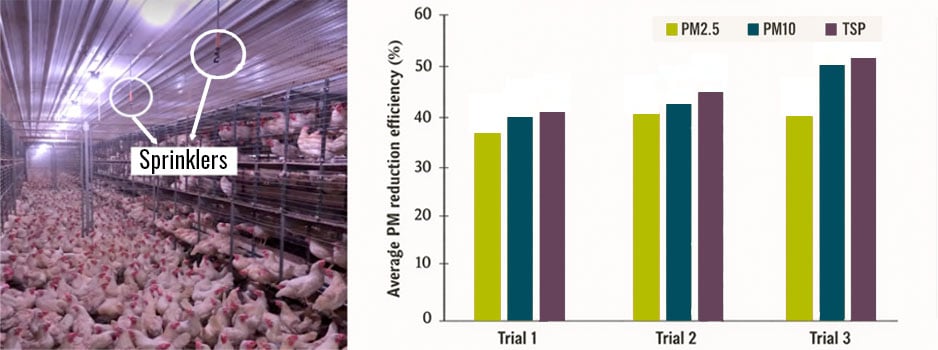
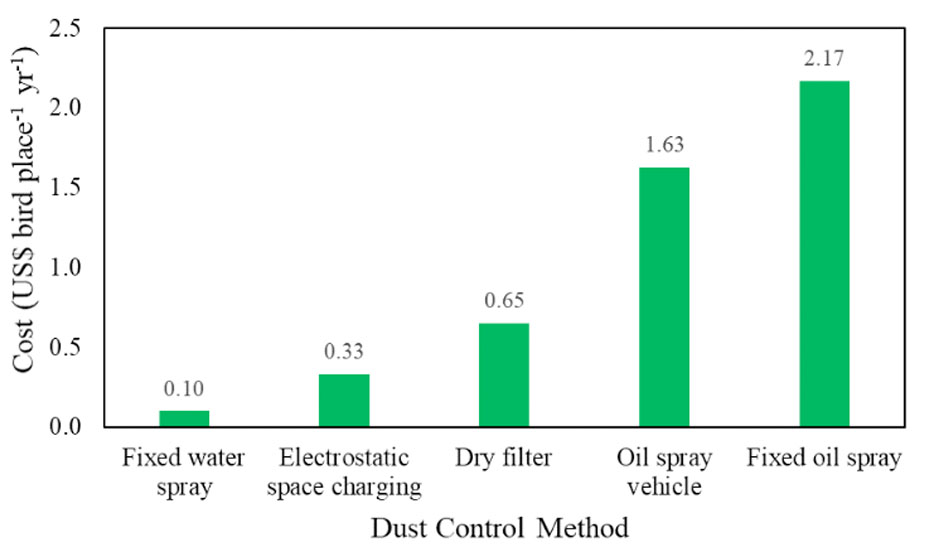
Spraying liquid agents, such as tap water, acidified water, electrolyzed water, and a mixture of water and soybean or canola oil, onto the litter floor has been shown to reduce the dust levels in layer houses. In the Netherlands, researchers reported that spraying 3.6-14.4 gallons of water onto a 1000-square-foot litter floor reduced the dust level by 18%–64%, but it increased NH3 emissions by 21%–65% in cage-free hen houses. In the U.S., researchers sprayed both regular tap water and slightly acidic electrolyzed water (SAEW) onto laying-hen litter and found no difference between tap water and SAEW in PM reduction (49% at a dosage of 80 mL/m2), but SAEW spray reduced airborne bacteria further than tap water, as it contained free chlorine. In the winter of 2017–18, a sprinkler system (Figure 2a) installed in a commercial cage-free henhouse (505 ft long, 70 ft wide, and 10 ft high with 50,000 hens) was tested for dust suppression. The tap water was sprayed at a rate of 3 gallons per 1000 ft2 based on 0.4-in. (1 cm) litter depth, once a day, 10 min before the birds accessed the litter floor (e.g., water would be sprayed at 8:50 a.m. if the birds were allowed to access litter floor at 9 a.m.). The sprinkler (nozzle) was operating at 50 psi. The dust reduction efficiency was 37%–51% without causing NH3 issues in the cage-free henhouse (Figure 2b). Adjusting the sprayer dosage according to litter depth is necessary because the birds will mix the top and bottom of the litter during foraging and dust bathing in the cage-free house. The cost of using a sprinkler system for dust suppression is among the lowest of existing methods. Combining the capital and operating costs equals a total cost of approximately 10 U.S. cents per bird per year for 50% dust mitigation (e.g., PM10).
Use caution when using liquid spray in humid areas such as the Southeastern U.S. because litter floors in the winter tend to be wetter than summer due to reduced ventilation. Adding extra water under wetter winter conditions can lead to increased ammonia and bacteria.
Broiler houses
Dust sources in the broiler house include bedding, feed, feathers, etc. Litter moisture in broiler houses tends to be greater compared to cage-free hen houses, so it is not recommended to add extra water for dust control.

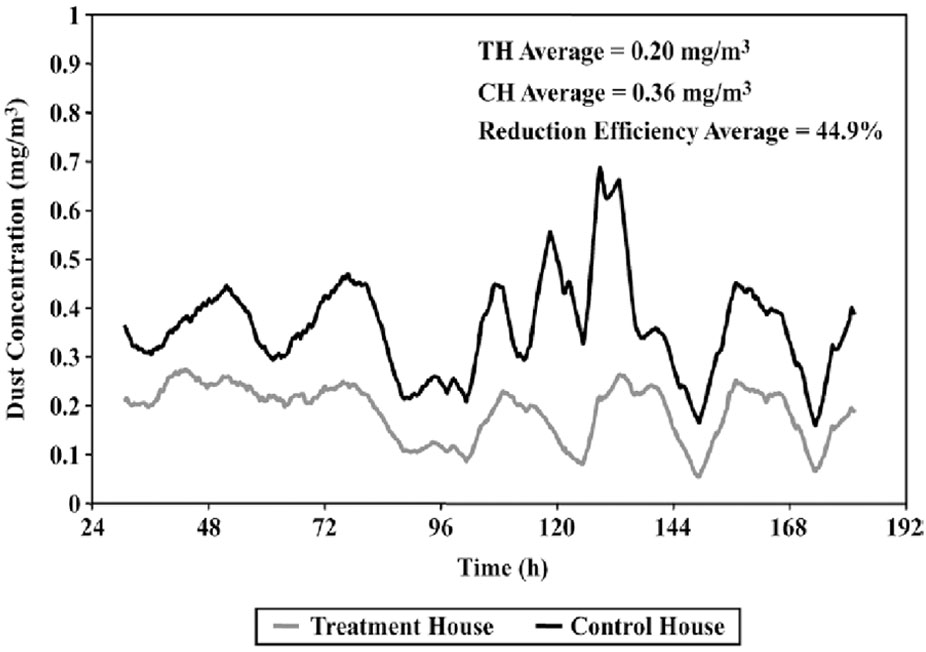
Ritz et al. (2006) studied the impact of an electrostatic space charge system (ESCS, Figure 3) for dust mitigation, and the results of the study indicated that the ESCS significantly reduced airborne dust by an average of 43%–45% (Figure 4) and reduced ammonia by an average of 13%.
The ESCS system’s power consumption was less than 100W when in operation. The commercial application of ESCS within the production house has the potential to improve in-house air quality and reduce dust emissions. Researchers confirmed similar findings (49% reduction) in the Netherlands. A poultry house with higher dust levels (like a cage-free henhouse) may require a stronger ESCS system (e.g., longer corona wire per 1000 ft2 floor area).
Dust measurements
Dust levels in poultry houses can be measured with different methods, and the key is selecting appropriate dust sensors and measurement locations. An optical sensor is a popular type of portable dust sensor that can estimate levels of different dust sizes (i.e., PM1, PM2.5, PM4, PM10, and TSP). It’s best to place sensors at the birds’ level in order to measure the air affecting animal health and welfare (Figure 5).

Due to the dusty environment, it’s important to protect and frequently clean sensors during measurement. It is not recommended to operate an optical sensor in the poultry house longer than the recommended stay length because the sensor filter may reach the maximum load (e.g., the TSI optical sensor suggests internal cleaning every 350 hr under 1 mg/m3 dust concentration). As the dust concentration of some poultry houses (like cage-free henhouses) could be over 20 mg/m3 in winter, the corresponding cleaning frequency is higher. Additionally, dust sensors need to be zero calibrated before each measurement and sent for manufacturer calibration annually to ensure accuracy.
Dust suppression costs
Different dust control methods have been tested worldwide. The efficiencies of different methods are reported to range from 30%–90%. Some mitigation strategies show higher efficiency but poor economic performance, and vice versa. Therefore, the control strategies can be standardized as 50% dust (i.e., PM10) mitigation cost. Figure 6 shows the estimated mitigation costs of different strategies based on the initial system capital cost, lifespan, and annual operation fees, etc. Selecting a practical dust control strategy should consider poultry type, housing design, local climate, and litter/bedding management (e.g., cleaning frequency and bedding quality). For instance, a cage-free henhouse in the Midwest U.S. may use water spray to reduce dust levels because the litter on the floor is relatively dry (10%–15%) in winter due to additional heating. However, caution should be taken in the Southeastern U.S. where litter/bedding is wetter in winter. Other strategies such as ESCS may be a better choice. A limited number of dust control methods in this study were compared. Emerging systems with better mitigation efficiency or lower costs are expected in the future.
Summary
Several studies on dust control methods have been tested worldwide and have concluded that good manure management and proper ventilation can alleviate problems. Mitigation strategies have various levels of effectiveness, but some are cost prohibitive. Selecting the appropriate dust control strategy should consider poultry type, housing design, local climate, and litter/bedding management (e.g., cleaning frequency and bedding quality).
References
Chai, L., Ni, J., Chen, Y., Diehl, C. A., Heber, A. J., & Lim, T. T. (2010). Assessment of Long-Term Gas Sampling Design at Two Commercial Manure-Belt Layer Barns. Journal of the Air & Waste Management Association, 60(6), 702–710. https://doi.org/10.3155/1047-3289.60.6.702
Chai, L., Ni, J.-Q., Diehl, C. A., Kilic, I., Heber, A. J., Chen, Y., Cortus, E. L., Bogan, B. W., Lim, T. T., Ramirez-Dorronsoro, J.-C., & Chen, L. (2012). Ventilation rates in large commercial layer hen houses with two-year continuous monitoring. British Poultry Science, 53(1), 19–31. https://doi.org/10.1080/00071668.2011.643766
Chai, L., Xin, H., Wang, Y., Oliveira, J., Wang, K., & Zhao, Y. (2019). Mitigating Particulate Matter Generation in a Commercial Cage- Free Hen House. Transactions of the ASABE, 62(4), 877–886. https://doi.org/10.13031/trans.12982
Chai, L., Zhao, Y., Xin, H., Wang, T., Atilgan, A., Soupir, M., & Liu, K. (2017). Reduction of particulate matter and ammonia by spraying acidic electrolyzed water onto litter of aviary hen houses – a lab-scale study. Transactions of the ASABE, 62(2), 497–506. https://doi.org/10.13031/trans.12081
Chai, L., Zhao, Y., Xin, H., Wang, T., Soupir, M., & Liu, K. (2018a). Mitigating ammonia and PM generations of cage-free henhouse litter with solid additive and liquid spray. Transactions of the ASABE, 61(1), 287–294. https://doi.org/10.13031/trans.12481
Chai, L., Zhao, Y., Xin, H., Wang, T., & Soupir, M. (2018b). Mitigating airborne bacteria emissions from litter of cage-free hen houses by spraying acidic electrolyzed water. Biosystems Engineering, 170, 61–71. https://doi.org/10.1016/j.biosystemseng.2018.03.013
Ellen, H. H., Bottcher, R. W., von Wachenfelt, E., & Takai, H. (2000). Dust levels and control methods in poultry houses. Journal of Agricultural Safety Health, 6, 275–282. https://doi.org/10.13031/2013.1910
Li, Q. F., Wang-Li, L., Bogan, B. W., Chai, L., Wang, K., Kilic, I., Ni, J. Q., & Heber, A. J. (2013). National air emissions monitoring study—Southeast layer site: Part II—Particulate matter. Transaction of the ASABE, 56(3), 1173–1184. https://doi.org/10.13031/ trans.56.9571
Lim, T. T., Sun, H., Ni, J., Zhao, L., Diehl, C. A., Heber, A. J., & Hanni, S. M. (2007). Field Tests of a Particulate Impaction Curtain on Emissions from a High-Rise Layer Barn. Transactions of the ASABE, 50(5), 1795–1805. https://doi.org/10.13031/2013.23943
Ogink, N. W. M., van Harn, J., van Emous, E. A., & Ellen, H. H. (2012). Top layer humidification of bedding material of laying hen houses to mitigate dust emissions: effects of water spraying on dust, ammonia and odor emissions. Proceedings of The Ninth International Livestock Environment Symposium; Jul 8–12, 2012, Valencia, Spain; St. Joseph, MI, ASABE. https://doi.org/10.13031/2013.41632
Ritz, C., Mitchell, B. W., Fairchild, B. D., Czarick, M. III, & Worley, J. W. (2006). Improving in-house air quality in broiler production facilities using an electrostatic space charge system. Journal of Applied Poultry Research, 15(2), 333–340. https://doi.org/10.1093/japr/15.2.333
Winkel, A. (2016). Particulate matter emission from livestock houses: measurement methods, emission levels and abatement systems (Doctoral dissertation, Wageningen University).
Zhao, Y., Shepherd, T., Li, H., & Xin, H. (2015). Environmental assessment of three egg production systems–Part I: Monitoring system and indoor air quality. Poultry Science, 94(3), 518–533. https://doi.org/10.3382/ps/peu076
Zheng, W., Zhao, Y., Xin, H., Li, B., Gates, R. S., Zhang, Y., & Soupir, M. L. (2014). Airborne Particulate Matter and Culturable Bacteria Reduction from Spraying Slightly Acidic Electrolyzed Water in an Experimental Aviary Laying-Hen Housing Chamber. Transactions of the ASABE, 229–236. https://doi.org/10.13031/trans.57.10306