Takeaways
- Sustainable leadership: Through the FFAR Fellows Program, Giabardo is exploring how to maximize her impact across industry, nonprofits, and public sectors to improve the sustainability of modern farming.
- Advanced genetic tools: Giabardo utilizes cutting-edge genomic tools, computational biology and biotechnology to bridge the gap between identifying beneficial genes and improving commercial crops to ensure global food security.
- Biomass innovation: Her research focuses on converting xylan — a biopolymer in poplar wood — into bioplastics and extracting precursors for biofuels from leaf trichomes.
For Anita Giabardo, agriculture isn’t just a field of study, it is a lifelong narrative that began in the vineyards of Northeastern Italy.
Growing up in Pordenone, Italy, Giabardo found herself captivated by the rhythmic world of viticulture. While her family did not come from a strictly farming heritage, her grandfather’s role as a vineyard manager provided a front-row seat to the industry.
“I was fascinated by the mechanization — seeing him maneuver a huge grape harvester was so cool,” Giabardo said. Beyond the machinery, it was the natural variation within the European wine grapes and the rich stories of the people working the land that sowed the seeds for her future career.
From grapevines to genes
That youthful fascination has since evolved into a high-tech pursuit of agricultural sustainability. Today, Giabardo is a researcher at the Institute of Plant Breeding, Genetics and Genomics at the University of Georgia, supported by the Georgia Crop Improvement Association, Georgia Seed Development and UGA.
Her work focuses on plant breeding, a field she describes as being in an “exciting time.” By leveraging cutting-edge genomic tools, computational biology and biotechnology, she aims to bridge the gap between identifying beneficial genes and improving commercial crops to ensure global food security.
Reimagining the poplar tree

Giabardo’s current research looks specifically at the untapped potential of the poplar tree. While often used for paper, much of the poplar’s biomass is currently underused. Giabardo is working to change that through several key focus areas:
- Engineering bioplastics: She is analyzing xylan, a biopolymer in poplar woodchips that accounts for 20% of their dry weight, for conversion into bioplastics.
- Harvesting biofuels: Her research explores leaf trichomes that could be reengineered to produce bisabolene, a precursor for biofuels.
- High-resolution data: She utilizes single-cell RNA sequencing to analyze gene expression at an unprecedented resolution.
- Targeted engineering: This data allows her to map the regulatory networks that control cell wall biosynthesis and find targets for poplar engineering.
The ultimate goal is enhancing the quality and composition of biomass for renewable products without sacrificing the plant’s yield.
Mapping a purpose-driven future
“These fellowships position trainees for competitive careers in academia, industry and government by integrating research excellence with professional skill development and cross-sector engagement” said Harshavardhan Thippareddi, associate dean for research at CAES and John Bekkers Professor of Poultry Science. “For CAES, participation in FFAR fellowships enhances our research enterprise, elevates our national visibility, and strengthens our ability to cultivate the next generation of scientists and leaders in agriculture and food systems.”
To complement her technical expertise, Giabardo joined the FFAR Fellows Program. As a purpose-driven scientist, she applied to the program to broaden her career horizons and explore how she can best impact the profitability and sustainability of modern agricultural systems.
In late 2025, she and other members of the FFAR 2025-2028 cohort met in Raleigh, North Carolina for their first in-person session.
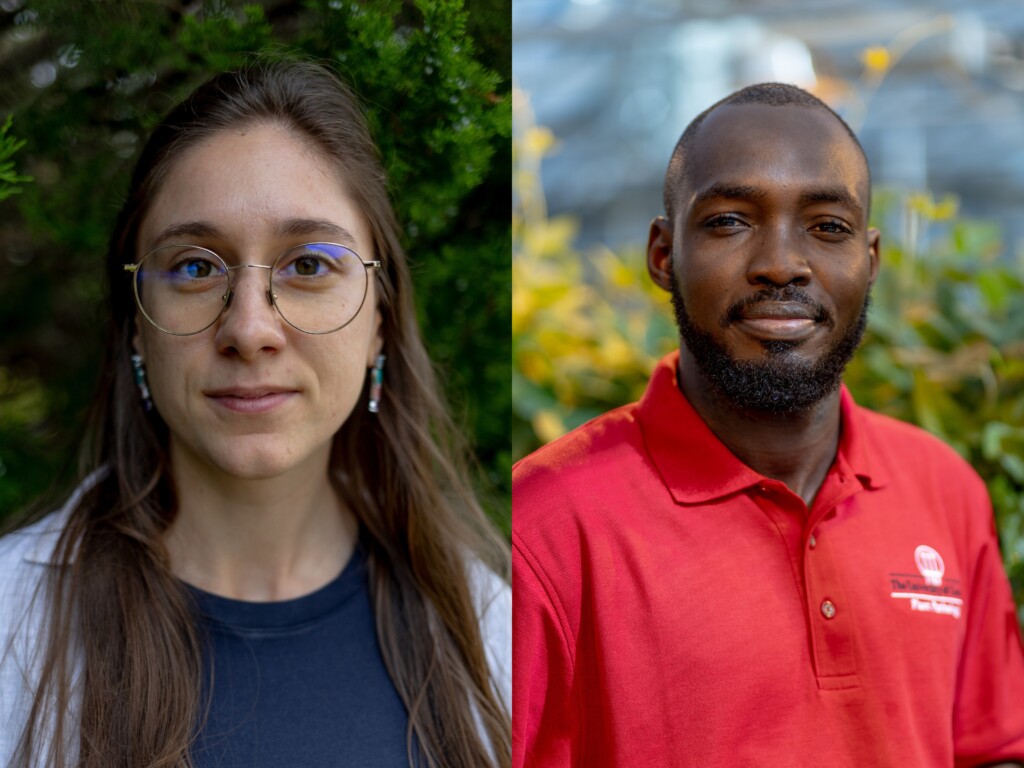
“The first in-person session was really energizing and not what I had expected. I wasn’t expecting to become such good friends with all the other Fellows in the program, and I wasn’t expecting it to develop such a positive energy,” she said. “We’re all a group of people that are in more or less the same field, and we’re all very passionate and committed, so that positive feedback loop is really beneficial. It also keeps you accountable — once you enter the program there’s a time commitment, and you need to be accountable for what you said you were going to do. Having that community support is very nice.”
While she is keeping her options open when it comes to her ultimate career goal, Giabardo said the FFAR Fellows program is allowing her to explore a variety of career paths. Wherever she lands, Giabardo is committed to pushing the boundaries of crop improvement.
What I’m really trying to do with FFAR is explore what it means to go into a specific role in industry versus a nonprofit versus an institution that represents farmers. How do these look in practice and where can I have the most positive impact as a professional?” she said.
“Whether it’s industry, the public sector, an institution or an NGO, I really hope for myself that I find a place where I can have that positive impact.”