Takeaways
- Researchers are working to develop cotton with color built directly into the fiber, reducing the need for water- and chemical-intensive dyeing.
- AI, genomics and gene editing are helping scientists accelerate the development of more resilient cotton varieties.
- UGA and Clemson researchers aim to create cotton that requires fewer inputs while remaining competitive with synthetic fibers.
Fueled by an $11 million grant from the Bezos Earth Fund, scientists at the University of Georgia and Clemson University are gearing up to develop cotton of the future.
Varieties with built-in color, greater resilience to heat and drought, and reduced reliance on water, fertilizers and pesticides will hopefully appeal to consumers looking for sustainable clothing materials and help push back against synthetic fibers, which currently dominate the fast-fashion industry.
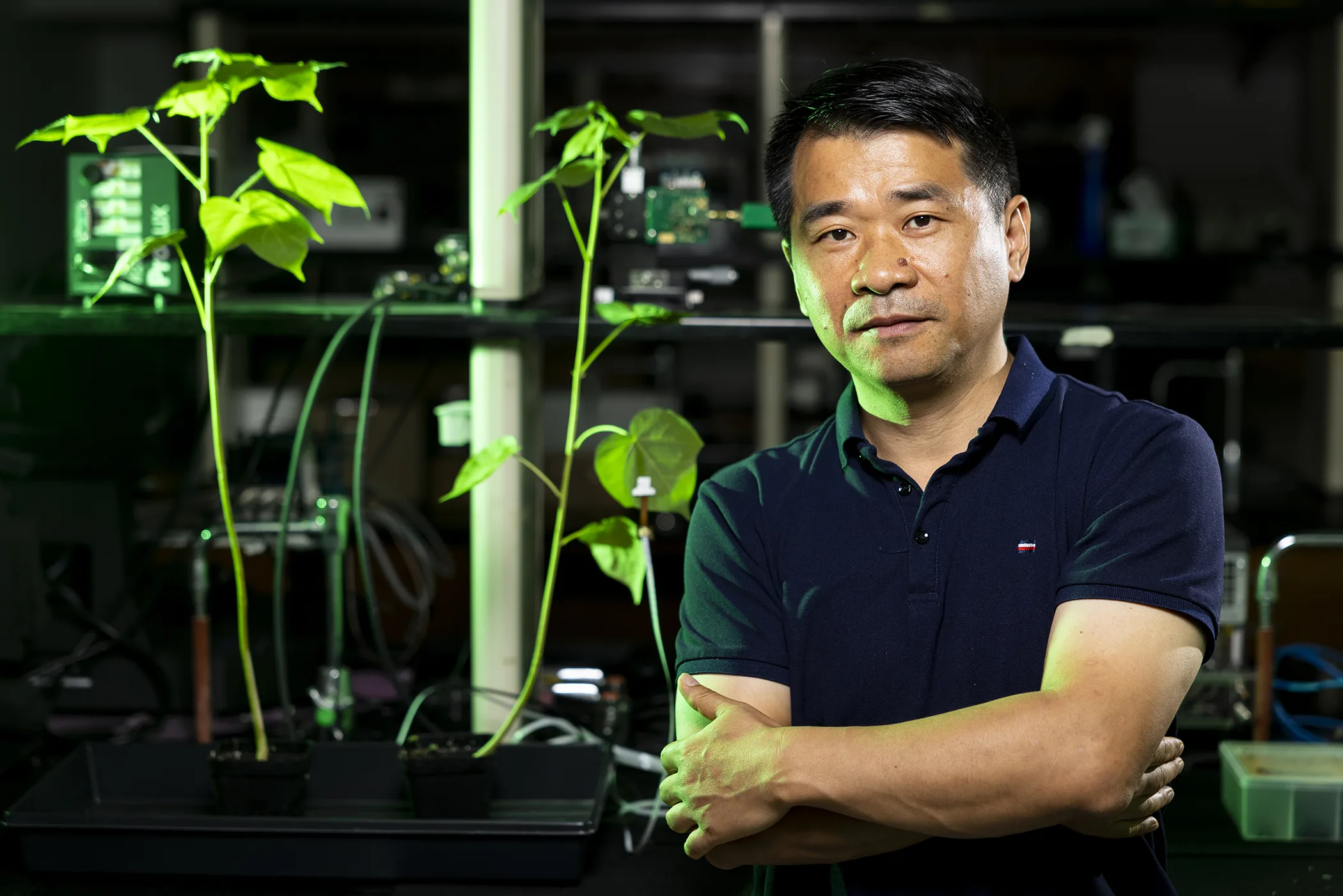
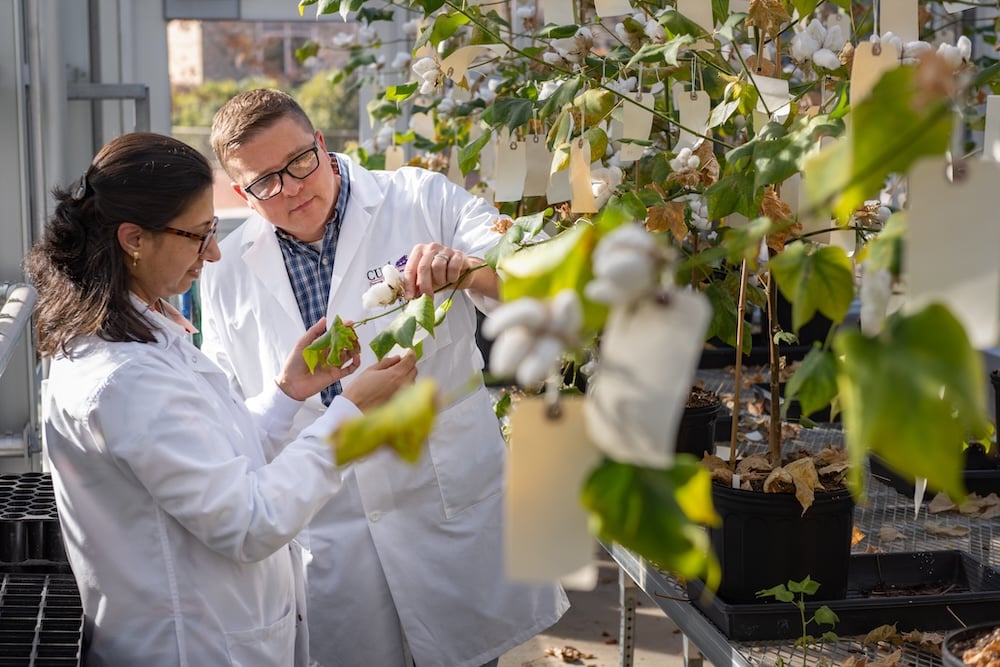
Chris Saski, Clemson researcher and professor of systems biology, is leading the effort to engineer cotton plants that naturally produce pigment in their fibers, while Peng Chee, UGA cotton breeder and professor of crop and soil sciences in the College of Agricultural and Environmental Sciences, is identifying genetic traits that help plants withstand disease and drought with fewer chemical inputs.
Once the best of the best varieties are identified, Chee and team will grow them out in fields to test them in real-world conditions.
“The activities are designed as an integrated pipeline, not separate projects,” said Saski. “The main goal is to make cotton more competitive and sustainable by moving value upstream into the plant itself to ultimately reduce greenhouse-gas emissions, water pollution and waste.”
Growing color directly into cotton fiber
So, how do you develop naturally colored cotton? Saski’s team has identified heirloom cotton varieties that naturally produce subtle reds, greens and browns. By enhancing those biological traits and pigment pathways, the team hopes to eventually expand the range and vibrancy of colors available to consumers.
The environmental implications could be substantial if successful at scale, Saski said. Instead of growing white cotton that must later be dyed through water- and chemical-intensive textile processing, he estimates a reduction in water use associated with textile dyeing by at least 70%, cutting dye-related chemical inputs and wastewater by 80%, and reducing dyeing energy demands by half.
Using AI to accelerate cotton breeding
The research will combine gene editing, artificial intelligence (AI) and advanced breeding tools to identify and assemble favorable genetic combinations that enable cotton plants to maintain productivity under increasingly challenging growing conditions far more rapidly than traditional breeding processes.
Without AI, Saski said, developing those combinations would rely on slow, one-gene-at-a-time trial-and-error experimentation. “Instead, AI systems can rapidly sort through massive amounts of genomic and biological data to pinpoint the most promising genes and trait combinations that would be very difficult to pursue through conventional breeding alone,” Saski emphasized.

Testing traits in growers’ fields
While Clemson researchers are leading efforts to identify and engineer those new, desirable traits, UGA’s role is to determine whether they hold up in the field.
Chee’s team will use advanced imaging systems, AI and DNA-based prediction models to evaluate thousands of cotton plants to develop elite germplasm — the most promising plant parent material — and provide the field evaluation and breeding infrastructure needed to bring desirable traits identified in Saski’s lab closer to practical use for growers.
“In other words, Saski said, “Clemson is helping build and discover the traits, while UGA helps test, validate and translate those traits into breeding-ready and grower-relevant cotton material.”
Competing with synthetic fibers

The multistate effort is ultimately driven by the researchers’ shared passion to revitalize cotton quality and functionality. Unlike synthetic fibers derived from petroleum, cotton is a natural, renewable and biodegradable fiber that can play an important role in reducing the textile industry’s environmental footprint.
They contend that if cotton can be grown with built-in color, better performance, and lower input requirements for pest and disease management, then sustainability is not just added at the end of the supply chain, but is built into the crop’s biology.
The overall project goal is not the development of a single “miracle variety,” but rather a long-term pipeline capable of producing multiple cotton lines tailored to different growing regions and market needs.
“A drought-prone region may prioritize water-use efficiency and heat tolerance. A textile partner may prioritize intrinsic color and fiber quality,” Saski explained. “The platform is designed to generate, test and refine multiple trait combinations.”
For both, the project represents a more substantial shift in how cotton breeding may evolve in the coming years.
“It’s fundamentally changing how we select and develop new varieties, making the process faster, more precise and more predictive,” Chee said.
How’s that for sustainable fast fashion?