Takeaways
- UGA Innovation Bootcamp supports faculty in moving research beyond the lab by emphasizing industry collaboration, commercialization and real-world application.
- Participants bring diverse expertise to the program, exploring innovations ranging from AI-driven food science discoveries to creative STEM education tools.
- The bootcamp encourages entrepreneurial thinking among researchers, introducing concepts such as market demand, pricing strategies and investment perspectives.
Innovation is on the rise at the University of Georgia, and faculty in the College of Agricultural and Environmental Sciences (CAES) are exploring new ways to translate research, creativity and collaboration into real-world solutions through Innovation Bootcamp.
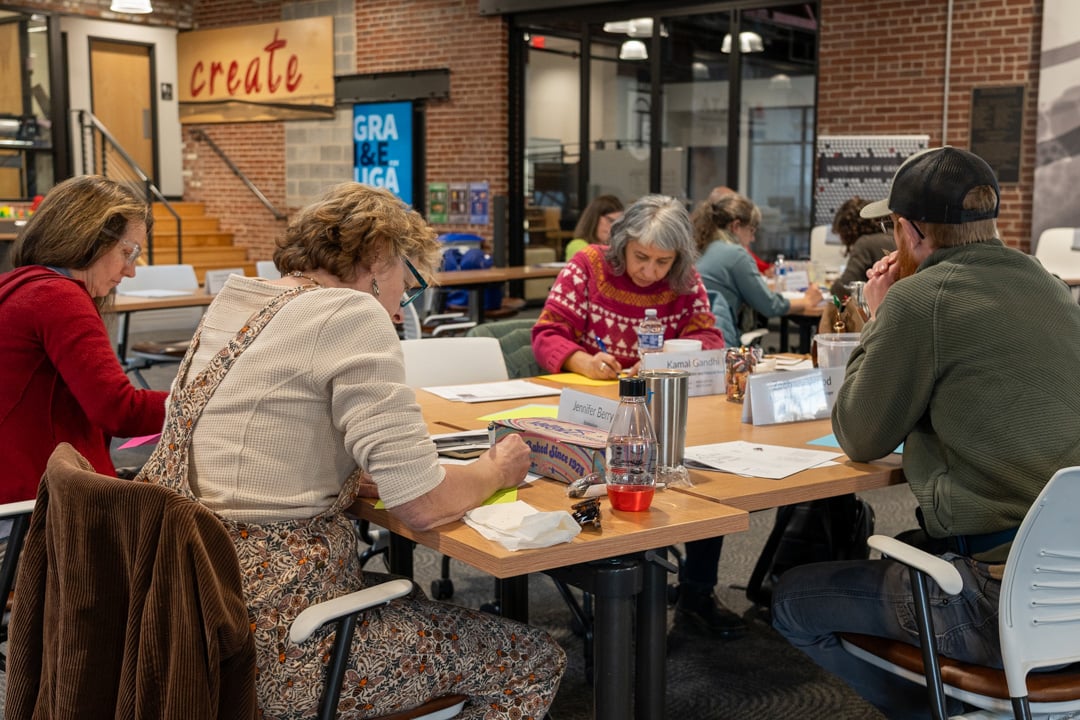
Hosted by UGA’s Innovation Gateway at the Delta Innovation Hub, Innovation Bootcamp is an opportunity for faculty to embrace entrepreneurial education, bringing innovation out of the laboratory and into the experiential ecosystem of the innovation hub.
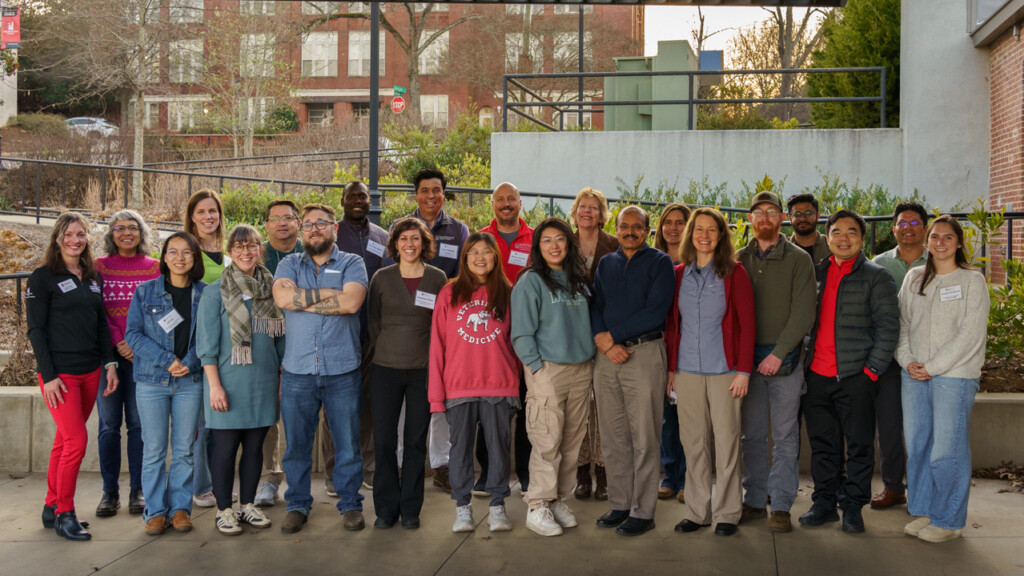
This year’s six-week bootcamp centered the theme of natural resource management. The program included 20 UGA faculty across various disciplines, with 10 CAES faculty contributing expertise across fields including entomology, plant pathology, horticulture, and animal and dairy science.
Harnessing developing technology
The bootcamp provided the opportunity to rethink how agricultural byproducts can be transformed into high-value health solutions, said Joonhyuk Suh, assistant professor in the Department of Food Science and Technology.
“Rather than spending years on trial-and-error chemistry, we’re using artificial intelligence to identify the exact peptide sequences hidden inside agricultural byproducts,” Suh explained. “AI-assisted discovery drastically minimizes lab work, reduces research and development costs, and accelerates time to market.”
Solving real-world problems
Tony Llano, director for industry partnerships and project-based learning at CAES, works with bootcamp participants on the business and commercialization side of innovation. Llano actively encourages faculty and staff to transform their research into practical, real-world applications.
“Industry partnerships add a translational layer to research,” Llano said. “It is not just about advancing science, which is quite important, of course — it is about translating creative discoveries into innovations that customers are actually willing to pay for because they solve real-world problems.”
The bootcamp helps participants explore how scientific ideas evolve into market-ready solutions, a process that often requires thinking beyond research outcomes and considering how innovations are introduced to the marketplace, Llano said.
It’s one thing to come up with a solution,” he said. “It is another thing to think intentionally about pricing, marketing, delivery and competitive advantage. Innovation isn’t just discovering something novel; it’s bringing it to market in a way that’s commercially viable and defensible.”
Participants also learn what potential funders look for in investments, a perspective many researchers have not encountered before.
“When participants begin to understand how the venture capital community evaluates investments, that realization is often revealed,” Llano said. “Many researchers have not had exposure to that way of thinking.”
Changing the delivery of knowledge
While some participants focus on product innovation, others are exploring new ways to transform how knowledge itself is delivered.
Brian Kvitko, associate professor in the Department of Plant Pathology, is using the bootcamp experience to advance an interdisciplinary initiative called Lab Partner Board Games, a faculty learning community focused on designing board and card games that help students learn complex STEM concepts through play.

“I’ve spent my career in academia, but if we want to turn educational games into a real product, we have to understand what it means to interact with the private sector,” Kvitko said. “Bootcamp gave me a way to explore how we bridge that gap.”
For Kvitko, analog games offer a unique educational advantage by creating a social learning environment that reinforces understanding.
“It’s not just about the tactile experience,” he said. “When you’re engaged and having fun, you reinforce what you’re learning instead of relying on rote memorization.”
From AI-driven food ingredients to innovative classroom tools, CAES faculty are using the bootcamp experience to turn research and collaboration into actionable solutions.
“Before the car was invented, people would have said they wanted a faster horse,” Kvitko said. “The real question isn’t what people say they want — it’s understanding the problem you’re actually trying to solve.”
Have an entrepreneurial idea?
Programs or individuals interested in guidance to progress an entrepreneurial idea can reach out to Innovation Bootcamp program manager Allyson Hester for information on upcoming cohorts.