What Affects Cold-Hardiness of Citrus?
One of the most common questions regarding citrus is how much cold weather they can withstand before being killed. Most citrus growers are looking for a specific low temperature, but there is no simple answer to this question because there are so many factors involved in citrus cold hardiness.
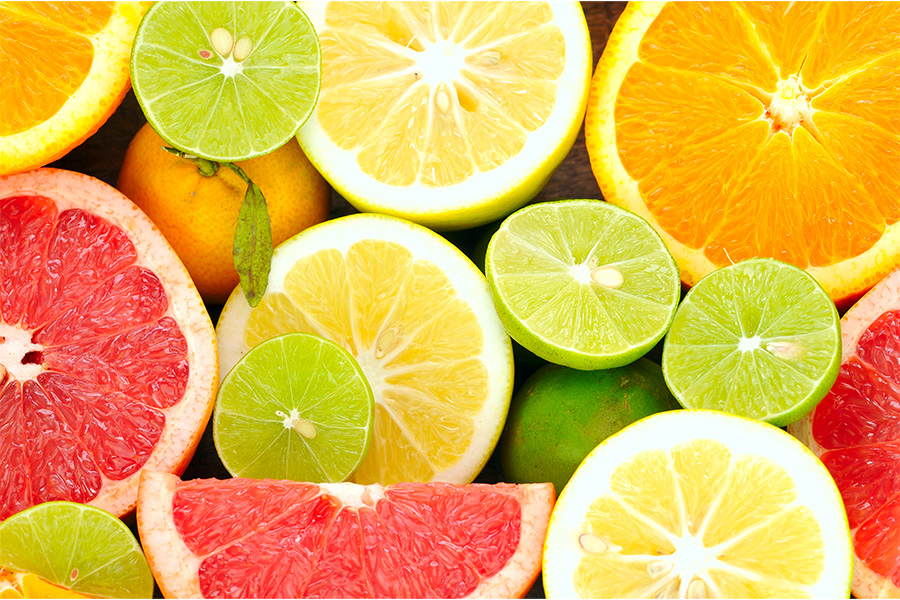
The most obvious factor is the variety. In order of cold-hardiness, the three main classes of citrus are mandarins, sweet oranges, and grapefruit. Examples of mandarsins are satsumas, tangerines, and tangerine hybrids. Sweet orange examples are navel, ‘Hamlin’, ‘Valencia’, and blood oranges. Grapefruits include red, pink, and white grapefruits and their hybrids. Acid types of citrus, such as lemons and limes, are the least cold hardy. University of California–Riverside is a great resource for information on citrus varieties (https://citrusvariety.ucr.edu/).
Citrus trees that are acclimated to cold temperatures before a freeze event will better endure a freeze, while trees that are actively growing before a freeze are more likely to be damaged. For example, trees exposed to a low temperature of 25 °F in November are much more likely to suffer damage than if the same temperature occurs in January. To help acclimate citrus trees, limit nitrogen fertility after August so the trees slow their growth.
Rootstocks also influence cold-hardiness of citrus, as citrus varieties commonly are grafted onto rootstocks. Poncirus trifoliata is particularly known for cold-hardiness and can survive as far north as New England. This rootstock goes dormant at higher day and night temperatures than other rootstocks, therefore slowing the growth of the tree before winter. There are hundreds of different rootstocks, many of which are hybrids of P. trifoliata. For more information on rootstocks, the USDA (https://citrusrootstocks.org/) and the University of Florida (https://crec.ifas.ufl.edu/extension/citrus_rootstock/tables.html) provide detailed resources.
The age of citrus trees is important to their cold-hardiness. First-year trees are more likely to experience freeze damage compared to older trees, so it’s important to protect younger trees during winter. Commercially, continuously applying irrigation to the trunks of citrus during a freeze can protect the trunk and scaffold branches. For homeowners with citrus trees, covering them with frost cloth is best. Blankets will help as well.
The site where trees are located is also very important. Trees on southern- or western-facing slopes will survive better than trees on northern-facing slopes. Windbreaks also protect trees from advective freezes, which displace warmer air that is emanating from the ground or nearby structures. Trees planted on higher ground have a better chance to survive because cold air flows downward into lower areas. Citrus trees planted in low areas are much more likely to experience freeze damage than trees planted on higher ground.
Trees exposed to a few hours of below-freezing temperatures are less likely to experience damage than trees exposed to below-freezing temperatures for many hours. Winters in southern Georgia can be mild with limited hours below freezing, but there is always a threat of severe, long-lasting freezes than can be devastating to citrus.
Another factor is tree health. Healthy, well-cared-for trees will better tolerate freezes than those stressed by insects, diseases, weeds, and lack of nutrients. Fruit should be harvested as soon as possible, since trees with heavy fruit loads are stressed and more likely to suffer freeze damage. Fruits can freeze when temperatures reach 28 °F for several hours. Fruit with a thinner peel will freeze before fruit with a thicker peel.
In Georgia, most citrus trees will have some degree of damage from freezing temperatures after each winter, but normally the damage is minimal. New angular growth that occurred in the fall often is killed, as are newer tender leaves. Citrus trees will overcome this type of damage and continue to grow in the spring and summer. For more information on citrus freeze damage, refer to the UF-IFAS publication Freeze Damage Symptoms and Recovery for Citrus (https://edis.ifas.ufl.edu/publication/HS1275).
Keep in mind that citrus is a tropical or subtropical plant and can be damaged by freezing temperatures. Farmers and small landowners in Georgia have begun to plant citrus trees commercially, and one of the biggest threats to this decade-old industry is freezing temperatures. For this reason, a survey of non-satsuma citrus trees was conducted by University of Georgia and University of Florida Extension agents.
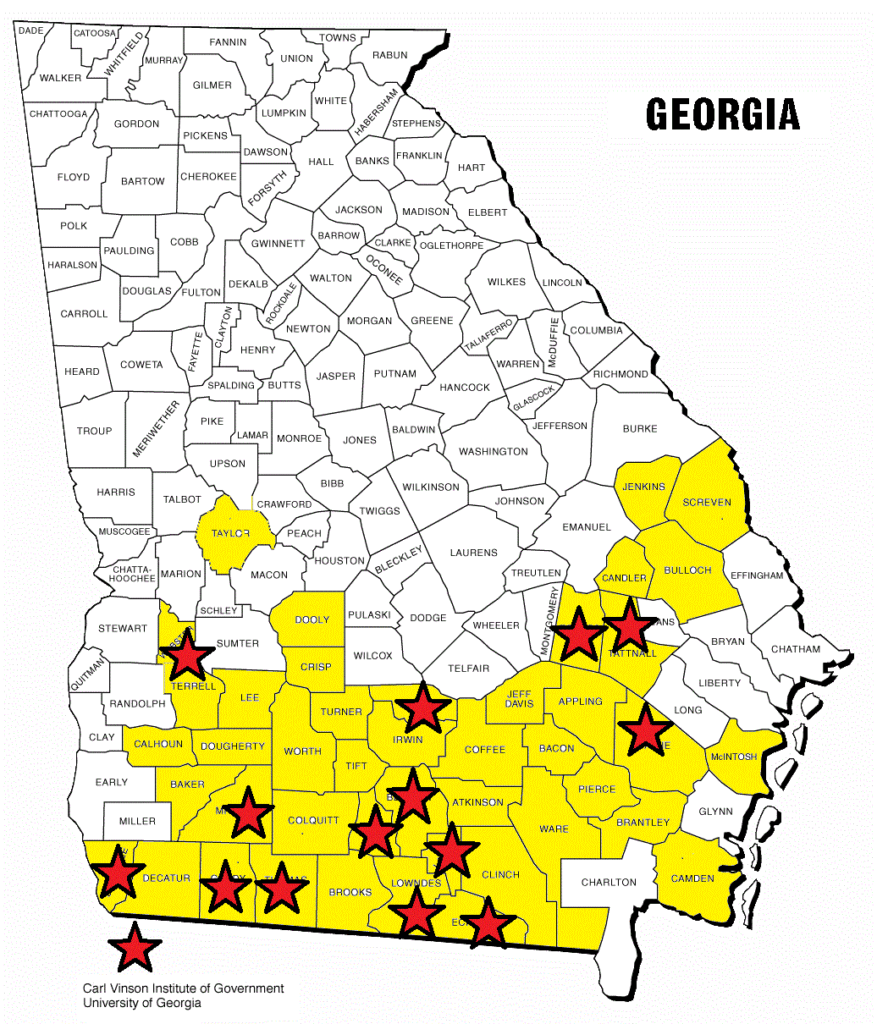
Note. Commercial citrus is being grown in the counties colored yellow, while red stars indicate locations of county agents participating in the survey.
Commercial Citrus in Georgia
As of 2023, Georgia growers have planted approximately 570,760 commercial citrus trees in 44 counties (Figure 1) with roughly 65% of the trees being satsuma mandarins, Citrus unshiu. In the last several years, the majority of trees planted were non-satsuma varieties.
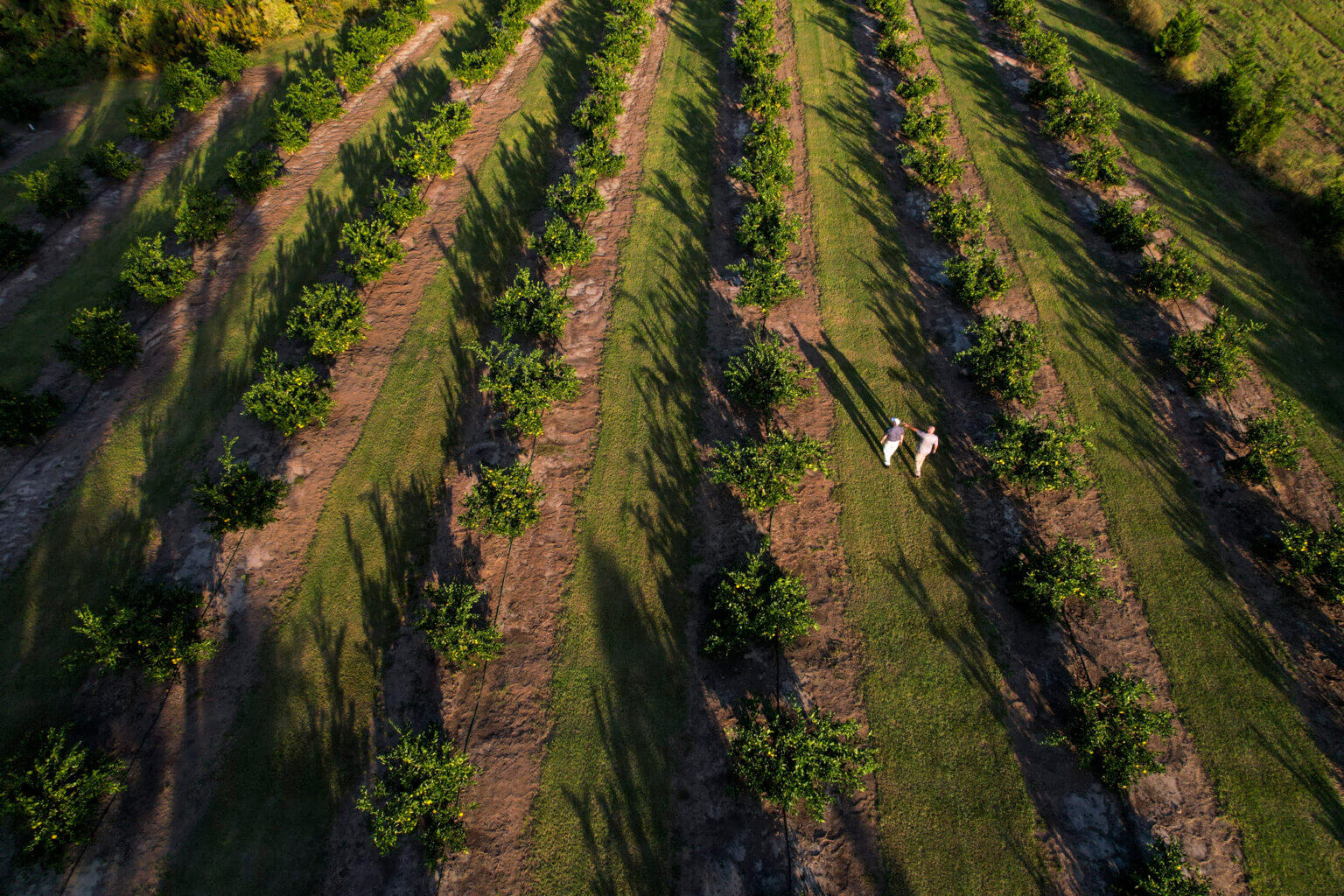
Growers are using many different tree spacings per acre, but if 145 trees are planted per acre, that is an estimated 3,936 acres. Prior to 2013 there were less than 1,000 trees planted commercially in Georgia in only a couple of locations. New trees are being added each year, with 131,030 trees planted in 2023. This is the most trees added since the industry began in 2013 (Figure 2). In 2022, approximately 33,000 trees were lost because of severe freezes (as indicated by the red bar segment in Figure 2).

Shifts in Varieties Planted
Satsumas have a short ripening window which can create a bottleneck when it comes to marketing. Satsumas need to be harvested as soon as they ripen and do not keep well on the tree or in refrigeration compared to other commercial citrus varieties. For these reasons, growers have shown interest in planting other citrus varieties to diversify and strengthen the Georgia industry.
Growers began planting varieties such as grapefruit, ‘Shiranui’, navels, lemons, blood oranges, ‘Kishu’, ‘Sugar Belle’, and others. The main problem with diversification of varieties is reduced cold hardiness compared to satsumas. Between 2013 and 2022, extended severe freezes were not a problem as Georgia winters were mild with occasional dips to around 20 °F in citrus-growing regions.
Until 2022, for the most part all varieties survived including lemons and grapefruits. One question many growers have is which non-satsuma varieties are the most cold hardy. That is a difficult question because there are so many variables that influence cold hardiness. Tree age, rootstocks, site selection, fruit load, tree health, freeze protection, fertility, duration of freezes, and low temperatures reached are just some of the major factors.
Severe Freeze Event 2022
| Date | Brooks County | Dougherty County | Crisp County | Bullock County |
|---|---|---|---|---|
| 12/23 | 25 °F | 22 °F | 21 °F | 22 °F |
| 12/24 | 18 °F | 18 °F | 16 °F | 15 °F |
| 12/25 | 22 °F | 20 °F | 19 °F | 22 °F |
| 12/26 | 20 °F | 19 °F | 18 °F | 22 °F |
| 12/27 | 26 °F | 24 °F | 24 °F | 25 °F |
| 12/28 | 27 °F | 24 °F | 26 °F | 27 °F |
In late December 2022, Georgia experienced a major, long- duration freeze event. All Georgia citrus trees were exposed to very low freezing temperatures and long durations below freezing. Table 1 shows low temperature data from the University of Georgia weather stations (https://www.georgiaweather.net) in four counties from December 23–28, 2022. The entire citrus growing region experienced long-term hard freezes.
Survey of Non-Satsuma Varieties
From March 3 to April 13, 2023, 15 University of Georgia Extension agents and one University of Florida Extension agent participated in a survey to rate non-satsuma citrus plantings that were planted prior to or during 2020. Observations of satsumas after the freeze clearly showed they were the most cold-hardy variety, so the focus of this work was on non-satsuma varieties.
The goal of the survey was to evaluate how well established non-satsuma citrus varieties tolerated extreme freezing temperatures to determine the varieties most suitable to recommend to growers.
Newly planted trees are much more susceptible to freezes, so trees that have survived at least two winters were chosen for the survey, as these trees would be more established. As trees age they increase their cold hardiness. Most non- satsuma varieties in Georgia are less than 5 years old, so finding older trees to evaluate was not an option.
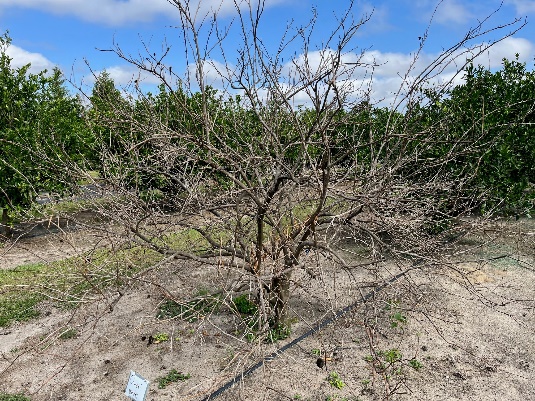
Agents selected 10 (sometimes five) consecutive non-satsuma trees in a field and estimated the percent of canopy loss for each tree. February 2023 was unusually warm and trees put on a flush of leaves, allowing agents to see which limbs were dead (Figure 3). This allowed agents to estimate the percentage of canopy loss in each tree.

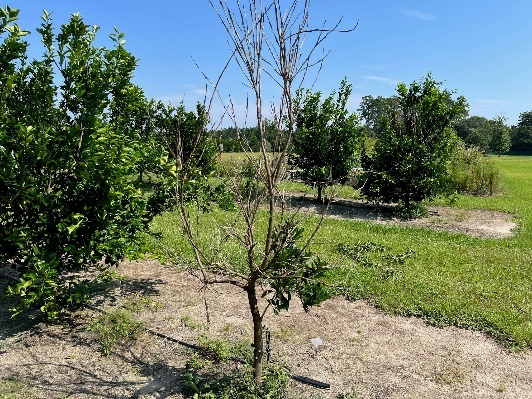
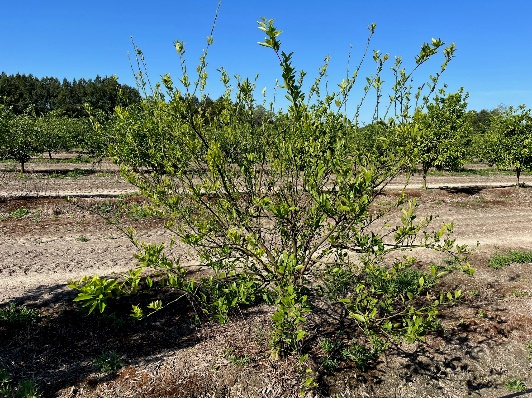
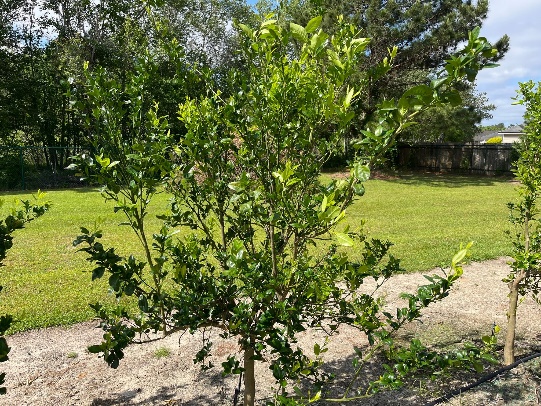
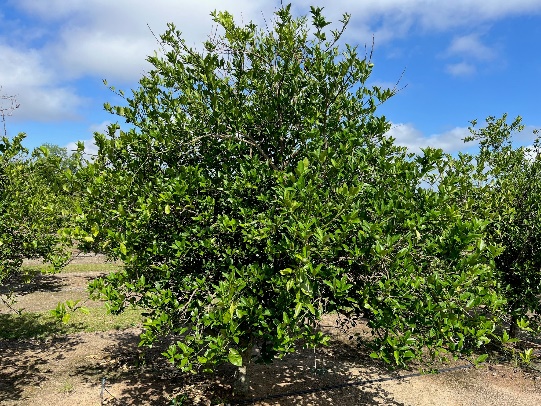
Agents then gave an overall visual assessment of each tree from 0 to 5, with 0 being dead and 5 having no visible freeze damage (Figure 4). In some instances trees put on a flush of growth with little noticeable limb loss, but the growth flush was minimal, making the trees look unhealthy. The 0–5 rating captured weaker-looking trees.
0
1
2
3
4

5
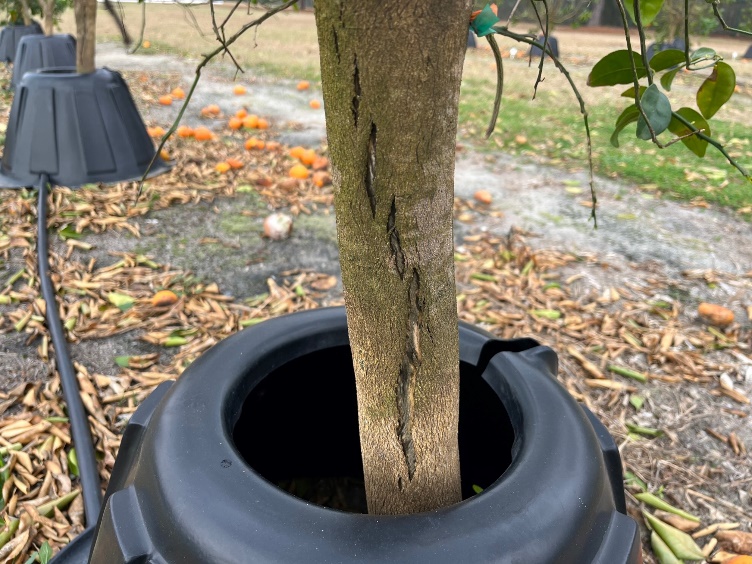
Agents also recorded if each tree had developed freeze cracks (Figure 5) in the bark or on the branches or trunk with a yes or no.
In several instances, trees rated were in the same field. If trees were on different rootstocks or planted in different years, they were rated separately. For example, if Tango trees were in the same field but on different rootstocks, that would be considered two different ratings although they were in the same field.
There were many variables in this survey, and the results simply show the average of how Extension agents rated each variety as of early spring 2023. Follow-up ratings were not possible because of dead wood being pruned and in some cases entire trees being removed. It is likely that many of these trees continued to decline months later. Ratings from all the agents were combined for each variety and the average is presented in Table 2. The varieties were listed in order least to most percentage canopy loss.
| Variety | Number of ratings taken for each variety | Total number of trees rated | Percentage of canopy loss | Visual assessment | Percentage of trees with freeze cracks |
|---|---|---|---|---|---|
| Sugar Belle | 10 | 80 | 22 | 3.3 | 28 |
| Tango | 12 | 110 | 35 | 2.4 | 66 |
| Navels | 14 | 135 | 36 | 2.7 | 24 |
| Kishu | 9 | 85 | 51 | 2.1 | 20 |
| Grapefruit | 20 | 195 | 55 | 2.1 | 59 |
| Shiranui | 11 | 110 | 60 | 1.7 | 10 |
Note. ‘Sugar Belle’ lost the least canopy; ‘Shiranui’ lost the most canopy.
According to the ratings, ‘Sugar Belle’ mandarins had the lowest percentage of canopy loss and the highest visual assessment, indicating this variety tolerated the freezing event best. ‘Tango’ mandarins and navels were similar to each other in canopy loss and visual assessment and were positioned behind ‘Sugar Belle’ in terms of cold tolerance. ‘Kishu’ mandarin and grapefruit had very similar canopy loss and visual assessment. ‘Shiranui’ had the highest percentage of canopy loss and the lowest visual assessment, making them the least cold hardy of these six varieties. Other varieties were assessed but not included in Table 2 because of fewer ratings. These other varieties include ‘Hamlin’, lemons, ‘UF950’, blood oranges, ‘Bingo’, ‘Gold Nugget’, and UGA’s ‘Sweet Frost’.
Observations and Conclusion
These results represent in-field ratings following the long-term freeze event from 15 counties and sites in southeastern Georgia, southwestern Georgia, and northern Florida. We believe results of this study will be helpful to growers when choosing varieties to diversify the Georgia citrus industry and avoid future tree loss caused by freezing conditions.
With so many variables and different locations rated, it is difficult to draw firm conclusions on cold hardiness, and more work needs to be done in the future. The percentage of trees with freeze cracks did not correlate with canopy loss. Many dead trees or severely damaged trees were observed with no freeze cracks, indicating trees likely died before forming freeze cracks. Freeze cracks may not be the best indicator of cold hardiness, although they can contribute to future limb loss or even tree death if they are on the trunk.
Rootstocks influence cold hardiness, but there were too many variety/rootstock combinations to consider in this survey. Trees of the same variety with heavy fruit loads seemed to suffer more freeze damage than trees with average or light fruit loads. Therefore, fruit load before a severe freeze event likely plays a big role in cold hardiness. Removing fruit as soon as possible could decrease damage to trees.
In the future, combining the most cold-hardy citrus varieties and rootstocks should give maximum protection to trees against any long-duration freeze events. Trees that were less cold hardy in this survey may still be profitable, as they have survived many prior winters and have been producing fruit. From our observations, trees in well-managed sites rated better than trees in neglected sites. To best assess cold hardiness between varieties in the field, multiple varieties need to be planted in the same location at the same time, on the same rootstock, have the same management, and have multiple repetitions.