Fruit, Vegetable and Ornamental Production
-

The 2023 edition of this publication covers integrated pest management information for blueberry producers in the Southeastern U.S. Recommendations are based on information from the manufacturer’s label and performance data from research and Extension field tests. This publication is intended for use only as a guide. Specific rates and application methods are on the pesticide label, and these are subject to change at any time.
|
-

This integrated pest management (IPM) guide for blackberry and raspberry production includes management of diseases, insects, and weeds through IPM principles. The 2023 Southeast Regional Caneberry Integrated Management Guide covers topics such as pesticide stewardship and safety, insect and disease control, pre-transplant and transplant operations, fungicide and insecticide efficacy comparisons and spray schedules, weed management, wildlife damage, and more. Recommendations are based on information from the manufacturer’s label and performance data from research and extension field tests. Because environmental conditions and grower application methods vary widely, suggested use does not imply that performance of the pesticide will always conform to the safety and pest control standards indicated by experimental data. This publication is intended for use only as a guide. Specific rates and applications methods are on the pesticide label, and these are subject to change at any time.
|
-
The commercial citrus industry in Georgia has only recently been established, with most groves planted after 2014. Initially,
satsuma mandarins (Citrus unshiu) on trifoliate rootstocks (Poncirus
trifoliata) were planted for their cold-hardiness, seedlessness, and
ease of peeling. Satsuma fruits begin to attain commercial maturity in
early November and usually avoid hard freezes in southern Georgia. As of
2022, approximately 75% of the 3,300 acres of citrus planted in Georgia are
satsumas, but that proportion is trending downward. To strengthen the new
Georgia citrus industry, growers recently have begun to diversify their citrus
varieties. Little is known about how these varieties will perform under Georgia
weather and soil conditions. Therefore, research is necessary to determine what
varieties can best tolerate Georgia’s winter weather and to determine cultural
norms such as maturation time, fruit quality, and insect and disease tolerance. This publication is associated with Annual Publication 127, the annual publication containing each season’s harvest data.|
-

2020 plant disease losses in Georgia, including control costs, amounted to an estimated $806 million. The value of the crops used in this estimate was approximately $6.712 billion, resulting in a 12.01% relative disease loss across all crops included in this summary. The estimated values for most crops used to compute these disease losses are summarized in the 2020 Georgia Farm Gate Value Report (AR-22-01) by the UGA Center for Agribusiness & Economic Development. Some estimates for fruits, ornamentals, and turf rely on specialists’ knowledge of the industry and industry sources for information. Losses covered include: apple, blackberry, blueberry, bunch grape, corn, cotton, muscadine grape, ornamentals, peach, peanut, pecan, soybean, strawberry, turfgrass, vegetables, and wheat.
|
-

C 576
Dahlias
Dahlias are among the most spectacular flowers you can grow in your garden. Hundreds of varieties are available, with flower sizes ranging from 1 to 14 inches in diameter. Almost any color except true
blue can be produced in Georgia. In exchange for their beauty, dahlias require dedicated care. Most of them need special soil preparation, staking, watering during dry periods, disbudding and a
strict insect control program. This publication contains information about successfully growing dahlias in Georgia.|
-

Damage to perennial woody trees and shrubs caused by hurricanes or high wind events is often not initially apparent. In some cases, it can take months or even years to manifest, despite plants looking relatively healthy after initial inspection by growers and insurance adjustors. This publication describes common damage seen in perennial woody trees and shrubs after a hurricane or high wind event.
|
-

This report provides research and extension results for trials conducted by the University of Georgia Vegetable Team and its collaborators in 2022. Contributing authors include county and regional faculty as well as specialists from UGA’s horticulture, plant pathology, crop and soil sciences, and entomology departments. All research has been supported by the Georgia Commodity Commission for Vegetables.
|
-
C 1260
Azalea Bark Scale
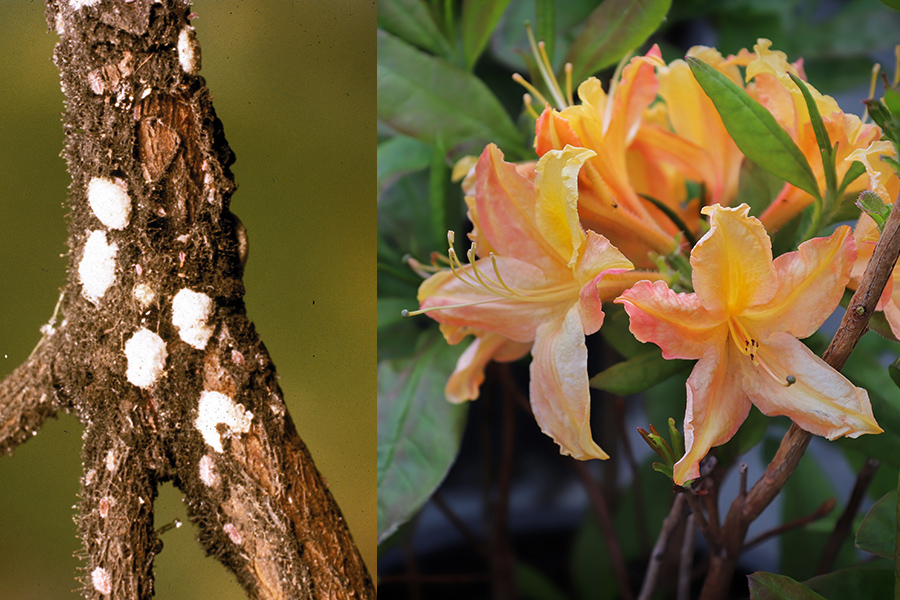
Azalea bark scale (ABS) poses a serious threat to azaleas, rhododendron, and Pieris (Andromedas) in Georgia. ABS is a soft scale insect; the nymph and female soft scales secrete a protective coating of waxy crust on their body that cannot be separated from the scale insect. ABS also is found on blueberry, hawthorn, huckleberry, poplar, and
willow. ABS is found in cracks or crevices in the surface of the bark, and also in areas where azalea branches fork. ABS can undergo two generations per year in Georgia.
Symptoms of ABS infestation include dropping yellow leaves and dying branches. Developing nymphs and females excrete a sugary syruplike liquid called honeydew on to the bark and leaves. As time passes, the surface of the bark, and sometimes the leaves, turns black because it gets infested with a sooty mold fungus that
feeds on the sugary secretions. The white crusts of scale insects are easily visible when the azalea bark turns completely black. An ABS infestation rarely kills the plant unless it is extremely severe and uncontrolled.|
-
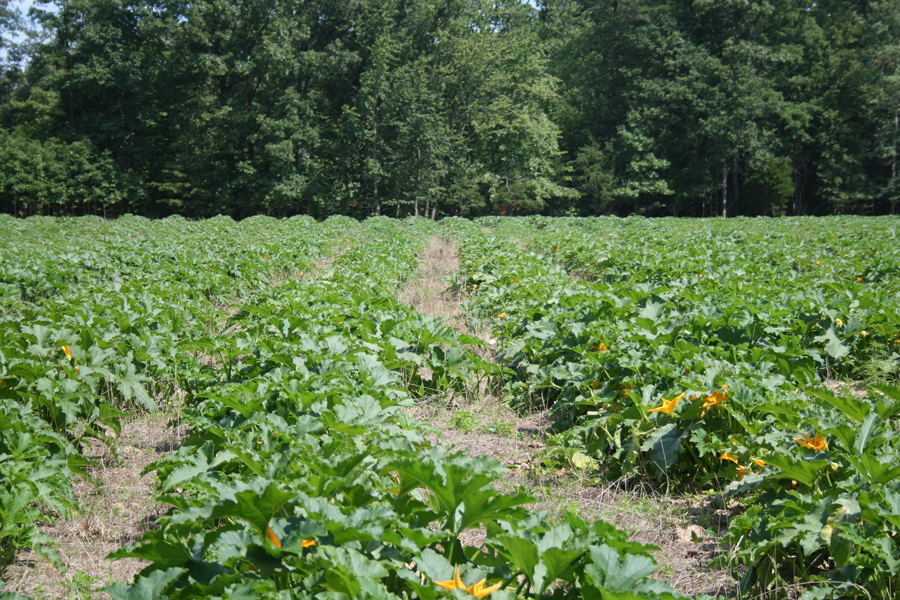
Conservation tillage with agronomic crops (i.e., cotton, corn, soybeans, etc.) has been successful in Georgia production. Such production practices have several benefits, the most notable being the elimination of soil erosion. Other benefits include but aren’t limited to increases in soil organic matter, maintaining a healthy rhizosphere (root-zone soil), reduction of riparian and waterway pollution, and water conservation.
Some examples of conservation tillage practices include no till, ridge till, and strip till. No–till production involves no tillage of field soils and leaves all of the previous crop residue on the soil surface. Ridge–till production involves building a ridge during cultivation, then scalping the ridge and sowing seed. The scalping process moves most of the previous–crop residue to the row middles, leaving a clean row for sowing. Strip–till production is when a narrow strip is tilled for each row that will be planted, leaving the row middles intact with the previous–crop residue. Strip–tillage may reduce yields if weeds in the untilled area are not killed, as these weeds will compete with the crop for water and nutrients. Although the planted row is free of previous crop residue, it may be advantageous to kill the cover crop to prevent it from competing for nutrients and water with the vegetable crop.
|