

On-site wastewater treatment systems provide treatment and ultimate dispersal of wastewater from homes and small businesses. They usually consist of a septic tank, a drainfield, and the underlying soil. When properly designed, installed, and maintained on suitable soils, on-site systems are an environmentally benign method to manage household wastewater. With proper care and maintenance, an on-site system should function properly for at least 20 years.
Failure of these systems can cause contamination of water by bacteria, viruses, nitrates, oils, detergents, and other household chemicals. Septic system failure can also cause health problems by exposing humans to raw sewage.

The Septic Tank
General information
- Tanks are constructed of pre-cast concrete, fiberglass reinforced plastic, or polyethelene.
- Tanks usually are 1000 to 2000 gallons (older tanks may be 750 gallons and some systems may have larger tanks).
- In Georgia, a four-bedroom home usually requires a 1000 to 1500 gallon tank.
- Each additional bedroom (over four) requires an additional 250 gallons of septic tank capacity.
- Garbage disposals increase the required capacity of a septic tank by 50%.
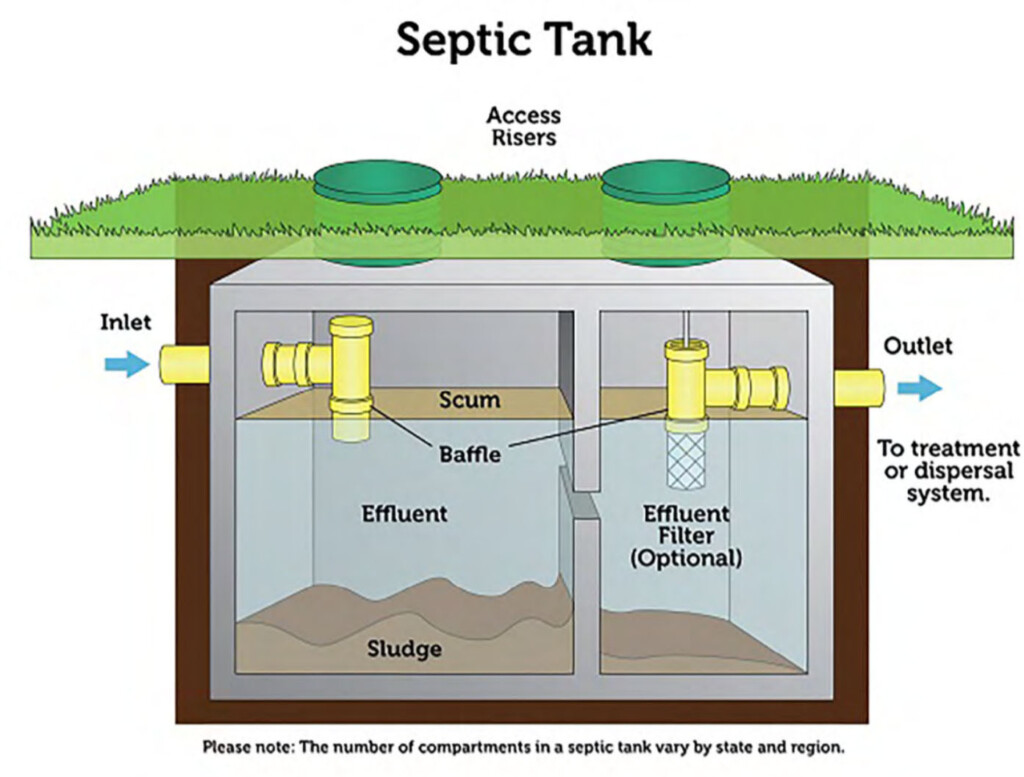
- New septic tanks have two compartments to help keep sludge from entering the drainfield. Older septic tanks will likely have only one compartment. The State of Georgia requires a two-chamber tank for all new installations.
Functions
Septic tanks are designed to receive raw sewage and retain it for a short time (approximately 2 days). While in the septic tank:
- Floatable materials (grease, oil, fecal matter) rise to the top where they are broken down by microbial organisms and form a whitish-brown scum.
- Suspended solids sink to the bottom where they are broken down by microbial organisms—most of the settled solids become a black sludge.
- Clarified sewage (a relatively clear liquid) occupies the space between the scum and sludge and exits to the drainfield.
What happens when a septic tank fails?
Settled solids in septic tanks undergo some decomposition, but they never completely go away. Consequently, sludge volume is always increasing. If the tank is not regularly pumped, sludge particles can reach the drainfield and plug the drainfield’s pores. This can stimulate additional growth of microorganisms that can further plug the soil and decrease the infiltration of wastewater. Periodic pumping helps to prevent septic tank solids from entering the drainfield, however, once the drainfield is clogged, pumping the tank will not correct the problem.
The Drainfield and the Soil
The drainfield
The drainfield (leachfield) is the next treatment step in an on-site wastewater management system. It is a soil adsorption field that is designed to receive clarified sewage from the septic tank and discharge it underground into the soil.
The drainfield is typically a gravel filled trench with a perforated pipe running through its length. There are alternatives for in-trench materials, such as plastic domes that are open on the bottom, polystyrene bundles, and large diameter pipes. Regardless of the in-trench material, the clarified sewage seeps through the installed media and spreads along the trench. The entire drainfield is usually covered with soil and vegetation.

The soil
The soil environment treats the wastewater by filtration, decomposition of organic material and retention of pathogens.
As the liquid spreads through the soil, a “biomat” or “clogging mat” forms on the wetted soil. The mat is composed of bacteria and bacterial products, which consume biodegradable materials and some microorganisms. The mat also filters out most pathogens and parasites and delivers the water to the soil at a rate slower than the soil can transmit so it slowly filters through the soil. The wastewater that enters the soil is taken up by plants or moves on to ground or surface water after treatment in the soil.
What happens when the drainfield fails?
If the drainfield fails, water can back up in sinks, showers and toilets in the house. In addition, untreated wastewater can bubble up to the soil surface, resulting in odors and possible health hazards. If a drainfield fails, it may be necessary to replace the entire drainfield with a new one, although in many cases, the addition of an extra drainfield or drainfield renovation can fix failing drainfields without complete replacement.
Environmental Impacts of On-Site Wastewater Treatment Systems
On-site wastewater treatment systems are generally effective wastewater treatment systems, however if they are improperly designed or maintained, or if they are in dense concentration, they can have adverse environmental impacts.
It has been estimated that between 10%–20% of all on-site wastewater treatment systems in the United States are not functioning properly (although Georgia’s failure rate is much lower because of generally favorable soil and geologic conditions). In addition, concerns have been raised that combined output from densely packed on-site wastewater treatment systems may exceed the natural ability of soils to receive and purify the wastewater before it reaches groundwater or adjacent surface water. Studies have shown that densities less than two systems per acre do not result in contaminant levels above EPA standards. The density of septic tanks has been identified as one of the most important factors influencing the likelihood of groundwater contamination.
On-site wastewater treatment systems handle and discharge large amounts of water into the soil, so densities of on-site wastewater treatment systems greater than two per acre could cause ground or surface water to become contaminated.
On-site wastewater treatment systems usually have high removal rates for most wastewater pollutants, including biochemical oxygen demand, suspended solids, bacterial indicators (fecal coliform), metals, phosphorus, and some viruses. However they are not designed for removing many other pollutants that are put into them. Byproducts of organic decomposition can also be pollutants. Nitrates, a byproduct of organic decomposition, are the most widespread contaminants of groundwater in the United States and contribute to health problems in humans and animals. Nitrates and many household chemicals are easily dissolved in water so they move with the water from the drainfield to groundwater.
Bacteria and viruses are also common in wastewater and can often readily move through wet soils. If the drainfield is not filled with water, the bacteria and viruses will be removed from the wastewater due to exposure to oxygen and dry conditions, however, if the drainfield is saturated due to excessive rainfall, poor soil conditions, or excessive household use, the filtration capacity of the soil will be lost and bacteria and viruses could survive for long periods of time. This is why Georgia regulations require 2 feet of unsaturated soil below the drainfield.
Domestic Wastewater Composition
| Constituent | Septic Tank Effluent | Percolate into groundwater |
|---|---|---|
| (% removal) 3–5 ft depth | May–Oct < 200 colonies/100 mL as geometric mean Nov–Apr < 4000 colonies/100 mL (instantaneous max) | > 5 mg/L daily average Not < 4 mg/L at all times |
| Total Suspended Solids | 50–100 mg/L | > 90% |
| Total Nitrogen | 40–100 mg/L | 10%–20% |
| Total Phosphorus | 5–15 mg/L | 0%–100% |
| Fecal Coliforms | 1,000,000–100,000,000 organisms/100 mL | > 99.99% |
| Viruses (hepatitis, etc.) | 0–100,000/mL (episodically present at high levels) | > 99.99% |
The figure below demonstrates how effluent from on-site wastewater treatment systems may reach ground water or surface water. This figure demonstrates the importance of proper siting of on-site wastewater systems.
Restrictive soil layers or bedrock reduce the amount of filtration treatment the effluent receives. These layers may cause effluent to reach surface water or shallow wells down grade of the system.

Preventing Negative Environmental Impacts of On-site Wastewater Treatment Systems
Locating your septic tank and drainfield
Your local environmental health department is responsible for permitting the installation of your on-site wastewater treatment system and should have a sketch of the location of your system. The location of your septic tank and drainfield may also be marked on the “as built” drawing of your house and property. This drawing is a line drawing of the layout of buildings on your property, and is usually filed in your local land records and/or your local department of public health. Newer on-site wastewater treatment systems may have visible lids or manhole covers on the septic tank. Older systems are often difficult to find as they may have no visible parts. An inspector or pumping professional can help you locate your system if you are unable to locate it.
Extending the life of your on-site system
- Have your system professionally installed and properly permitted—required by the State of Georgia.
- Have your septic tank inspected and pumped periodically—recommendations for pumping frequency range from 3–7 years, with an average of 4 years. The filter in the outlet “T” of the septic tank should be cleaned when the tank is pumped.
- Use garbage disposals as little as possible—they increase the need for routine pumping.
- Use water efficiently.
- Do not dispose of cooking oil, paper towels, paper hygiene products, household chemicals, paint, cat litter, coffee grounds, etc., in sinks or toilets.
- Keep livestock away from the septic tank and drainfield area.
- Do not park or drive over your septic tank or drainfield.
- Do not plant large trees nearby—roots could disturb the drainfield area or septic tank.
Contacts and More Information
Your County Extension Agent
extension.uga.edu (search “septic system”)
1-800-ASK-UGA1 (directs you to the UGA Extension office in the county where your phone is registered)
A Homeowner’s Guide to Septic Systems
www3.epa.gov/npdes/pubs/homeowner_guide_long.pdf
EPA Onsite/Decentralized Septic Systems Website
Includes manuals, guidance, and policies for on-site wastewater treatment systems.
National Drinking Water Clearinghouse
The National Drinking Water Clearinghouse (NDWC) was a public service organization dedicated to helping small communities by collecting, developing, and providing timely information relevant to drinking water issues. NDWC provided free and low-cost publications, products, databases, referrals, and more.
www.nesc.wvu.edu/about-actat/national-drinking-water-clearinghouse
Rural Community Assistance Program
National Onsite Wastewater Recycling Association
National Association of Wastewater Technicians
National Standard for Septic Tanks (National Sanitation International)
www.nsf.org/water-systems/onsite-wastewater-water-reuse-systems/wastewater-protocols