

To have a successful equine breeding program, producers must be able to ensure the delivery of a healthy foal while maximizing the health of the mare. The following information is designed to provide basic concepts in pregnant mare management.
General Health
Broodmares should receive boosters in the fall for tetanus, West Nile virus and Eastern and Western equine encephalomyelitis. Mares should also be vaccinated for equine herpesvirus type 1 (rhinopneumonitis) during her fifth, seventh, and ninth month of gestation.
Pregnant mares that come in contact with new horses on a regular basis, or are housed in a facility that have horses entering and leaving the premises, should also be boostered with equine influenza and herpesvirus type 4. Spring vaccines for West Nile virus, Eastern and Western equine encephalomyelitis, rabies, tetanus, influenza, and herpesvirus should be timed so that they are given four to six weeks prior to foaling. This will allow time for the antibodies to build up and be placed in the colostrum for foal protection. All vaccines should contain a killed (inactivated) virus, not a modified live virus.
The strategic deworming practices that are currently recommended for mature horses are also recommended for broodmares. They should be dewormed in September or October with ivermectin, and again two months later with a combination dewormer containing both ivermectin and praziquantel.
Fecal egg count tests should be done in January, and any mare with egg counts greater than 200 eggs per gram should be dewormed with ivermectin. For foal health, mares should be dewormed with ivermectin 30 days prior to foaling, or within 30 to 60 days post-foaling.
See Figure 1 for basic items necessary to perform a fecal egg count. This process will reduce the number of Strongyloides westeri (threadworms) in the mare’s milk as well as reduce the likelihood of the foal consuming parasite eggs or larvae as it ingests the mare’s manure in order to inoculate the large intestine with microbes essential for fiber digestion, a normal process.

Mares should be introduced to their foaling area four to six weeks prior to foaling. This will allow time for the immune system to build up antibodies to pathogens in the area for both the mare and foal. Antibodies will be present in the colostrum for the foal to consume and absorb. Moving the mare to the area any closer to the foaling date might delay sufficient antibodies getting in to the colostrum, potentially leaving the foal unprotected against pathogens found in the new area. Moving the mare prior to her foaling date will also allow her to adjust to her new surroundings so that the added stress of relocation will be lessened in time for foaling.
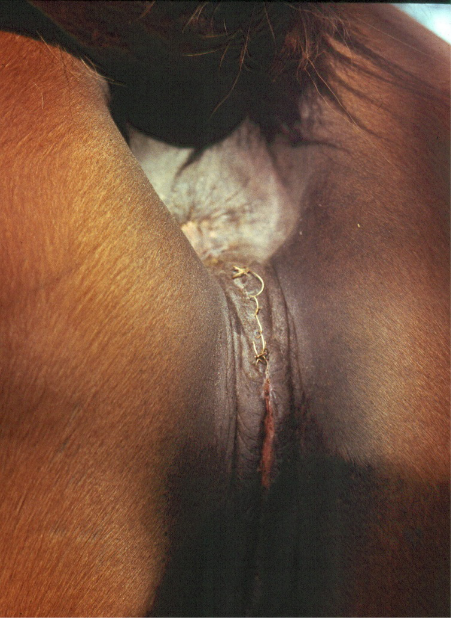
If a Caslick’s procedure (suturing the upper portion of the vulva—see Figure 2) was performed on a mare, it will need to be opened one to two weeks prior to foaling to ensure that there is no tearing or damage from foaling. If a mare is showing signs of early foaling she will need the Caslick opened as soon as possible.
Transport
Trailering a pregnant mare is generally considered safe, but should be limited for mares that have high-risk pregnancies or experience severe stress when hauled. Timing of transport is also a consideration. Mares three to five weeks into gestation have been trailered for 9 hours with no food and water, with no difference in early embryonic loss compared to mares not transported (Baucus et al., 1990). However, mares should not be transported to new locations less than 30 to 45 days prior to foaling, for stress and immunological purposes mentioned above. As with all horses, vaccination protocols should be in place for broodmares that are traveling, and high-risk areas should be avoided.
Nutrition
Ensure adequate body condition. Physiologically, the body has basic responsibilities as a matter of preservation. Those are to maintain their own body, to grow, if possible, to nurture any offspring present, and finally, to become pregnant. If at any point one of the aforementioned variables waver, the body’s ability to carry another pregnancy is compromised.
It is recommended that broodmares maintain a Henneke body condition score of 5 to 7 on a 9-point scale. The score should never fall below a 5 to ensure foaling and rebreeding ease. Ribs should not be able to be seen, but should be felt easily or with slight pressure when you run your hand over them. The back should be flat or have a slight crease, and the shoulders should blend smoothly into the neck. Mares in a body condition score of less than 5 may require more estrous cycles before they become pregnant, and have lower conception and pregnancy maintenance rates when compared to mares with a higher body condition score (Morley and Murray, 2014). While it has been shown that mares with a body condition score greater than 7 have normal pregnancies with no changes in gestation length, duration of the actual foaling, and size of the foal (Cavinder et al., 2009), scores over 7 are not beneficial from an economical standpoint. Having mares at a score of 6 to 7 at foaling will allow them to stay in good condition during lactation so that they are rebred easier. A body condition score around 7 is more desirable for mares that will be nursing during winter. A producer’s goal should be to get mares to appropriate body condition pre-breeding and maintain that score throughout gestation. Body condition for a mare during gestation should not increase tremendously. For help with body condition scoring in mares, reference Table 1.
| Condition | Neck | Withers | Shoulder | Ribs | Loin | Tailhead |
|---|---|---|---|---|---|---|
| 1 Poor | Bone structure easily noticable. | Bone structure easily noticable. | Bone structure easily noticable. | Ribs protruding prominently. | Spinous processes projecting prominently. | Tailhead, pin bones, and hook bones projecting prominently. |
| 2 Very Thin | Bone structure faintly discernible. | Bone structure faintly discernible. | Bone structure faintly discernible. | Ribs prominent. | Slight fat covering over base of spinous processes. Transverse processes of lumbar vertebrae feel rounded. Spinous processes are prominent. | Tailhead prominent. |
| 3 Thin | Neck accentuated. | Withers accentuated. | Shoulder accentuated. | Slight fat over ribs. Ribs easily discernible. | Fat buildup halfway on spinous processes, but easily discernible. Transverse processes cannot be felt. | Tailhead prominent but individual vertebrae cannot be visually identified. Hook bones appear rounded, but are still easily discernible. Pin bones not distinguishable. |
| 4 Moderately Thin | Neck not obviously thin. | Withers not obviously thin. | Shoulder not obviously thin. | Faint outline of ribs discernible. | Negative crease (peaked appearance) along the back. | Prominence depends on conformation. Fat can be felt. Hook bones not discernible. |
| 5 Moderate | Neck blends smoothly into body. | Withers rounded over spinous processes. | Shoulder blends smoothly into body. | Ribs cannot be visually distinguished, but can be easily felt. | Back is level. | Fat around tailhead beginning to feel soft. |
| 6 Moderately Fleshy | Fat beginning to be deposited. | Fat beginning to be deposited. | Fat beginning to be deposited. | Fat over ribs feels spongy. | May have slight positive crease (a groove) down the back. | Fat around tailhead feels soft. |
| 7 Fleshy | Fat deposited along neck. | Fat deposited along withers. | Fat deposited behind shoulder. | Individual ribs can be felt with pressure, but noticeable fat filling between ribs. | May have positive crease down the back. | Fat around tailhead is soft. |
| 8 Fat | Noticeable thickening of neck. | Area along withers filled with fat. | Area behind shoulder filled in flush with body. | Difficult to feel ribs. | Positive crease down the back. | Fat around tailhead very soft. |
| 9 Extremely Fat | Bulging fat. | Bulging fat. | Bulging fat. | Patchy fat appearing over ribs. | Obvious crease down the back. | Bulging fat around tailhead. |
As the majority of fetal growth does not occur until after the eighth month of gestation, broodmares can be fed according to their activity level prior to breeding. If they were a performance or maintenance horse they should be fed as such. Since energy, protein, and mineral needs are not substantially different from maintenance needs, most mares are able to meet their nutritional needs during the first eight months with high-quality forage. However, during late gestation (nine to eleven months), they should be introduced to a feed balanced for a broodmare and fed at approximately 0.5-1 percent of their body weight to meet their increasing needs.
Energy and protein requirements are higher compared to maintenance horses, and increase as the mare approaches foaling (and thus lactation). The increase in amount of feed should provide the increased energy and protein needed to meet requirements without the need to increase the protein or energy contents of the feed. Calcium and phosphorus requirements substantially increase during late gestation, but the addition of grain formulated for a broodmare and fed at manufacturer recommended levels should meet those needs.
Zinc and copper levels are of particular importance. These minerals are important for proper fetal bone development, and their requirements during late gestation are greater than that of early gestation. Inadequate zinc and copper levels during late gestation have been linked to developmental orthopedic disorders in the foal during its first few years of life. Supplementation of zinc and copper to the foal after its birth had no effect on the bone disorders, nor did supplementing the lactating mare so that the minerals were consumed in the milk. Thus, it is important that the mare’s mineral needs, particularly that of zinc and copper, are met during late gestation. Good quality forage should be provided to the broodmare at all times to maintain good digestive health, lessen the incidence of ulcers, and reduce the likelihood of stereotypic behaviors such as weaving and stall walking.
Managing the Environment
Pregnant mares should be allowed access to as much turnout and pasture as is feasible. It is generally recommended that mares be turned out for at least six hours per day. This decreases the risk of ulcers, lowers stress, and helps with foaling ease. However, access to tall fescue pastures should be avoided during late gestation. Tall fescue has been shown to cause toxicity problems such as abortion, prolonged gestation, red bag presentation, dystocia, and a lack of milk once the foal is born. Mares should be completely removed from tall fescue pastures approximately 90 days prior to foaling. If this is not possible, domperidone can be administered daily to the mare beginning two weeks prior to foaling to prevent fescue toxicosis. If a facility has a number of mares foaling on an annual basis, it may be easier to manage the mares if the tall fescue were eradicated and replaced with an endophyte-free or novel-endophyte variety, or with another grass species altogether.
House broodmares together for better ease of management and feeding, and if possible, group mares by their foaling date. This way they can be fed the same feed and in the same amounts, and be moved as a group to the foaling area (if different from their pasture). Stress will be reduced in the mares if they are able to stay in their pre-established herds, particularly when turning mares and new foals out together.
To protect them from pathogens that may come in to the facility, broodmares should be kept away from new horses entering the property as well as horses that leave repeatedly, such as horses traveling to shows. Mares should be kept in quiet, low-traffic areas of the facility to reduce exposure to pathogens as well as reduce stress. In addition, buckets, water troughs, blankets, tack, and equipment should not be shared between pregnant mares and other horses.
Final Considerations
Even with best practices and best intentions, some factors will be unavoidable and compromise pregnancy success. However, it is possible to reduce risk factors that are readily apparent. A conscientious producer interested in maximizing rates of success should be aware of management practices that are conducive to successful establishment and maintenance of pregnancy in the mare.
References
Baucus, K. L., Ralston, S. L., Nockels, C. F., McKinnon, A. O., & Squires, E. L. (1990). Effects of transportation on early embryonic death in mares. J. Anim. Sci., 68(2), 345–351. https://doi.org/10.2527/1990.682345x
Cavinder, C. A., Vogelsang, M. M., Gibbs, P. G., Forrest, D. W., & Schmitz, D. (2009). Variances in reproductive efficiency of mares in fat and moderate body conditions following parturition. Prof. Anim. Sci., 25(3), 250–255. https://doi.org/10.15232/S1080-7446(15)30714-2
Henneke, D. R., Potter, G. D., Kreider, J. L., & Yeates, B. F. (1983). Relationship between condition score, physical measurements and body fat percentage in mares. Equine Vet J., 15(4), 371–372. https://doi.org/10.1111/j.2042-3306.1983.tb01826.x
Morely, S. A., & Murray, J. A. (2014). Effects of body condition score on the reproductive physiology of the broodmare: A review. J. Eq. Vet. Sci., 34(7), 842–853. https://doi.org/10.1016/j.jevs.2014.04.001