
Introduction
Trellising, training, and dormant pruning are among the most significant efforts and expenses for producers who cultivate bunch wine grapes. The University of Georgia Cooperative Extension Viticulture Team has created a novel training system that combines canopy and fruit-zone division to increase leaf exposure and fruit production and uses cane pruning to reduce springtime shoot-thinning requirements. This system is called the Athena training system, known henceforth as “Athena.” Grapevine pruning and trellising systems and their common terminology are described in UGA Extension Circular 1162, “Introduction to Wine Grape Trellising and Pruning Terms.” Novice growers may benefit from reviewing that introductory publication before reading this publication on Athena. For convenience, a glossary of terms is included at the end of this publication.
Concept of design
Bilateral cordon training with spur pruning and vertical shoot positioning (VSP) is one of the most common training systems used for bunch wine grape production in the Eastern U.S. (Figure 1; Hickey and Hatch, 2018).

The VSP system is a single-canopy system that is less expensive to establish than divided-canopy systems, as only wires and posts are needed for its construction and cross arms are not required. The VSP system also allows for narrower row spacing and thus greater vine-planting densities when compared to divided-canopy systems. VSP is often the system of choice for upright-growing cultivars with low to moderate vigor. The Lyre system is the divided-canopy system used for more vigorous, upright-growing cultivars.
Cordon training with spur pruning often requires extensive shoot thinning in the spring to remove shoots arising from basal or latent buds on grapevine wood that is at least 2 years old (Hickey, 2019). Unfruitful, or less fruitful, shoots are generally undesirable, as they crowd the fruit zone and canopy—limiting light, air movement, and spray penetration—yet do not contribute to crop yield. Cordon-trained, spur-pruned vines are ideally thinned to three to five shoots per linear foot of cordon in a single-canopy trellising system. A very narrow window of opportunity exists in the spring for proper shoot thinning, and producers are often unable to complete thinning before shoots begin to lignify at their junction with the cordon and grab neighboring shoots with tendrils. The result is often undesirable urgency and possible damage to retained shoots.
The alternative to bilateral cordon training and spur pruning is head training with bilateral cane pruning, also referred to as “cane replacement” pruning (Figure 2; Hickey and Hatch, 2018).

Head training with bilateral cane pruning involves selecting a cane—the previous season’s green shoots; 1-year-old wood—on each side of the trunk and securing these canes to the fruiting wire. When necessary, some canes in the head region are pruned back to two-bud spurs to serve as a site for replacement canes to be used in the following year. With cane pruning, fruitful shoots typically emerge from the buds along the cane. Cane pruning does not require extensive shoot thinning as unfruitful shoots generally only grow from the head/crown region of the vine, where trunk and fruiting wire meet (Figure 2). While cordon training/spur pruning requires timely shoot-thinning labor in the spring, head training/cane pruning involves greater labor in the dormant period to select canes and tie them to fruiting wires (Hickey and Hatch, 2018). However, some studies have reported an approximately 40% reduction in crop yield with cane pruning compared to cordon training with spur pruning (Howell et al., 1987). Because bud fruitfulness ascending the cane varies across cultivars, the pruning method will differentially impact crop yield across cultivars.
Various combinations of pruning, trellising, and training techniques have resulted in the creation of several training systems, such as Smart-Dyson, Scott-Henry, Geneva double curtain (GDC), Lyre, and Watson. For example, the Watson system, which was discussed in depth in UGA Extension Bulletin 1522, “Watson Training System for Bunch Wine Grapes” (White et al., 2020), is a modification of the standard high-wire system to improve spray penetration and reduce bunch rot in the production of Pierce’s disease-tolerant hybrid bunch wine grapes in Texas and Georgia. Training systems often evolve and are modified to optimize quality and quantity of grape crops from regionally important cultivars. While some of the aforementioned training systems are still used today, none are as popular as the VSP or single high-wire systems, which are largely used for production of bunch wine and juice grapes, respectively. VSP and single high-wire systems are easy to set up and are relatively inexpensive to implement compared to their divided-canopy counterparts.
The UGA Viticulture Team has developed Athena, a new training system for bunch wine grape production. Athena incorporates the benefits of cane pruning with those of a horizontally divided canopy and fruit zone while using narrower row spacing than popular, horizontally divided systems such as Lyre and GDC. Small modifications to trellis hardware, wires, pruning, and shoot positioning can result in novel training systems. Athena may immediately appear to be a narrower Lyre system, but there are nuances that make Athena unique from the Lyre system. For example, Athena: (1) may be an easier retrofit from a single-canopy system (such as VSP) in which between-row spacing can be 10 ft or less; (2) employs annual quadrilateral cane pruning compared to the quadrilateral cordon training with spur pruning of the Lyre system; (3) has a trellis structure that accommodates quadrilateral cane pruning through a narrower fruit zone division than Lyre; and (4) is trained into a V-shape above the fruit zone, while Lyre is trained vertically as a method to intercept more sunlight.
Putting concept into practice
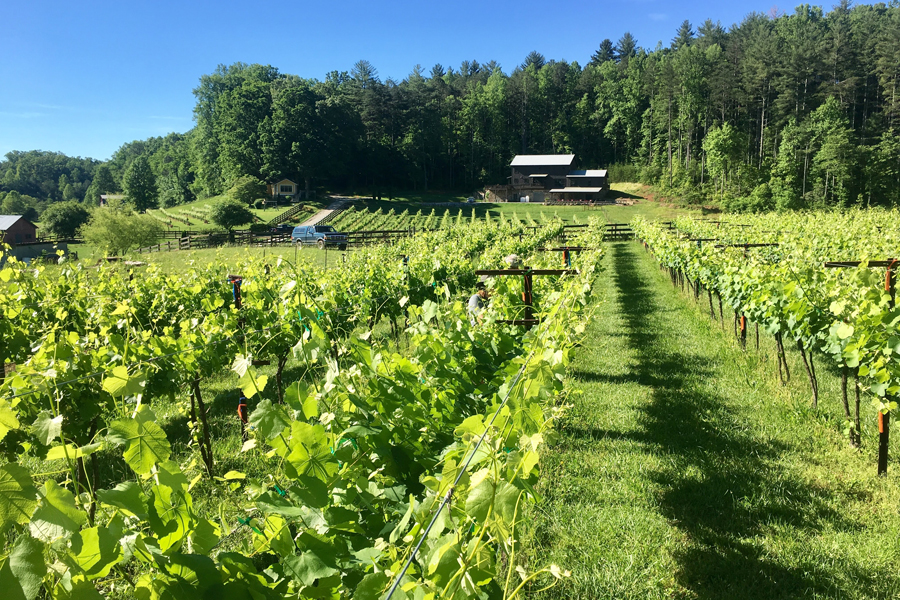
Athena was tested as a retrofit of an established ‘Petit Manseng’ vineyard trained to VSP with bilateral cordon training and spur pruning, the suggested training system for this low-yielding, late-ripening cultivar. The vineyard was 7 years old, with 6 ft between vines and 9 ft between rows (Figure 3).
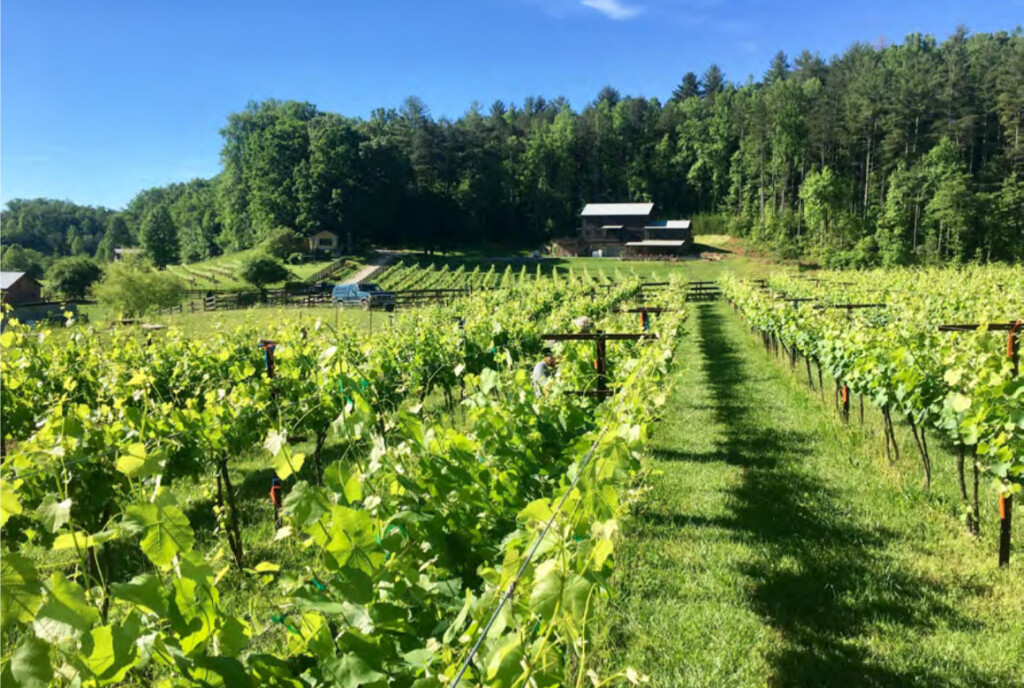
Preliminary results showed that Athena (without shoot thinning) produced greater crop yield while maintaining similar primary fruit chemistry relative to VSP with bilateral cordon training and shoot thinning to four shoots per linear foot of cordon. The vineyard was retrofitted to Athena during the dormant season. See the Catalyst journal article (White et al., 2020) for a detailed description of methods and results from the field research trial that resulted in the development of the Athena system. Observational trials were also conducted in commercial ‘Cabernet Franc’ and ‘Traminette’ vineyards.
Pruning
Athena uses head training with quadrilateral cane pruning (four canes tied to two horizontally separated fruiting wires) and a V-shaped, divided-trellis structure (Figures 3, 4, and 5).
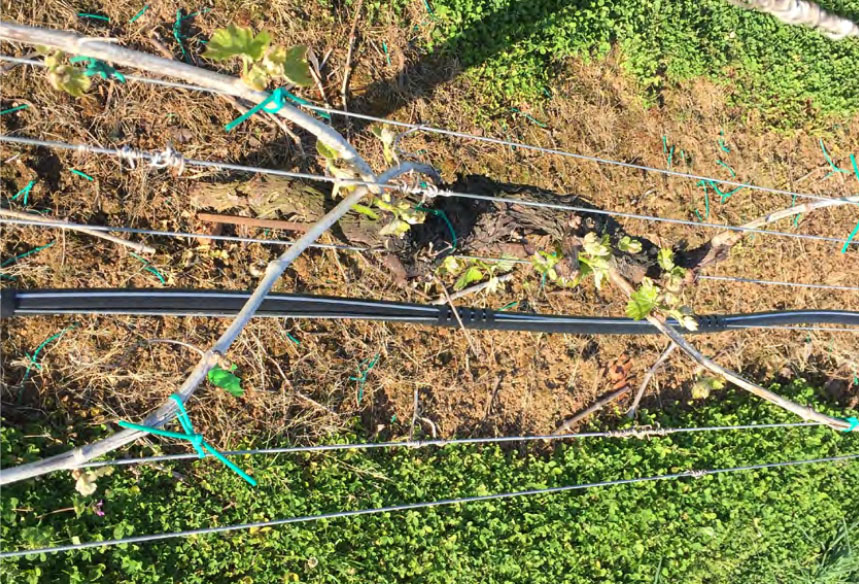
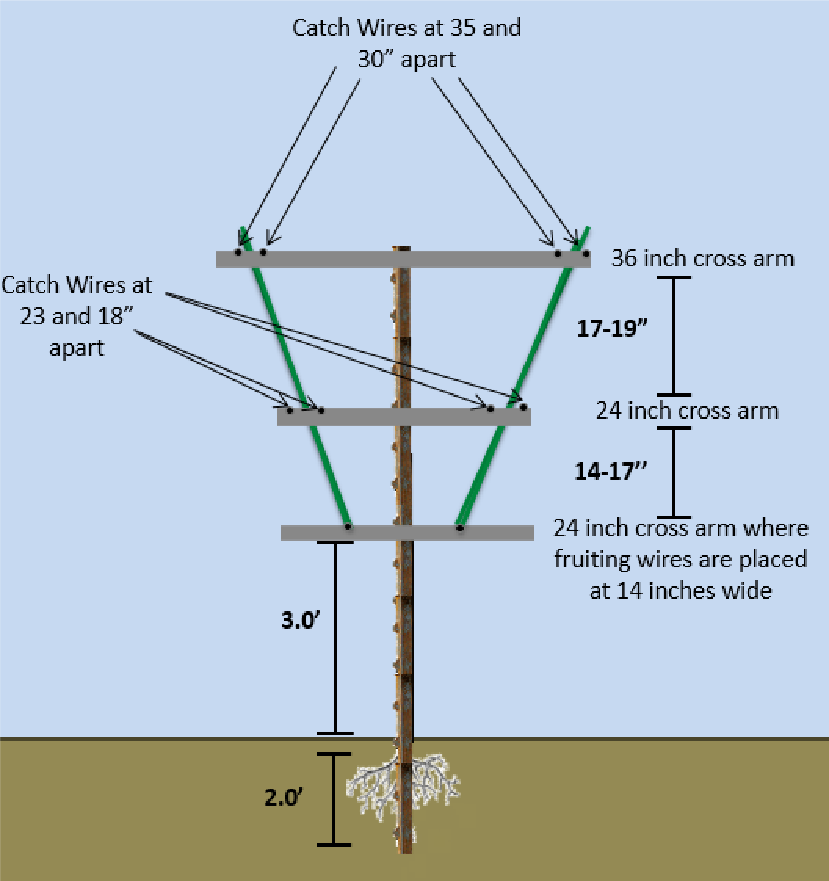
In an attempt to increase fruitful bud number per linear foot of trellis, Athena uses four canes—twice that of standard, bilateral cane pruning (Figure 4). Two fruiting wires are separated by 14 in. using a cross arm that is fastened to trellis posts at 36 to 42 in. above the ground (Figures 4 and 5). The canes are laid in an X-shaped pattern extending from the head region of the vine onto the horizontally separated fruiting wires.
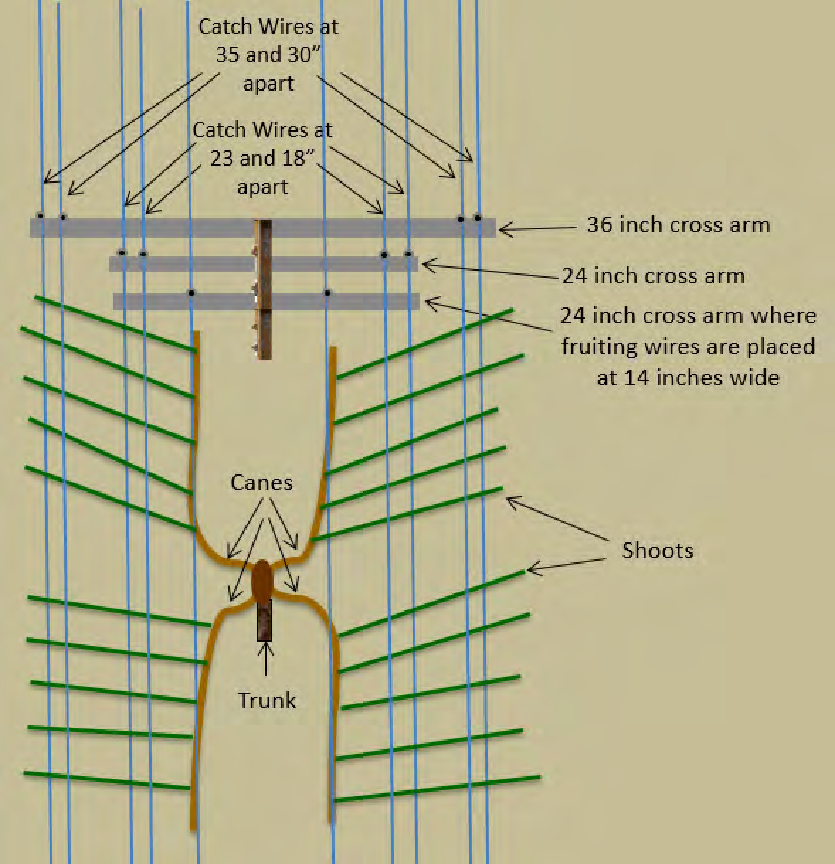
Trellising and training
With Athena, the VSP system is divided to create two horizontally offset canopies. The shoot training is accomplished via two cross arms—or more if greater shoot support is desired—placed on vineyard trellis posts. The cross-arm placement gives the divided trellising a V-shape and, with proper shoot positioning, increases the leaf area exposed to sunlight when compared to standard VSP (Figure 6).
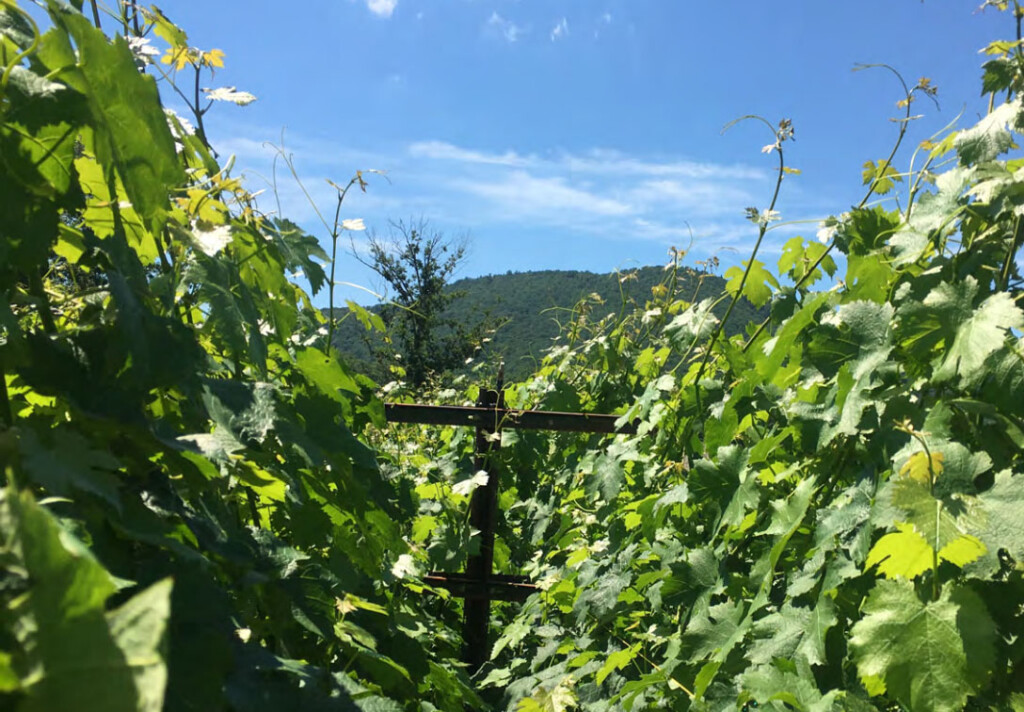
The first cross arm is 2 ft long with a set of catch wires in notches at 23 and 18 in. apart. The second cross arm is 3 ft long with a set of catch wires in notches at 35 and 30 in. apart (Figures 6 and 7).
The canopy division in Athena was shown to reduce canopy density by 56% when compared to standard VSP (White et al., 2020). The leaf area index was increased by 60% in an Athena-like divided canopy when compared to standard VSP (White et al., 2020). With high bud densities—as with the adopted quadrilateral cane pruning practice of Athena—the increased exposed leaf area that results from canopy division can enhance radiation interception and maintain a healthier vine-carbon balance relative to crowded, highly self-shaded canopies, such as those observed in high vigor vines trained to VSP. Reduced lower-canopy congestion will further enhance foliar drying and spray penetration throughout the canopy. To further reduce canopy congestion, shoots should be removed from the bases of the canes and from the head region of the vine. Aggressive fruit-zone leaf thinning may also aid in spray penetration through the divided-fruit zone, which may be particularly important in rot-susceptible cultivars.
In order to maintain canopy division and its benefits, it is important that the middles of the canopies are open and free of lateral growth. It is important that shoot positioning into the divided catch wires occurs as soon as shoots are long enough to reach the first catch wire and before tendrils begin to grab neighboring shoots, which precludes efficient shoot positioning. Aside from the differences in dormant pruning strategy and decongesting the middle of the divided canopy, the Athena system can be managed similarly to VSP and Lyre in terms of shoot positioning, shoot training, and shoot hedging.
Crop yield and fruit composition
The Athena system increased crop yield in the aforementioned ‘Petit Manseng’ vineyard by 47% in 2017, 79% in 2018, and 62% in 2019 compared to VSP with bilateral cordon training and shoot thinning (Table 1). In our studies, those annual percent increases amounted to a 1.77 tons per acre increase in crop yield in 2017, 2.75 tons per acre increase in crop yield in 2018, and 2.03 tons per acre increase in crop yield in 2019 (Table 1). Note that the crop yield data in Table 1 is based on 9-ft row spacing; it is likely more practical to either modify Athena or implement it in vineyards with row spacings of 10 or 11 ft. For example, the average crop yield data for Athena in Table 1 is 5.68 tons per acre, but this would be reduced to an average of approximately 4.65 tons per acre with 11-ft row spacing. There were no differences in the sugar concentration of the fruit (Brix) between the different pruning and trellising treatments at commercial harvest. Data was also collected from the observational trials in ‘Cabernet Franc’ and ‘Traminette’ vineyards, but in fewer years than ‘Petit Manseng’; crop yield was generally increased by Athena relative to VSP in those trials as well (data not shown). The goals of the experiments mentioned here were to evaluate crop yield and fruit chemistry responses when implementing Athena as a retrofit to a vineyard already established with VSP and narrow between-row spacing. Note that Athena has a divided fruit zone and, therefore, greater bud numbers per linear foot of row compared to a non-divided training system such as VSP. Comparing the performance of Athena and Lyre would provide important information to those who have yet to decide on a training system in a yet-to-be established vineyard. Please note that results are preliminary and may differ across cultivars and sites over time.
| Year | Athena2 | VSP with bilateral cordon2 | ||
|---|---|---|---|---|
| Yield (tons/acre) | °Brix | Yield (tons/acre) | °Brix | |
| 2017 | 5.54 | 24.12 | 3.77 | 24.42 |
| 2018 | 6.22 | 22.55 | 3.47 | 23.12 |
| 2019 | 5.28 | 24.50 | 3.25 | 24.40 |
| 1 Table adapted from White et al. (2020). 2 Athena was not shoot thinned; VSP was thinned to four shoots per linear foot of row. Spaced 6 ft between vines and 9 ft between rows. | ||||
Limitations
There is no single, universally best trellising and training system for all types and cultivars of grapes, sites, soils, and management and labor systems, and the Athena system is no exception. While we have found encouraging results with Athena, there are limitations. Athena requires greater setup costs due to the three to four cross arms that are necessary to divide the canopy and fruit zone and the four extra wires that are necessary to maintain canopy division (Table 2). However, a rough economic assessment shows those one-time input costs would be quickly recovered by repeated perennial crop and/or wine sales (Table 2). Note that crop and wine sales will be lower in Athena if implemented in a vineyard with row spacing of greater than 9 ft. While climatic and soil conditions in the Eastern U.S. are generally conducive to ample vine vigor, implementing quadrilateral cane pruning may reduce vine size over time where vine growth is already limited by other factors such as the combination of cultivar, rootstock, and site. A concern of cane pruning, particularly in the Southeastern U.S., is that the bacterium that causes Pierce’s disease infection may be retained more consistently in canes than in spurs (Varela et al., 2001). Athena should not be adopted if there are concerns about vineyard equipment hitting the cross arms, especially in vineyards with tight row spacing (e.g., 9 ft or less), extreme slopes, or use of tractors and equipment with wide wheelbases. Because Athena uses a 3-ft-long cross arm, it will effectively reduce row widths by 3 ft. However, these issues are of less concern for new growers who can space rows to accommodate Athena at the time of planting.
If bird netting is deployed at veraison, Athena requires over-row netting to prevent birds from entering the middle of the canopy from above to access the fruit zone. Extra labor may also be required to maintain canopy separation and harvesting two fruit zones instead of one. Additional research and experimentation is required to further define the labor inputs of Athena to compared to other popular training systems.
| System | One-time input costs | Crop yield | |||||
|---|---|---|---|---|---|---|---|
| Wires needed | Wire cost (per acre) | Cross arms | Total cost1 | Crop yield2 (tons/acre) | Fruit sale3 | Wine sale4 | |
| Athena | 10 | ~$1,450 | $8.50 per post | ~$3,100 | 5.7 | $9,700 | $71,700 |
| VSP | 7 | ~$1,100 | N/A | ~$1,100 | 3.5 | $5,900 | $44,100 |
| 1 Costs evaluated per acre assuming the same vine and row spacing and does not include posts, labor, end post structures, or other variable costs; costs are reflective of the use of three total cross arms, including the fruit zone; costs will increase if additional cross arms and wires are employed or as material costs change 2 Crop yield calculated as an average of all of crop yield data reported in Table 1 3 Fruit prices based on $1,700 cost estimate per ton 4 Wine sales based on 100 gallons of wine produced from 1 ton of grapes. Price point based on $25 cost per bottle of wine. Estimated revenue in wine sales does not account for wine production or packaging costs. | |||||||
Grower testimonials and modification opportunities
Growers have provided feedback on Athena. Eric Seifarth, a vineyard owner in Young Harris, Georgia, has switched every other row of his bilateral cordon-trained, spur-pruned, VSP-trellised ‘Traminette’ to the Athena system. Seifarth has a unique perspective on Athena as he can directly compare it to a Lyre system also on his property. He emphasized the ease of conversion and the cost effectiveness of the Athena system as desirable over the Lyre. Carl Fackler and Mark Diehl, vineyard owners in Tiger, Georgia, liked the Athena system due to increased yields and decreased labor for shoot thinning. However, Diehl commented that the tighter row spacing (9 ft in his case) used with Athena resulted in less-than-optimal spraying efficiency with a larger tractor and sprayer. The double cane pruning method of Athena opens the fruit zone, Diehl stated, adding that the divided canopy seems to help spray penetration within the canopy. Greg Crumly, a vineyard owner and operator in Cleveland, Georgia, echoed Diehl’s sentiment about the divided trellis. Crumly noted that the divided trellis seemed to increase sunlight interception of ‘Chambourcin’ grapes and allowed for quicker drying and better spray penetration through the canopy. Eric Case, a vineyard manager in North Carolina, knew his 9-ft-spaced vineyard rows were too close together to install a full Athena system and permit the passage of the conventional tractor. Instead, he implemented a modified Athena with 24-in. cross arms at the fruit zone and canopy positions (Figure 8).
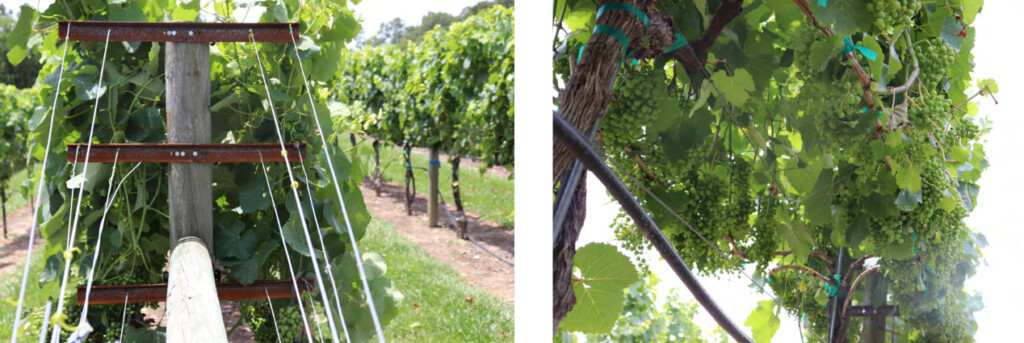
Case noted one drawback of the system: the divided canopy prevented his mechanical leaf puller from pulling leaves out of the middles of the fruit zone. Case is planning to implement an Athena system with three 30-in. cross arms for catch wires in a ‘Petit Manseng’ vineyard that will be planted to 5-ft-by-11-ft (vine by row) spacing in spring 2020.
In vineyards wishing to retrofit an already established vineyard with 9-ft or closer spacing between rows, or on a heavily sloped site, there are several modifications that could be made to reduce the spacing necessary to implement Athena. Using shorter trellis cross arms would preclude a V-shaped canopy but would reduce cross-arm extension into the row and save space for the passage of vineyard equipment. Even if the canopy is not V-shaped, we anticipate that crop yield and leaf area exposed to sunlight would be greater in the modified Athena when compared to standard VSP. Other modifications could include a shorter cross arm for the fruit zone to slightly reduce cost and reduce the between-row spacing needed to implement the divided fruit zone. There are a multiple options for shorter crossarms that are available for purchase. With this modification, however, remember that the shorter the cross arms, the closer the fruit zones (with likely less air circulation). For reference, a 12-in. cross arm would reduce the fruit zone separation by approximately 2 in. in comparison to the method described here.
Conclusion
In summary, Athena is a new trellising and pruning combination that may increase crop yield per unit of land without decreasing fruit quality—and with an anticipated reduction in shoot thinning costs. Athena can be implemented in newly planted vineyards or used to retrofit currently established VSP vineyards to obtain the benefits of cane pruning with a divided canopy.
We suspect that vigorous cultivars that display consistent bud fruitfulness along the cane, and cultivars grown on resource-unlimited sites, may benefit from the retention of four canes to increase crop production and attenuate vegetative vigor. Further studies need to be conducted on different cultivars, in different regions, and over longer time periods, but preliminary results from our initial studies in an established ‘Petit Manseng’ vineyard are encouraging.
A forthcoming economic analysis is expected to outline a detailed cost-benefit comparison between Athena and a standard VSP trellising system with bilateral cordon training and spur pruning.
Glossary
Bud – Typically refers to buds contained on 1-year-old grapevine wood (e.g., canes and spurs) from which fruitful shoots grow in the spring
Cane – A former green, vegetative shoot that has hardened off and become dormant; 1-year-old grapevine wood that generally contains fruit-producing buds
Catch wire – The trellising system wire used to guide canopy growth and maintain its physical position to optimize leaf exposure
Cordon – A former cane that is a lateral extension of the trunk along the fruiting wire and is at least 2 years old; also refers to a training type (“cordon training”) with which spur pruning is commonly implemented
Dormant pruning – The selection and retention of fruitful, 1-year-old grapevine wood through cutting and discarding older, undesirable, and diseased grapevine wood; spur or cane pruning methods are most common
Fruiting wire – The wire on which the fruiting cane or cordon is tied; becomes the crop load bearing wire
Head – The region of a vine where the vertical grapevine trunk meets the horizontal fruiting wire, also called the “crown” region; refers to a training type (“head training”) with which cane pruning is commonly implemented
Shoot – The green stems and leaves that grow from dormant grapevine wood; shoots grow from buds in the spring then become canes once they drop leaves and become dormant in the fall
Shoot thinning – A practice that removes the shoots that do not bear fruit clusters and shoots in highly dense areas on the vine early in the spring before the shoots harden onto the vine and become difficult to remove
Shoot training/positioning – A management practice that tucks shoots “flopping” into the row between trellis catch wires to prevent damage to the shoots and maintain canopy structure
Spur – 1-year-old grapevine wood that is cut back to one to three buds that bear new shoots the following season; a “short” or “spurred” cane position
Grapevine training – Used to describe the grapevine training method for which 1-year-old grapevine wood is retained to produce fruit-bearing shoots; the two most common training methods are cordon training (with spur pruning) and head training (with cane pruning)
Training systems – Refers to combinations of trellising systems with the implemented training dormant pruning method; not an interchangeable term with trellising systems
Trellis – Physical framework of cross arms and wires used to guide and direct grapevine growth
References
Hickey, C., & Hatch, T. (2018). Dormant spur and cane pruning bunch grapevines (Publication No. B1505). UGA Cooperative Extension. https://extension.uga.edu/publications/detail.html?number=B1505
Hickey, C. (2019). Vineyard canopy management: Shoot thinning (Publication No. C1152). UGA Cooperative Extension. https://extension.uga.edu/publications/detail.html?number=C1152
Howell, G., Mansfield, T., & Wolpert, J. (1987). Influence of training system, pruning severity, and thinning of yield, vine size, and fruit quality of Vidal blanc grapevines. Am. J. Enol. Vitic., 38, 105–112. https://doi.org/10.5344/ajev.1987.38.2.105
Varela, L. G., Smith, R. J., & Phillips, P. A. (2001). Pierce’s disease (UC ANR Publication 21600). University of California Davis. https://iv.ucdavis.edu/files/24470.pdf
White, R., Vogel, A., Scaduto, J., & Hickey, C. (2020). Evaluation of canopy division and cane pruning to retrofit spur-pruned, vertical shoot-positioned Petit Manseng. Catalyst: Discovery into Practice, 4, 21–32. https://doi.org/10.5344/catalyst.2020.19002
Wolf, T. (Ed). (2008). Wine grape production guide for Eastern North America (NRAES 145). Cornell Cooperative Extension. https://ecommons.cornell.edu/handle/1813/67189