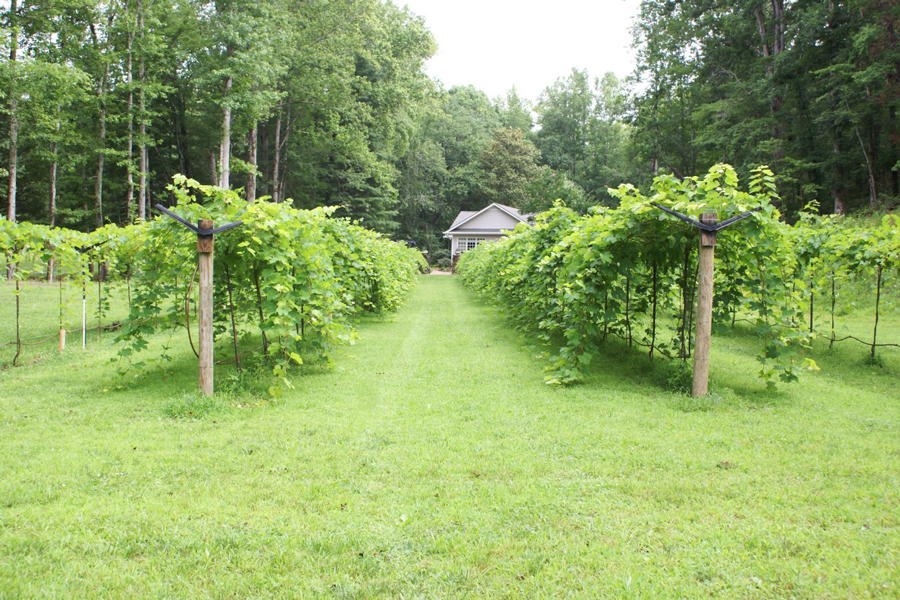

There are two main trellising system categories: divided and single canopy. Jerry Watson, a grape grower and owner of Austin County Vineyards in Cat Spring, Texas, developed the divided canopy “Watson System” in 2002 to solve some issues he was having with bunch rot management and harvest inefficiency in his ‘Blanc Du Bois’ and ‘Lenoir’ vineyards. By adding a series of cross arms and catch wires to his high wire system, Jerry was able to improve spray penetration to the fruit zone and increase picking efficiency at harvest.
The Watson hardware and wires separate clusters from the canopy foliage and limit cluster touching compared to a standard, single high wire system. The Watson system has since been employed in the Southeastern U.S. and can be found as far west as California. The Watson system is currently used for training hybrid and trailing grape cultivars such as, but not limited to, ‘Blanc du Bois’, ‘Norton’, ‘Lenoir’, ‘Lomanto’, ‘Crimson Cabernet’, and ‘Villard blanc’.
A high wire-trained vineyard, such as those planted with ‘Chambourcin’, ‘Seyval blanc’, ‘Vidal blanc’, ‘Traminette’, and other cultivars could be retrofitted to Watson training with success. Future research will evaluate hybrid and Vitis vinifera cultivars that have yet to be evaluated for training on the Watson system.
Structure, design, and relative cost
The Watson system employs a divided canopy that promotes grapevine vegetative growth out and over to “rest” on trellis catch wires without requiring intensive training. Canopy division is aided by a 4-ft-wide cross arm with two wires on each side to guide the shoot growth outward (Figure 1).
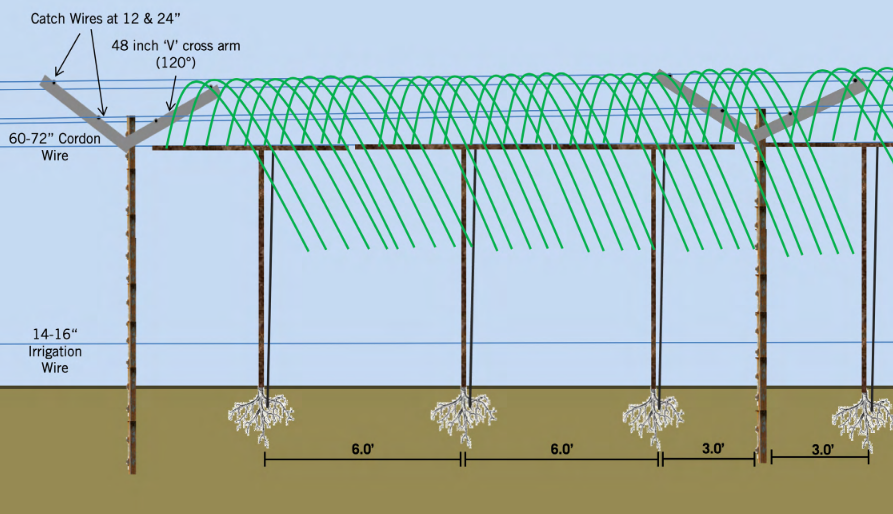
The Watson cross arms have a 120-degree angle that promotes the “sprawl” nature of the divided canopy (Figures 1 and 2). Five total wires are necessary to train the Watson system: one cordon wire at approximately 5 to 6 ft (60 to 72 in.) above the ground, two catch wires placed 12 in. from the fruiting wire, and two catch wires placed 24 in. from the fruiting wire. An additional wire will be needed if drip irrigation is desired.
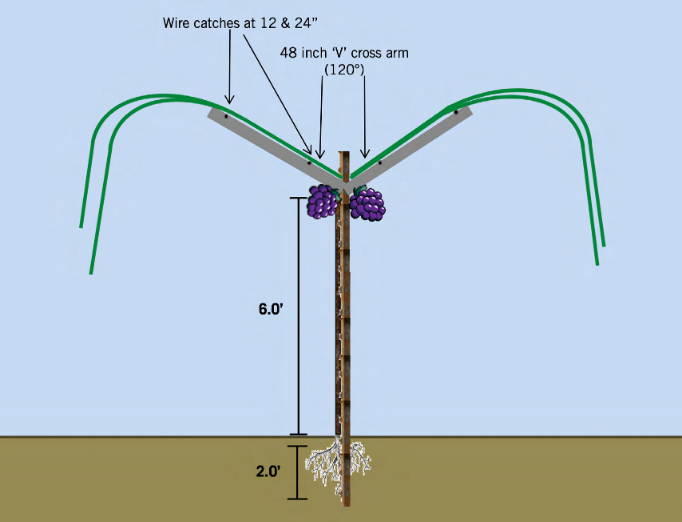
Table 1 shows the estimated hardware cost per acre for establishing popular single and divided canopy trellising systems. The cross arms for the divided canopy systems results in an increased cost compared to a standard high wire system. Note that a decreased distance between rows will increase the trellis system costs per acre; for example, by spacing the Watson system at 11 ft as opposed to 12-ft spacing.
| Trellis system characteristic | High wire | VSPa | GDCb | Watson |
|---|---|---|---|---|
| Between-row spacing | 9 ft | 9 ft | 12 ft | 12 ft |
| Plants/acre | 807 | 807 | 605 | 605 |
| Wire number/rowc | 2 | 7 | 3 | 5 |
| Feet of wire needed/acre | ~10,000 ft | ~35,200 ft | ~11,300 ft | ~18,800 ft |
| Line posts/acre | 191 | 191 | 136 | 136 |
| Cross armsd | N/A | N/A | 272 | 272 |
| Note. Figures were calculated using 6-ft between-vine spacing with 24-ft post spacing within the row. a VSP = Vertical shoot positioning b GDC = Geneva double curtain c Wire number per row is calculated without an irrigation wire. d Two cross arms are required per line post. | ||||
Due to the separated fruit zone created by the Watson system (Figure 3), there is greater potential for increased air movement through the fruit zone and increased spray coverage on fruit when compared to the standard single high-wire system. The Watson system is hedged, or “skirted,” throughout the season by hedging the bottoms of the shoots at roughly waist height (3 ft above the ground) to encourage airflow and spray penetration into the fruit zone.

Pruning, training, and management

In years one and two, the goal is to train the vines with a trunk and cordons per recommended vineyard establishment protocol (Wolf, 2008). During the following two years, the vine training is refined for the intended trellising system. After shoot growth extends upward and outward (toward the vineyard alleys) beyond the top wires of the cross arms, it then drapes downward (Figures 4 and 5).

The cordon height and separation of the fruit zone through the offset spurs (Figures 3 and 6) result in efficient hand harvesting of the crop. The Watson system cannot be mechanically harvested with standard over-the-row harvesting machines due to the size of the cross arms. However, research is in progress to evaluate adapting the Watson system to enable mechanical harvest.

The Watson system is cordon trained to a wire placed at 5 to 6 ft above the ground. The Watson system employs spur pruning. An average of four buds per linear foot of row are retained when spur pruning in non-divided, single canopy training systems such as VSP (Table 2).
| Training system characteristic | High wire | VSP | GDC | Watson |
|---|---|---|---|---|
| Number of cordons per vine | 2 | 2 | 4 | 2 |
| Average number of buds per linear foot of cordon/linear foot of row | 3–5 / 3–5 | 3–5 / 3–5 | 3–5 / 6–10 | 6–8 / 6–8 |
| Shoot positioning | Draping | Vertical | Draping | Draping |
| Summer pruning | Skirting | Topping | Skirting | Skirting |
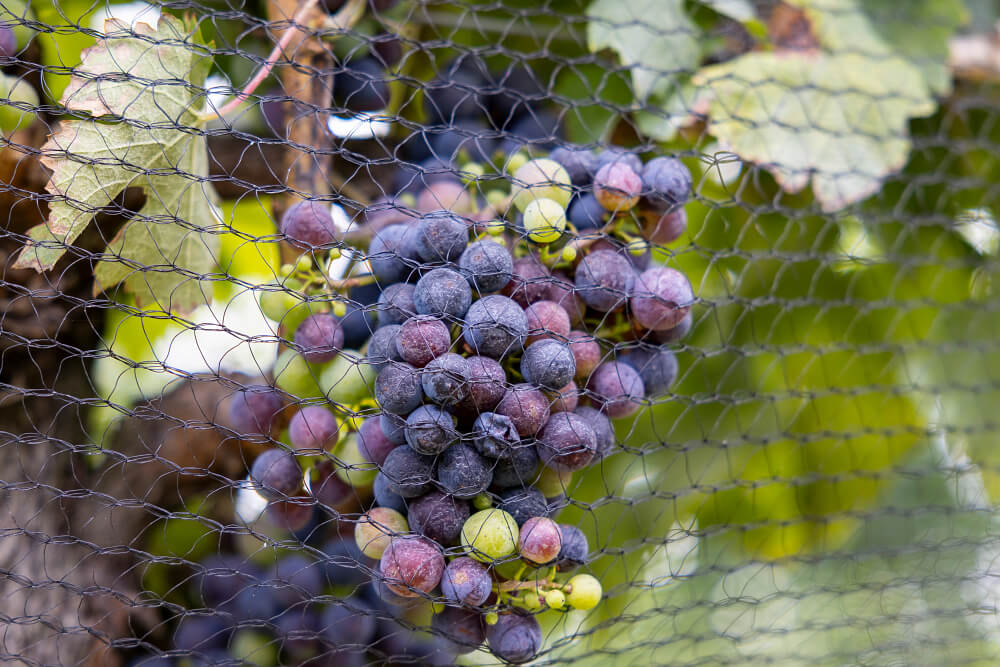
| Type/relative ease of bird netting placement | Overhead/moderate | Zone or overhead/easy | Overhead/difficult | Overhead/moderate |
| Mechanically harvestable | Yes | Yes | No | No |
Greater bud densities per linear foot of row can be retained in the Watson system due to the vertically offset angles of the spurs (Figure 6). The horizontal canopy division created at the cordon results in spurs (and consequently, shoots and clusters) that are spaced farther apart relative to a non-divided system with inherent space limitations within the fruit zone (Figures 5 and 6). Once the well-trained shoots of the divided canopy become dormant canes and are pruned to the desired density, the resulting spurs are already positioned in the desired, vertically offset angles. The increased space between clusters and shoots in the Watson system is anticipated to improve air movement and reduce bunch rots relative to high wire systems in which fruit zones are often highly congested. Thus, roughly six to eight buds per linear foot of row can be retained when spur pruning in the Watson system (Table 2). Different vineyard management techniques are required in Watson compared to other popular training systems, as outlined in Table 2. Variable management will result in different labor costs over the course of the growing season, during harvest, and during the dormant season.
Harvest parameters
A study in Texas compared ‘Blanc du Bois’ productivity as affected by Watson, VSP, and high wire quadrilateral cordon training systems (Table 3). Harvest parameters include crop yield and grape maturity. Comparable fruit maturity was observed in ‘Blanc du Bois’ grown on both a Watson and VSP in the Rio Grande Valley of Texas (data not shown). The same study found an average 52% increase in crop yield in Watson compared to VSP over three years, however quadrilateral cordon (similar to a GDC) produced greater crop yield than Watson (Table 3).
| Year | Watson (tons/acre) | VSP with cordon (tons/acre) | High wire quadrilateral cordon (tons/acre) |
|---|---|---|---|
| 2012 | 1.2 | 0.5 | 2.5 |
| 2013 | 3.6 | 2.0 | 6.0 |
| 2014 | 8.6 | 9.2 | 10.6 |
| Note. Crop yield measured on a per-vine basis, but extrapolated to a per-acre basis based on vine by 12-ft row spacing. Vineyard planted in 2009. | |||
A training system study in Georgia compared Watson, VSP, and GDC (Table 4). In the third leaf (2015), Watson and GDC produced comparable crop yields, which were an average equivalent of 2.9 more tons of crop per acre than VSP (Table 4). Watson produced fruit with numerically greater Brix values relative to both VSP and GDC. In the fourth leaf (2016), GDC produced an equivalent of 1.6 more tons of crop per acre than Watson and an equivalent of 3.5 more tons of crop per acre relative to VSP. In 2016, juice Brix values were again numerically greatest in Watson relative to VSP and GDC, but to a lesser extent than in 2015. Please note that data in Tables 3 and 4 is based on row spacing within those experimental vineyards. Planting vines trained to VSP at more representative commercial row spacings (e.g., 9 ft, as described in Table 1), would potentially result in crop yields of 5.2 and 5.6 tons per acre in 2015 and 2016, respectively. This is a good lesson about how row spacing can greatly affect crop yield per unit land.
| Training System | 2015 | 2016 | ||
|---|---|---|---|---|
| Yield (tons/acre) | Brix | Yield (tons/acre) | Brix | |
| Watson | 6.7 | 20.0 | 6.1 | 22.0 |
| VSP | 3.9 | 19.0 | 4.2 | 21.7 |
| GDC | 6.9 | 18.3 | 7.7 | 21.0 |
| Note. Crop yield measured on a per-vine basis, but extrapolated to a per-acre basis based on vine by 12-ft row spacing. Yield is an average across four cultivars: ‘Blanc du Bois’, ‘Lenoir’, ‘Norton’, and ‘Villard blanc’. Vineyard planted in 2013. | ||||
Conclusion
The Watson training system was developed by making intuitive, practical changes to the standard high-wire training system. The Watson system gives the fruit zone structure and uniformity and improves the separation of fruit and foliage. The hope is that this simple trellis structure modification to the high-wire system results in improved vineyard management, improved spray penetration to the fruit zone, and greater harvest efficiency. We do not report on any of these assumptions, so the information in this report should be considered and implemented if the concept of design and practice are desirable in your vineyard.
Bruce Cross, a vineyard and winery owner in Bremen, Georgia, credits the Watson system as easier to manage relative to the GDC system, particularly in terms of shoot training and harvesting. Cross stated that “while the Watson system reduces vine planting density per unit land compared to non-divided systems (e.g., VSP), the crop yield increase per Watson-trained vine can offset that reduction in planted vine number.”
Three seasons after the initial publication of this bulletin, Cross and vineyard manager Erik Griewisch still prefer the Watson trellis to the GDC and VSP, finding it “easier and more comfortable to work with in every aspect of vine management from establishing and training new vines, managing the canopy, ease of harvest and winter pruning.”
The Watson system has obvious disadvantages in terms of up-front costs, the inability to mechanically harvest, the increased between-row spacing required for installation, and the potential requirement for overhead bird netting placement. However, potential benefits of the Watson system, such as crop yield and management efficiency, may offset those disadvantages. For this reason, the Watson system may be worthy of consideration in some commercial vineyard situations.
Further reading and references
Scheiner, J., & Pontasch, F. (2019). Grape variety profile: Blanc du Bois (Publication No. HORT-PU-143). Texas A&M AgriLife Extension.
Westover, F. (2013). Grapevine training systems and demonstrations. Westover Vineyard Advising. https://www.vineyardadvising.com/wp-content/uploads/2013/11/Training-Systems-for-Hybrids_Demonstrations_2013_Grape-Camp_F.Westover_Handout.pdf
Westover, F. (2013, March). Grapevine training system trends in the South. Wines Vines Analytics. https://winebusinessanalytics.com/sections/printout_article.cfm?content=112608&article=feature
Westover, F. (2015, December). Growing grapes in Georgia. Wines and Vines, 4, 82–85. https://www.vineyardadvising.com/wp-content/uploads/2015/12/Growing-Grapes-in-GA_WV_Dec.2015.pdf
Wolf, T. (Ed). (2008). Wine grape production guide for Eastern North America (NRAES 145). Cornell Cooperative Extension. https://ecommons.cornell.edu/handle/1813/67189
The original manuscript was prepared by Rachael White, Paula Burke, Fritz Westover, Justin Scheiner, Jason Lessl, Daniel Jackson, Rachel Itle, Bruce Cross, Jerry Watson, and Cain Hickey. Reviewed by Sarah R. Lowder, UGA Extension Viticulturist.