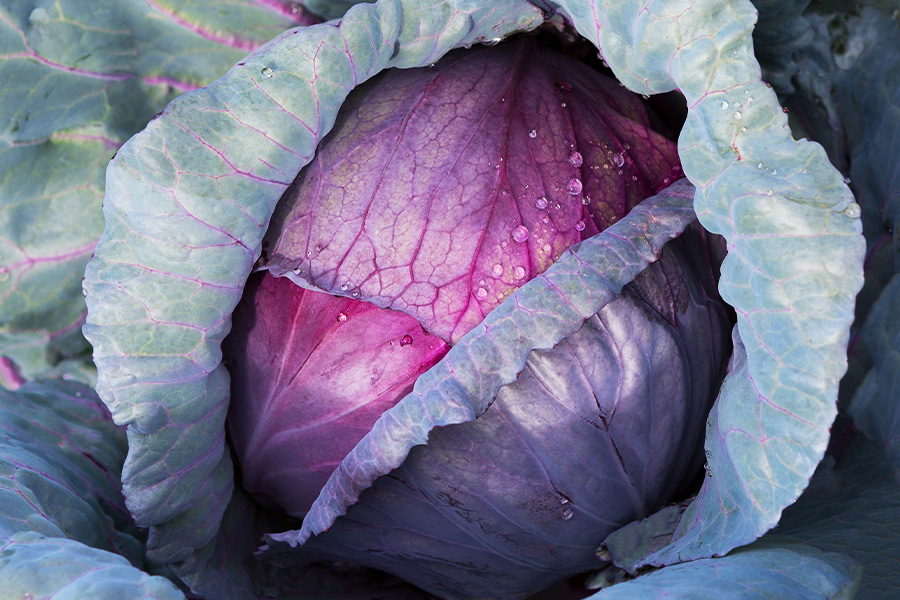

Red cabbage is a highly nutritious vegetable crop, rich in minerals, vitamins, and several other chemical compounds that are beneficial for human health, including phenols, proteins, glucosinolates, and anthocyanins. While red cabbage belongs to the same group as the other cabbage varieties (white and green) widely produced and consumed in the state, red cabbage production and consumption in Georgia is still low. This publication contains basic information on crop management, food safety practices, and the biochemical properties of red cabbage.
Crop management practices
Similar to other cabbages, red cabbage is adapted to a wide range of environmental conditions and can be grown in several locations throughout Georgia. Planting dates may occur in the spring, fall, and winter months for much of the state, but planting should occur in spring and summer in north Georgia. Overall, red cabbage is tolerant to hard frosts, but optimum temperatures for growing conditions are 60-70 °F.
Red cabbage can be either direct seeded or transplanted. In commercial production fields, transplants have some advantages over direct seeding, such as quick plant growth and uniformity. However, it is important to highlight that transplants increase the cost of production, and the use of Georgia-certified plants is important to avoid seedborne diseases. The optimum plant population per acre will depends on the growing system and the market. Red cabbage can be planted in-ground or in raised beds. Bare ground planting occurs in rows spaced 36 inches apart with overhead sprinkler irrigation. Raised beds are typically 6 inches in depth with plastic mulching and drip irrigation. Beds are spaced 6 feet center to center and double rows are used with 18-inch spacing between rows and a drip line in the center. In-row plant spacing can vary from 8 to 12 inches. Large in-row spacing between plants allows for larger heads and should be used for the slaw market, while short in-row spacing is commonly used for fresh market red cabbage.
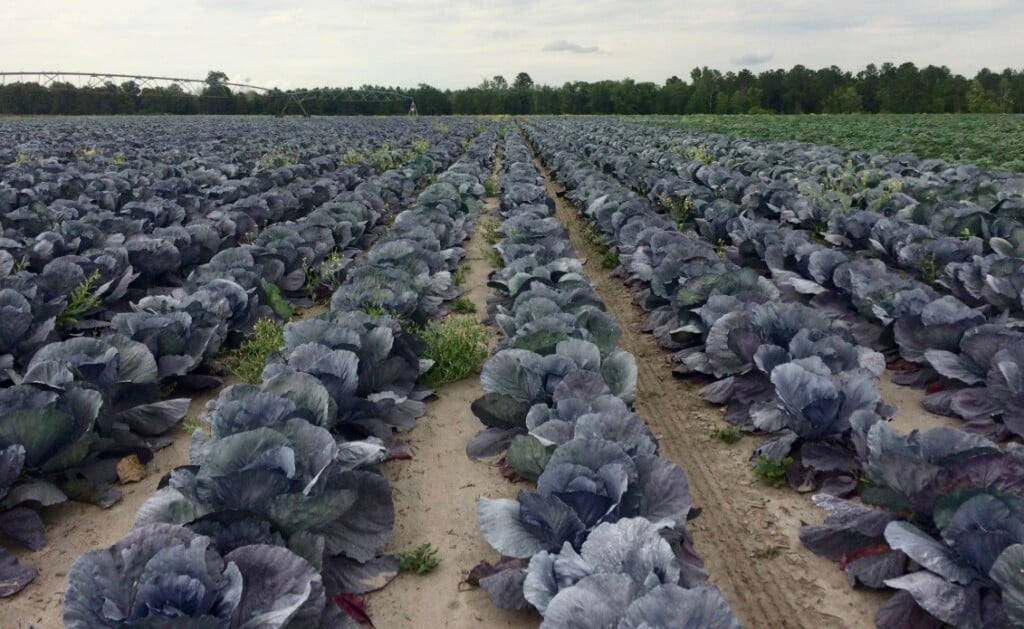
The irrigation water requirements of red cabbage vary widely according to the growing season, location, and stage of crop development. Red cabbage grown during the spring requires larger volumes of irrigation water later in the season, while plants grown during the fall require larger volumes of irrigation water in the early season (Figure 2).


Figure 2. Average of the historical irrigation water demand per week for red cabbage planted Feb. 1 (Left) and Sept. 1 (Right) in southwest Georgia, with data from eight different southwest Georgia locations. Irrigation water demand represents the mean crop evapotranspiration of 18 years of weather data (from 2000 to 2017) and the crop coefficients of cabbage recommended by Allen et al. (1998).
This is mostly due to the weather conditions in spring and fall (i.e., temperature), rather than water uptake by the crop. The irrigation water requirement by location is similar to the irrigation water requirement by season in Georgia. The higher temperatures of south Georgia require more irrigation water than the lower temperatures of northern Georgia. In general, the total volume of irrigation water needed for a spring crop may vary from 5.6 inches for an early planting date in northeast Georgia to 12.1 inches of water for a late planting date in southwest Georgia. In the fall, irrigation water requirements may vary from 2.6 inches for a late planting date in northeast Georgia to 8.0 inches for an early planting date in southwest Georgia. For a full recommendation of irrigation scheduling for red cabbage production, see University of Georgia Cooperative Extension Circular 1183, “Water Use and Irrigation Management for Vegetables in Georgia: Brassica Crops.”
An important aspect of red cabbage production is fertilizer management. Fertilizer management directly correlates to crop yield and biological active compounds that benefit human health (Biesiada et al., 2010). Macronutrients, such as nitrogen (N), phosphorus (P), and potassium (K), are essential for optimum crop development. While Table 1 provides general fertilizer recommendations for these macronutrients, soil samples during crop development are recommended to ensure proper fertilizer management.
Table 1. General macronutrient fertilization and soil pH for red cabbage production in Georgia.
| Soil pH | Nitrogen (N) lb/acre | Phosphorus (P) lb/acre | Potassium (K) lb/acre |
|---|---|---|---|
| 6.0 to 6.5 | 150 to 225 | 50 to 150 | 100 to 150 |
Splitting fertilizer application is strongly recommended for red cabbage production, especially in sandy soils where rainfall and irrigation events can easily move soil nutrients below the crop root zone. Sandy soils are common in south Georgia, while north Georgia is characterized by clay soils. Regardless of location, red cabbage requires high P rates early in the season to induce root development and transplant establishment, while N and K rates are mostly required early and midseason. Therefore, a single fertilizer application of P is typically performed at planting and three to four applications of N and K are split from planting to the beginning of head formation.
Weather conditions in Georgia allow for the rapid proliferation of diseases and insects in red cabbage fields. Cabbage black rot (Xanthomonas campestris pv. Campestris), Alternaria leafspot (Alternaria brassicae), and Sclerotinia (Sclerotinia sclerotiorium) are the most common diseases, while diamondback moth (Plutella xylostella) and cabbage looper (Trichoplusia ni) are the most common insects in red cabbage fields in Georgia. Use the Georgia Pest Management Handbook to follow UGA’s recommendations for spraying programs in red cabbage production throughout the state.
The harvest of red cabbage occurs when heads are 2 lbs or heavier, which may take from 80 to 100 days after planting, depending on the cultivar. At harvest, cut the heads from the stems and trim the external leaves. Heads are typically packed in the field, and field crews must be properly trained to meet buyers’ quality standards and minimize losses caused by damaged heads. After harvesting, red cabbage can be stored for up to six months at 35 °F and 95% relative humidity. The presence of ethylene in the storage area should be avoided since it will cause yellowing and abscission of leaves.
For additional information on crop production for red cabbage in Georgia, see UGA Extension Bulletin 1181, “Commercial Production and Management of Cabbage and Leaf Greens.”
Food safety
Microbial contamination is one of the primary food safety hazards in leafy greens production. Red cabbage is hand-harvested and transported to the packinghouse for trimming, grading, and packaging, and each step poses an opportunity for microbial contamination. The best way to guarantee the safety of red cabbage is by identifying and preventing hazards during preharvest and postharvest practices. Farmers should be familiar with safe production practices and how to adhere to adequate food safety requirements. Most operations follow Good Agricultural Practices (GAPs) as a way to promote safe food production; however, depending on their business size, practices may be required to comply with the Produce Safety Rule as part of the U.S. Food and Drug Administration Food Safety Modernization Act (U.S. FDA, 2017), as well as third-party audits or buyer specifications.
In the field, some food safety practices must be followed in order to prevent and minimize the risks of microbial contamination. Animals can harbor pathogenic microorganisms, such as Salmonella enterica, pathogenic Escherichia coli (including E. coli O157:H7), and Campylobacter spp., that can potentially contaminate produce and be harmful to humans. Exclude wildlife from produce fields, and monitor for indications of animal intrusion prior to harvest. Cabbage with fecal contamination must never be harvested. Livestock should also be located away from produce fields when possible. The California and Arizona Leafy Greens Marketing Associations (2019) suggest a 1200-ft buffer between crops (outside edge) and concentrated livestock operations, and a buffer of at least 30 ft between crops and grazing livestock. Likewise, the use of treated biological soil amendments and properly composted manure is recommended for production, as red cabbage is grown in direct contact with the soil. A validated treatment procedure is important to reduce or eliminate pathogenic microorganisms that may be present in biological soil amendments of animal origin, so that they can be safely incorporated into the soil.
For farms that are covered by the Produce Safety Rule, the water used for irrigation and other applications that result in direct crop contact must meet the established microbial water quality requirements to guarantee product safety. Growers need to establish a microbial water quality profile (MWQP) for all water sources that contact the harvestable portion of the crop. This is done over a two- to four-year period (20 samples minimum) for surface water sources, and one year (four samples minimum) for ground water sources. After the establishment of the MWQP, surface water sources are tested five times annually, and ground water sources once; each new sample data point is rolled into the MWQP, and the oldest sample is removed as long as the MWQP has at least the required 20 (surface) or four (ground) samples. Water samples are tested for generic E. coli, an indicator of fecal contamination, and levels should not exceed 126 colony forming units (CFU; also reported as most probable number or MPN) in 100 mL of water for the geometric mean (GM) and 410 CFU in 100 mL of water for the statistical threshold value (STV). When these values are exceeded, the water is considered inadequate for overhead irrigation use, or other uses where the water is likely to come into direct crop contact (pesticide application, fertigation, etc.). Growers may use the online GM and STV calculator developed by the UGA Agricultural and Environmental Services Laboratory (AESL) at https://aesl.ces.uga.edu/calculators/ FSMA.
When it is determined that water that does not meet the Produce Safety Rule MWQP requirements prior to harvest, growers may:
- Apply the water in a manner that does not contact the harvestable portion of the crop (such as through drip tape).
- Use an alternative water source.
- Treat the water using an approved antimicrobial pesticide (such as chlorine or peracetic acid) or antimicrobial device (such as ultraviolet, or UV, light).
- Apply a time interval between the last contact of the water and crop harvest.
This time interval assumes the die-off of microorganisms from the water that may have contacted the produce and assumes a die-off rate of 0.5 log/CFU per day for up to four consecutive days (Bihn et al., 2017). The UGA AESL water calculator can generate the required die-off period required prior to harvest. Another alternative is to redirect the crop to an alternative market which uses a “kill” step process, such as cooking, to control microorganisms. Washing, even when using sanitizer such as chlorine, is not considered an adequate kill step. When a water source consistently fails to meet MWQP requirements, growers need to consider alternative water sources or water treatments (U.S. FDA, 2015).
Growers must ensure and document that field and packinghouse workers receive proper food safety training for any scenarios they may encounter. Hands must be washed for 20 seconds with soap and water prior to any produce handling activities, even if gloves are to be worn. Workers must also be provided appropriate tools and equipment to safely perform their work and be instructed on their proper use to prevent contamination, as well as cleaning and sanitizing protocols. For instance, harvest knives, when used, should never be placed on or in the soil between cuts, and if a knife is dropped, it should be replaced with a clean one or thoroughly cleaned and sanitized before it is used again. Bulk containers and buckets, as well as any surfaces that will contact cabbage, need to be included on the cleaning and sanitizing schedule. Workers must also have access to clean toilets, well- stocked hand-washing stations, and a designated break area outside of the field. Once harvested, red cabbage is room-cooled to 35 °F at 95% relative humidity. Some buyers require icing during storage and transportation to preserve the quality of red cabbage leaves. According to the Produce Safety Rule, water that is used during harvest or for postharvest activities, including water used to make ice, must be free of detectable generic E. coli (U.S. FDA, 2015). Agricultural water also includes any water that is used to wash produce, hands, and used to clean cabbage-contact surfaces and equipment. Ice machines should be included on a regular cleaning and sanitation schedule to ensure the machine itself does not contaminate the ice. In addition, the use of food-grade sanitizers, such as sodium hypochlorite or peroxyacetic acid (PAA) is recommended in water used to wash produce to reduce the likelihood of cross-contamination between cabbages. Finally, areas and containers used during storage and transportation must not be overlooked. These areas must be cleaned and sanitized frequently and should be included in environmental monitoring at farms or facilities with regular monitoring programs in place.
Biochemical Properties
Red cabbage has numerous macro- and micronutrients required for a healthy human diet. This specific Brassica has been described as providing a good source of vitamins, as equal quantities of red cabbage contain more vitamin C than oranges (1 cup provides about 85% of daily recommended intake with only 28 calories); and a serving of red cabbage can provide up to 42% of daily vitamin K needs and is a good source of vitamins A and B-complex (U.S. Department of Agriculture, 2016). Red cabbage is also high in dietary fiber (72% of daily value per cup), contributing to the maintainance of healthy gut microbiota.
The anthocyanins, responsible for the blue, purple, and red color of many plants such as grapes, purple sweet potatoes, radishes, and red cabbage, belong to a large family of compounds called flavonoids (Ahmadiani et al., 2014). Due to their intense color, anthocyanins are commonly used as natural colorants in the food industry and have numerous medicinal properties. Interest in the consumption of foods rich in these compounds, including red cabbage, has increased as their nutritional benefits have been elucidated, especially since they also provide great antioxidant potential (Wu et al., 2006; Podsedek et al., 2006). The intake of anthocyanin-rich food can help with prevention and attenuation of outcomes associated with chronic diseases, such as obesity, diabetes, and cardiovascular diseases (Wedick et al., 2012; Wallace et al., 2016; Lee et al., 2017). The daily recommended consumption of total anthocyanins is between 180 and 215 mg/day (Hertog et al., 1993).
The anthocyanin profile is complex, and up to 36 different forms of this compound have been found in red cabbage (Charron et al., 2007). However, anthocyanins can vary in red cabbage depending on the cultivar, weather conditions, fertilizer application, cooking methods, and even location where plants are cultivated. These factors can alter the chemical profile and directly affect the biological properties of the plant, including antioxidant capacity. Particularly, fertilizer N application plays an important role in red cabbage production. Recent studies have shown that fertilizer N rates above 225 lbs/acre may not increase yields, while fertilizer N rates between 150 and 200 lbs/acre are reported to increase anthocyanins, total polyphenol levels, and antioxidant activity of the edible parts (Biesiada et al.., 2010).
Cooking directly influences the concentration of chemical compounds and consequently the biological activity of those compounds in red cabbage (Table 2). Studies have shown that some cooking methods reduce the content of anthocyanins in red cabbage as well as decrease their potential antioxidant activity. However, some cooking processes soften vegetable tissue, facilitating the extraction of bioactive compounds. Based on the available literature, raw or steamed red cabbage contains the greatest amount of bioactive compounds, such as anthocyanins and vitamin C, and has, consequently, the greatest antioxidant capacity (Volden et al., 2008; Xu et al., 2014; Wiczkowski et al., 2015; Murador et al., 2016).
Table 2. Effects of domestic cooking methods on the chemical profile of red cabbage.
| Cooking Methods | Anthocyanins (mg/100g) | Total phenols (mg/100g) | Carotenoids (μg/100g) | Antioxidant Capacity (μmol TE/g) |
|---|---|---|---|---|
| Raw | 23.9 | 28.5 | 35.5 | 54 |
| Boiling | 14.1 | 23.7 | 45.0 | 35.4 |
| Steaming | 29.0 | 18.7 | 32.1 | 62.9 |
| Stir frying | 25.0 | 27 | 39.5 | 54.8 |
Summary
Best management practices are necessary to increase the crop yield and quality of red cabbage during production while protecting its nutrient content. Some compounds found within red cabbage may minimize certain harmful symptoms associated with many chronic diseases. Adequate food safety practices are crucial to guarantee the microbial safety of red cabbage during production and postharvest activities.
References
Ahmadiani, N., Robbins, R. J., Collins, T. M., & Giusti, M. M. (2014). Anthocyanins contents, profiles, and color characteristics of red cabbage extracts from different cultivars and maturity stages. Journal of Agricultural and Food Chemistry, 62(30), 7524–7531. https://doi.org/10.1021/jf501991q
Allen, R. G., Pereira, L. S., Raes, D., & Smith, M. (1998). FAO Irrigation and drainage paper No. 56. Rome: Food and Agriculture Organization of the United Nations, 56, 97–156.
Arizona Leafy Greens Marketing Associations (2019). Commodity specific food safety guidelines for the production and harvest of lettuce and leafy greens. Arizona Leafy Greens. https://283b5790-0f10-43d8-a0fe-cbdf892578b5.filesusr.com/ugd/cdf4b0_93b056d1ec0e4b5a8ed40cd766430ee4.pdf
Biesiada, A., Nawirska-Olszańska, A., Kucharska, A., Sokół-Łętowska, A., & Kędra, K. (2010). The effect of nitrogen fertilization on nutritive value and antioxidative activity of red cabbage. Acta Sci. Pol. Hortorum Cultus, 9(2), 13–21.
Bihn, E., Fick, B., Pahl, D., Stoeckel, D., Woods, K., & Wall, G. (2017). Geometric Means, Statistical Threshold Values, and Microbial Die-Off Rates. Produce Safety Alliance. https://producesafetyalliance.cornell.edu/sites/producesafetyalliance.cornell.edu/files/shared/documents/2017%20GM%20STV%20Worksheet%20v1.0.pdf
Charron, C. S., Clevidence, B. A., Britz, S. J., & Novotny, J. A. (2007). Effect of dose size on bioavailability of acylated and nonacylated anthocyanins from red cabbage (Brassica oleracea L. var. capitata). Journal of Agricultural and Food Chemistry, 55(13), 5354–5362. https://doi.org/10.1021/jf0710736
Hertog, M. G., Hollman, P. C., Katan, M. B., & Kromhout, D. (1993). Intake of potentially anticarcinogenic flavonoids and their determinants in adults in The Netherlands. Nutr Cancer, 20(1), 21–29. https://doi.org/10.1080/01635589309514267
Lee, Y. M., Yoon, Y., Yoon, H., Park, H. M., Song, S., & Yeum, K.J. (2017). Dietary Anthocyanins against Obesity and Inflammation. Nutrients, 9(10), 1089. https://doi.org/10.3390/nu9101089
Lunn, J., & Theobald, H. E. (2006). The health effects of dietary unsaturated fatty acids. Nutrition Bulletin, 31(3), 178–224. https://doi.org/10.1111/j.1467-3010.2006.00571.x
Murador, D. C., Mercadante, A. Z., & de Rosso, V. V. (2016). Cooking Techniques Improve the Levels of Bioactive Compounds and Antioxidant Activity in Kale and Red Cabbage. Food Chem, 196, 1101–1107. https://doi.org/10.1016/j.foodchem.2015.10.037
Podsedek, A., Sosnowska, D., Redzynia, M., & Anders, B. (2006). Antioxidant capacity and content of Brassica oleracea dietary antioxidants. International Journal of Food Science and Technology, 41, 49–58. https://doi.org/10.1111/j.1365-2621.2006.01260.x
U.S. Department of Agriculture (2016). Cabbage, red, raw. FoodData Central. https://fdc.nal.usda.gov/fdc-app.html#/food-details/787782/nutrients
U.S. Food and Drug Administration (2015). FSMA final rule on produce safety. https://www.fda.gov/food/food-safety-modernization-act-fsma/fsma-final-rule-produce-safety
U.S. Food and Drug Administration (2017). Full Text of the Food Safety Modernization Act (FSMA). https://www.fda.gov/food/food-safety-modernization-act-fsma/full-text-food-safety-modernization-act-fsma
Volden, J., Borge, G. I. A., Bengtsson, G. B., Hansen, M., Thygesen, I. E., & Wicklund, T. (2008). Effect of thermal treatment on glucosinolates and antioxidant-related parameters in red cabbage (Brassica oleracea L. ssp. capitata f. rubra). Food Chemistry, 109(3), 595–605. https://doi.org/10.1016/j.foodchem.2008.01.010
Wallace, T. C., Slavin, M., & Frankenfeld, C. L. (2016). Systematic Review of Anthocyanins and Markers of Cardiovascular Disease. Nutrients, 8(32), 1–13. https://doi.org/10.3390/nu8010032
Wedick, N. M., Pan, A., Cassidy, A., Rimm, E. B., Sampson, L., Rosner, B., Willett, W., Hu, F. B., Sun, Q., & van Dam, R. M. (2012). Dietary Flavonoid Intakes and Risk of Type 2 Diabetes in U.S. Men and Women. Am J
Clin Nutr, 95(4), 925–933. https://doi.org/10.3945/ajcn.111.028894
Wiczkowski, W., Szawara-Nowak, D., & Topolska, J. (2013). Red cabbage anthocyanins: Profile, isolation, identification, and antioxidant activity. Food Research International, 51(1), 303–309. https://doi.org/10.1016/j.foodres.2012.12.015
Wiczkowski, W., Szawara-Nowak, D., & Topolska, J. (2015). Changes in the content and composition of anthocyanins in red cabbage and its antioxidant capacity during fermentation, storage and stewing. Food Chemistry, 167, 115–123. https://doi.org/10.1016/j.foodchem.2014.06.087
Wu, X., Beecher, G. R., Holden, J. M., Haytowitz, D. B., Gebhardt, S. E., & Prior, R. L. (2006). Concentrations of anthocyanins in common foods in the United States and estimation of normal consumption. J Agric Food Chem, 54(11), 4069–4075. https://doi.org/10.1021/jf060300l
Xu, F., Zheng, Y., Yang, Z., Cao, S., Shoo, X., & Wang, H. (2014). Domestic cooking methods affect the nutritional quality of red cabbage. Food Chemistry, 161, 162–167. https://doi.org/10.1016/j.foodchem.2014.04.025