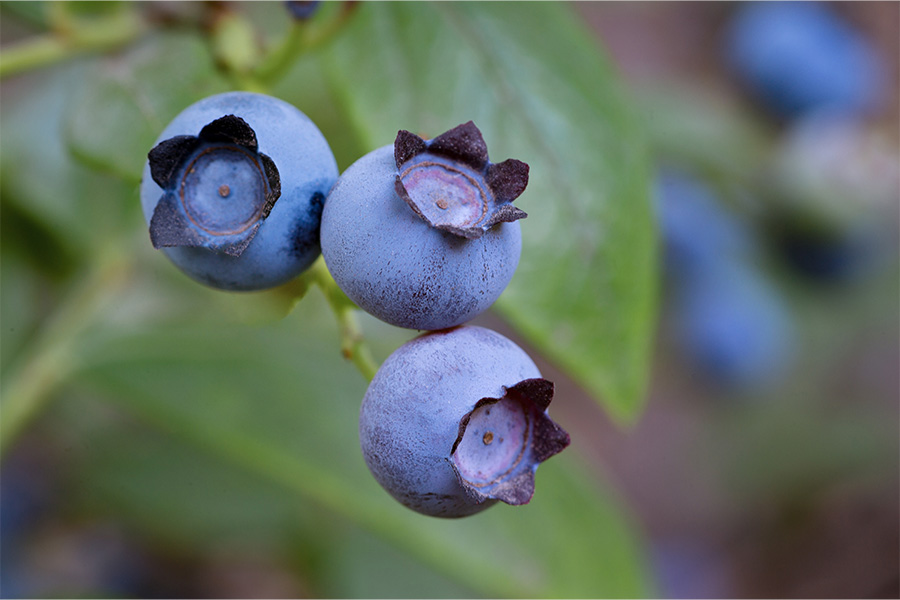

Propagating disease-free blueberry plants is important for the future sustainability of the blueberry industry in Georgia and the Southeast. Over the past two to three decades, the Georgia blueberry industry has experienced remarkable growth and has become a national leader in blueberry production. To remain competitive, Georgia blueberry producers need a supply of healthy plants to replace older plantings and obsolete cultivars.
The current blueberry propagation methods used in Georgia are highly variable, and there are few standardized practices that are used across the industry. Both new and seasoned growers may find it difficult to determine the most suitable methods to adopt when managing their nursery. The following information presents a set of best practices for implementing a propagation system to minimize losses and improve the quality of plants produced.
Although Georgia nurseries currently use traditional methods to propagate blueberries from vegetative cuttings, tissue culture is another way to develop transplants as an alternative to on-farm propagation; this method is outside the scope of this publication, but growers should be aware that this is an alternative to using softwood cuttings (stems of new growth rather than mature—or hardwood—stems) or other propagation methods.
Growers must be mindful of the need to be licensed when propagating patented cultivars, such as those licensed by the University of Georgia or University of Florida. It is illegal to propagate cuttings from patented cultivars without first obtaining authorization from the patent holder, usually a propagation license that requires the grower to keep records and pay royalties on a per-plant basis.
Setting up a propagation system
Several questions need to be answered before propagating from cuttings. How many plants need to be produced? Will cuttings be produced annually or only for a short time? Are the cuttings for sale or for use on-site? All of these factors will ultimately determine the selection of propagation methods.
System type

Photo: Bill Cline, North Carolina State University
There are two basic system types that can be employed to produce rooted cuttings, open (outdoor) systems (Figure 1) and closed (greenhouse or hoop house) systems (Figure 2). In an open growing system, cuttings are exposed to the elements, and there are advantages and disadvantages in selecting such a system. The open system reduces the initial investment required to begin production relative to a closed system. The main disadvantage of an open system is a loss of the ability to control environmental conditions in the nursery.

Photo: Bill Cline, North Carolina State University
For example, moisture levels are more difficult to control in open systems, as plants are exposed to rain and ambient humidity. Excess rain can lead to saturated root zones, and this should be taken into account when selecting containers and media (see below). Plant protection from wind is important, as drying of the leaves for periods as short as 30 minutes can permanently damage cuttings that have not yet rooted (Cline and Mainland, 2008). Thus, windbreaks will need to be provided (Figure 1). Further, 40-63% shade should be sufficient for propagation (Krewer and Cline, 2003). An open system generally lends itself to growers who intend to grow cuttings in small numbers for use in their own operation, as initial financial input is lower and the usable space for propagation can be adjusted as needed.
Structures used for closed systems can vary greatly depending on the budget of the propagator. Both shadehouses and greenhouses can be used, allowing the grower to better control the environment. Moisture levels are controlled by irrigation, and shade can be controlled by the use of shade cloth or pigmented plastic greenhouse coverings. Again, similar to an open system, 40-63% shade should be provided. For long-term propagation, a permanent structure provides the grower with a dedicated area that is much easier to control and where sanitation regimes (e.g., bleaching benches) can be readily implemented between propagation runs.
Media
Blueberry is an ericaceous crop (in the heather family) that requires an acidic substrate for proper growth. The media must also allow for 100% relative humidity around the base of the cuttings while providing support against lodging. The media must be porous enough to facilitate drainage, as anoxic conditions adversely affect rooting. In the past, growers have favored aged sawdust as a propagation material (Cline and Mainland, 2008), which was obtained from the discard piles of sawmills. Over time, sawdust availability has dwindled, forcing growers to find other sources of propagation media. Currently, two main media types are recommended for blueberry propagation: artificial soilless mixes and pine bark.
In Georgia, the most popular propagation media is pine bark. This media is readily available and relatively inexpensive, although prices have been increasing recently. Several factors must be taken into account when using pine bark media. Bark should be finely milled to a uniform size. By volume, 70-80% of pine bark particles should be 0.6 to 9.5 mm in diameter, with the remaining particles being smaller than 0.6 mm (Krewer and Ruter, 2005). The bark should be relatively free of wood chips. Bark is a hydrophobic substance that is relatively difficult to wet. Milling the pine bark into small, uniform pieces increases the water-holding capacity of the media and facilitates placement of the cutting during sticking. Composted pine bark is preferred over fresh pine bark, as the increased biological activity will act to suppress many soilborne pathogens, including species of Pythium, Phytophthora, and Rhizoctonia (Hoitink and Boehm, 1999). The naturally low pH of pine bark makes it suitable for the acid-loving blueberry. However, contamination by foreign materials at sawmills can lead to problems. Lime (CaCO3) is often spread over the ground at sawmills to prevent waterlogging in bare areas with high foot and vehicle traffic. Bark that is stored on this surface can be contaminated with lime, which will raise the pH and result in poor rooting.
Another option for propagation media is a sterile, soilless mix. While not commonly used for propagation in Georgia, there are several advantages to using a soilless mix, especially in closed systems. In a closed system where moisture can be controlled, peat and perlite mixes perform well as a rooting media. In open systems, peat-based media tend to become waterlogged, which leads to anoxic conditions and subsequent poor rooting (Cline and Mainland, 2008). In many prepared mixes, lime is added to balance the acidity of the peat moss ingredient, so this must be kept in mind when selecting a propagation mix. There are several benefits to using a soilless mix, but the primary benefit is its consistency relative to bark, the consistency of which can be highly variable, especially when the source changes. If the grower mixes it themselves, a soilless mix should be consistent every year. Cuttings rooted in a peat-based media will also produce more extensive root systems than those produced in a bark media. In recent years, the price of pine bark has increased steadily. If this trend continues, soilless mixes may become more common. Once used, rooting substrate should be considered contaminated by disease-causing organisms, and it should be discarded so that each round of cuttings starts with fresh media. Regardless of the substrate used, do not reuse propagation media.
Propagation beds
Traditional blueberry propagation beds are most often constructed of 2-by-8-in. treated lumber, with ¼-inch mesh hardware cloth (galvanized wire mesh) underneath to retain the rooting media (Figure 3). Beds are built outdoors with no cover, atop an 18-in.-deep layer of sand. The sand is necessary to wick away excess water during rain events; summer storms and hurricanes can quickly dump several inches of rain, so the bed must be designed to rapidly drain large amounts of water. Rooting media for open outdoor beds must drain rapidly, so it is usually milled, composted pine bark.

Photo: Bill Cline, North Carolina State University
Container selection and bench use
In the past, many propagators have used propagation beds, but propagation in containers offers many important benefits. Containers must be at least 9-10-cm deep to ensure that the cuttings do not come in contact with zones of saturation that can form at the bottom of shallow containers (Krewer and Cline, 2003). Many types of containers have been used for blueberry propagation, but the most popular is the “trade gallon” black plastic container favored by the ornamental industry (Figure 4). Trade gallon containers are inexpensive, readily available, and reusable; they are easy to handle when filled with media; and they can support between 10 and 14 cuttings per container.

Another recommended container is the deep cell pack (also known as flats). These remove the need to determine the correct spacing of cuttings and can reduce the amount of media needed to produce one cutting. While a typical trade gallon container with a volume of 2.8 L (0.2 L per cutting) can support a maximum of 14 cuttings, a deep cell insert can support 18 cuttings and has a volume of 2.32 L (0.13 L per cutting). Therefore, using the deep cell insert allows for the amount of media used to be reduced by almost 50%. The inserts cannot be reused; however, if the containers are discarded, then there is less likelihood of the spread of disease via contaminated containers. Depending on the needs of prospective customers, cuttings grown in deep inserts may be sold without being potted up, and the cost of the containers can be passed on to the buyer. One disadvantage to growing in deep cells is that they take up more space than potted cuttings. If space is limited, using pots may be the better option.
Container propagation (pots or trays) may fail due to lack of drainage if rainfall is excessive and the containers cannot drain quickly enough to avoid saturating the rooting media. When in doubt, plan to conduct container propagation in a closed or partially closed system under a greenhouse or other cover to exclude rainfall.

Another decision that must be made is whether to grow cuttings at ground level or on benches. The most obvious benefit of using benches is the decreased likelihood of substrate saturation due to pooling water on the ground (Figure 5a and 5b). In cases of excess rain or accidental over-irrigation, zones of saturation in the media will kill roots and promote disease. With that said, cuttings on benches (beds, trays, or pots) that have airspace underneath can have a saturation zone that is not wicked away readily, so cuttings that are stuck too deep in the substrate will rot. As presented above, propagation on the ground with a layer of sand underneath (18-in. deep) with sand in direct contact with the rooting media can work really well, as the sand wicks away excess water and prevents substrate saturation. There are pros and cons to both systems, but good drainage is important.

Benches also make scouting for diseases easier, as cuttings on benches are much closer to eye level, and disease problems are more readily observed early in their establishment. Furthermore, it is easier to work with cuttings on benches, as cuttings produced at ground level require more bending and lifting. If cuttings will be produced annually, benches are highly recommended and likely well worth the expense. If cuttings are only grown on a temporary basis, then growing them on the ground may be appropriate if proper precautions are taken. If grown on the ground, containers should be placed on a well-drained surface (preferably a layer of gravel) covered with landscape fabric to prevent the pooling of water and contamination from the native soil.
Propagation
Mother blocks
Although many transplant producers simply “skim” over current commercial plantings of known cultivars taking cuttings to produce new plants, skimming is dangerous relative to multiple diseases—particularly those caused by viruses and systemic bacteria, since those can be transmitted readily via vegetative propagation. Establishment of a clean block of mother plants for propagation is the preferred method for developing disease-free transplants. Ideally, the mother plants would be established from tissue-cultured, virus-indexed material. Mother plants should be tested for known viruses and systemic bacterial diseases on a yearly basis to ensure that these disease agents have not entered the planting. Any plants that have been confirmed to have disease, whether symptomatic or non-symptomatic, should be destroyed. Due to the potential for pathogen ingress, mother blocks should ideally be located far from established commercial plantings and wild blueberries.
Cutting selection and preparation
There are two opportunities to collect cuttings during the growing season: the first and second vegetative growth flush. Late April to early May (first flush of vegetative growth) is the preferred timing for cutting collection in south Georgia, but this conflicts with harvest on many cultivars. Cuttings can also be taken early to mid-August after the second flush of growth has occurred in the summer (Krewer and Cline, 2003) (Figure 6).

Photo: Bill Cline, North Carolina State University
Cuttings should be selected from designated mother blocks, and only cuttings from vigorous plants with no disease (stem blight, leaf spots, viruses, bacteria, other systemic issues, etc.) should be used (Figure 7).
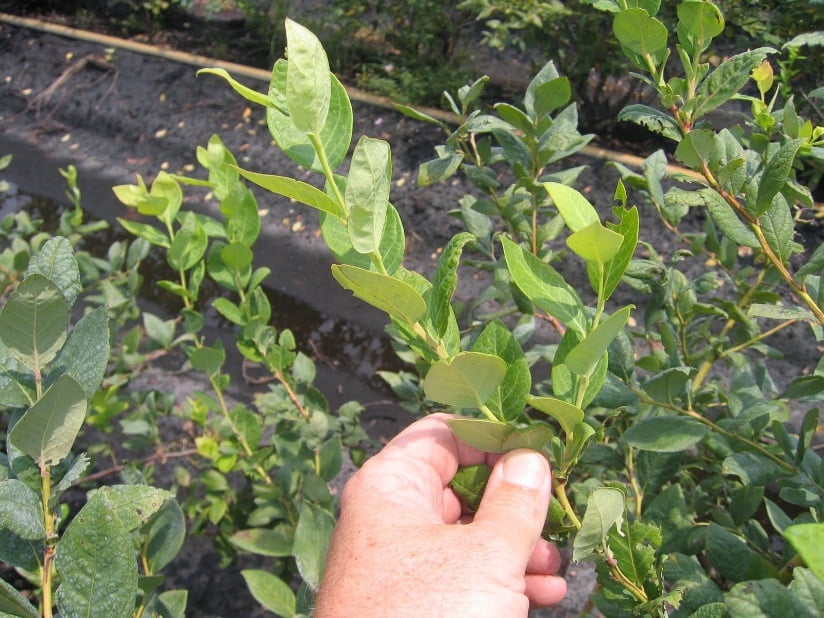
Photo: Bill Cline, North Carolina State University
Document the location and date where cuttings are taken, and remove and destroy bushes that appear off-type or stunted. Again, if viral or bacterial symptoms are present, additional testing may be required to determine whether the mother block has been compromised.
Cuttings should be taken early in the morning while the plant stems are turgid (swollen). Cuttings should be approximately 11.5-15 cm in length and should be selected from the terminal ends of new growth; cuttings should have a stem that is stiff enough to withstand insertion into the media without breaking; and they should never be allowed to wilt (Figure 8).

If cutting material is in short supply, two or three cuttings can be made from the same shoot, but cuttings taken from more basal shoot positions will generally not root as well as terminal cuttings (Cline and Mainland, 2008). The cuttings should be stored in containers (coolers or 5-gal buckets) and wetted with ice water until they can be stuck (Figure 9).

Photo: Bill Cline, North Carolina State University
Ice should be prevented from making direct contact with the cuttings as it can damage plant tissues (Cline and Mainland, 2008; Krewer and Cline, 2003). Cuttings should be stripped of all but the top two or three leaves and be spaced 3.85 cm apart in containers to provide adequate air flow and promote effective pesticide application (Cline and Mainland, 2008) (Figures 10 and 11).

Photo: Bill Cline, North Carolina State University

Irrigation
Irrigation is critical during the early stages of the rooting process. An intermittent mist system is used to rewet leaves as they dry. A constant film of water should remain on the leaves until roots are formed, and misting systems are highly recommended for this purpose (Figures 12 and 13).
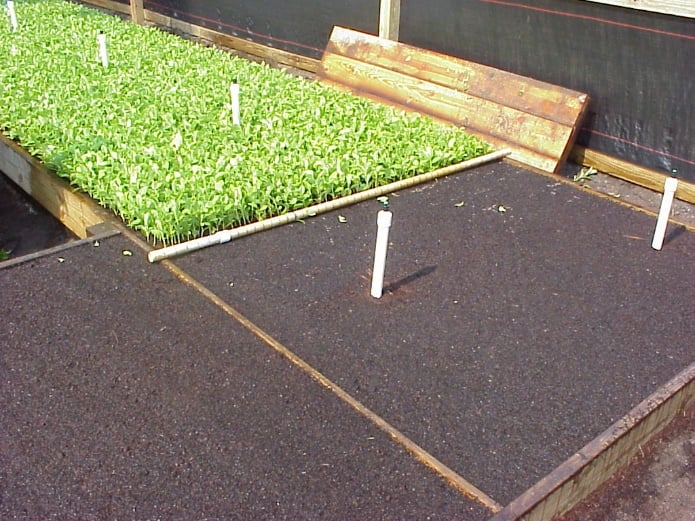
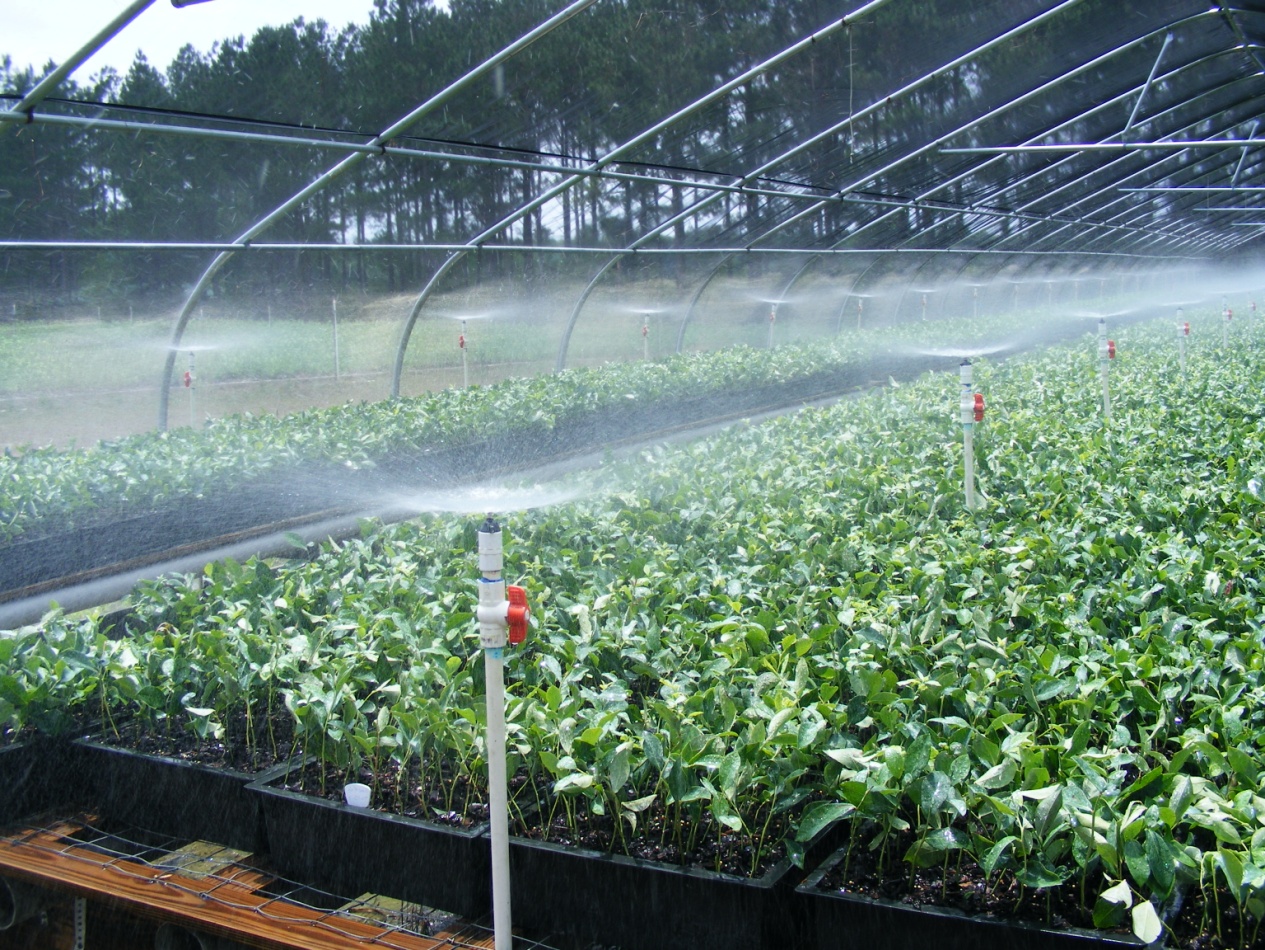
Photo: Bill Cline, North Carolina State University
Although it is possible to use other irrigation methods (impact sprinklers), mist heads provide the best coverage. Several different types of mist heads are available on the market, but all generally fall into one of two categories: deflection nozzles and oilburner heads. The deflection models are less likely to become clogged, but they tend to use more water relative to oil-burner heads (Hartmann and Kester, 1983). In either case, coverage must be uniform and consistent. If using mist heads in an open system, employ windbreaks, as the fine spray from overhead mist is subject to being blown by the wind.
The simplest method for controlling irrigation is by using a timer. Although conditions will vary between propagation systems, cuttings are usually grown under intermittent mists of 7 to 10 seconds every 5 to 6 minutes. The timer on the irrigation system should be set to turn on 1 to 2 hours after sunrise and to turn off 1 to 2 hours before sunset. In general, night irrigation is not necessary, but be sure to consider modifying the program under excessively hot conditions. All propagation systems should be monitored frequently to prevent irrigation problems from developing. Mist heads are subject to clogging by algal or mineral deposits, which could result in severe cutting losses due to desiccation. The growing media should be monitored through the day for formation of saturated layers at the bottom of containers and for drying out under high temperatures. To conduct a simple test of misting frequency, squeeze a handful of media as hard as you can. If more than two or three drops of water is extracted, the media is too wet (Cline and Mainland, 2008). The frequency of watering can be reduced when roots begin to form. Prior to investing in a mist propagation system, water should be tested to ensure it is suitable for irrigation use. In counties near the coast, saltwater intrusion into well water makes some water sources unusable for propagation; water pH, bicarbonates, and calcium levels may also be problematic for blueberry production.
Record-keeping
One of the most important activities a grower can do is to keep detailed records of propagation operations. The location from where the cuttings were collected, along with the quantity, variety, and the date of collection, should be recorded each growing season. Records should also include the date the cuttings were stuck, any disease that appears during propagation, and the percentage of cuttings that root. This data can be beneficial in determining the source of potential problems in the nursery, such as the optimal times for collecting cuttings, how to optimize the propagation system to reduce labor and costs associated with propagation, and for determining the location of diseased propagation (mother) blocks.
Diseases of blueberry cuttings and their management
While problems caused by abiotic agents (irrigation issues, temperature, etc.) are responsible for poor rooting, several diseases can affect propagation success. The primary soilborne diseases of cuttings are caused by species of Pythium and Phytopthora (both of which belong to the fungus-like group of oomycetes) as well as species of Rhizoctonia (Figures 14 and 15) and Cylindrocladium (true fungi) (Figures 16 through 18). In addition to root and stem rots, blueberry cuttings are also subject to various foliar diseases due to the high humidity environment required during propagation. Another issue that could have a significant negative impact on blueberry propagation is the spread of viruses and other systemic pathogens through cuttings taken from infected plants.
Rhizoctonia root rot
Rhizoctonia is a common soilborne pathogen in propagation systems, especially in the ornamental industry (Figure 14) (Haralson, 2009; Haralson et al., 2017).

The typical symptoms caused by this pathogen are stem and root lesions as well as defoliation. In cases where humidity is very high, the pathogen can cause an aerial blight of foliage (Figure 15).

This condition is typified by web-like strands of mycelium forming between leaves and stems. Unlike most other fungi, Rhizoctonia does not generally form spores in nature; instead, this pathogen survives either as mycelia on plant debris or in the soil as sclerotia (a survival structure formed from compacted mycelia). Conditions that favor Rhizoctonia are high humidity, excessive soil moisture, and overcrowding. Accordingly, this pathogen can cause serious damage in propagation systems where conditions are ideal for disease development.
Cylindrocladium root rot
Cylindrocladium parasiticum, one of the most frequently observed pathogens in blueberry propagation (Childer and Cline, 2017; Cline, 2004; Haralson, 2009; Haralson et al., 2012), causes symptoms similar to those of Rhizoctonia. This pathogen also causes stem lesions at the crown of the plant, which can girdle and kill cuttings and prevent rooting from occurring. If roots have already formed, the pathogen will attack the roots, causing lesions and eventual rotting of the root system, ultimately resulting in death of the cutting.

Photo: Bill Cline, North Carolina State University
Like Rhizoctonia, Cylindrocladium will cause defoliation (Figure 16); however, unlike Rhizoctonia, it will not generally cause web-blight within the canopy. What sets this pathogen apart from Rhizoctonia is its ability to reproduce using spores. Cylindrocladium forms two kinds of spores: conidia (asexual spores) and ascospores (sexual spores). Under a microscope the conidia form on structures called conidiophores (Figure 17), which together look like small cylindrical bundles of rods surrounding a central stipe tipped with a bulbous vesicle.

The sexual ascospores are formed in specialized fruiting bodies called perithecia which are bright orange and — although small (pinhead-sized) — are visible to the naked eye (Figure 18).

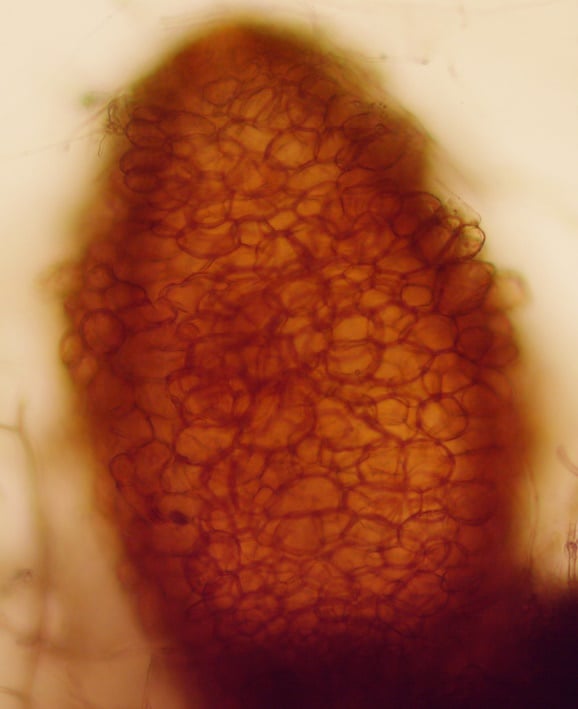
In addition to spores, Cylindrocladium can also form small survival structures called microsclerotia which can survive in plant debris or in the soil. Although similar in structure and function to the sclerotia formed by Rhizoctonia, microsclerotia are much smaller and can only be seen with magnification. Since these structures can survive in the propagation media between crops, the reuse of media is very risky in propagation operations and should be avoided whenever possible. In nurseries where media has been reused, losses up to 100% have been reported (Cline, 2004). Cylindrocladium has been implicated in plant-to-plant spread through direct contact; using correct spacing to avoid overcrowding is important to controlling this disease (Cline, 2004).
Oomycetes
Another common group of pathogens in propagation systems are the oomycetes, particularly Pythium spp. and Phytophthora cinnamomi (Milholland and Oudemans, 2017). These organisms, commonly known as water molds, are favored by excessively wet media and high humidity. They cause stunting, poor root growth, defoliation, and root and crown rots on young plants. Under a microscope, the mycelia of these pathogens are colorless and lack crosswalls. Oomycetes have a relatively complex life cycle that encompasses both sexual and asexual components. Sexual reproduction results in the formation of a structure called an oospore. Oospores are thick-walled and act as a survival structure for the organism. A functionally similar asexual survival structure called a chlamydospore is formed by some species of oomycetes (especially P. cinnamomi) within the roots of infected plants. Sporangia are asexual sporecontaining structures that release zoospores, which can swim actively in a film of water using whip-like flagella. Zoospores have the ability to detect plant root secretions and move toward a potential host based on the concentration gradient formed by root exudates. Oomycetes can be spread by splashing of spores, transfer of contaminated plant material or propagation media, and also by irrigation from a water source contaminated by zoospores.
Managing soilborne diseases
The wet, humid conditions used in the production of cuttings are ideal for soilborne pathogens to spread and survive. There are two basic options for disease control in propagation systems: chemical applications and implementation of good sanitation practices. Currently Terraguard SC (triflumizole) and Cannonball WP (fludioxonil) are registered fungicides for use in blueberry propagation. Unfortunately, many fungicides that are registered for use in the field are not registered for the nursery propagation use pattern.
During propagation, there are three points where pathogens can enter into the nursery. The first is through contamination from physical propagation tools and facilities. All tools used in collecting cuttings should be cleaned before, after and (if possible) periodically during use. A 10% household bleach solution (1 part bleach to 9 parts water) should be sufficient to kill potential pathogens before they come in contact with collected cuttings. The area where the cuttings are prepared for sticking should be made of a material that is cleaned easily and should be wiped down before and after each propagation session. Preferably, this staging area will be located away from high-traffic areas and on either a concrete slab or a bed of gravel or on another well-drained material—rather than soil that could carry potential pathogens. All plant material that remains after propagation has been completed should be removed and disposed of in an area distant from the propagation area. If containers are to be reused, they should be washed thoroughly to remove debris and soaked in a 10% bleach solution for 30 minutes before being reused. This is especially important if the nursery has had a history of soilborne diseases. All of the previously mentioned pathogens here can be spread by contaminated soil or propagation media (Hartmann and Kester, 1983). In the case of oomycetes, contaminated irrigation water must also be considered. If pond water is used, care must be taken in the placement of the intake valve from the pond. Most fungal spores sink to the bottom of collection ponds, whereas zoospores of the oomycetes tend to rise to the pond surface. If the intake valve for the pond is located mid-water, the likelihood of contamination is greatly reduced (Thomas et al., 2005).
The second possible pathogen entry point is through the use of contaminated propagation media (Hartmann and Kester, 1983). Media should never be reused for propagation, as inoculum can build up to lethal levels in a relatively short period of time. This is especially true in the case of Cylindrocladium (Cline, 2004; Haralson, 2009).
The third entry point of pathogens is through infected plant material (Hartmann and Kester, 1983). All mother plants should be checked for the presence of pathogens prior to cutting and sticking, but any cutting showing symptoms or signs of infection should be removed from the propagation area and discarded as soon as possible.
Leaf spots and blights
In addition to root and stem rots, blueberry cuttings are also subject to various foliar diseases due to the high humidity environment required during propagation. Several fungal pathogens have been shown to cause leaf spots including Alternaria tenuissima, Gloeosporium myrtilli, and Phyllosticta spp. Based on communications with producers and UGA Cooperative Extension agents, two of the most frequently reported leaf diseases in south Georgia’s blueberry nurseries are Septoria leaf spot and Botrytis blight. Septoria leaf spot is caused by Septoria albopunctata and produces leaf spots that are circular and range in color from white to tan with a red or purplish border (Figure 19).

Severe infections can lead to poor growth, defoliation, and eventual death of cuttings. On the upper surface of the leaf, one or more pycnidia (asexual flask-shaped fruiting bodies) are usually present and visible with a good hand lens (Figure 20).

Conidia of this pathogen are long and slender, and composed of five to 11 cells (Scherm, 2017) (Figure 21).

In the field, Septoria leaf spot is usually most prevalent and severe during late summer and fall (Ojiambo, 2007), but some spots begin to appear in early May prior to the onset of the propagation season, when they are difficult to see or are still in the latent phase. In production fields, this pathogen is controlled by fungicide sprays during the summer and fall, but currently no chemicals are registered for use on blueberry cuttings. Before sticking, all cuttings taken for propagation should be inspected for leaf spots, which may be very faint at the time spring cuttings are taken, and any cutting showing symptoms or signs of infection should be discarded.
Botrytis blight (caused by the fungus Botrytis cinerea) is a common disease in many crops and has a wide host range (Jones and Benson, 2001). This pathogen causes a blight of the flowers, twigs, and young succulent tissues of blueberries (Bristow et al., 2017). While generally a weak pathogen under normal conditions, Botrytis can result in severe losses during propagation due to the high humidity and tenderness of the tissue of cuttings (Jones and Benson, 2001). Commonly referred to as gray mold, Botrytis takes this common name from the appearance of its conidia, which in great numbers appear as grayish brown tufts on the surface of infected tissue (Figure 22).

When viewed under the microscope, the conidia are single-celled, ovate, and borne in clusters at the tip of highly branched, darkly pigmented conidiophores. Excessive humidity plays a key role in infection and dissemination of Botrytis. Irrigation should be reduced as soon as possible (when sufficient roots have formed) if Botrytis is observed. Sanitation of the propagation area is also of utmost importance. All plant debris should be removed, and work surfaces should be sterilized using a 10% household bleach solution before each propagation session.
Viruses
Another issue that could have a significant negative impact on blueberry propagation is the spread of viruses through cuttings taken from infected plants. Viruses are generally systemic, and therefore most, if not all, cuttings taken from an infected mother plant will also carry the virus. There are numerous viruses which have been confirmed to infect blueberries in North America (Polashock et al., 2017). While not all of these cause severe disease, some can have serious effects on the crop, including poor growth, yield reductions, slow decline, and premature plant death. Typical leaf symptoms of viral infection include mosaic, mottling, ring spots, leaf-rolling, and elongated strap-like leaves (commonly called “shoestringing” in the industry). Any plants showing such symptoms of viral infection must be avoided when making cuttings. It must be kept in mind, however, that infected mother plants may not always show symptoms, either due to a latent period between infection and symptom development or because leaf symptoms do not manifest themselves until later in the season, after cuttings have been taken. This makes regular virus testing of mother plants so important.
In recent years, blueberry red ringspot virus (BRRSV) has come to the attention of both blueberry growers and researchers alike when a number of highbush or southern highbush blueberry plantings in Georgia and North Carolina began showing symptoms and tested positive for presence of the virus. According to the general literature, this virus is strictly transmitted via propagation, and no insect vector appears to be involved. However, in-field spread has been reported in North Carolina (Cline, personal communication), so there is at least some discrepancy as to whether this disease can be vectored. In-field spread has not been observed to date in Georgia, so when observed, BRRSV is an excellent indicator that propagation practices need to be improved with respect to the production of disease-free propagation material. As the name implies, BRRSV causes red ringspots that are 3-6 mm in diameter on the leaves and stems (Figure 23), and in some cultivars, the fruit may show symptoms as well. Ringspots are most evident on the upper surface of the leaves (Polashock and Hillman, 2017), but they are not visible on the new growth at the time when spring cuttings are taken. At that time, dark red to purple or tan ringspots on stems produced during the previous year are the best indication that mother plants are infected.

Overall, the yield losses associated with BRRSV appear to be limited, although on some varieties, discolored ring spots on fruit can render fruit unmarketable.
Bacterial diseases
In addition to viruses, some bacterial diseases can also be spread through blueberry propagation from infected mother plants. Since it was first described in Georgia in 2007, bacterial leaf scorch of blueberry (Figure 24), caused by Xylella fastidiosa, has been found in southern highbush plantings throughout Georgia and Florida, as well as in Alabama, Louisiana, and Mississippi (Brannen et al., 2016). Bacterial leaf scorch can lead to rapid plant decline and death of infected blueberry plants. Although this pathogen is primarily spread from plant to plant in the field by sharpshooter insects, prior work has shown that it can be transmitted at a low level (5% transmission) when propagated cuttings are taken from infected mother plants (Holland, 2013).

In addition to bacterial leaf scorch, another bacterial disease of blueberries likely to be spread via cuttings from infected plants is blueberry stunt. This disease is caused by a phytoplasma that is primarily spread by an insect vector, the sharpnosed leafhopper, and results in stunted plants with shortened internodes, cupping leaves, and yellowing between the veins (Ramsdell and Polashock, 2017) (Figure 25). Although this disease is common in Michigan, New Jersey, and North Carolina, it has not yet been identified in Georgia or Florida. To prevent the dissemination of bacterial diseases through propagation, propagators should avoid taking cuttings from symptomatic plants. It is important to remember that asymptomatic mother plants, those that do not show symptoms at the time cuttings are taken may still be infected, so continued monitoring of mother plants throughout the season is necessary to identify potential sources of viral and bacterial diseases. Frequent monitoring and inspection of mother plants and propagated plants allows for the destruction of infected mother plants and cuttings taken from them before they are widely disseminated in propagation material.

In order to further ensure that cuttings are disease-free, yearly testing of mother plants through use of molecular techniques is also recommended.
Conclusions
The methods of blueberry propagation in south Georgia currently vary widely. Employing the practices laid out in this publication will give propagators the best chance of successfully producing cuttings that are of high quality and free of disease. Growers should completely avoid the reuse of media, and propagation containers should be sterilized before reuse. If possible, the sticking of cuttings should be done on benches above ground level to prevent contamination by soil, and the work surface should be cleaned and cleared of all plant debris before and after each propagation session.
After sticking, cuttings should be scouted frequently for disease. All cuttings showing any signs of disease should be culled immediately and discarded away from all propagation operations. These preventative steps are usually less expensive and more effective than addressing a problem after it reaches critical levels. Generally, by the time disease is visible in a nursery, it is too late to avoid serious losses. In the future, chemical controls will likely play a larger role in the control of soilborne and foliar diseases of blueberry cuttings. As research progresses, an integrated disease management system should be implemented to ensure a constant supply of high-quality, disease-free blueberry plants.
References
Brannen, P. M., Chang, C. J., Boland, R. T., Horton, D. L., & Krewer, G. W. (2016). Bacterial Leaf Scorch of Blueberry. UGA Cooperative Extension Circular 922. University of Georgia, Athens.
Brannen, P. M., Chang, C. J., & Horton, D. L. (2017). Bacterial leaf scorch. Pages 79-81 in: Compendium of Blueberry and Cranberry Diseases. Polashock, J. J., Caruso, F. L., Averill, A. L., and Schilder, A.C. eds. American Phytopathological Society, St. Paul, MN.
Bristow, P. R., Milholland, R. D., & Schilder, A. M. C. (2017). blight and fruit rot. Pages 17-19 in: Compendium of Blueberry and Cranberry Diseases. Polashock, J.J., Caruso, F.L., Averill, A.L., and Schilder, A.C. eds. American Phytopathological Society, St. Paul, MN.
Cline, B., & Mainland, M. (2008). Blueberry propagation. Pages 56-62 in: Proceedings of the 42nd Annual Open House and Trade Show, North Carolina Blueberry Council, Clinton, NC.
Cline, B. (2004). Fungal pathogens associated with blueberry propagation beds in North Carolina. Small Fruits Rev. 3 (1/2):213 – 221.
Haralson, J. C. 2009. Pathogens associated with blueberry cutting failure in south Georgia nurseries and their control (M.S. thesis, University of Georgia, Athens, GA). Retrieved from https://getd.libs.uga.edu/pdfs/haralson_jeremy_c_200905_ms.pdf
Haralson, J. C., Brannen, P. M., Scherm, H., & NeSmith, D. S. (2012). Chemical control of Cylindrocladium and Rhizoctonia root rots in blueberry propagation. Crop Protection 44:1-5.
Hartmann, H. T., & Kester, D. E. (1983). Plant Propagation: Principles and Practices. Prentice-Hall, Englewood Cliffs, NJ.
Hoitink, H. & Boehm, M. (1999). Biocontrol within the context of soil microbial communities: a substrate-dependent phenomenon. Annu. Rev. Phytopathol. 37:427-446.
Holland, R. M. (2013). Location, transmission, and impact of Xylella fastidiosa in southern highbush blueberries. (M.S. thesis, University of Georgia, Athens, GA). Retrieved from https://getd.libs.uga.edu/pdfs/holland_renee_m_201305_ms.pdf
Jones, R. K., & Benson, D. M., ed. (2001). Diseases of Woody Ornamentals and Trees in Nurseries. American Phytopathological Society, St. Paul, MN.
Krewer, G., & Cline, B. 2003. Blueberry Propagation Suggestions. Southern Region Small Fruit Consortium. Retrieved from https://smallfruits.org/files/2019/06/03BlueberryPropagationSuggestions.pdf
Krewer, G. & Ruter, J. (2005). Fertilizing Blueberries in Pine Bark Beds. UGA Cooperative Extension Bulletin 1291. University of Georgia, Athens.
Milholland, R. D., & Oudemans, P. V. (2017). Phytophthora root rot. Pages 37-39 in: Compendium of Blueberry and Cranberry Diseases. Polashock, J.J., Caruso, F.L., Averill, A.L., and Schilder, A.C. eds. American Phytopathological Society, St. Paul, MN.
Ojiambo, P. S., Scherm, H., & Brannen, P. M. (2007). Temporal dynamics of Septoria leaf spot of blueberry and its relationship to defoliation and yield. Online. Plant Health Progress. doi:10.1094/PHP-2007-0726-05-RS.
Polashock, J. J., Caruso, F. L., Averill, A. L., & Schilder, A. C. (2017). Compendium of Blueberry and Cranberry Diseases. American Phytopathological Society, St. Paul, MN.
Polashock, J. J., & Hilman, B. I. (2017). Red ringspot. Pages 68-70 in: Compendium of Blueberry and Cranberry Diseases. Polashock, J.J., Caruso, F.L., Averill, A.L., and Schilder, A.C. eds. American Phytopathological Society, St. Paul, MN.
Ramsdell, D. C., & Polashock, J. J. (2017). Stunt. Pages 84-85 in: Compendium of Blueberry and Cranberry Diseases. Polashock, J.J., Caruso, F.L., Averill, A.L., and Schilder, A.C. eds. American Phytopathological Society, St. Paul, MN.
Scherm, H. (2017). Septoria leaf spot. Pages 41-43 in: Compendium of Blueberry and Cranberry Diseases. Polashock, J.J., Caruso, F.L., Averill, A.L., and Schilder, A.C. eds. American Phytopathological Society, St. Paul, MN.
Schilder, A. M. C., & Cline, W. O. (2017). Cylindrocladium rot. Pages 19-21 in: Compendium of Blueberry and Cranberry Diseases. Polashock, J.J., Caruso, F.L., Averill, A.L., and Schilder, A.C. eds. American Phytopathological Society, St. Paul, MN.
Thomas, P. A., Seymour, R. M., Pennisi, B. V., & Stegelin, F. E. (2005). Greenhouse*A*Syst: Water Recycling and Water Reuse Assessment. UGA Cooperative Extension Bulletin 1278. University of Georgia, Athens.