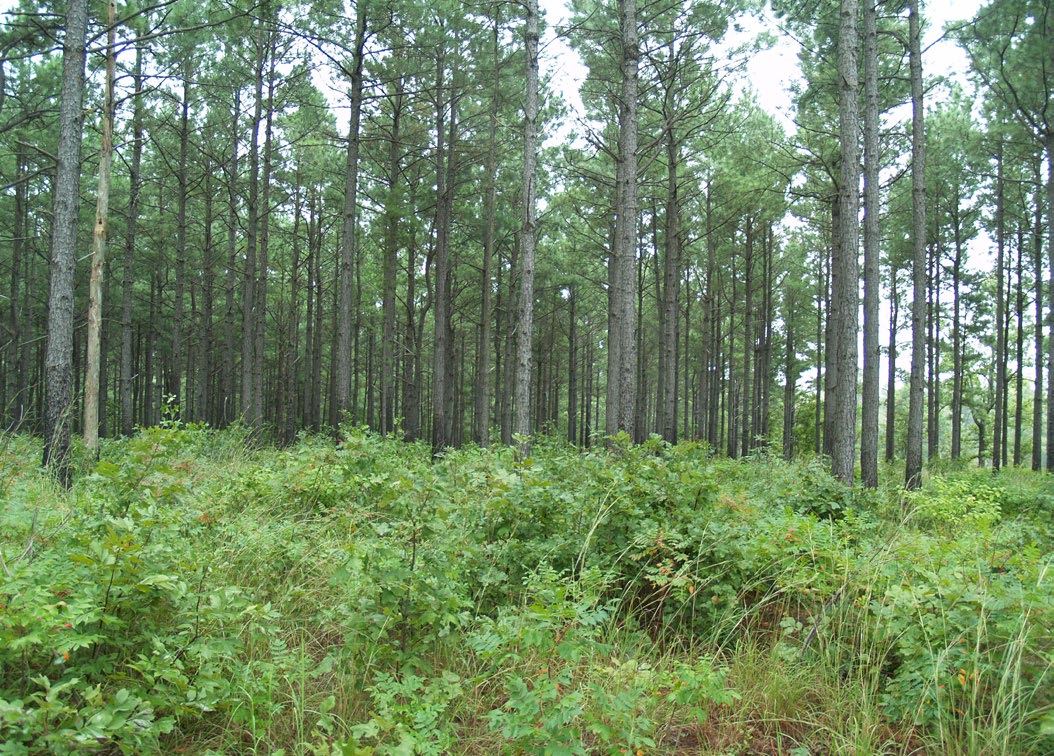

Shortleaf pine and its associated plant communities evolved with fire of varied temperatures, or mixed severity, and a fire return interval, or frequency of 2–18 years. Periodic occurrences of fire provide shortleaf a growth advantage; a competitive edge that allows it to both establish and maintain a place in the canopy.11 Without fire, hardwoods and loblolly or Virginia pines out-compete shortleaf.4 Across its wide range, shortleaf is found growing with blackjack, white, and post oaks; trees that have similar adaptive traits and fire resistance.6 The high diversity and number of herbaceous understory plants and wildlife found in shortleaf savannahs and woodlands is sustained with frequent prescribed burns.10 The frequency, intensity, and time of year of a burn all influence how fire shapes a shortleaf forest.
Due to its reliance on fire, foresters and ecologists commonly refer to shortleaf as fire resistant, fire resilient, fire dependent, or fire adapted.11 However, shortleaf pine is not fire-proof. And while fire provides many benefits there are risks. Some trees, particular seedlings and saplings will be damaged or destroyed from fire. Land managers must base the decision to burn on their overall management goals.
Fire Adaptations

Credit: Holly Campbell
Shortleaf pine possesses many fire tolerant traits. These include: (1) the ability to rapidly sprout following, (2) thick platy bark protecting the cambium from fire injury, and (3) abundant seed crops and persistent cones that allow seedlings to recover after a fire.4,12 It is thought that needle configuration and low needle flammability protect terminal buds on the branches allowing shortleaf to survive complete crown scorch.7 Additionally, shortleaf is naturally resistance to fire scar rot, doesn’t produce large quantities of flammable resin, and is well adapted to drought conditions.5,12 Trees that are greater than 4 to 6 inches in ground-line diameter, 8 to 16 feet tall, and 8 to 15 years old are less likely to be killed from fire.8,12
Seedlings and saplings top-killed by fire sprout from reproductive buds located in the basal crook, a unique root feature of shortleaf.12 The basal crook (Fig. 2) is positioned at or slightly below the soil where cooler temperatures and insulating properties of the duff layer protects the buds from the heat of a fire.12 Loblolly pine does not sprout after a fire, likely because without a basal crook its adventitious buds are located higher on the stem and are more likely to be damaged by fire.14 The ability to sprout provides shortleaf a key competitive advantage in a fire prone landscape.

Sprouting After a Fire
Shortleaf pine sprouting success following a fire varies with the season of burn, seedling size, and fire intensity and damage. Better sprout survival, as high as 90%, is reported with dormant season burns.5,1 In contrast, one study found less than half (43%) the seedlings survived a mid-April burn.9 The study also concluded that smaller seedlings (1/4 to 3/4 inch ground line diameter and 1 to 2.5 feet tall, with less than 50% crown scorch) were more likely to sprout after top-kill.9 Shortleaf can sprout several times. Sprouting decreases significantly once the stem reaches a six inch ground-line diameter.
Fire Frequency
Mature shortleaf pine forests are rarely killed from frequent low intensity prescribed burns. However, mortality is seen in shortleaf pine stands with thick litter layers accumulated after years of fire exclusion. In mature shortleaf stands diameter growth may be decreased with frequent fire.
Fire plays a key role in encouraging shortleaf pine natural regeneration and later survival; however, repeated top-kill often prevents seedlings from growing into sapling size.2,13 Stambaugh concluded, “Frequent burning (1 to 4 year frequency) likely promotes natural regeneration, but a lowered frequency (8 to 15 years) promotes survival and recruitment into the overstory.”13
Season of Burn
Growing season burns are the best time to control hardwood intrusion and enhance the growth of understory vegetation.3 J.S. Glitzenstein advocates that fire frequency is more important than fire season, and advises that burning in any season is better than no fire at all. A combination of growing season and dormant season fire of mixed intensity occurring every 3 to 15 years is a good management approach to maintain and establish shortleaf forests.5
Role of Fire
Periodic fire, once common from the Carolina Piedmont to the Missouri Ozarks, is necessary to perpetuate the shortleaf ecosystem. The historic fire regime favored shortleaf pine and kept fire intolerant hardwoods in check. Today prescribed fire is a useful tool to manage shortleaf pine forests for specific management goals.
In artificial regeneration, prescribed burns are used before planting to reduce fallen woody debris, or slash, and remove unwanted pines or hardwoods that seed in or sprout after harvest. Fire is critical for natural regeneration to expose mineral soil prior to seedfall. Prescribed fire mimics natural disturbance keeping the woodland in early succession and creating habitat rich in grass and forbs preferred by many animals including bobwhite quail, wild turkey, and grassland birds. A burning program that varies in frequency and applied during the dormant season is recommended to restore and maintain shortleaf ecosystems.
While the benefits of prescribed burns to enhance wildlife habitat or restore plant communities are many, the advantages for timber are far fewer. Land managers are ill-advised to apply fire to young plantations as the loss of growth from being top killed lengthens the time till harvest and reduces return on investment. Even in mature stands the potential for growth loss and mortality often outweigh the benefits of fire. Landowners managing plantations for timber production are better advised to use herbicides to control competition and begin a burn program, if desired, once the trees are sufficient size.
| Key Points on Shortleaf Pine and Fire |
|---|
| Fire is a primary disturbance that shapes the composition and structure of the shortleaf forest plant community; shortleaf pine is adapted to fire. |
| Fire adaptations include; a thick platy bark, natural resistance to fire scar rot, ability to sprout many times after top-kill. |
| Frequent burns of 1 to 4 years increase seedling recruitment; burns applied 8-15 years favor stand establishment. |
| Fire can be safely applied to stands that are greater than 4 to 6 inches in ground-line diameter, 8 to 16 feet tall , and 8 to 15 years old. |
| Smaller seedlings less than 3/4 inch GLD, 1 to 2.5 feet tall, and have less than 50 % crown scorch have best chance to sprout and survive fire top-kill. |
| Seedlings burned in the dormant season sprout better than those burned the growing season. |
| For ecosystem maintenance, frequency of fire is preferred over season of fire. |
References
- Cain, M.D., and M.G. Shelton. 2000. Survival and growth of Pinus echinata and Quercus seedling in response to simulated summer and winter prescribed burns. Can. J. For. Res. 30, pp.1830-1836.
- Cain, M.D., and M.G. Shelton. 2002. Does prescribed burning have a place in regenerating uneven-aged loblolly-shortleaf stands? SJAF 26, pp 117-123.
- Glitzenstein, J.S., D.R. Streng, and D. Wade. 2003. Fire frequency effects on longleaf pine (Pinus palustris) vegetation in South Carolina and northeast Florida. Natural Areas Journal 23:22-37.
- Guldin J. M. 1986. Ecology of shortleaf pine. In: Proceedings of symposium on the shortleaf pine ecosystem, P.A. Murphy, editor. Arkansas Cooperative Extension Service. March 31- April 2, 1986, Little Rock, AR. pp 25-40.
- Guyette, R.P., R. Muzika., and S.L. Voelker. 2007. The historical ecology of fire, climate, and the decline of shortleaf pine in the Missouri Ozarks, In: Shortleaf pine restoration and ecology in the Ozarks: proceedings of a symposium. General Technical Report -NRS-P-15, USDA Forest Service, Nor. Res. Sta. Newton Square, PA pp 8-18
- Heirs, Kevin J., J.R. Walters, R.J Mitchell, J.M. Varner, L.M Conner, L.A.Blanc, and J. Stowe. 2014. Ecological value of retaining pyrophytic oaks in longleaf pine ecosystems. The Journal of Wildlife Management 78(30: 383-393.
- Kormarek, E.V. 1981. Scorch in pines. Management Note 2. Tall Timbers Research Station. Tallahassee, FL 7pp.
- Lawson, E. R. 1990. Pinus echinata Mill. shortleaf pine. Pages 316-326 in R. M. Burns and B. H. Honkala, technical coordinators. Silvics of North America. Volume 1. Conifers. U.S. Department of Agriculture, Forest Service. Agriculture Handbook No. 654. Washington, DC.
- Lilly CG, Will RE, Tauer CG, Guldin JM, Spetich, M. 2012. Factors affecting the sprouting of shortleaf pine rootstock following prescribed fire. Forest Ecology and Management 265:13-19.
- Masters RM. 2007. The importance of shortleaf pine for wildlife and diversity in mixed oak-pine forests and in pine-grassland woodlands. In: Shortleaf pine restoration and ecology in the Ozarks: proceedings of a symposium. General Technical Report -NRS-P-15, USDA Forest Service, Nor. Res. Sta. Newton Square, PA. pp. 35-46.
- Masters, R. E. 2008. Fire ecology and management of shortleaf pine. http://www.fire.forestencyclopedia.net/p/p165/view, Accessed 2007.
- Mattoon, W.R. 1915. Life history of shortleaf pine. US Dept. Of Agri. Bulletin No. 244. Washington DC 46pp.
- Stambaugh, M.C., R.P. Guyette, and D.C. Dey. 2007. What fire frequency is appropriate for shortleaf pine regeneration and survival? In: Shortleaf pine restoration and ecology in the Ozarks: proceedings of a symposium. General Technical Report -NRS-P-15, USDA Forest Service, Nor. Res. Sta. Newton Square, PA. pp. 121-128
- William, R.A., 1998. Effects of fire on shortleaf and loblolly pine reproduction and its potential use in shortleaf/oak/hickory ecosystem restoration. In: Proceedings of the 9th Biennial Southern Silviculture Research Conference. General Technical. Report. SRS-20. USDA Forest Service, Southern Research Station, Asheville NC, pp.321-325.
Shortleaf pine (Pinus echinata) forests and associated habitats contain extraordinary cultural, ecological, and economic value by providing wildlife habitat, recreational opportunities, enhanced water quality, and high value wood products. Despite these values and services, shortleaf pine has significantly declined across much of its 22-state range. These fact sheets provide tools and resources necessary for the restoration of shortleaf pine.