

Irrigation scheduling
Decisions regarding the timing, frequency, and amount of water required for a crop are some of the most critical factors in vegetable production. There are numerous irrigation scheduling strategies employed by growers, but the crop water demand method of irrigation management is one of the most reliable and precise ways to schedule irrigation. This method adjusts irrigation events using the crop evapotranspiration, or ETc (da Silva et al., 2019).
The ETc is a product of daily reference evapotranspiration (ETo) and crop coefficients (Kc). See UGA Extension Bulletin 1511, “Principles of Irrigation and Scheduling for Vegetable Crops in Georgia,” for more information. The ETo represents the weather portion of ETc, and accurate daily ETo for several locations around the state of Georgia can be gathered from the Georgia Automated Environmental Monitoring Network. The Kc represents the crop water requirement portion of ETc and it must be specific to the growth stage of each crop (Allen et al., 1998).
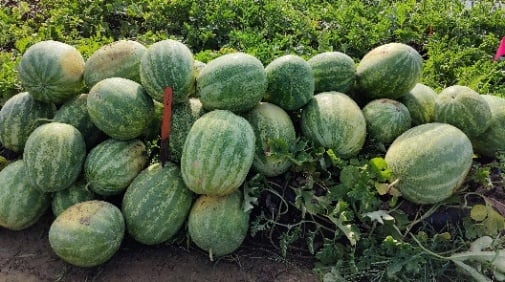
For watermelon (Figure 1), like most vegetables, the Kc is divided into initial (Kcini; field establishment), mid-season (Kcmid.; vegetative, flowering, and fruiting growth stages), and late-season (Kcend; maturity growth stage). The values commonly used to estimate crop water requirements in watermelon are 0.4, 1.0, and 0.75, respectively. The Kc is simply a factor that is multiplied by the ETo to determine water usage. If ETo for a week is 1 inch and the crop Kc is 0.75, then 1 inch x 0.75 (Kc) = 0.75 inches of water would be required for that week (Figure 2).
The Kcini (0.4) is used from transplanting until root establishment, which takes about two weeks. After root establishment, watermelon plants enter into the vegetative stage, and the midseason, Kcmid (1.0) should be used throughout this period that goes approximately from three to eight weeks after planting. The Kcmid should also be used during the flowering and fruiting period, which may take an additional three to four weeks depending on the cultivar. When watermelon reaches fruit maturity around 12 weeks after planting, the late-season Kcend (0.75) should be used to calculate the ETc as the crop matures. Particularly, the Kcend should be assumed when plants are senescing, which means water uptake is for maintenance instead of reproduction.


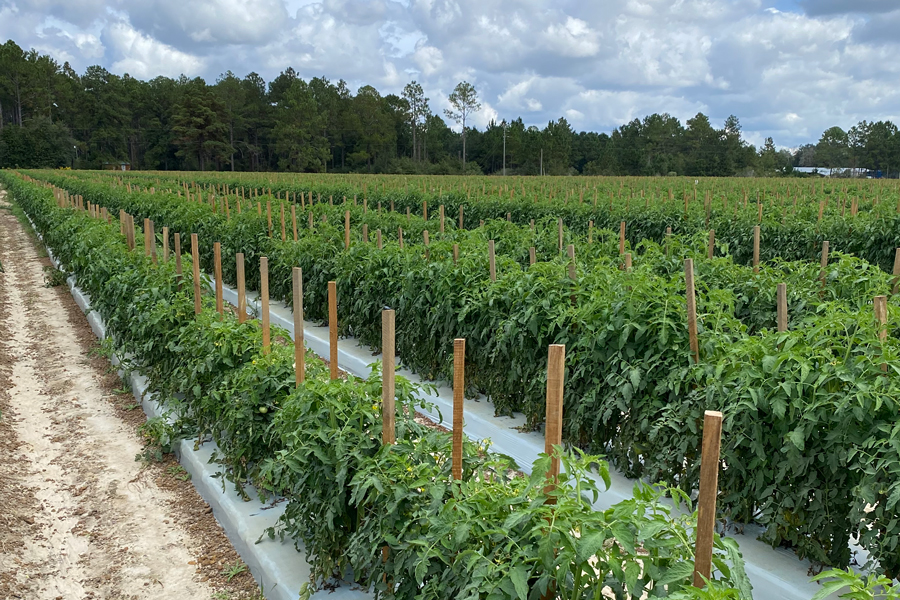
In Georgia, watermelons are grown primarily using plastic mulch with drip or overhead irrigation. In both cases, irrigation scheduling during the crop development is required to maximize crop yields. Growers can use the watermelon crop ETc to determine the irrigation scheduling requirements. In this section, 18 years of historical information on the watermelon ETc was calculated and used to schedule weekly irrigation strategies for four planting dates (i.e., March 1, March 15, April 1, and April 15) in the southwest, southeast, northwest, and northeast regions of Georgia. Daily ETc from 2000 to 2017 was calculated using the average ETo from eight different locations in each of the four regions of Georgia (Figure 3), as well as the aforementioned Kcini (0.4), Kcmid (1.0), and Kcend (0.75).

Figure 3 contains weekly ETc for watermelon production in the southwest portion of the state for each planting date studied. This location was selected for illustration because watermelon production in Georgia is concentrated in the southwest portion of the state. The watermelon ETc for all locations and planting dates are presented in Table 1.
| Week after planting | Southwest 3/1 | Southwest 3/15 | Southwest 4/1 | Southwest 4/15 | Northeast 3/1 | Northeast 3/15 | Northeast 4/1 | Northeast 4/15 | Northwest 3/1 | Northwest 3/15 | Northwest 4/1 | Northwest 4/15 | Northeast 3/1 | Northeast 3/15 | Northeast 4/1 | Northeast 4/15 |
|---|---|---|---|---|---|---|---|---|---|---|---|---|---|---|---|---|
| 1 | 0.22 | 0.28 | 0.32 | 0.40 | 0.19 | 0.25 | 0.30 | 0.36 | 0.17 | 0.22 | 0.26 | 0.33 | 0.17 | 0.22 | 0.27 | 0.35 |
| 2 | 0.28 | 0.33 | 0.38 | 0.44 | 0.25 | 0.30 | 0.36 | 0.39 | 0.22 | 0.26 | 0.31 | 0.38 | 0.22 | 0.26 | 0.32 | 0.36 |
| 3 | 0.69 | 0.81 | 1.00 | 1.18 | 0.63 | 0.74 | 0.94 | 1.07 | 0.55 | 0.66 | 0.83 | 0.99 | 0.56 | 0.67 | 0.87 | 1.00 |
| 4 | 0.83 | 0.94 | 1.11 | 1.21 | 0.72 | 0.88 | 0.99 | 1.10 | 0.66 | 0.78 | 0.96 | 1.00 | 0.65 | 0.80 | 0.91 | 1.01 |
| 5 | 0.81 | 1.00 | 1.18 | 1.34 | 0.74 | 0.94 | 1.07 | 1.27 | 0.66 | 0.83 | 0.99 | 1.14 | 0.67 | 0.87 | 1.00 | 1.16 |
| 6 | 0.94 | 1.11 | 1.21 | 1.30 | 0.88 | 0.99 | 1.10 | 1.16 | 0.78 | 0.96 | 1.00 | 1.10 | 0.80 | 0.91 | 1.01 | 1.09 |
| 7 | 1.00 | 1.18 | 1.34 | 1.40 | 0.94 | 1.07 | 1.27 | 1.27 | 0.83 | 0.99 | 1.14 | 1.22 | 0.87 | 1.00 | 1.16 | 1.21 |
| 8 | 1.11 | 1.21 | 1.30 | 1.39 | 0.99 | 1.10 | 1.16 | 1.27 | 0.96 | 1.00 | 1.10 | 1.21 | 0.91 | 1.01 | 1.09 | 1.22 |
| 9 | 1.18 | 1.34 | 1.40 | 1.35 | 1.07 | 1.27 | 1.27 | 1.27 | 0.99 | 1.14 | 1.22 | 1.25 | 1.00 | 1.16 | 1.21 | 1.23 |
| 10 | 1.21 | 1.30 | 1.39 | 1.44 | 1.10 | 1.16 | 1.27 | 1.35 | 1.00 | 1.10 | 1.21 | 1.34 | 1.01 | 1.09 | 1.22 | 1.36 |
| 11 | 1.01 | 1.05 | 1.01 | 1.10 | 0.94 | 0.94 | 0.94 | 1.02 | 0.86 | 0.92 | 0.94 | 1.02 | 0.87 | 0.91 | 0.93 | 1.01 |
| 12 | 0.98 | 1.04 | 1.08 | 0.99 | 0.88 | 0.94 | 1.02 | 0.94 | 0.83 | 0.91 | 1.00 | 0.95 | 0.82 | 0.91 | 1.02 | 0.98 |
| Total | 10.26 | 11.60 | 12.73 | 13.56 | 9.34 | 10.58 | 11.69 | 12.46 | 8.50 | 9.78 | 10.99 | 11.95 | 8.55 | 9.81 | 10.99 | 11.98 |
| inches of water per week | ||||||||||||||||
Scheduling irrigation events
Watermelon is transplanted to the field when plants are 4- to 6-inches tall. After transplanting, seedlings should be frequently irrigated to ensure that there is sufficient water for root establishment. Applying an average of 0.25, 0.31, 0.35, and 0.42 inches of water per week in the initial two weeks after transplanting should be sufficient to ensure root establishment when transplant occurs on March 1, March 15, April 1, and April 15, respectively (Figure 4). As plants grow larger, there is a peak of water demand due to a quick leaf expansion (vegetative growth stage), which occurs about three weeks after transplanting. Watermelons transplanted on March 1 require 0.69 inches of water per week at three weeks post-transplant (rapid vegetative growth), while crop water needs increase up to 1.18 inches of water per week for the same developmental stage of the plant when transplanting occurs in April 15 (Figure 4). Regardless of the planting date, proper water application is important due to the low water-holding capacity of Georgia soils. Inadequate soil moisture in the watermelon root zone during the early vegetative stage can reduce leaf area and shoot length, delaying watermelon maturity and causing yield loss (Coolong and Granberry, 2017; Najafabadi et al., 2018).

After the vegetative stage, crop water demand steadily increases as watermelon plants enter flowering and early fruit development (up to 10 weeks after transplanting). In case of late planting dates, irrigation volumes can potentially increase to 1.4 inches of water per week to avoid water stress (Figure 4). Water deficits during watermelon flowering induces physiological disorders (Erdem and Yuksel, 2003), while water deficits during fruiting are mostly attributed to a reduction of fruit number per plant, fruit weight, and fruit size (Leskovar et al., 2002).
Georgia weather conditions lead to a continuous increase of ETc during the watermelon season with a peak of ETc typically occurring at maturity, approximately 10 weeks after transplanting as previously reported by Maynard et al., (2001). Crop water demand decreases at the end of the season (weeks 11 and 12), indicating that fruit are ready to harvest (Srivastava, 2005). However, the warm temperatures in late spring and early summer in Georgia may still require growers to supply water to avoid drought stress. Applying in average 1.03, 0.95, 0.93, and 0.93 inches of water per week for the southwest, southeast, northwest, and northeast regions should be enough to supply crop water demand in the end season, or harvesting time.
Overall, delaying the planting date for watermelons in the spring will result in a higher water demand during the season, mostly due to increased temperatures during crop development. Late planting dates required an average of 27% more water during the season for all Georgia locations. Differences in water requirements among planting dates were especially high from three to eight weeks after planting (Figure 4). Failure to replace crop water loss by adjusting the irrigation volume according to the different planting dates can result in yield and quality losses. It is important to highlight that the use of historical ETc in years with abnormally dry or wet conditions may lead to underirrigation or overirrigation. Growers must track weather conditions to properly adjust water requirements.
Food safety considerations
Managing irrigation in vegetable production is a matter of food safety for crop production, and growers should be aware of whether they must comply with the Produce Safety Rule (PSR; U.S. FDA, 2015), a third-party audit, or buyer requirements in order to sell their produce. Information regarding the Produce Safety Rule can be found through the Food and Drug Administration or by contacting UGA Extension.
For farms covered by the Produce Safety Rule, each water source used for irrigation, fertigation, pesticide application, or any other water that comes in contact with the fruit surface must meet the FDA’s microbial water quality standards. A grower must establish a microbial water quality profile (MWQP) if using surface or ground water to ensure that their water has a geometric mean of 126 colony forming units (CFU) or less generic Escherichia coli per 100 ml sample and a statistical threshold value of 410 or less CFU per 100 mL generic E. coli, based on a four-year rolling average (US FDA, 2015). For groundwater sources, a minimum of four samples must be tested within the first year, with one additional test each subsequent year to be rolled into the MWQP. Surface water sources must be sampled 20 times within the first two to four years, with an additional five samples rolled into the MWQP each subsequent year. To help growers determine whether their water meets the water quality requirements, UGA’s Agricultural and Environmental Services lab has developed online tools at https://aesl.ces.uga.edu/calculators/fsma.
A grower using drip tape under plastic mulch does not need to establish a MWQP if that is the only water used on the crop and the water is not likely to contact the fruit, but a grower covered by the Produce Safety Rule using overhead irrigation must establish a MWQP because there is a direct contact between applied water and the harvestable portion of the crop. However, if the grower using drip tape applies a foliar spray that will contact the melons, that water must meet the Produce Safety Rule MWQP standards. Farms not covered by the rule should regularly sample and test their surface and ground water sources for generic E. coli, which is the most commonly used indicator of fecal contamination and potential pathogenic E. coli presence. Regardless of whether a farm is covered by the Produce Safety Rule, a third-party food safety auditor may require an irrigation water profile. If a water source is consistently failing to meet the required microbial water quality standards, a grower may consider water treatment using ultraviolet light (Jones et al., 2014) and other validated water treatment processes.
Summary
Irrigation strategies designed to replace crop water losses by adjusting the irrigation volume based on crop evapotranspiration can improve water use efficiency in watermelon production. Late planting dates do require higher volumes of water than early planting dates, although marketing—not irrigation—usually determines when watermelons are planted.
Irrigation scheduling reported in Table 1 can be used as an important, simple, and robust guideline for the efficient use of water in watermelon production. The efficiency of water delivery by different irrigation systems can be best managed when ETc is combined with soil water monitoring in the root zone. More information regarding watermelon production can be found in UGA Extension Bulletin 996, “Commercial Watermelon Production.”
References
Allen, R. G., Pereira, L. S., Raes, D., & Smith, M. (1998). Crop evapotranspiration: Guidelines for computing crop water requirements (FAO Irrigation and Drainage Paper No. 56). Food and Agriculture Organization of the United Nations.
Coolong, T., & Granberry, D. M. (2017). Commercial watermelon production (Publication No. B 996). https://extension.uga.edu/publications/detail.html?number=B996
da Silva, A. L. B. R., Coolong, T., & Diaz-Perez, J. C. (2019). Principles of irrigation scheduling for vegetable crops in Georgia (Publication No. B 1511). https://extension.uga.edu/publications/detail.html?number=B1511
Erdem, Y., & Yuksel, A. N. (2003). Yield response of watermelon to irrigation shortage. Scientia Horticulturae, 98(4), 365–383. https://doi.org/10.1016/S0304-4238(03)00019-0
Jones, L. A., Worobo, R. W., & Smart, C. D. (2014). UV light inactivation of human and plant pathogens in unfiltered surface irrigation water. Applied Environmental Microbiology, 80(3), 849–854. https://doi.org/10.1128/AEM.02964-13
Leskovar, D. I., Bang, H., Kolenda, K., Franco, J. A., & Perkins-Veazie, P. (2002, August). Deficit irrigation influences yield and lycopene content of diploid and triploid watermelon. In XXVI International Horticultural Congress: Issues and Advances in Postharvest Horticulture 628 (pp. 147–151).
Leskovar, D. I., Bang, H., Kolenda, K., Franco, J. A., & Perkins-Veazie, P. (2002, August). Deficit irrigation influences yield and lycopene content of diploid and triploid watermelon. In XXVI International Horticultural Congress: Issues and Advances in Postharvest Horticulture (Vol. 628, pp. 147–151). International Society for Horticultural Science. https://doi.org/10.17660/ActaHortic.2003.628.17
Maynard, D. N., Hochmuth, G. J., Vavrina, C. S., Stall, W. M., Kucharek, T. A., Webb, S. E., Taylor, T. G., & Smith, S. A. (2001). Cucurbit production in Florida. In D. N. Maynard & S. Olson (Eds.), Vegetable production guide for Florida (Ch. 27, pp. 151–178). Institute of Food and Agricultural Sciences, University of Florida.
Saha, U., Hitchcock, R., & Sonon, L. (n.d.). A tool for microbial water quality profile evaluation as per produce safety rules under Food Safety Modernization Act. University of Georgia Agricultural and Environmental Services Laboratories. https://aesl.ces.uga.edu/calculators/fsma/
Shukla, S., Shrestha, N. K., Jaber, F. H., Srivastava, S., Obreza, T. A., & Boman, B. J. (2014). Evapotranspiration and crop coefficient for watermelon grown under plastic mulched conditions in sub-tropical Florida. Agricultural Water Management, 132, 1–9. https://doi.org/10.1016/j.agwat.2013.09.012
Srivastava, S. (2005). Crop coefficients and water quality for watermelon and bell pepper under drip and seepage irrigation (Doctoral dissertation, University of Florida). University of Florida Institutional Repository.
U.S. Food and Drug Administration. (2015). Standards for the growing, harvesting, packing, and holding of produce for human consumption. Federal Register, 80, 74353–74642.
U.S. Food and Drug Administration. (2017). Standards for the growing, harvesting, packing, and holding of produce for human consumption: What you need to know about the FDA regulation: Guidance for industry small entity compliance guide. https://www.fda.gov/media/107298/download
U.S. Food and Drug Administration. (2019). FSMA final rule on produce safety. https://www.fda.gov/food/food-safety-modernization-act-fsma/fsma-final-rule-produce-safety
Yoosefzadeh Najafabadi, M., Soltani, F., Noory, H., & Díaz-Pérez, J. C. (2018). Growth, yield and enzyme activity response of watermelon accessions exposed to irrigation water deficit. International Journal of Vegetable Science, 24(4), 323–337. https://doi.org/10.1080/19315260.2017.1419329