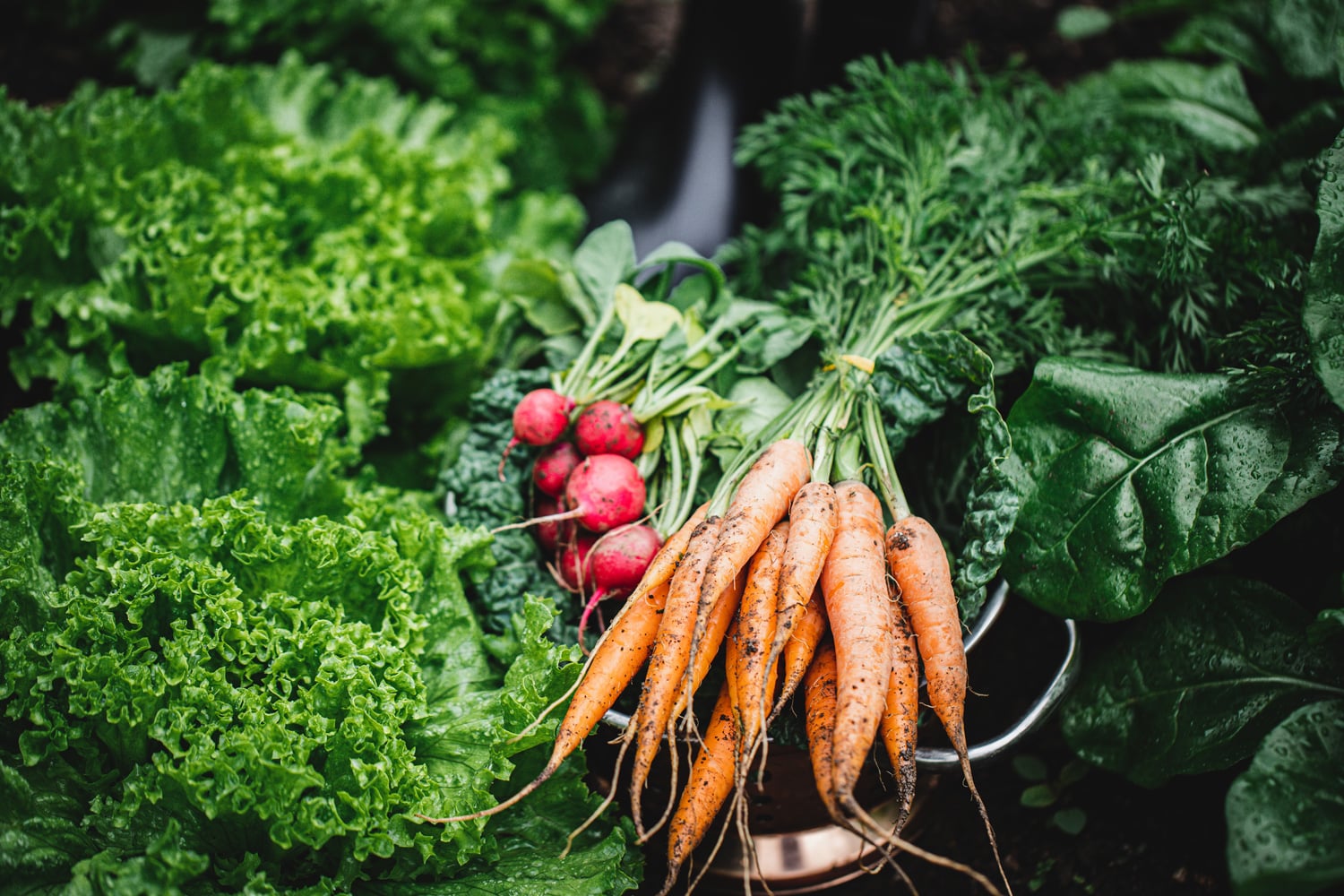

Growing vegetables organically can be rewarding and productive. This resource explains the basic elements of successful organic vegetable production, from initial site location, soil preparation, irrigation, and variety selection to insect and disease control, composting, mulching, and fertilization, and successive planting and crop rotation.
Garden Location
The garden should have a southern exposure (south side of your home) or be in an open field if at all possible. Full sun all day is desirable; however, at the least there should be a minimum of 6-8 hr of direct sunlight at the chosen location. A well-drained site even after a heavy rain is necessary particularly for root vegetables. Poor drainage may be improved by regrading, digging ditches, installing a tile drain
field, or building raised beds.
Nearby trees and shrubs may have extensive root systems that may interfere with water and nutrient uptake of plants at your site. Locate the site to minimize or avoid this problem. As a last resort, consider removal of trees and shrubs that may interfere with production.
Land with a slope of 1.5% or greater (18-in. elevation change in 100 ft) should be avoided or terraced to prevent runoff and soil erosion. Contour planting, which is setting the rows to follow the contour of the land, can also help with runoff problems. Ask your local county Extension agent for more information on dealing with this situation.
The site should also have a water supply nearby. Sites with serious weed problems such as nutsedge, Bermuda grass, or kudzu should be avoided unless adequate measures are taken to control them. This does not preclude using these sites, but considerable work is required to remove and control these weeds.
You should consider fencing the site if you have a significant wild animal population nearby. Deer, raccoons, and rabbits, to name a few, may become problems. Domestic animals such as dogs may also become a problem because many like to dig. Fences as high as 6 ft, an electric fence, or some combination may be required to control animals such as deer. Local building codes and/or restrictive covenants may govern what type of fence or even if a fence can be erected. Electric fences in particular may be prohibited in residential neighborhoods. Finally, for convenience, a location near the house is desirable.
Not all of the above recommendations can be accommodated in all situations. Many established neighborhoods have large shade trees and extensive landscaping. This may preclude having a garden, but container gardens may still be possible where they can be moved to sunny locations as needed. Growing leafy greens may still be possible in a less than ideal light situation, but they will require some full sun during the day.
Garden Planning
The size of your garden will determine, in part, many aspects of your garden plan. Large gardens where tractors will be used can be worked more easily with long rows; small gardens may be worked more easily in small beds with footpaths surrounding them.
There are many other things to consider in planning your garden. Fertility requirements vary with the crop, so heavy feeders and light feeders may be grouped separately to help manage fertilization. Long-season crops such as eggplant, tomato, pepper, and okra should be planted so they don’t interfere with replanting short-season crops such as beans and brassicas. Tall-growing crops such as pole beans, tomatoes, and corn should be planted so they don’t shade shorter crops. You may not be able to accommodate all of these recommendations in your garden, but you should try to accommodate as many as possible to help insure a successful garden.
An important part of garden planning is record keeping. General information about soil amendments used and weather information (particularly rainfall and first and last frost dates) can be useful, especially when tracked from year to year. Specific information about a particular vegetable can also be helpful for future planning. Information such as variety selection, planting date, days to harvest, disease, and insect problems should be noted. This data can help you determine which vegetables and varieties are best for your location.
Watering, fertilizing, and any cultural practices should also be recorded. This helps in determining what should be done in the garden from day to day. Finally, keep track of what is grown where in your garden. This information will help with successive plantings and crop rotation as noted elsewhere in this publication.
When to plant is also an important part of garden planning. Table 1 lists the hardiness and days to maturity for several vegetables. Vegetables can be classed into two broad categories: warm- and cool-season crops.
Warm-season crops can be further subdivided into tender and very tender vegetables, and cool-season crops can be subdivided into hardy and half-hardy crops. Very tender crops cannot stand any frost and will not do well under cool nighttime temperatures (below 55 °F). Tender crops also don’t like frost but can stand cooler night temperatures.
Hardy cool-season vegetables can withstand frost and can be grown during the winter in all but the coldest northern parts of Georgia. Half-hardy cool-season vegetables can withstand cool temperatures and light frosts, but hard freezes and heavy frost can be detrimental.
Irrigation
Irrigation is critically important when growing vegetables. Several different methods of irrigation can be used, with overhead and trickle irrigation the most
common.
Trickle irrigation is the most water-use efficient because water is delivered directly to plant roots with a low volume soaker hose, drip tape, or emitters. There are some disadvantages of trickle irrigation including cost of installation and maintenance. These types of systems may need to be monitored more closely especially with newly transplanted plants. These systems may not wet the soil sufficiently or evenly for new plants. Drip irrigation tape or soaker hose placement may have to be adjusted particularly during plant establishment.
Overhead sprinkler systems are easy to use and require less maintenance and monitoring. They can, however, result in uneven water application and use water inefficiently. For more detailed information on irrigation see Irrigation for Lawns & Garden, Bulletin 894 from Georgia’s Cooperative Extension Service.
Soil Preparation
Organic gardening requires a long-term outlook with respect to soil preparation. In fact, the key to successful organic gardening is to feed the soil with organic matter, which feeds the plant, rather than to feed the plant with inorganic fertilizer as in conventional production. An ideal soil would have equal parts of sand (0.02 to 2.0 mm), silt (0.002 to 0.02 mm) and clay (0 to 0.002 mm), and contain about 5% organic matter. Most mineral soils in Georgia will have less than 1% organic matter and are rarely ideal. However, with work, most soils can be improved and made productive.
Some soils may have hardpans, which are impervious layers several inches under the soil. These hardpans are often found on old farmland or new home sites where equipment has compacted the soil. In either case, these hardpans must be broken up. On clay soils this can be very difficult.
Soils should be turned to 10 to 12 in. deep. One method is to double dig the garden. Dig a trench 6 to 8 in. deep along one side of the garden, placing the soil on the outside edge of the garden. Then use a spade or garden fork to loosen the soil 6 in. deep at the bottom of the trench. Soil adjacent to the trench on the inside edge of the trench is moved to fill the existing trench, creating a new trench in its place. Again with a spade or garden fork, loosen soil in the bottom of this trench to a 6-in. depth. Continue in this fashion until the entire garden has been double dug. The soil from the first trench can then be moved into the last trench.
This method of garden preparation will result in a deep tumed soil, but is very labor intensive. Alternatives include use of equipment such as tractor-mounted plows or a rototiller set to the deepest depth. Organic matter should be added during this deep-turning process.
Organic matter in soil is important for two reasons. First, as it breaks down, it releases nutrients that crops can utilize, and second, it improves the water- and nutrient-holding capacity of the soil. The amount of organic matter to add varies with the chosen material, the type of soil, and weather conditions. On sandy soils in tropical and subtropical regions, as much as 2,300 to 4,600 lb per 1,000 square feet may be required to gain a benefit from the addition of organic matter. On heavier soils in regions with cooler climates and less rainfall, as little as 200 lb per 1,000 square feet may be sufficient.
As an example, an acre of dry soil 6 in. deep weighs about 2 million lb, which means that 1,000 square feet of soil to the same depth weighs approximately 46,000 lb. If we wished to raise the organic matter of this soil 1 percent, we would have to add 460 lb of organic matter. The amount of material required may actually be quite a bit more because most organic sources have a high water content, as much as 50% or more. In addition, many have high ash (nonorganic residues) content, as high as 25 percent or more.
Organic matter with 50% water content and 25% ash would require 1,840 lb applied to 1,000 square feet to raise the organic fraction of the soil 1%. This may be impractical both in terms of obtaining the necessary organic matter and the fact that organic matter may be required each year to sustain the increase. Low rates (200 lb per 1,000 square feet) of organic matter can have a noticeable improvement in soil tilth.
Additions of 500 to 1,000 lb of organic matter per 1,000 square feet per year can have a beneficial effect on soil tilth and plant growth. Table 2 lists the minimum amounts of several types of organic matter that should be added to the soil. It is highly recommended that you have the organic matter tested so that application rates can be adjusted accordingly. The University of Georgia’s Soil Test Laboratory (https://aesl.ces.uga.edu) can perform this function.
In all cases, fresh manures should be composted to kill harmful pathogens and weed seed. In addition, fresh manures can damage plants and be hazardous to the environment through runoff.
Composting
Compost is an excellent source of organic material for your garden. If you make it yourself, it has the added benefit of reducing the amount of waste your household generates. All organic kitchen and garden waste except animal products can be composted. Material such as bones and animal scraps should be avoided because they attract vermin, flies, and scavenging animals. A convenient size for a compost pile is 4 ft wide by 5 ft long by 5 ft high. A frame made of rot resistant lumber can be built to hold the compost. In addition, containers specifically designed for composting can be purchased including types that can be easily tumbled.
If you build your own compost pile, begin the compost by adding 12 in. of organic matter (kitchen scraps, yard waste, etc.). Then apply 1 to 2 lb of high-nitrogen organic fertilizer such as dried blood, guano, or poultry manure. Finally, add 2 in. of soil. Continue building the compost pile in this layered fashion as you generate organic matter. Another method of composting is to add 65% “brown” material with 35% “green” material. Brown materials include yard clippings and raked leaves, while green materials include grass clippings and kitchen scraps. For complete and rapid decomposition, the compost pile should be turned regularly particularly during
the initial stages. The center of the pile should be concave to hold rain water. The center of the pile should begin to heat up within a couple of weeks. The composting process should be complete within 2 to 3 months, depending on material and outside temperature.
Large material such as tree limbs, corn stalks, etc., should be chopped into smaller pieces to facilitate decomposition. Some materials, such as lawn clippings, will decompose very rapidly; others will require turning the compost pile to reposition the material and adding more high-nitrogen organic fertilizer. This will restart the heating and decomposition process.
If you use materials from outside sources (e.g., pasture hay or straw), you should check to make sure no persistent herbicides have been applied. Herbicides such as picloram (Grazon®) are extremely persistent and will damage your plants.
Green Manures
Any crop grown on land with the intent of turning it into the soil is called a green manure. Generally, legumes and various grasses are grown as green manure. Turning under a crop can provide a number of benefits, including increasing organic matter of the soil, decreasing certain disease problems, and increasing the nutrient level in the soil. After the green manure is turned under, it decomposes and adds nutrients and organic matter to the soil.
When used as a green manure, grasses and small grains can decrease the incidence of nematodes. Nematodes are microscopic worms that feed on certain plant roots, weakening the plants.
Using various legume crops can increase the amount of nitrogen in the soil. The amount of nitrogen will depend on the crop, the time of year, and when in the crop cycle the plants are turned under. Anywhere from 30 to 125 lb of nitrogen per acre may be added to the soil when a legume crop is turned under. Table 3 lists several crops that can be used as green manures.
Soil Solarization
Difficult to control weeds and soilborne pathogens may be controlled with soil solarization. Soil solarization in temperate regions where there can be a significant number of overcast days may require an entire season to be effective. For best results solarization should extend over the entire summer. Although an entire season may be lost, weed and soilborne pathogen control will carry over to the following season. This can be particularly effective when done prior to winter vegetable production.
Soil solarization involves covering the soil surface with clear plastic for 8 to 12 weeks or longer. Clear plastic is used because most of the light energy is transferred to the soil. Black plastic absorbs a lot of heat, but it also shades the soil and is not as effective as clear plastic.
To begin with, all plant material and crop residue, as is practical, should be removed. The soil should be turned to break up any clods of soil and raked smooth. The area should be watered thoroughly so the soil is saturated. The area then should be covered with a clear plastic sheet of 1–4 mils thick. The sheet can be secured along the edges with soil or rocks. Soil solarization works best when air temperatures are high and sunlight is most intense during the summer months. Soil solarization is not effective during extended periods of cool temperatures or overcast weather.
Starter Solutions
Starter solutions can help get transplants and newly emerged seedlings off to a good start. High phosphorus is particularly important in these solutions because it encourages root growth, however, high phosphorus organic fertilizers may not be readily available. Water soluble fertilizers such as fish emulsion can help plants get off to a good start. This material should be mixed with water at a rate of 2–4 tablespoons per gallon and applied to newly set transplants. Apply ½ to 1 pint of this solution to each plant.
In the past manure teas were recommended as a starter solution. This practice should be abandoned because of the possibility of transmitting human pathogens.
Successive Planting and Crop Rotation
Because of the relatively long growing season in Georgia (particularly South Georgia), it is possible to produce more than one crop a year on the same land. Planting a second or third crop on the same land within the same year is called successive cropping or double cropping. Crop rotation, on the other hand, refers to planting different vegetables on the same land from year to year. Related vegetables should not be planted on the same land in succession or rotation. For example, squash should not be followed with a related vegetable such as watermelon, cantaloupe,
or cucumber. This practice helps minimize soilborne disease problems and helps maintain soil fertility. Table 4 lists related vegetables, which will help you plan successive plantings and rotations.
Crop and Variety Selection
One of the most important decisions an organic grower makes is crop and variety selection. Not all vegetables do well in all locations. Vegetables commonly grown in your area are your best bet for success. Trial and error will also help determine which vegetables are best suited to your area. As you try different vegetables, keep records so that this information can be used in planning subsequent years. Climate, disease, and insect problems will be important criteria when selecting vegetable crops. It should be pointed out; however, that one year’s results may not be enough to determine the success of a particular vegetable. For example, a mild winter may result in a greater insect problem than one might expect the following season. On the other hand, a cold winter may result in sufficient suppression of the insect to make for a successful year.
Variety selection is another important consideration when selecting crops to be grown. When available, varieties with disease and insect resistance are best. Resistance, however, is seldom 100 percent, and the plant may show some symptoms but less severe symptoms than susceptible varieties.
Varieties can be grouped into two broad categories based on how they were developed. F1 hybrids are developed from crossing lines that have been inbred for several generations. These varieties have advantages of increased uniformity and, often, increased yield compared with open-pollinated varieties. The disadvantage of these varieties is that the seeds are costlier and seed saved from hybrids will not perform as well if planted the following year (they are said not to be true-to-type). In addition, F1 hybrid varieties are constantly being changed by the seed companies. Not all vegetables lend themselves to F1 production. Because of the low amount of seed produced from each cross, beans and peas are not available as F1 hybrids.
Open-pollinated varieties are less expensive, and popular open-pollinated varieties will remain in the market for years. In addition, these seed will remain true to type from one year to the next. Most older varieties are open-pollinated types. Very old varieties are often referred to as heirloom varieties, and many can be dated to the previous century and beyond. These varieties are often sources of unusual colors, shapes, and flavors.
Several vegetables are reproduced vegetatively; that is, from parts of the plant itself. These would include sweet potatoes and Irish potatoes. To improve your results with these crops, buy certified slips for sweet potatoes and seed pieces for Irish potatoes. The certification process insures true-to-type, disease-free material.
Mulching
Mulching serves several purposes in organic production including reducing weed growth, conserving soil moisture and nutrients, regulating soil temperature, helping prevent soil erosion, and reducing water splashing on plants (which keeps them cleaner and reduces the spread of disease). An added benefit comes from organic mulch: As it decomposes, it increases the amount of organic matter in the soil. Almost any organic matter can be used successfully as mulch. This can include things such as hay, straw, leaves, pinestraw, or bark. Avoid materials that may have a lot of seed such as overgrown grass clippings. Fresh material, particularly sawdust should be avoided because it can rob your soil and thus your plants of nitrogen. In addition, avoid organic material that may be contaminated with toxic chemicals or herbicides because these may damage your plants. Pastures are often treated with herbicides that can injure plants when mulch is used from such sources. In addition, some herbicides such as picloram (Grazon®) can even survive the composting process.
Mulches should not be applied too early in the spring because this can delay soil warming. Wait until the soil is 65 °F to a depth of 4 in. before applying. Solid materials such as newspapers should be weighted with soil to prevent them from blowing away. Weed control with mulches may require the continual addition of new material to smother weeds as they emerge. Keep all mulches 2 to 3 in. back from the stems of plants.
Fertilization
You must have accurate information about your soil to fertilize properly. First, the pH of the soil is important in determining nutrient availability to the crop. Optimum pH for most vegetables is between 6.0 and 6.5.
Soil testing is the only accurate method of determining the soil pH. Such tests will offer recommendations on the amount of lime to apply if the soil pH is too low. Approximately 1 ton of lime is required to raise the pH of an acre 1 point. This is about 5 lb per 100 square feet.
The actual amount of lime required, however, will vary based on soil texture, the crop grown, and the buffering capacity of the soil. In order to determine proper fertilization, it is important to know the nutrient status of the soil, which a soil test will provide. To illustrate using Tables 5 and 6, assume you are planting only heavy feeders in your garden and plan to use Fertrell Super as an organic fertilizer. Heavy feeders require 3 lb of nitrogen per 1,000 square feet. Fertrell Super contains 4% nitrogen. Convert 4% nitrogen to its decimal equivalent by dividing 4 by 100 to get 0.04. Calculate the pounds of Fertrell Super required to provide 3 lb of nitrogen by dividing 3 by 0.04 to get 75 lb. If your garden is smaller or larger than 1,000 square feet, adjust the amount accordingly.
Organic fertilizers are low in solubility. In addition, since plants require nutrients in their simple ionic form, these nutrients must undergo a process of mineralization to become available for plants to use. This means that organic growers need to plan ahead concerning their fertility needs. Organic fertilizers generally will have to be applied earlier than conventional fertilizers and may have to be applied in greater quantities. Applications of organic materials such as manures and compost are not necessarily to added to soils as fertilizers, but rather to improve soil characteristics such as water and nutrient holding ability.
Weed Control
Weed control will the single most difficult problem that organic growers will face. Although effective herbicides are few, there are several things growers can do to manage this problem.
Using stale seedbed preparation can dramatically reduce the amount of weeds. This involves preparing land for planting at least 2 weeks before planting. During this 2-week period weed seedlings are allowed to germinate. The land is then lightly tilled (2–3 in.) to kill these emerging weeds. Deep turning can be counterproductive because it brings weed seeds to the surface from deeper in the soil.
Cover crops can help reduce subsequent weed pressure, particularly when sown at a heavy rate. Some covers like brassicas and certain grasses can have allelopathic effects, that is they inhibit the germination of other species.
Soil solarization and mulches, both natural and synthetic, as mentioned above, can also be very effective at controlling weeds. There are a handful of natural herbicides available; however, they tend to be expensive, non-selective, and not particularly effective.
Finally the most important method of weed control is physical control of weeds. This can be as simple as hoeing your garden regularly, to using more sophisticated weeding equipment such as tine weeders, rototillers, sweeps, etc.
Insect and Disease Control
The best first-line method of reducing insect and disease pressure is to use resistant varieties when available. A good example is VFN tomatoes, where the VFN stands for Verticillium-, Fusarium-, and nematode-resistance. Your local county Extension office or seed supplier will have the latest information on available resistant varieties.
Keep the garden as free of diseases as possible. Plants with disease symptoms should be removed and destroyed. A properly constructed compost pile, which should heat up in the center, can control many diseases.
Keeping your plants dry will help reduce disease pressure. Using trickle irrigation rather than overhead will reduce the amount of time plants remain wet and also conserve water. Of course, there’s nothing we can do about the rain.
Crop rotation also can be an important method of controlling some, but not all soilborne diseases. The proper crop rotation can substantially reduce nematodes in the soil, but will do little to reduce southern blight.
Insect control begins with healthy plants. Don’t bring problems into your garden; buy insect-free transplants. Timing is also important. Insect populations tend to increase as the season progresses, so planting early can avoid many insect problems. Encourage beneficial insects to stay in your garden. This can be as easy as nailing a horizontal board to a fence to encourage wasps to build a nest.
Finally, there are many organically acceptable products that can be applied to your crops. Find the most recent list of products acceptable for organic farming from the Organic Materials Review Institute (https://www.omri.org/lists-and-standards).
To control diseases there are several products that can be used. Using sodium bicarbonate (baking soda) or potassium bicarbonate has been successfully used to control some diseases. Sodium bicarbonate has the disadvantage of accumulating sodium over time, whereas potassium bicarbonate is a source of potassium, an important plant nutrient.
Sulfur and lime-sulfur are effective fungicides against some diseases. Sulfur has been used since ancient times particularly for controlling rust diseases. Lime-sulfur will be more effective at lower concentrations; however, it has a strong rotten egg smell.
Copper based fungicides have also been around for a long time. Copper sulfate, known as bluestone, is an effective fungicide. When mixed with lime (calcium hydroxide) it is known as Bordeaux mixture and was originally used to control grape diseases.
In addition to organic fungicides there are organic insecticides available that can be effective. Horticultural oils, particularly neem oil, can be effective against many insects. Horticultural oil can also be effective in preventing the transmission of
plant viruses by aphids.
Spinosad is a naturally occurring bacteria that has insecticidal properties. It is very effective against a wide range of insects by disrupting their nervous system.
Insecticidal soaps are effective against soft bodied insects like aphids and mites. It is important to use the right kind of soap. Long-chain fatty acids act as insecticides whereas short-chain fatty acids act as herbicides. The latter can cause extensive damage to plants.
Bt is also a naturally occurring bacteria that affects caterpillars. The caterpillars have to eat the material and it then kills them by affecting their gut. Because the insect must consume it first, it should be applied before insects are present.
Beauveria bassiana is a fungus that attacks the cutin (insect exoskeleton) causing the insect to literally rot.
Finally, naturally occurring pyrethrins are very effective insecticides that are made from chrysanthemums. Check with your local county Extension agent, who can give you the latest information on these insect, disease, and weed control in organic production.
Tables
Table 1. Vegetable Hardiness and Days to Maturity.
| Crop | Hardiness | Days to Maturity |
|---|---|---|
| Asparagus | Perennial, winter tolerant | Second Season |
| Bean, bush | Tender | 50-60 |
| Bean, pole | Tender | 65-75 |
| Bean, lima | Tender | 65-75 |
| Beet | Half-hardy | 55-65 |
| Broccoli | Hardy | 60-80 |
| Cabbage | Hardy | 65-80 |
| Cantaloupe | Very tender | 80-90 |
| Carrot | Half-hardy | 70-80 |
| Cauliflower | Half-hardy | 55-60 |
| Collard | Hardy | 55-70 |
| Corn | Tender | 80-100 |
| Cucumber | Very tender | 60-65 |
| Eggplant | Very tender | 75-90 |
| Kale | Hardy | 50-70 |
| Lettuce | Half-hardy | 60-85 |
| Mustard | Hardy | 40-50 |
| Okra | Very tender | 55-60 |
| Onion | Hardy | 100-120 |
| Peas, garden | Hardy | 60-80 |
| Pepper | Very tender | 65-80 |
| Potato, Irish | Half-hardy | 70-90 |
| Radish | Hardy | 25-30 |
| Southernpea | Tender | 60-70 |
| Spinach | Hardy | 40-45 |
| Squash, summer | Very tender | 50-55 |
| Squash, winter | Tender | 85-120 |
| Sweet potato | Very tender | 90-150 |
| Tomato | Tender | 70-85 |
| Turnip | Hardy | 45-65 |
| Watermelon | Very tender | 80-90 |
Table 2. Amount of Organic Matter to Add from Various Sources.
| Material | Rate/1000 sq ft |
|---|---|
| Cattle manure | 150–500 lb |
| Compost | 4 bushels |
| Horse manure | 100–200 lb |
| Poultry manure | 50–200 lb |
| Sheep manure | 75–100 lb |
| Swine manure | 75–100 lb |
| Rates are minimum initial applications; you may wish to experiment with more or to have the material analyzed for actual nutrient content and adjust application accordingly. In addition, you may wish to have your soil tested to determine the amount of organic matter present. | |
Table 3. Green Manure Crops, Season of Growth, Amount of Seed, and Type.
| Crop | Season | Seed (lb/acre) | Type | Nitrogen (lb/ton dry material) |
|---|---|---|---|---|
| Buckwheat | Summer | 75 | Non-legume | 14 |
| Crimson clover | Winter | 15 | Legume | 45 |
| Rye | Winter | 75 | Non-legume | 21 |
| Southernpea | Summer | 90 | Legume | 60 |
| Soybean | Summer | 75 | Legume | 46 |
| Sudan grass | Summer | 25 | Non-legume | 28 |
| Vetch | Winter | 30–50 | Legume | 62 |
| Wheat | Winter | 75 | Non-legume | 20 |
Table 4. Vegetables in Related Groups or Families.
| Nightshade Family | Legumes | Cucurbits | Brassicas |
|---|---|---|---|
| Eggplant | English pea | Cantaloupe | Broccoli |
| Irish potato | Lima beans | Cucumber | Cabbage |
| Pepper | Peanuts | Pumpkins | Collards |
| Tomato | Snap beans | Squash | Mustard |
| Southernpea | Watermelon | Turnips |
Table 5. Comparison of Fertilizer Needs for Heavy, Medium, and Light Feeders.*
| N | P | K | |
|---|---|---|---|
| 3.0 | 2.8 | 2.8 | Heavy Feeders |
| 2.2 | 1.8 | 1.9 | Medium Feeders |
| 0.8 | 0.9 | 0.9 | Light Feeders |
| *with a medium soil test for phosphorus and potassium in pounds per 1,000 square feet of actual nutrient (nitrogen, phosphorus, or potassium). | |||
Table 6. List of Vegetables by Light, Medium, or Heavy Feeders.
| Light Feeders |
|---|
| Southernpeas |
| Medium Feeders | ||
|---|---|---|
| Asparagus | Corn | Peppers |
| Beans, all | Cucumbers | Pumpkin |
| Beets | Eggplant | Radish |
| Broccoli | Greens | Squash |
| Cantaloupes | Herbs | Sweet potato |
| Carrot | Okra | Swiss chard |
| Cauliflower | English peas | Watermelon |
| Heavy Feeders | ||
|---|---|---|
| Cabbage | Lettuce | Onions |
| Potatoes | Tomatoes | |
Table 7. Recommended Vegetable Varieties for Georgia.
| Vegetable | Days to maturity* | Cultivars** | Planting dates (Spring) | Planting dates (Fall) | Seeds or plants/100 ft. | Spacing: rows × plants | Depth to plant† |
|---|---|---|---|---|---|---|---|
| Asparagus | 2nd year | Jersey Giant, Jersey Knight, Mary Washington, Purple Passion | Jan 15–Mar 15 | Nov & Dec | 50 roots | 36 in. × 18–24 in. | 6 in. |
| Beans, bush | 50–60 | Bronco, Blue Lake 274, Half-Runners (State, White, Volunteer) Kentucky Runner, Roma | Mar 15–May 1 | Jul 5–Aug 1 | ½ lb | 36 in. × 2–4 in. | 1–1½ in. |
| Beans, pole | 65–75 | Blue Lake, Dade, Kentucky Blue, Moccasin | Mar 15–May 10 | Jul 1–Aug 1 | ½ lb | 36 in. × 4–12 in. | 1–1½ in. |
| Beans, lima | 65–75 | Henderson’s Bush Fordhook 242, Jackson Wonder (speckled) | Mar 15–Jun 1 | — | ½ lb | 36 in. × 3–4 in. | 1–1½ in. |
| Beans, pole lima | 80–85 | Sieva, Florida Speckled | Mar 15–Jun 1 | — | ½ lb | 36 in. × 6–8 in. | 1½ in. |
| Beets | 55–65 | Detroit Dark Red, Red Ace, Ruby Queen | Feb 15–Apr 1 | Aug 1–Sept 1 | 1 oz | 18–36 in. × 2 in. | ½ in. |
| Broccoli | 60–80 | Marathon, Packman, Patriot, Premium Crop, Bravo, Decathlon | Feb 15–Mar 15 | Aug 1–Sept 1 | 100 plants | 36 in. × 12 in. | — |
| Butterpea | 70 | Dixie | Apr 1–May 1 | Jul 1–Aug 1 | ½ lb | 36 in. × 3–4 in. | 1–1½ in. |
| Cabbage | 70–120 | A&C No. 5+, Blue Dynasty, Bravo, Early Round Dutch, Rio Verde, Green Jewel | Jan 15–Mar 15 | Aug 1–Oct 1 | 100 plants | 36 in. × 12 in. | — |
| Cantaloupe | 80–90 | Ambrosia, Athena, Saticoy Early, Sweet | Mar 20–Jun 20 | — | 1 oz | 60 in. × 36 in. | 1 in. |
| Carrot | 70–95 | Chantenay, Scarlet Nantes, Sweetbites, Sweet Delight, Thumbelina (small) | Jan 15–Mar 20 | Aug 20–Sept 15 | ½ oz | 18–36 in. × 2–3 in. | ¼ in. |
| Cauliflower | 60–75 | Absolute, Early Snowball, Graffiti (purple color), White Magic, Symphony | Mar 1–Apr 1 | Jul 15–Aug 15 | 100 plants | 36 in. × 12 in. | — |
| Collards | 55–85 | Blue Max, Georgia Southern, Hevi-Crop | Feb 1–Mar 15 | Aug 1–Sept 1 | 100 plants | 36 in. × 8–16 in. | ½ in. |
| Corn, yellow | 65–90 | Bodacious, Golden Queen, Honey Select, Mirai 131, Seneca | Mar 15–Jun 1 | — | ¼ lb | 36 in. × 12–18 in. | 1–1½ in. |
| Corn, white | 65–90 | Avalon, How Sweet It Is, Seneca Sensation, Silver King, Silver Princess, Silver Queen | Mar 15–Jun 1 | — | ¼ lb | 36 in. × 12–18 in. | 1–1½ in. |
| Corn, bicolor | 65–90 | Ambrosia, Butter & Sugar, Honey ‘n Pearl, Mirai 301, Peaches & Cream, Serendipity, Sweet Breed Chorus | Mar 15–Jun 1 | — | ¼ lb | 36 in. × 12–18 in. | 1–1½ in. |
| Cucumber, slicing | 50–65 | Bush – Salad Bush Hybrid, Bush Crop, Fanfare | Apr 1–May 15 | Jul 15–Aug 15 | 1 oz | 60 in. × 12 in. | ½–¾ in. |
| Cucumber, pickling | 50–65 | Vine – Burpless Hybrid, Diva, Marketmore, Straight Eight, Sweet Slice, Sweet Success | Apr 1–May 15 | Jul 15–Aug 15 | 1 oz | 60 in. × 12 in. | ½–¾ in. |
| Cucumber, gynoecious | 50–65 | Bush Pickle, Calypso, County Fair, Calypso, General Lee | Apr 1–May 15 | Jul 15–Aug 15 | 1 oz | 60 in. × 12 in. | ½–¾ in. |
| Eggplant | 75–90 | Black Beauty, Classic, Dusky, Ghost Buster’s (white), Calliope | Apr 1–May 15 | Jul 10–30 | 50 plants | 36 in. × 24 in. | — |
| Kale | 50–70 | Vates, Dwarf Siberian, Blue Armor, Blue Knight | Feb 1–Mar 1 | Aug 1–Sept 1 | ½ oz | 36 in. × 8–16 in. | ½ in. |
| Lettuce | 60–85 | Butterhead, Romaine, Buttercrunch | Jan 15–Mar 1 | Sept 1–Oct 1 | ½ oz | 18–36 in. × 8–12 in. | ⅛ in. |
| Mustard | 40–50 | Florida Broadleaf, Southern Giant Curled, Red Giant, Savannah | Jan 15–Apr 1 | Sept 5–15 | ½ oz | 18–36 in. × 2 in. | ½ in. |
| Okra | 55–65 | Annie Oakley II, Burgundy, Cajun Delight, Clemson Spineless | Apr 1–Jun 15 | Jun 15–Jul 10 | 1 oz | 36 in. × 12 in. | 1 in. |
| Onion, green | 60–90 | White Portugal | Jan 1–Mar 15 | Sept 1–Dec 31 | 300 plants | 18–36 in. × 3 in. | — |
| Onion, dry bulb | 100–120 | Burgundy, Excel, Grano, Red Creole, Savannah Sweet | Jan 1–Mar 15 | Oct 10–Nov 10 | 300 plants | 18–36 in. × 3–4 in. | — |
| Peas, garden | 60–70 | Lincoln, Jackson Wonder, Wando, Little Marvel, Green Arrow, Maestro | Jan 15–Feb 15 | — | 1 lb | 36 in. × 2 in. | 1–2 in. |
| Peas, edible pod | 60–70 | Sugar Daddy, Snow Pea, Sugar Snap | Jan 15–Feb 15 | — | 1 lb | 36 in. × 2 in. | 1–2 in. |
| Peas, Southern | 60–70 | Blackeyed – California #5; Pinkeyed – Purple Hull FVR; Cream Pea – Texas Crėme; Crowder Pea – Mississippi Silver, Zipper Cream | Apr 1–Aug 10 | — | ½ lb | 36 in. × 3–4 in. | 1–2 in. |
| Pepper, bell | 65–80 | Big Bertha, Camelot x3a, Colossal, Karma | Apr 1–Jun 1 | Jul 25–Aug 10 | 50 plants | 36 in. × 24 in. | — |
| Pepper, hot | 65–95 | Habeñero, Jalepeno, Tula, Marbles | Apr 1–Jun 1 | — | 50 plants | 36 in. × 24 in. | 4–5 in. |
| Pepper, hot-sweet | 65–95 | Banana Supreme, Kuberille, Sweet Banana | Apr 1–Jun 1 | — | 50 plants | 36 in. × 24 in. | — |
| Potatoes, Irish | 90–120 | Red (Pontiac), White (Kennebac, Atlantic, Yukon Gold) | Jan 15–Mar 1 | — | 12 lbs | 36 in. × 12 in. | 4–5 in. |
| Potatoes, sweet | 90–120 | Centennial, Georgia Red, Giant Jet, Hernandes, Red Jewel | Apr 15–Jun 15 | — | 100 plants | 36 in. × 12 in. | — |
| Pumpkin, tiny | 85–120 | Little Ironsides | May 15–Jul 1 (based on maturity) | — | 1 oz | 72 in. × 48 in. | 1 in. |
| Pumpkin, pie type | 85–120 | Small Sugar, Sugar Baby, Touch of Autumn | May 15–Jul 1 (based on maturity) | — | 1 oz | 72 in. × 48 in. | 1 in. |
| Pumpkin, small | 85–120 | Autumn Gold, Jack O Lantern, Jack of All Trades | May 15–Jul 1 (based on maturity) | — | 1 oz | 72 in. × 48 in. | 1 in. |
| Pumpkin, large | 85–120 | Aladdin, Gold Rush, Major Lantern, Merlin | May 15–Jul 1 (based on maturity) | — | 1 oz | 72 in. × 48 in. | 1 in. |
| Pumpkin, giant | 85–120 | Dill’s Atlantic, Giant, Prize Winner | May 15–Jul 1 (based on maturity) | — | 1 oz | 72 in. × 48 in. | 1 in. |
| Radish | 25–30 | Cherry Bell, Scarlet Globe, Champion | Jan 15–Apr 1 | Sept 1–Oct 15 | 1 oz | 24 in. × 1 in. | ½ in. |
| Spinach | 40–45 | Melody, Winter Bloomsdale, Hybrid #7 | Jan 15–Mar 15 | Sept 1–Oct 1 | 1 oz | 18–36 in. × 2 in. | ⅜–½ in. |
| Squash, summer (zucchini) | 40–55 | Any yellow or green—all are good and easy to grow. Use compact varieties for limited-space gardens. | Apr 1–May 15 | Aug 1–25 | ½ oz | 36 in. × 24 in. | 1–2 in. |
| Squash, winter | 85–120 | Acorn, Buttercup Bonbon, Butternut | Apr 1–Jul 1 | — | ½ oz | 60 in. × 36 in. | 1–2 in. |
| Tomato, determinate | 70–90 | Bush—Celebrity, Early Girl, BHN 444, BHN 640, Celebrity, Mountain | Mar 25–May 1 | Jun 15–Jul 15 | 50 plants | 48 in. × 24 in. | — |
| Tomato, indeterminate | 70–90 | Fresh, Mountain Spring, Rutgers, Amelia, Mountain Pride, Early Girl, Better Boy, Big Beef, Big Boy, Beefmaster | Mar 25–May 1 | Jun 15–Jul 15 | 50 plants | 48 in. × 24 in. | — |
| Tomato, cherry | 70–90 | Jolly, Sweet Baby Girl, Super Sweet 100 | Mar 25–May 1 | Jun 15–Jul 15 | 50 plants | 48 in. × 24 in. | — |
| Tomato, grape | 70–90 | Grape, Juliet | Mar 25–May 1 | Jun 15–Jul 15 | 50 plants | 48 in. × 24 in. | — |
| Turnip | 40–60 | Purple Top, Royal Crown | Jan 15–Apr 1 | Aug 10–Sept 15 | ½ oz | 18-36 in. × 2 in. | ½ in. |
| Watermelon, large | 80–90 | Mardi Gras, Royal Majesty, Sangria | Mar 20–May 1 | — | 1 oz | 72 in. × 36–48 in. | 1–2 in. |
| Watermelon, round | 80–90 | Baby Doll, Crimson Sweet, Ice Box, Imagination, Jade Star | Mar 20–May 1 | — | 1 oz | 72 in. × 36–48 in. | 1–2 in. |
| Watermelon, small | 80–90 | Palm Melon, Solitaire | Mar 20–May 1 | — | 1 oz | 72 in. × 36–48 in. | 1–2 in. |
| *Days to maturity are from planting seed or setting transplants in the garden. The number of days will vary depending on cultivar (some mature earlier than others), temperature, and general growing conditions. Check catalogues for individual maturity time. **Cultivars listed represent a few of those recommended. There are many other good cultivars worthy of trial. †Plant shallowly in heavy (clay) soil when adequate moisture is present. | |||||||
Table 8. Guide to the Mineral Nutrient Value of Organic Materials.
| Materials | Percent† | Availability | ||
| N | P2O5 | K2O | ||
| Bone meal | 0.7–4 | 18–24 | 0 | Slow/medium |
| Compost | 1.5–3.5 | 0.5–1 | 1–2 | Slow |
| Cottonseed meal (dry) | 6 | 2.5 | 1.7 | Slow/medium |
| Blood meal | 12 | 1.5 | 0.6 | Medium rapid |
| Fertrell Blue Label | 1 | 1 | 1 | Slow |
| Fertrell Gold Label | 2 | 2 | 2 | Slow |
| Fertrell Super | 3 | 2 | 3 | Slow |
| Fish meal | 10 | 4 | 0 | Slow/medium |
| Guano | 6–12 | 9–11 | 2–3 | Medium |
| Chilean nitrate | 15 | 0 | 0 | Rapid |
| Green sand | 0 | 0 | 3 | Slow |
| Kelp†† | 0.9 | 0.5 | 4–13 | Slow |
| Fresh manure: Cattle | < 1 | < 1 | < 1 | Medium |
| Fresh manure: Horse | < 1 | < 1 | < 1 | Medium |
| Fresh manure: Poultry | 3–4 | 1–3 | 1–2 | Medium/rapid |
| Mushroom compost | 0.5–1 | < 1 | 0.5–1.5 | Slow |
| Peat | 1–2 | < 1 | 1 | Very slow |
| Soybean meal | 6–7 | 2 | 2 | Slow/medium |
| Wood ashes | 0 | 1–2 | 3–7 | Rapid |
| † The percentage of plant nutrients is highly variable; with some materials, average percentages are listed. †† Contains common salt, sodium carbonate, sodium, and potassium sulfates. | ||||
The original manuscript for this publication was prepared by George E. Boyhan, Darbie Granberry, W. Terry Kelley, and Wayne McLaurin. Later revised by
George Boyhan, Robert Westerfield, and Suzanne Stone. Reviewed by Robert Westerfield.