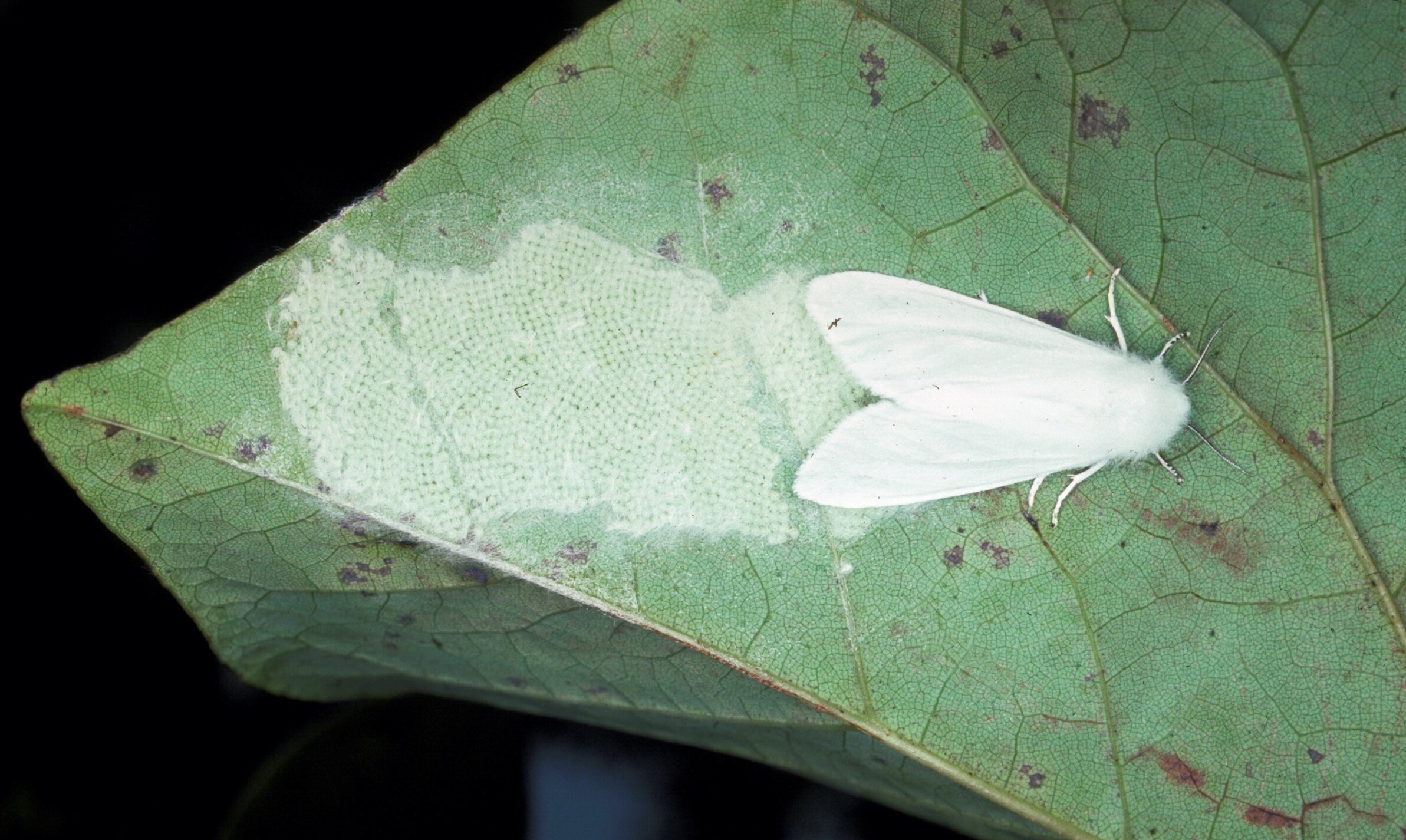

The fall webworm, Hyphantria cunea (Drury) (Lepidoptera: Erebidae; Figure 1) is a polyphagous caterpillar pest of ornamentals and trees in Georgia. Polyphagous means that it can feed on many types of food, and the fall webworm is known to feed on more than 600 species of plants, including row crops, herbaceous plants, shrubs, fruit, and ornamental trees in orchards, nurseries, and landscapes.

Figure 1. An adult fall webworm laying eggs.
Photo: Lacy L. Hyche, Auburn University, Bugwood.org
Fall webworm larvae construct silk web nesting to facilitate feeding, to escape the attack of natural enemies, and for heat retention. The webbing is considered unsightly, and feeding on foliage inside the nest leads to extensive defoliation. The fall webworm can quickly reduce the aesthetic appeal of landscape trees and shrubs (Figure 2), and severe infestation can cause considerable damage to trees.
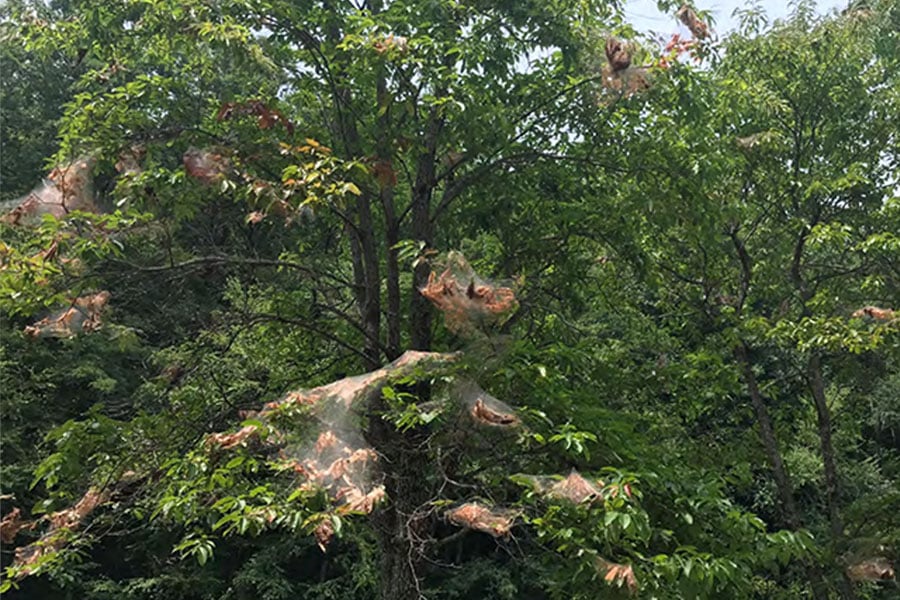
Figure 2. A fall webworm attack on landscape trees.
Photo: Shimat Joseph, University of Georgia
Biology
The fall webworm is active during the summer and early fall. The white, hairy female moth (Figure 1 deposits approximately 600 eggs on the underside of leaves in masses covered with white hairs from the female’s body (Figure 3).

Figure 3. Fall webworm eggs.
Photo: Pennsylvania Department of Conservation and Natural Resources – Forestry, Bugwood.org

Figure 4. Fall webworm larvae.
Photo: G. Keith Douce, University of Georgia, Bugwood.org
The eggs hatch within a week, revealing red- or black-headed larvae covered with fine hair (Figure 4). Almost immediately, the larvae begin working together to construct a silken web over a branch tip, where they begin to feed.

Figure 5. Skeletonization and webbing on foliage by fall webworm larvae feeding.
Photo: Shimat Joseph, University of Georgia
Initially they skeletonize the leaves inside the web (Figures 5 and 6), but as the larvae develop, the webbing expands and covers more foliage on the tree branch.

Figure 6. Fall webworm larvae feeding inside the web.
Photo: Fawad Khan and Shimat Joseph, University of Georgia
Larvae feed for up to 6 weeks until pupation. Mature caterpillars leave the web to pupate under bark crevices, soil, or stones. The pupal period may range from 12 to 80 days, depending on environmental conditions, followed by adult moth emergence. The fall webworm overwinters as pupa and can have multiple generations in a year.
Management
Regularly inspecting trees and shrubs starting in midsummer will help detect infestations. Traps containing sex pheromones were developed to determine early flights. As part of a cultural control strategy, pruning infested branches will reduce extensive webbing. However, intensive pruning is not recommended, as it can reduce the productivity of fruit trees.
Biological control plays a critical role in reducing fall webworm populations. Many beneficial arthropods, including spiders, insect predators, and parasitoids, are associated with the fall webworm. Vertebrate predators like birds and lizards will also feed on the caterpillars given the chance. Disrupting the protective webbing usually leads to death of all or most of the caterpillars inside, so any nests within reach of a long pole can be torn open as a control measure.
As for chemical control, the microbial insecticide, Bacillus thuringiensis, is commercially available and can be used to manage fall webworm. Many synthetic insecticides are available, but spraying insecticides on a tree of any size is problematic and should only be attempted by trained professionals. Contact your county University of Georgia Cooperative Extension office for insecticide recommendations. If insecticides are used, always read and follow label instructions—it is the law.
References
Edosa, T. T., Jo, Y. H., Keshavarz, M., Anh, Y. S., Noh, M. Y., & Han, Y. S. (2019). Current status of the management of fall webworm, Hyphantria cunea: Towards the integrated pest management development. Journal of Applied Entomology, 143(1–2), 1–10. https://doi.org/10.1111/jen.12562
Li, Y. P., Goto, M., Ito, S., Sato, Y., Sasaki, K., & Goto, N. (2001). Physiology of diapause and cold hardiness in the overwintering pupae of the fall webworm Hyphantria cunea (Lepidoptera: Arctiidae) in Japan. Journal of Insect Physiology, 47(10), 1181–1187. https://doi.org/10.1016/S0022-1910(01)00099-3
Schowalter, T. D., & Ring, D. R. (2017). Biology and management of the fall webworm, Hyphantria cunea (Lepidoptera: Erebidae). Journal of Integrated Pest Management, 8(1), 1–6. https://doi.org/10.1093/jipm/pmw019
Tadić, M. D. (1963). Natural enemies of fall webworm (Hyphantria cunea Dr.) in North America. Biocontrol, 8(4), 245–252. https://doi.org/10.1007/BF02377530
Yearian, W. C., Gilbert, K. L., & Warren, L. O. (1966). Rearing the fall webworm, Hyphantria cunea (Drury) (Lepidoptera: Arctiidae) on a wheat germ medium. Journal of the Kansas Entomological Society, 495–499.