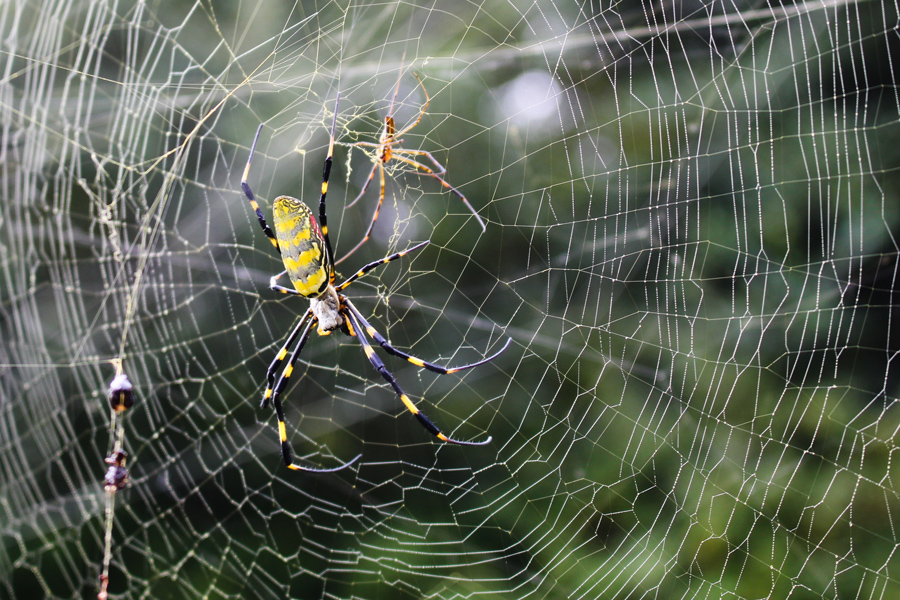

The Joro spider is native to East Asia and was first detected in Georgia in 2014. It is established in Georgia, North Carolina, South Carolina, Tennessee, Alabama, and spreading to adjacent regions. There are also isolated populations found in Maryland, Virginia, and Pennsylvania. It has one generation per year in its native range.
Life cycle
Related Content
Egg sacs are laid mid-October to November and are dense, white silk sacs with 400–500 eggs. Sacs are attached to leaves, tree bark, and human-made structures.
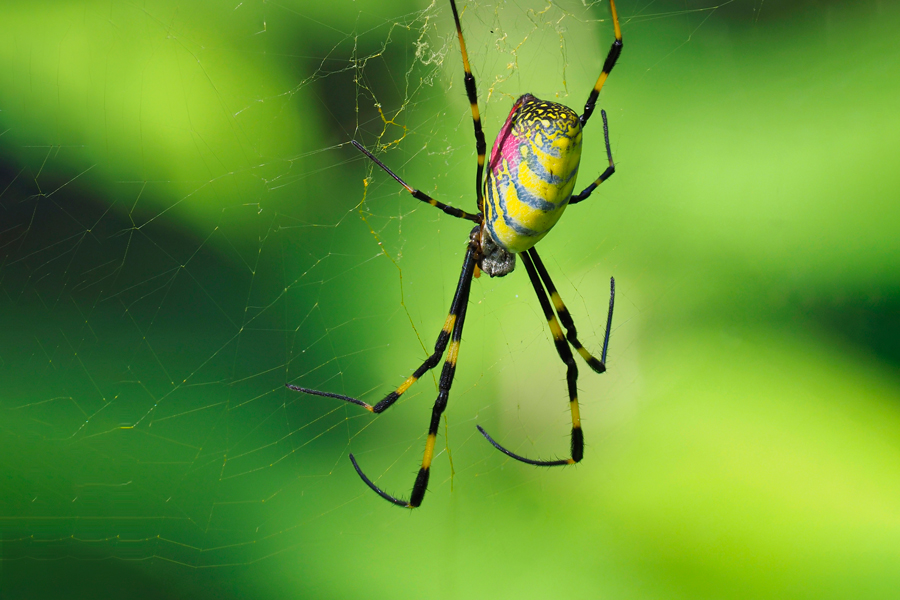
Adult females become sexually mature in September and early October. The female’s body is 0.67–1.2 in. (17–30 mm) long and bright yellow with broad, horizontal bluish-green bands on the top side of the abdomen, and large red markings on the bottom side of the abdomen. She also has long, black legs with yellow-orange bands or—rarely—all black legs.


Adult males mature by late August. The male’s body is 0.16–0.31 in. (4–8 mm) long and his cephalothorax is light brown with two dark brown long bands on both sides. His abdomen is elongate-oval with a greenish-brown topside that has two yellowish long stripes on both sides of the dark brown middle line.

Joros resemble native spiders in the Southeast
The closest look-alike in the Southeastern U.S. is the golden silk orb weaver (Trichonephila clavipes). The adult female golden silk orb weaver has rows of silvery white spots on its abdomen instead of blue bands, and her legs are yellow-orange with brown bands; three of the four pairs of legs have black tufts of hair at the joints.

Photo: Whitney Cranshaw, CSU, Bugwood.org

Photo: Chris Evans, University of Illinois, Bugwood.org

Photo: Leslie J. Mehrhoff, UCon, Bugwood.org
Basic spider biology
Joro spiders (Trichonephila clavata) are in the golden orb weaver genus, Trichonephila, which is a diverse group commonly occurring in tropical, subtropical, or temperate areas. Similar to other golden orb weaver spiders, adult females have distinctive colorations (see pictures); however, from our initial surveys, juvenile spiders (spiderlings or baby spiders) have varying color patterns. If confirmed, this is similar to other reports of golden orb weavers and other spiders in general. These spiders also are known for sexual dimorphism, which is when sexually reproductive males and females look different from each other. With Joro spiders, females are as much as 500 times heavier than males. If you look closely at one of their webs, you likely will find one or more males inhabiting the web; last year we encountered as many as 10 males in a single female’s web.
An interesting characteristic of adult Joro webs is their golden color—this is why they are considered golden orb weavers. Currently, researchers speculate that the golden pigment may deter vertebrates like birds from damaging the webs, or it may attract insects. The spiders’ silk glands produce the silk thread (webs) using a variety of proteins and also produce sticky glue-like drops for prey capture. Silk threads are elastic and very strong. Not all silk is the same and the different types have different purposes. When spiders wander around they let out a dragline silk, which you often can see on plants, on the ground, or when spiders move between areas. This dragline silk is very strong, and helps to anchor them and anchor their webs. The silk used to capture prey, such as what is found in web spirals, is incredibly flexible or stretchy. You’ve probably noticed this if you walk through a web—it has a springy quality because of these strong and stretchy silk types. You also can observe this by touching the web.
There are some other functions of silk—it can help a spider quickly spread over long distances through ballooning. Spiders release silk strands that catch on wind currents that can carry them many miles, even between islands in the Caribbean and to the North American mainland. Ballooning is common in many spider species, especially when spiders are smaller and lighter juveniles.
Where have Joro spiders been found in the Southeast so far?
An EDDMapS distribution map of counties where Joro spiders have been confirmed as of March 2022. Not pictured: Washington County, OK, where a single Joro spider was observed and reported in November 2021. Currently, from the data available, the spiders appear to make webs on many surface types and commonly on the edge of habitats, like the perimeter habitat of a park or yard, as well as places like between powerlines. View the most current map on the EDDMapS site: www.eddmaps.org/distribution/uscounty. cfm?sub=87670&map=density
When do we start seeing the spiders?
This is a bit difficult to answer. The small juveniles begin showing up as early as May, but are not easily detectable. In addition, they look a lot like other spiders. From public observations and reporting, we start observing or detecting the more mature spiders in late July and August, with peaks in observations in September and October. The figure shows a summary of observations by month from EDDMapS through April 6, 2026.

Are Joros disrupting the ecosystem and displacing native species?
At this time, we honestly don’t know. This is a big question that a newly formed team of scientists is working on. However, we also need your help. The first thing we need to know is where Joro spiders are. Use the Joro Watch website (jorowatch.org) or the EDDMapS app to submit observations from parks, forests, and even your own yard. Fill out the report form and, if you can, count how many Joro spiders you see and upload pictures.
Some homeowners view Joro spiders as a nuisance, which is common for many spiders. Spiders’ roles often are underappreciated, but they are important insect pest predators and consume an estimated 400–800 million tons of insects globally. If you are bothered by spiders in a pathway or parts of your yard, these can be removed with a long stick or pole. Short videos on the Joro Watch website provide guidance for removing spiders from pathways with a stick (e.g., broom, telescoping paint pole, PVC pipe, etc). Use the stick or pole to wrap the web around the spider to capture it and then remove it from the pathway.
Until we know more, we advise against using insecticides to control this spider over large areas. The insecticides available for spiders are termed broad spectrum, which means these kill all kinds of insects and spiders. Good insects—like pollinators for crops and flowers, butterflies, and other predators that eat pests—also will be killed by these insecticides. When natural predators are removed, pests like aphids, scales, mealy bugs, and mites become bigger problems in our yards, parks, and natural areas, as well as agricultural and horticultural areas.