

Smutgrass (also known as small smutgrass; Sporobolus indicus [L.] R. Br.) is a warm-season perennial grass weed that has historically been found in bahiagrass (Paspalum notatum Alain ex Fluggé) pastures and hayfields in the southern portion of the state. Unfortunately, smutgrass has spread north in Georgia and can now be found sporadically throughout the central and northern regions of the state in both bermudagrass (Cynodon spp.) and tall fescue (Lolium arundinaceum) forages.
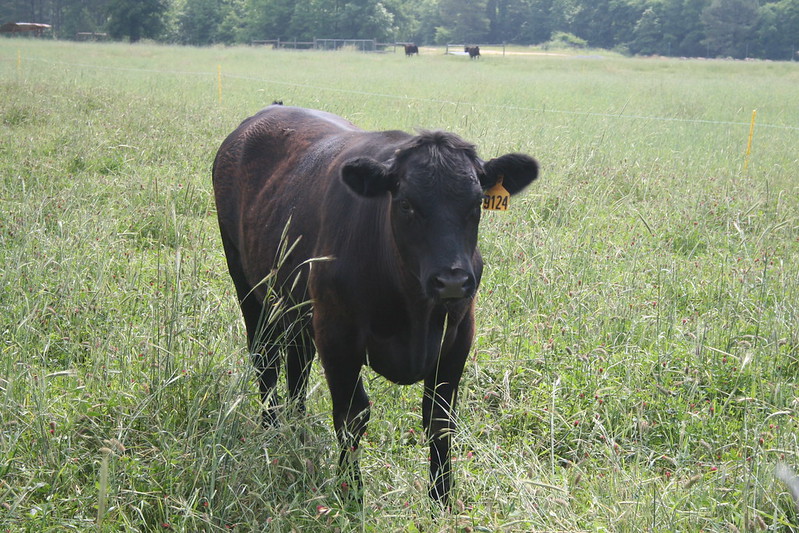
Although smutgrass does not pose any animal health risks, its forage quality is not sufficient to meet the nutritional demands of most grazing animals. Unless frequently mowed to force new growth, livestock will avoid grazing smutgrass.
Perennial grass weeds can be problematic in forage systems as few herbicides are available, especially for use in bahiagrass and tall fescue. Smutgrass prefers moist soils, but like many perennial grass weeds, it is adaptable and will invade unimproved pastures, especially open canopies of weakened forage stands.
Extensive research has identified hexazinone as an effective management tool for controlling smutgrass in bahiagrass, but it’s challenging to time a hexazinone application so that it receives adequate rainfall.
An integrated weed management plan is critical for combating smutgrass in Georgia forage systems (Shay et al., 2022, 2024). A timely fertilizer application based on current soil test reports following hexazinone can accelerate bahiagrass recovery, giving it a competitive advantage over other weed species.
Identification of Smutgrass
Proper identification is key to ensuring appropriate herbicide recommendations are made.
Growth Habit and Roots
Smutgrass has a bunch-type growth habit, where the stems will spread around the perimeter of the tuft (bunch) of grass (Figure 1). Smutgrass bunches are typically 8 to 10 in. in diameter. Most smutgrass plants are around 3 ft tall when mature.
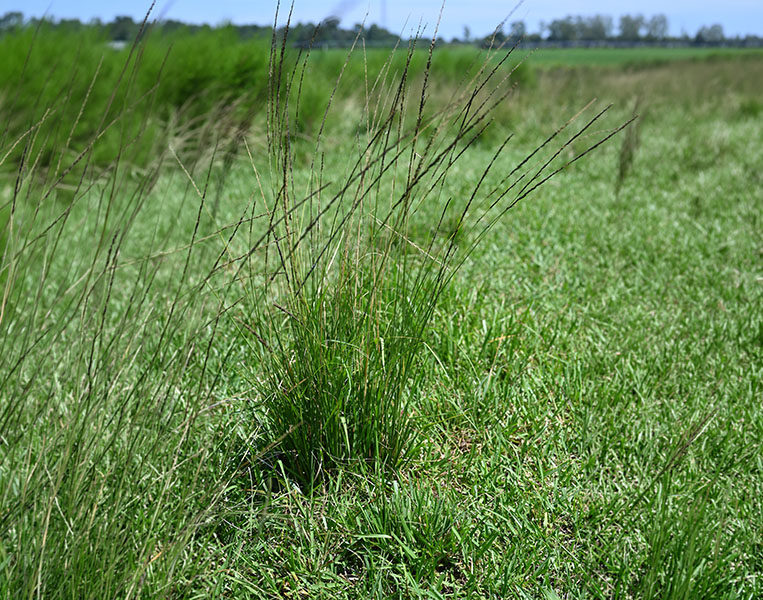
Smutgrass can spread by seeds or roots. Although smutgrass does not have a rhizomatous root system in the way bermudagrass does, new plants can develop from roots. The robust root structure and adaptability allow smutgrass to quickly overtake desirable pasture grasses if interventions are not taken.
Seedhead and Seeds
Smutgrass has a long, narrow, spike-like panicle (Figure 2). The seedhead may be green or black in color with the presence of a fungus (Drechslera ravenelii [M.A. Curtis ex Berk.]; see Figure 2). The spikelets will be oval with a single seed.

Stems and Leaves
The leaves of smutgrass will be rolled in the bud with a ligule with a fringe of hairs (Figure 3). The collar will be divided into two parts by the midvein. The leaf sheath is smooth and round. The leaf blades are flat and usually no more than ¼ in. wide. The blades will be widest at the stem and taper to a point at the ends.

Species Commonly Mistaken for Smutgrass
Giant smutgrass (S. jaquemontii): Not commonly found in Georgia at this time. Giant smutgrass bunches are typically 12 to 18 in. in diameter. The giant smutgrass seedhead is a more open panicle than a smutgrass seedhead. The seedheads are generally not infected by the black fungus.
Longspike tridens (Tridens strictus [Nutt.] Nash): This species has a similar growth habit and seedhead structure to smutgrass. It is predominantly found on roadsides and prefers upland areas. It is most easily distinguished from smutgrass by the hairs on the leaves and wider panicle (seedhead).
Broomsedge (Andropogon virginicus): Although broomsedge is easily distinguished from smutgrass when the seedheads are present, they may be easily confused prior to seedhead emergence. Leaves of broomsedge will be folded in the bud with a membranous ligule fringed with more hairs than smutgrass has. The leaf collar is narrower and the leaf sheath is flattened.
Integrated Weed Management
Like many other perennial weed species, smutgrass will require an integrated weed management approach for long-term control. Although it is tempting to cut input costs and apply only herbicide, mechanical and cultural control are equally important. These strategies encourage desirable species in the forage canopy and reduce the need for continued herbicide use in the future.
Mechanical Control of Smutgrass
Regular mowing before seed maturity may decrease stem diameter, deplete root carbohydrate reserves, and limit the spread of the weed by reducing seed spread. However, mowing after seed maturity will increase the number of plants through seed dispersal. More research is needed to quantify these impacts. Burning is not effective at suppressing the smutgrass population (Sellers et al., 2023).
Complete control of smutgrass through mechanical methods alone is highly unlikely. Intensive tillage with implements that completely pulverize the soil surface and any established smutgrass clumps, such as disking, rotary tillage, or moldboard plowing, will provide temporary control. However, the longevity of smutgrass seed in soil has not been documented, and it is uncertain how long tilled sites will remain free of smutgrass.
Herbicides will be required for long-term control. Mechanical control can be used to suppress the smutgrass population when the season or weather conditions are unsuitable for herbicide application.
Cultural Control
Improved cultural management of the pasture or hayfield can improve suppression of smutgrass and other weed species (Shay et al., 2022, 2024). Improved management practices to consider are:
- Recognize and correct nutrient deficiencies in the soil through soil testing and adherence to sampling recommendations.
- Correct soil pH following soil testing and sampling recommendations.
- Increase grazing or harvest height to 3 in. for bermudagrass, 3 in. for bahiagrass, and 4 in. for tall fescue.
- Minimize soil disturbance by discontinuing vertical tillage or aeration.
- Improve soil drainage by clearing drainage ditches or installing drainage systems.
Each of these management practices will help promote the growth and persistence of the desirable forage species. This should improve ground coverage, increasing the competition for weeds that may try to encroach on your pasture or hayfield. Open gaps in the forage canopy enable the invasion of undesirable weed species.
Chemical Control
Preemergence Herbicides
Preemergence (PRE) herbicides are not currently labeled for control of smutgrass, but research is ongoing. It has been challenging to evaluate the activity of PRE herbicides on smutgrass seed germination because of the lack of knowledge of the seed’s biology. These herbicides will control annual grass weeds and may remove competition from the smutgrass, causing the weed to spread.
Postemergence Herbicides: Hexazinone
Currently, hexazinone is the only labeled and effective postemergence (POST) herbicide for selective smutgrass control in bermudagrass and bahiagrass that has been established longer than 1 year. Control may not be possible within 1 year, and repeat applications in subsequent years may be required.
In some cases, suppression—instead of control—of smutgrass may be expected. Suppression is a visible reduction in the plant population and vigor, but not a complete removal of smutgrass.
Hexazinone is available in five products currently on the market. Their use rates and other details are available in Table 1. Even though these products are marketed under five different trade names, they are all hexazinone, and only one application of hexazinone is allowed per year. Therefore, you cannot apply multiple products per year as they all contain the same active ingredient.
Hexazinone should be applied in summer when air temperatures are above 80 °F. This is usually from June to August, depending on location. Hexazinone should be applied in a broadcast application with a boom sprayer. Other application methods are less effective because this chemical is only effective in the root zone and has little foliar activity. Calibrate your boom sprayer to deliver 25 gallons per acre of the spray solution to ensure coverage and canopy penetration.
Lack of rainfall will result in reduced efficacy because (without rain) hexazinone is not moved into the rootzone, while excessive rainfall could result in hexazinone moving beyond the rootzone. Hexazinone requires at least ¼ to ½ in. of rain within 1 week of the application. If rainfall does not occur, then the application will not be effective. Heavy rainfall may flush the herbicide below the root zone and result in poor herbicide activity.
A surfactant is not required and does not improve hexazinone efficacy. In fact, the surfactant may increase injury to the desirable grass species. Bahiagrass may turn yellow for up to 3 weeks after the herbicide application (Sellers et al., 2023). Bermudagrass may sustain injury for up to 1 month following the application (Sellers et al., 2023). The injury will be more severe when the forage species are stressed by drought, insects, or poor soil fertility.
Unfortunately, there are no selective control options for controlling smutgrass in newly established bermudagrass or bahiagrass, other forage species such as tall fescue, or near desirable tree species. Spot treating with hexazinone is not allowed in these susceptible species since the herbicide can injure surrounding areas via the rootzone. The best option currently available is spot treatment with glyphosate.
Postemergence Herbicides: Glyphosate
Glyphosate is a nonselective herbicide and cannot be applied to desirable grasses without severe injury. Glyphosate will translocate, or move within, any plant that comes into contact with it. Use caution to avoid injury to nontarget forage species.
If smutgrass control is required in sensitive species or near tree canopies, spot-treat the plants with a 2% glyphosate solution (2.8 fluid ounces per gallon of water). There are many different formulations of glyphosate, and actual rates will depend on the product used. Please refer to the herbicide label for exact mixing instructions.
Grazing and Hay Restrictions
There are no grazing restrictions for any of the hexazinone products in Table 1. The forage cannot be harvested for hay until 38 days after the hexazinone has been applied. If spot treatments with glyphosate are applied, please refer to the actual product label for guidance on grazing or haying restrictions.
| Product | Company | Rate2 | |
| Liquids (oz/acre) | Granular (lb/acre) | ||
| Established bermudagrass and bahiagrass1 | |||
| Velpar L VU | Bayer Environmental Science | 44 to 72 | — |
| Tide Hexazinone 2SL | Tide International | 44 to 72 | — |
| Tide Hexar 2SL | Tide International | 44 to 72 | — |
| Velossa | Helena Agri-Enterprises, LLC | 36 to 60 | — |
| Tide Hexazinone 75 WDG | Tide International | — | 0.9 to 1.5 |
| All other forage species | |||
| Glyphosate | Various products available | Check label | — |
1 Hexazinone is the only labeled and effective postemergence herbicide for smutgrass control in bermudagrass and bahiagrass that has been established longer than 1 year. These hexazinone products were the only ones available at the time of publication.
2 Rates of herbicides are presented in ounces (oz) or pounds (lb) of product per acre for liquid and granular herbicides, respectively.
Overview of UGA Research on Smutgrass Control
Unfortunately, weed seed banks are dynamic in sod-based systems, and disturbances to a system (e.g., smutgrass removal) can trigger weed seed germination and a shift in species distribution. Shay et al. (2022) found that combining preemergence (indaziflam) and postemergence (hexazinone) herbicides with fertilization (nitrogen and potassium) improved bahiagrass stands.
Timely weed suppression removed competition, while fertilizer provided essential nutrients for optimum bahiagrass growth and recovery, allowing it to fill in the gaps left by controlled weeds. However, no studies had addressed long-term sward responses to herbicide applications of hexazinone with indaziflam applications and/or fertilizer in bahiagrass forage systems.
The objective of this experiment was to evaluate population shifts in bahiagrass forage following the implementation of integrated herbicide and fertilizer management plans for controlling smutgrass.
Treatments Applied
This small plot experiment included four herbicide and three fertilizer treatments, totaling 12 treatment combinations. Herbicides were only applied to plots in the initial year and included an unsprayed control, PRE (indaziflam), POST (hexazinone), and a combination of both PRE and POST (indaziflam and hexazinone; see Table 2).
The PRE was applied in spring following green-up (April), and the POST was applied following the July harvest. Fertilizer treatments included an unfertilized control, nitrogen only (N), and nitrogen plus potassium (N+K). Fertilizer was applied annually in spring following green-up (April) and following the July harvest.
| Treatment1 | Product | Rate2 | Application timing | |
| lb/acre | oz/acre | |||
| Herbicides | ||||
| Control | None | — | — | — |
| PRE | Indaziflam | 0.05 | 4 | Spring of initial year |
| POST | Hexazinone | 0.87 | 56 | After July harvest of initial year |
| PRE + POST | Indaziflam + hexazinone | 0.05 + 0.87 | 4 + 56 | Spring of initial year and after July harvest of initial year |
| Fertilizers | ||||
| Control | None | — | — | — |
| N | Ammonium nitrate | 50 | n/a | Following green-up and after the July harvest |
| N + K | Muriate of potash | 50 + 56 | n/a | Following green-up and after the July harvest |
1 Treatment components included preemergence (PRE), postemergence (POST), nitrogen (N), and potassium (K).
2 Rates of herbicides are presented in pounds (lb) of active ingredient per acre and ounces (oz) of product per acre. The concentration of any product may be found on the first page of an herbicide label. Fertilizer rates are presented in pounds (lb) of each nutrient per acre.
Plots were rated for cover from bahiagrass, smutgrass, and other species every 4 to 5 weeks during the bahiagrass production season. Bahiagrass hay production expenses (Table 3) were calculated under the hay production calculator in the University of Georgia 2024 Bahiagrass Forage Enterprise Budget.
| Treatment components1 | Treatment expenses | Total expenses over 3 years | ||||
| POST | PRE | Fertilizer | Product | Application | Total | |
| None | None | None | — | — | — | — |
| N and N+K | $104 | $20 | $121 | $729 | ||
| Indaziflam | None | $84 | $10 | $94 | $94 | |
| N and N+K | $188 | $27 | $215 | $820 | ||
| Hexazinone | None | None | $124 | $10 | $131 | $131 |
| N and N+K | $225 | $27 | $252 | $860 | ||
| Indaziflam | None | $207 | $17 | $225 | $225 | |
| N and N+K | $432 | $45 | $477 | $1,085 | ||
| Treatment components1 | Total expenses over 3 years |
| Hay production (with recommended herbicide and fertilizer)2 | $14,393 |
| Hay production (no herbicide) | $12,563 |
| Hay production (no herbicide or fertilizer) | $7,005 |
| Bahiagrass renovation | $2,042 |
| Bahiagrass renovation + two grazing seasons | $4,329 |
1 Treatment components included PRE (preemergence, indaziflam, 4 oz/acre), POST (postemergence, hexazinone, 56 oz/acre), fertilizer (50 lb N/acre, applied as ammonium nitrate; 50 lb N/acre + 50 lb K2O/acre, applied as muriate of potash).
2 Bahiagrass hay production, renovation, and grazing expenses calculated with the University of Georgia 2024 Bahiagrass Budget.
Changes in Groundcover Percentage Over Time
Regardless of the level of smutgrass coverage at study initiation, several interesting trends emerged throughout the experiment. After year 1, the POST herbicide reduced smutgrass coverage regardless of PRE or fertilizer applications (Table 4). When no POST was applied, the PRE and fertilizer were both required to decrease smutgrass ground cover (Table 4).
All treatments reduced smutgrass coverage by the end of year 3 (Table 4). Therefore, the complete removal of biomass by mowing had the unintended benefit of decreasing smutgrass coverage over time.
| Treatment components1 | Year 1 | Year 2 | Year 3 | |||||
| POST | PRE | Fertilizer | Start | End | Start | End | Start | End |
| None | None | None | 372 | 27 | 13** | 26 | 19** | 20** |
| N and N+K | 24* | 31 | 18** | 24* | 19** | 25* | ||
| Indaziflam | None | 33 | 35 | 27 | 27 | 24* | 22* | |
| N and N+K | 29 | 22** | 25* | 25* | 19** | 22** | ||
| Hexazinone | None | None | 34 | 5** | 10** | 9** | 10** | 15** |
| N and N+K | 26* | 2** | 7** | 5** | 10** | 10** | ||
| Indaziflam | None | 32 | 7** | 5** | 9** | 17** | 12** | |
| N and N+K | 28 | 0** | 8** | 8** | 10** | 14** | ||
1 Treatment components included preemergence (PRE), postemergence (POST), nitrogen (N), and potassium (K).
2Difference from nontreated control at initiation at alpha 0.05 (*) and 0.01 (**). Note: standard error of the mean (SEM) = 5.6%
Hexazinone (POST) played a critical role in removing smutgrass from bahiagrass forage systems in the first year following application. Still, only the POST + fertilizer treatment was able to maintain the greater bahiagrass coverage at the end of the experiment compared to all other herbicide and fertilizer combinations (Shay et al., 2024).
When smutgrass was removed from the plots, there was a risk of shifting weed populations and the introduction of opportunistic annual and perennial weeds. However, these other species never comprised more than 5% of the canopy during these evaluations.
Although herbicide applications were important for the control of smutgrass, frequent mowing also reduced smutgrass coverage. Mowing can decrease the diameter of the smutgrass plants, but will increase the number of plants through seed disbursement, and complete control is highly unlikely. More research is needed to confirm how harvest frequency impacts carbohydrate stores in smutgrass; however, harvesting hay from bahiagrass is not economically viable.
Cost Comparison
The treatment costs summed across the three seasons are presented in Table 3. These varied greatly from $94/acre for PRE alone to $1,085/acre for PRE + POST + fertilizer. Using only the POST to control smutgrass may appeal to producers, but bahiagrass can decline over time with the absence of fertilizer.
Ultimately, only the POST + fertilizer treatment was able to maintain greater bahiagrass coverage at the conclusion of the experiment. This treatment totaled $860/acre across the 3-year experiment.
Alternatives to these researched treatments include hay production and stand renovation. Both hay production, which would mechanically remove smutgrass, and renovation are unfortunately even more expensive than the other treatments.
Conclusion
Hexazinone remains an important component of smutgrass control, but fertilizer can help the forage recover from herbicide injury and give desirable species a competitive advantage over weedy species. Like many other perennial weed species, smutgrass requires an integrated weed-management approach for long-term control.
References
Sellers, B. A., Rana, N., Dias, J. L. C. S., & Devkota, P. (2023, October 9). Smutgrass control in perennial grass pastures (Publication No. SS-AGR-18). University of Florida IFAS Extension. https://ask.ifas.ufl.edu/publication/AA261
Shay, N. J., Baxter, L. L., Basinger, N. T., Schwartz, B. M., & Belcher, J. (2022). Smutgrass (Sporobolus indicus) control in bahiagrass is improved with applications of herbicide and fertilizer. Weed Technology, 36(5), 700–707. https://doi.org/10.1017/wet.2022.73
Shay, N. J., Baxter, L. L., Basinger, N. T., Secor, W., Burt, J. C., Hancock, G. A., Schwartz, B. M., & Belcher, J. (2024). Evaluating shifts in species distribution following herbicide and fertilizer applications for smutgrass (Sporobolus indicus) control in bahiagrass. Weed Technology, 39, e1. https://doi.org/10.1017/wet.2024.99