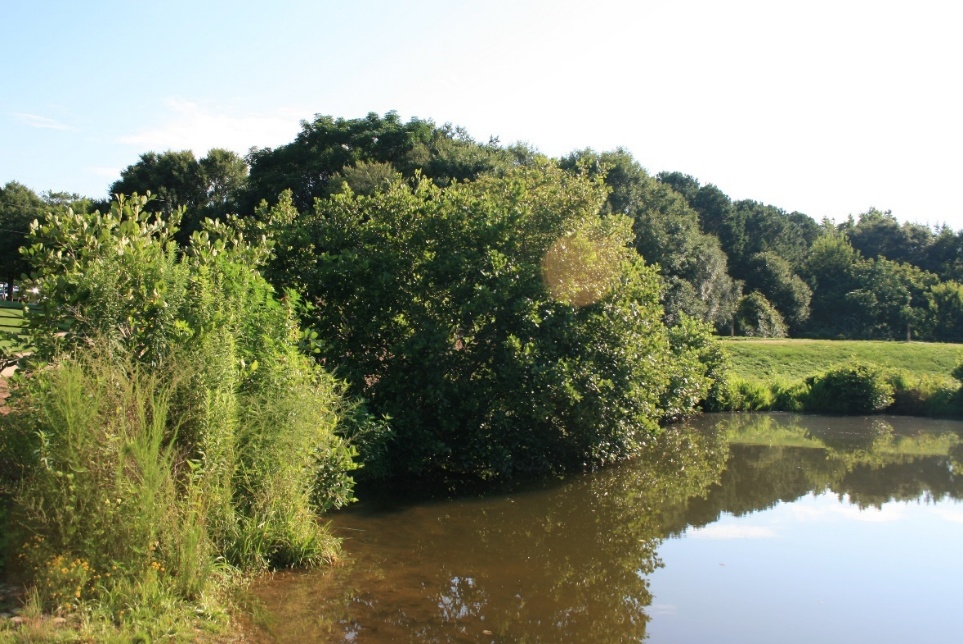


White Wild Indigo, Baptisia alba
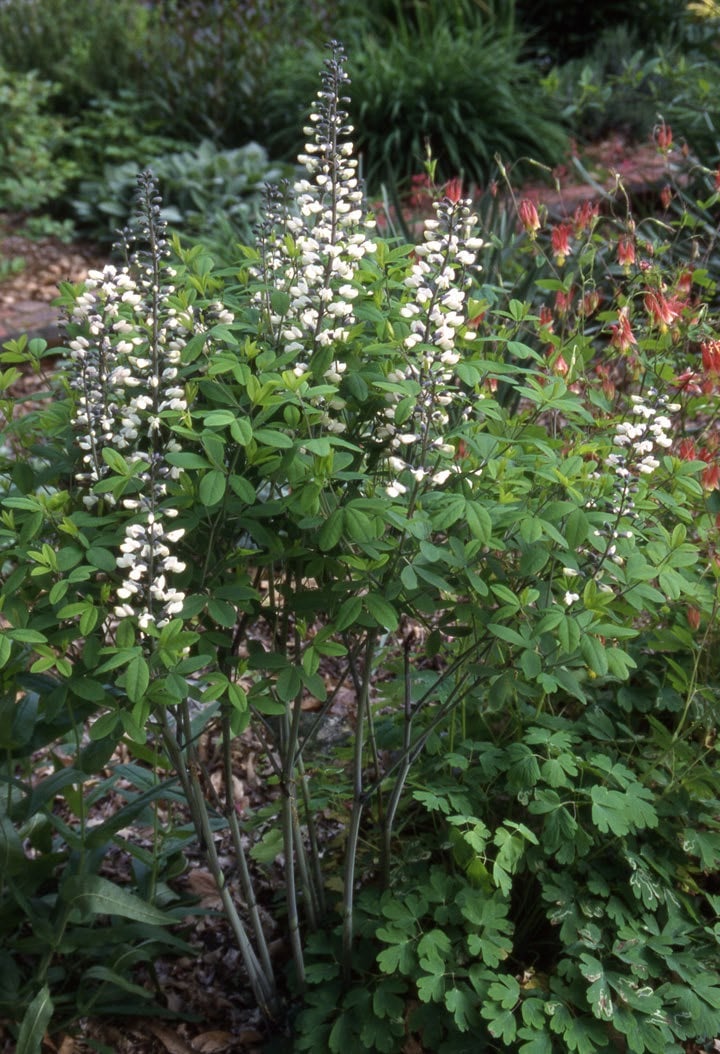
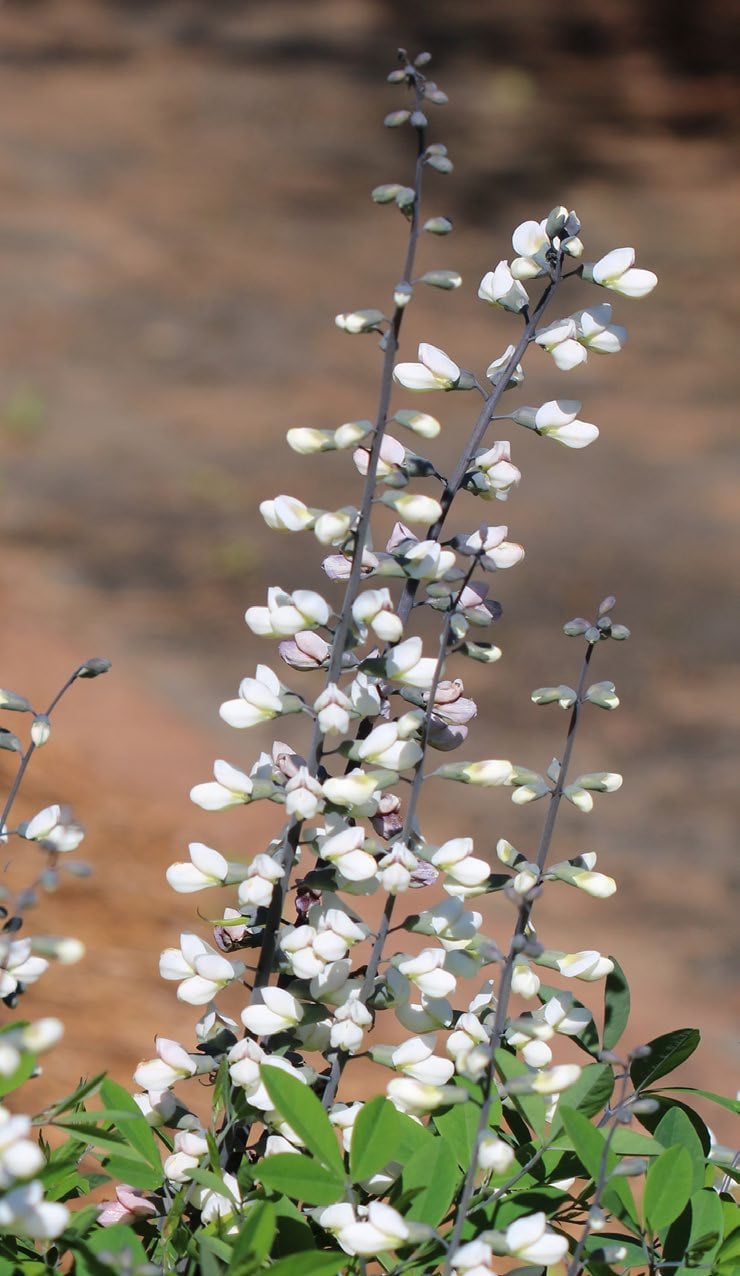
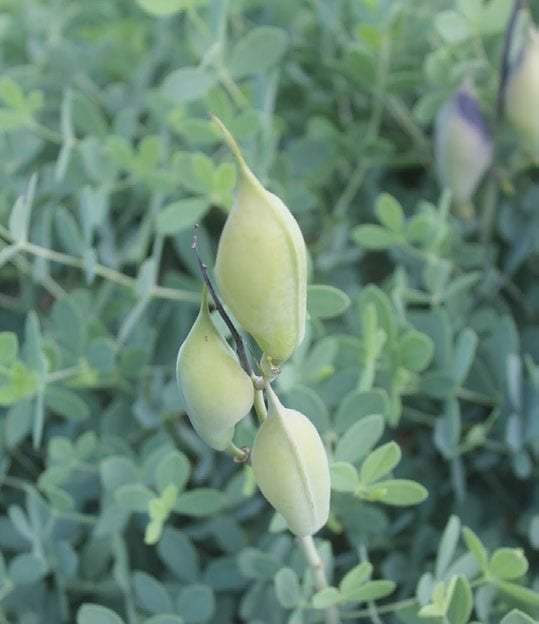
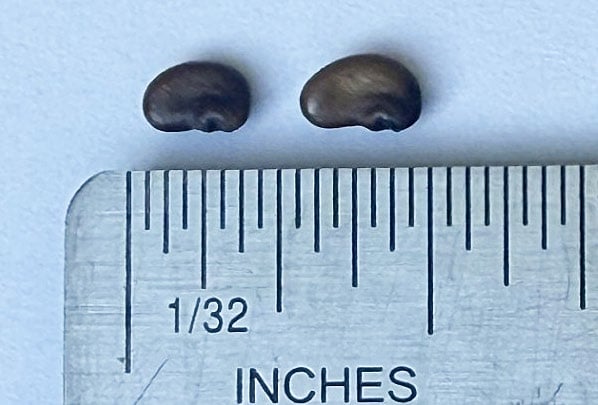
White Wild Indigo. Clockwise from top L: Habit and flower; seeds; immature seedpods.
Family: Fabaceae
Life cycle: Perennial
Description: White wild indigo features an upright cluster of stems, typically mounding up to 2–3 ft tall and wide. There are three-lobed, bluish-green leaves with leaflets ½ to 2 ½ in. long. It also has multiple pure white, bilaterally symmetrical flowers that are 1 in. long and 3/4 in. wide are arranged in 6-to-9-in. flower spikes up to 3 ft tall. Prominent pea pods, up to 2 in. long and ½–1 in. wide, develop on the spikes and turn from bluish green to black when ripe, with seeds that audibly rattle when shaken. Seeds are ¼ in. long legumes and tan in color with a hard seed coat. The seed is ripe about 6 weeks after flowering (Chafin, 2016).
Related Content
Bloom period: April to May
Cultural requirements: Full sun to part shade, dry to moist soil, medium water use; rocky, sandy, or clay soils; prefers near-neutral soil (pH 6.5–7) but tolerates a wider range.
USDA Plant Hardiness Zones: 3–9
Range: Georgia, Alabama, Florida, South Carolina, and North Carolina (Chafin, 2016)
Distribution in Georgia: Uncommon in Piedmont and Coastal Plain regions (Weakley, 2020)
Habitat: Dry woodlands, pine flatwoods, roadsides (Weakley, 2020)
Seed propagation: Collect pods when they turn black. Freshly collected, mature green seeds may germinate within 4 weeks, while hardened. Older tan seeds require scarification (breaking down of outer seed coating) or weathering to germinate. This may be achieved by sowing outdoors in the fall to allow weathering to occur naturally or by soaking seeds in hot (at first) water for 24 hr before sowing. Plugs may be ready to plant in 7 months. Most plants will not flower until their third season. Technical information for commercial Baptisia propagation is published by the U.S. Department of Agriculture (USDA) Natural Resources Conservation Service (NRCS) and through the USDA Native Plant Network.
Garden tips: Baptisias are medium-sized plants that can work well in the middle or back of the landscape border. They may become floppy in late summer and can be cut back for a tidier appearance.
Pollinators and other beneficial insects: Wild indigos are particularly valuable for bumblebees and frequented by lady beetles. They are the host plant for the wild indigo duskywing (Erynnis baptisiae), Zarucco duskywing (Erynnis zarucco), frosted elfin (Callophrys irus), clouded sulfur (Colias philodice), and black-spotted prominent moth (Dasylophia anguina; Adamson, et al., 2017).
Eastern Smooth Beardtongue, Penstemon laevigatus
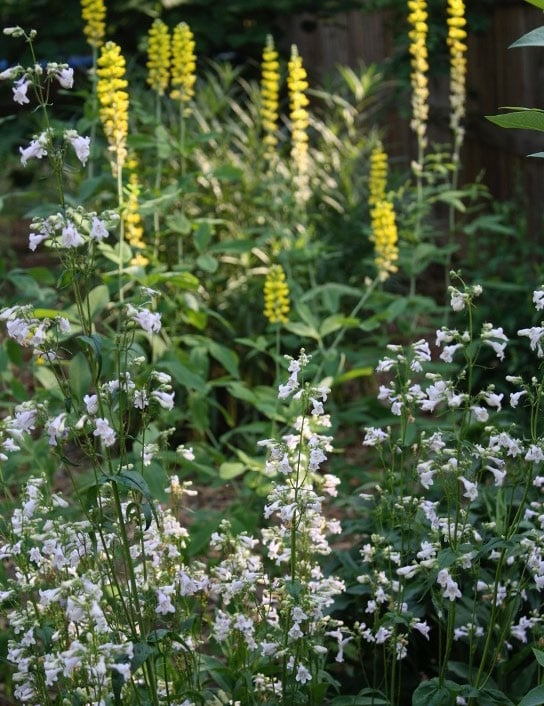
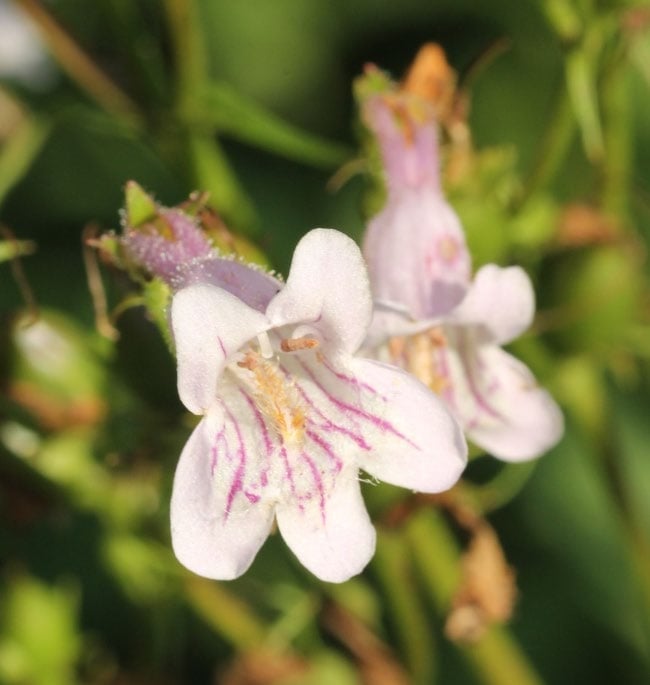
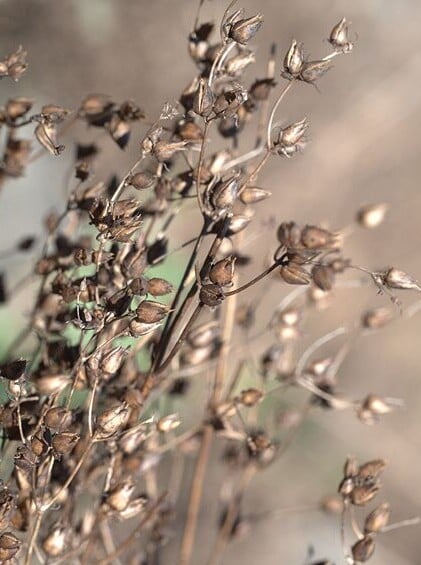
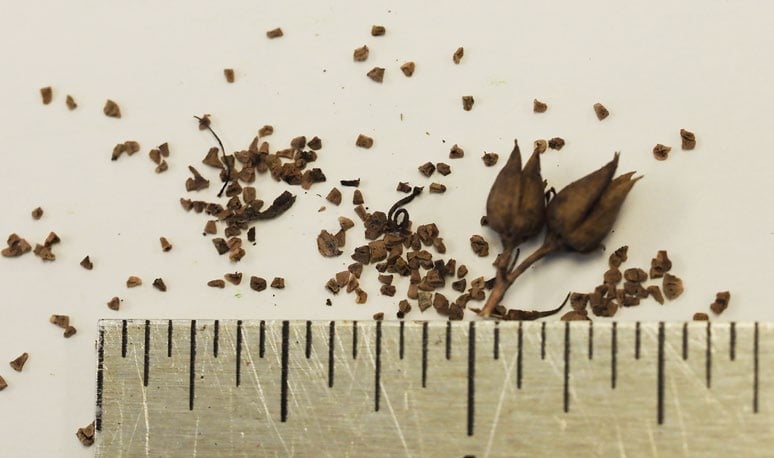
Eastern Smooth Beardtongue: Habit and Seeds.
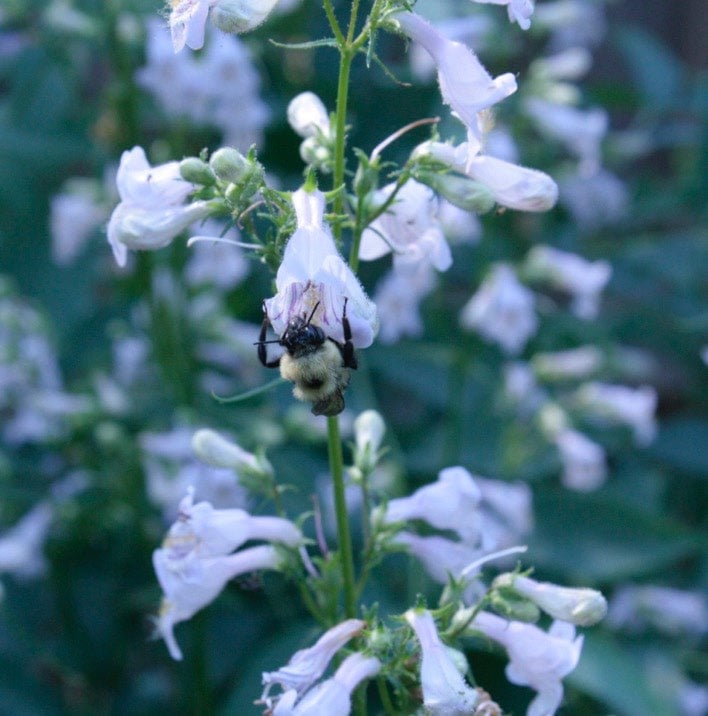
Bumblebee on Beardtongue.
Family: Plantaginaceae
Life cycle: Perennial
Description: Eastern smooth beardtongue features a dark green basal rosette that spreads up to 2–3 ft in width, with leaves that are 2–6 in. long, up to 1.75 in, wide, and spoon-shaped. The flower stalks rise to 2 to 3.5 ft tall, with flowering stems and cauline leaves (leaves that grow directly from the upper part of the stem). The flowers are tubular in shape, white, pink, or lavender in color, often linearly pink striped within the tube, hairy on the lower lip, and less than ¾ in. long.
Bloom period: May to July
Cultural requirements: Full sun to shade, although flowering is highest in sun; performs well in a variety of soil types: sand, loam, and clay; refers moist soil; tolerates periodic drought
USDA Plant Hardiness Zones: 5–9
Range: Southeastern U.S., north to Pennsylvania and Ohio, south into Florida, west to Mississippi (Biota of North America Program, 2014)
Distribution in Georgia: Common throughout all of Georgia (Weakley, 2015)
Habitat: Low meadows, bottomlands, forest edges, hammocks (Weakley, 2015)
Seed propagation: Seeds are ready when capsules dry and split open at the top, resembling bird beaks, which happens by October. Seeds are retained in the winter by cup-like capsules. They require cold, moist stratification of 60–90 days, depending on ecotype, with longer times for seeds from the northern areas to break seed dormancy for germination. Alternatively, seeds may be sown outside in the fall or early winter. Sow in well-drained potting soil. Technical information for commercial propagation of the Penstemon genus is published through the USDA Forest Service. Penstemon seeds are reported to remain viable for up to 15 years when properly stored. Other Georgia Penstemons (P. australis, P. hirsutus) can be propagated with the same techniques.
Garden tips: Eastern smooth beardtongue draws attention when planted in a large group. This is easy to achieve given a little time, as it readily reseeds. They serve nicely as groundcover plants with short basal rosettes that are somewhat evergreen in mild winters. Leave flowers in place after they bloom, as the fruits that follow are also quite attractive, changing from green to maroon to brown and shaped as bird-beak-like capsules.
Pollinators and other beneficial insects: Penstemon flowers are highly adapted to attracting a great diversity of bees, including sweat bees (Family: Halictidae), leafcutter bees (Family: Megachilidae), mason bees (Family: Megachilidae), and bumblebees (Bombus spp.; Wheeler, 2017a). They provide nectar during a time of relative scarcity in late spring. Penstemons support beardtongue mason bee, a specialist bee (Fowler & Droege, 2020). It is a host plant for the common buckeye butterfly (Junonia coenia).
Butterfly Milkweed, Asclepias tuberosa
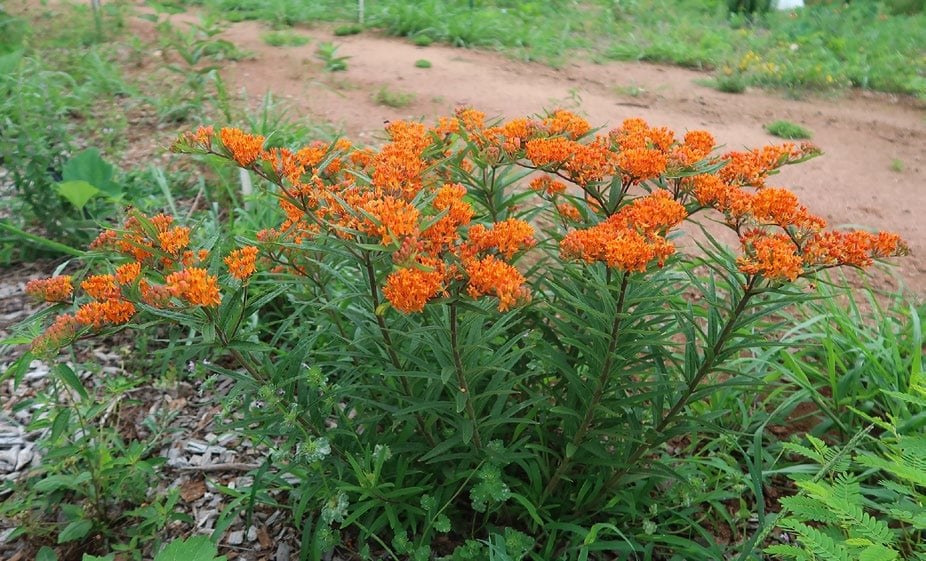
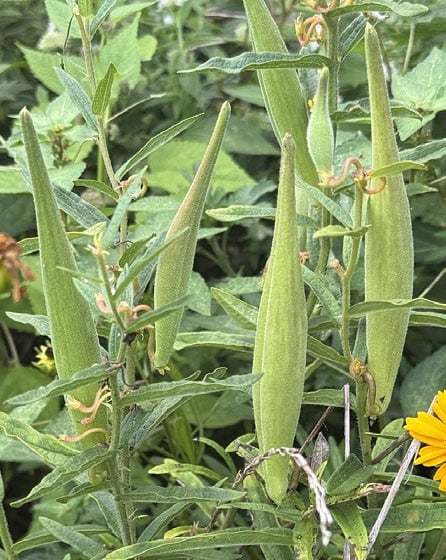
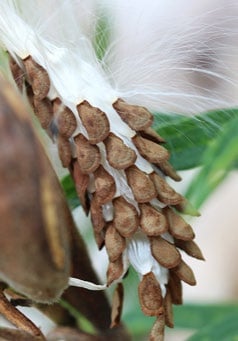
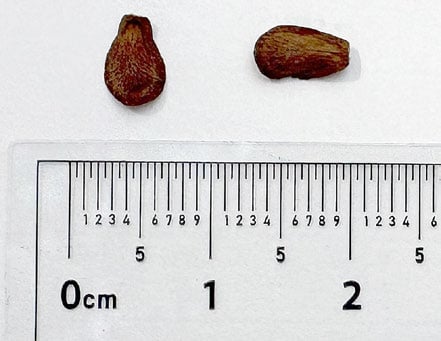
Butterfly Milkweed. Clockwise from top L: Habit and flower; immature seedpods; seeds; mature seedpod.
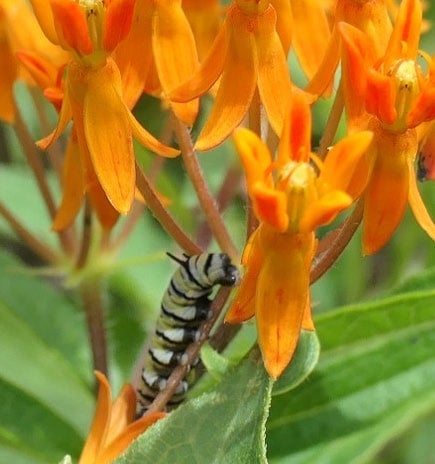
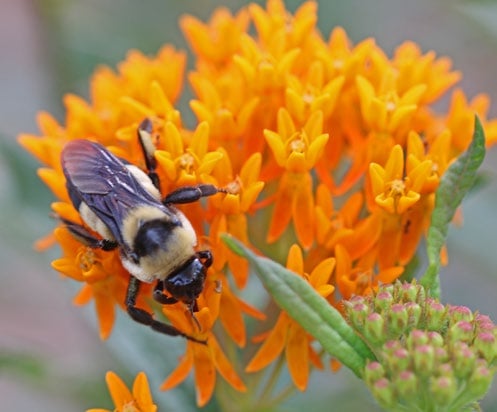
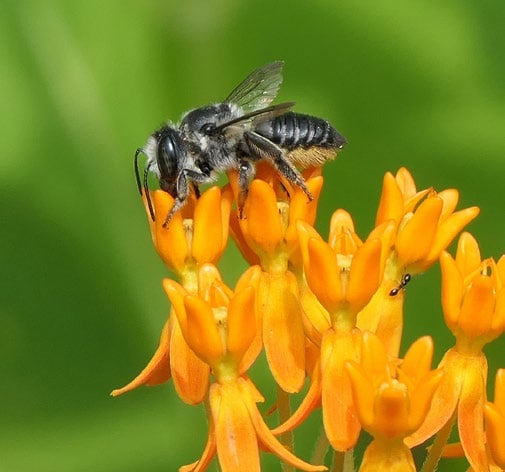
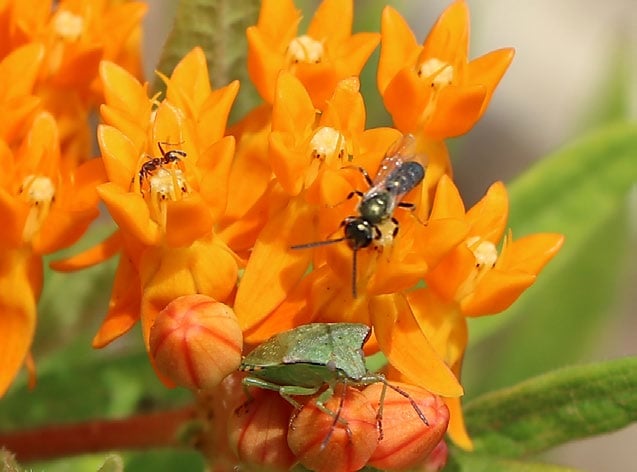
Insects on Butterfly Milkweed. Clockwise from top L: Monarch butterfly caterpillar; bumblebee; sweat bee, ant, and stinkbug; leafcutter bee.
Family: Asclepiadaceae
Life cycle: Perennial
Description: Butterfly milkweed has bushy plants with hairy stems emerging from a single crown 1 to 2 ft wide and typically 2 ½ ft tall. Leaves are alternate, lance-shaped, and 1 ½ to 2 ¼ in. with pointed ends and smooth margins. It is the only milkweed species in Georgia to have alternate leaves and clear sap (not milky). Many small, bright orange flowers are borne in clusters, 2 to 5 in. across, on stem terminals. Silky-haired seeds are borne in spindle-shaped pods that are 3 to 6 in. long and split in the fall (Chafin, 2016).
Bloom period: May to June
Cultural requirements: Full sun and well-drained soil; tolerates drought once established. It is difficult to transplant established plants because of its deep taproots, so it is best to plant container-grown plants.
USDA Plant Hardiness Zones: 3–9
Range: Most of eastern and central North America (Chafin, 2016)
Distribution in Georgia: Common throughout (Weakley, 2015)
Habitat: Woodland margins, roadsides, pastures (Weakley, 2015)
Seed propagation: Collect pods when they turn tan and begin to split. Remove silky tails from the seeds, then store the seeds dry at 40 °F for 4 to 6 months. They require cold, moist stratification for 60–90 days, depending on ecotype, with longer times for seeds from the northern areas to break seed dormancy for germination. Light is required for germination, so do not cover seeds other than lightly with sand. Alternatively, seeds may be sown outside in the fall or early winter. Technical information for commercial propagation is published by the USDA NRCS, Native Plant Network, and through the USDA Forest Service.
Garden tips: Because it is somewhat small, butterfly milkweed is best suited among smaller grasses such as splitbeard bluestem and little bluestem, and smaller perennials like wild indigo, coreopsis, sneezeweed, blazing star, beardtongue. Additionally, its vibrant orange blooms complement beautifully with their yellow, blue, and purple flowers.
Pollinators and other beneficial insects: Butterfly milkweed is a host plant for the monarch (Danaus plexippus) and Queen (Danaus gilippus) butterflies and the cycnia tiger moth (Cycnia tenera; Adamson et al., 2017). It is an excellent nectar source for many insects including bees, flies, wasps, and beetles.
Rattlesnake Master, Eryngium yuccifolium

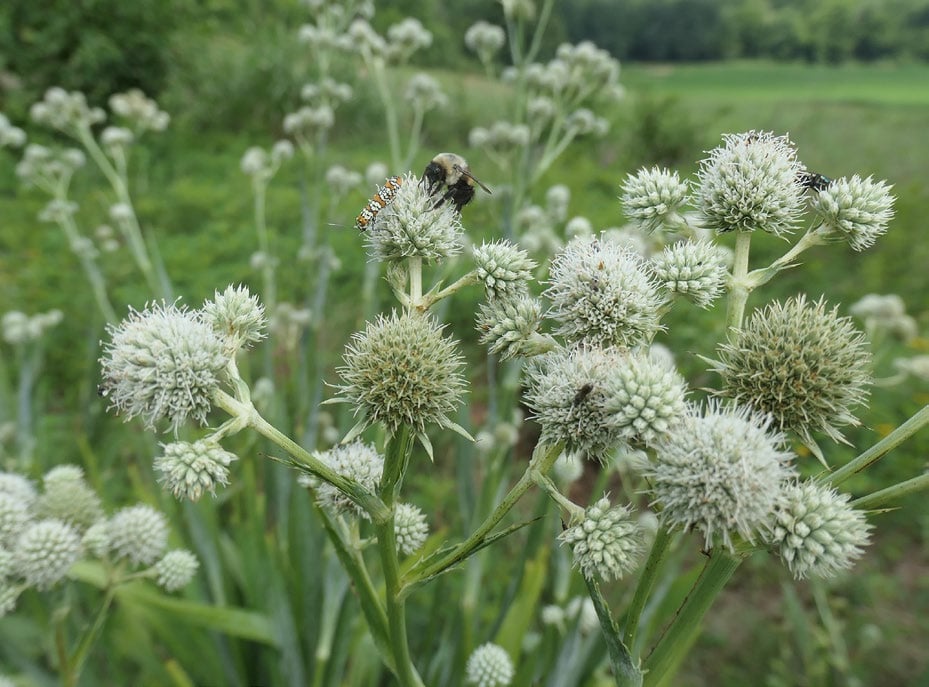


Rattlesnake Master. Clockwise from top L: Habit and flower; seeds; mature seedpod.


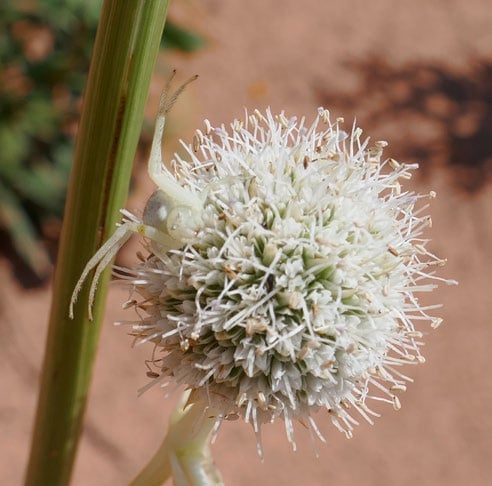

Insects on Rattlesnake Master. Clockwise from top L: Ambush bug and bee; hoverfly; scoliid wasps; spider.
Family: Apiaceae
Life Cycle: Perennial
Description: Rattlesnake master has basal rosettes of long, thin, strap-like leaves with bristly edges measuring up to 3 ½ in. long and 2.5 in. wide. These are blue-gray waxy and edged with bristles, typically spreading up to 2–3 ft wide. Flowering stems average 2–4 ft tall with groups of round, bristly flowerheads (1 in. wide) at the tips, displaying minute greenish-white flowers and prominent spiky bracts (modified leaves). Seeds are presented in single-seeded dry fruits under 1/8 in. long, three-sided, dark brown, and retaining spiky remnant bracts. Seeds ripen in late September in Georgia but are retained well into winter unless distributed by birds.
Bloom period: June to August
Cultural requirements: Full sun; tolerates a wide range of soil profiles and moisture
USDA Plant Hardiness Zones: 3–9
Range: Florida west to Texas, north to Minnesota and Connecticut (Chafin, 2016)
Distribution in Georgia: Uncommon throughout Georgia (Weakley, 2015)
Habitat: Diabase barrens and glades, olivine barrens, pine savannas, pine flatwoods over loamy or clay soils, prairies, other open sites with at least periodic moisture, generally in sites showing some prairie affinities (Weakley, 2015).
Seed propagation: Collect seeds beginning in September when the heads dry out on the stems. To break dormancy, place the seed in moistened media in 35–40 °F (cold-moist stratification) for 60 days. Seeds can be sown outdoors in the fall.
Garden tips: As the name yuccifolium suggests, rattlesnake master resembles yucca. Its gray-green, strap-like leaves are as interesting as its prickly flowerheads, performing well in the middle of the border. It can reseed in moist areas and is hard to weed, so site it in hard, dry locations to curtail spread.
Pollinators and other beneficial insects: It is a host plant a diversity of butterflies, bees, wasps, flies, and beetles. It is also a host plant for the twirler moth (Family: Gelechiidae; Adamson et al., 2017).
Dense Blazing Star, Florist’s Blazing Star, Liatris spicata
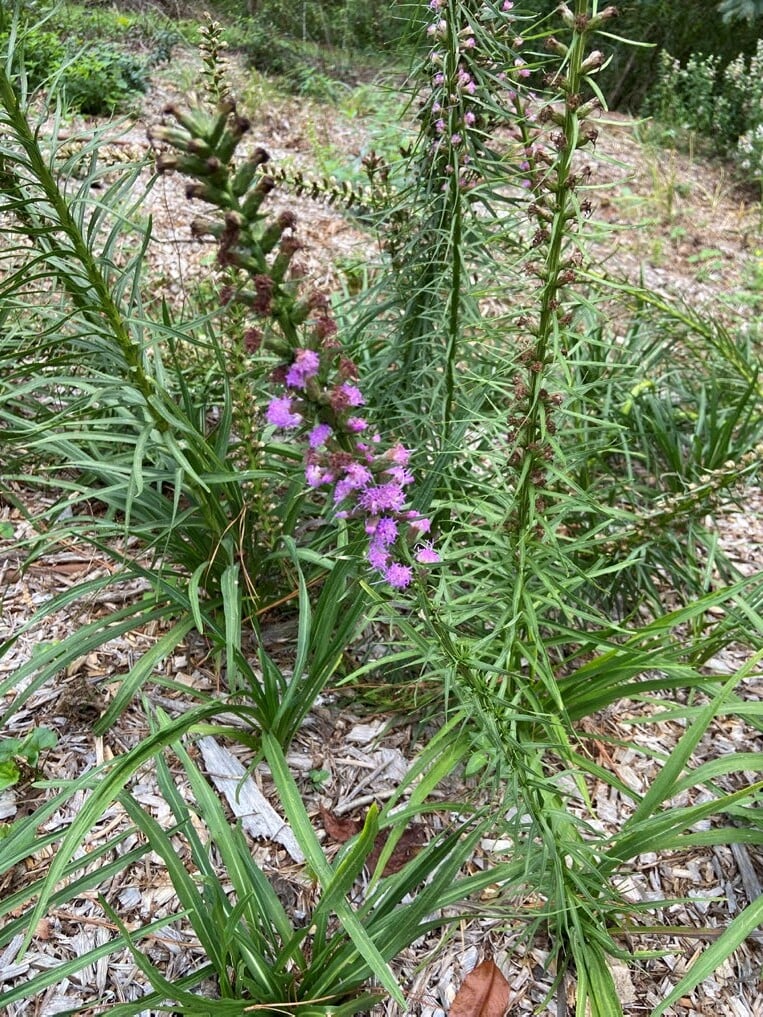
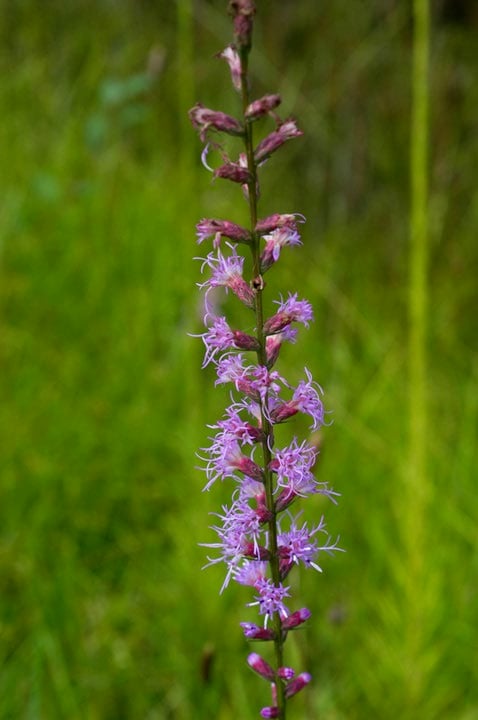
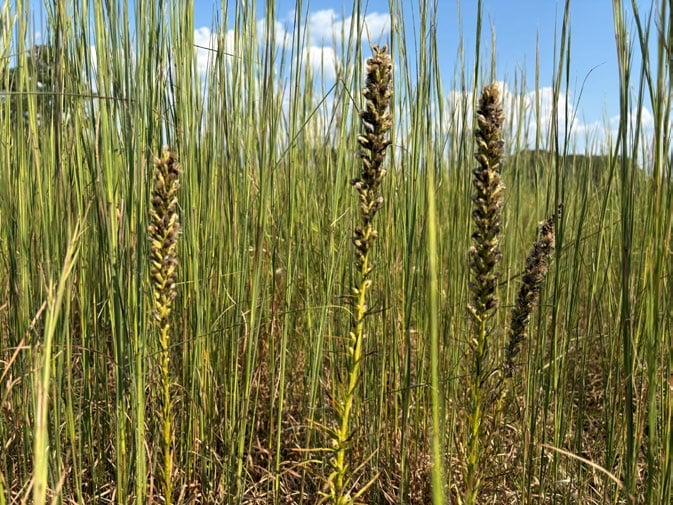
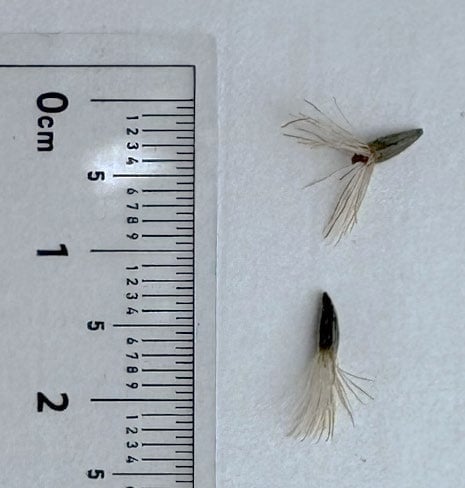
Dense Blazing Star. Clockwise from top L: Habit; flower; seeds; mature seedpods.
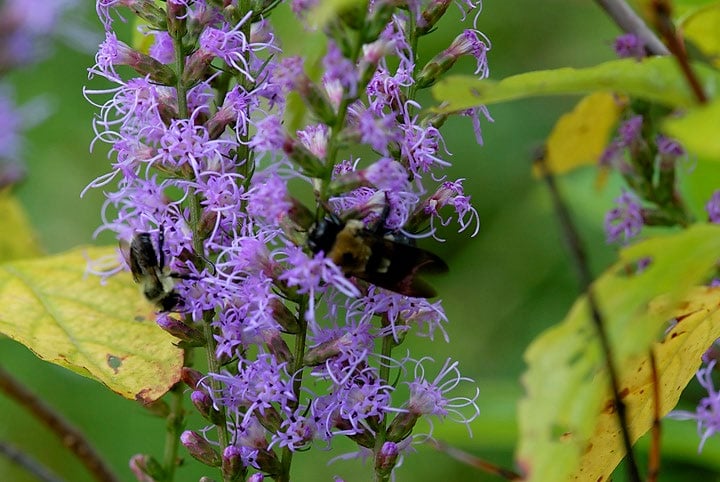
Bees on Dense Blazing Star.
Family: Asteraceae
Life cycle: Perennial
Description: Blazing star leaves are long and narrow, in grasslike basal rosettes, up to 8–14 in. long and ½ in. wide. There are 1–4 ft tall stems topped with prominent flower spikes. The purple-pink flowers, surrounded by bristles, occur close to the stem in tight clusters (Chafin, 2016).
Bloom period: July to November
Cultural requirements: Performs well in a variety of soil types: sand, loam, and clay; refers dryer soil; drought-tolerant; sun to partial shade.
USDA Plant Hardiness Zones: 3–9
Range: Eastern U.S., southern Florida, west to Louisiana, north to Wisconsin and Massachusetts (Chafin, 2016)
Distribution in Georgia: Liatris spicata var. spicata is only common in the mountains and Piedmont, while Liatris spicata var. resinosa is only common in the Coastal Plain (Weakley, 2015).
Seed propagation: Collect in November through December when seeds pull away from the stem with little resistance. Moist-stratify 2–3 months, depending on ecotype, with longer times for seeds from the northern areas. Sow in well-drained potting soil. Liatris tends to grow quite slowly in its first year, during which time it is prone to rot. Water sparingly during this time and allow them to dry between waterings. Plants will fare better in the ground over winter. The Native Plant Network has references for mechanized seed cleaning. Species for propagation that occur in Georgia include Liatris squarrosa, Liatris squarrulosa, Liatris graminifolia.
Garden tips: Blazing stars are slender plants with striking spikes of purple flowers. They look best interplanted within patches of shorter filler plants such as little bluestem, splitbeard bluestem, and beardtongue. Liatris species are generally adapted to dry, less fertile soils and will become overgrown and fall in overly rich soils.
Pollinators and other beneficial insects: Blazing stars are highly attractive to butterflies, especially monarchs (Danaus plexippus), bees, hoverflies, and other nectar seekers; they are host plants for flower moths (Noctuidae: Heliothinae; Wheeler, 2017b).
Spotted Horsemint, Monarda punctata var. punctata
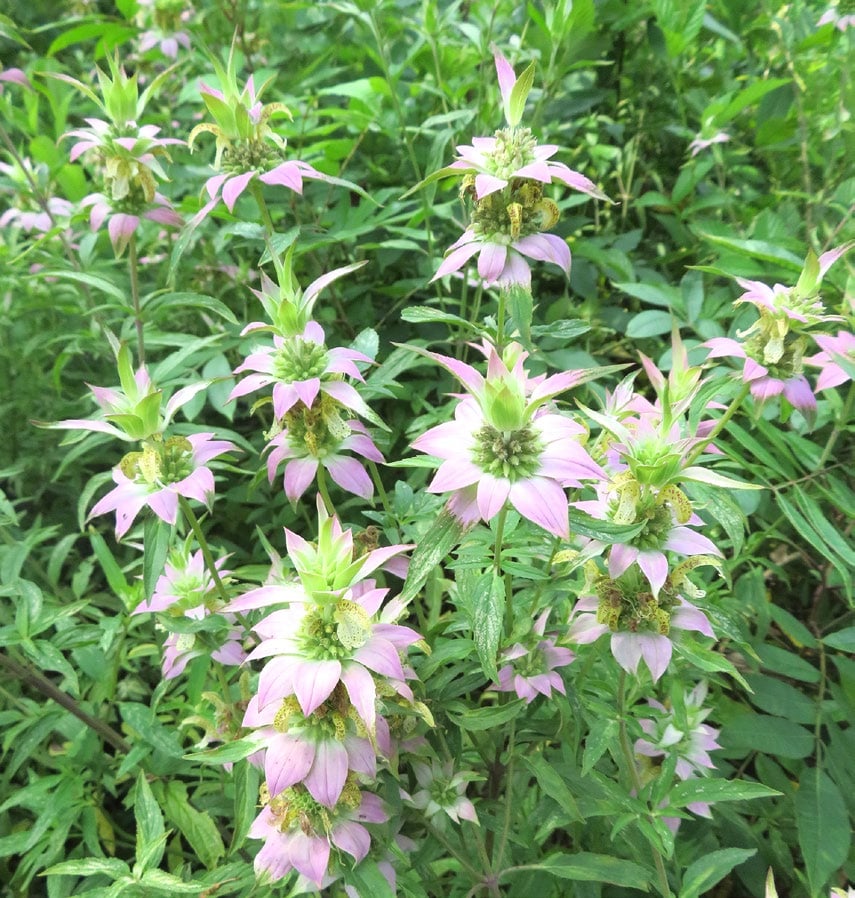
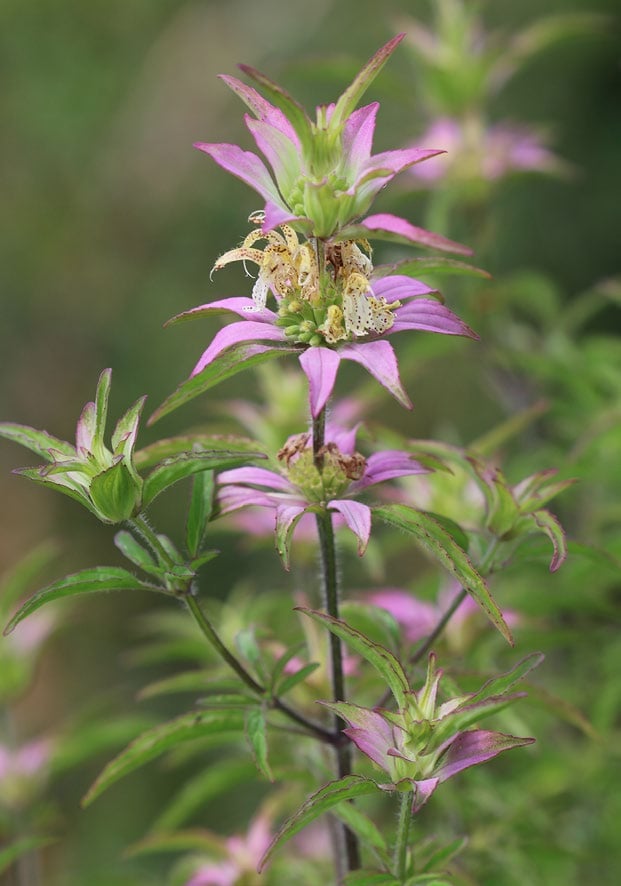
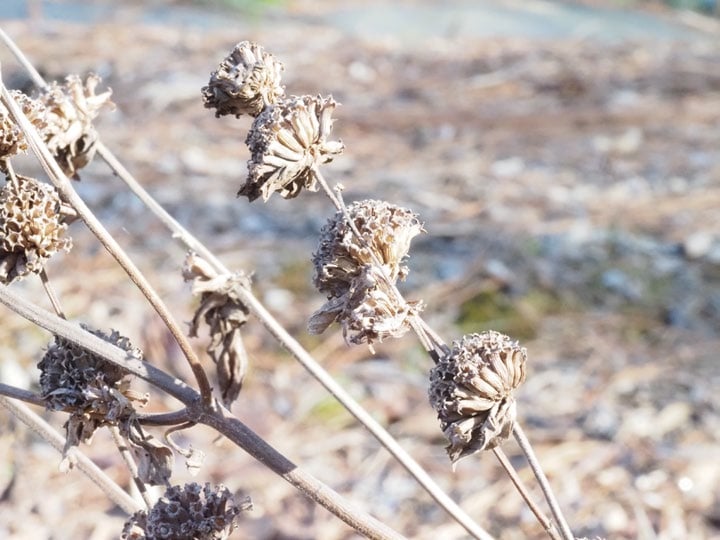
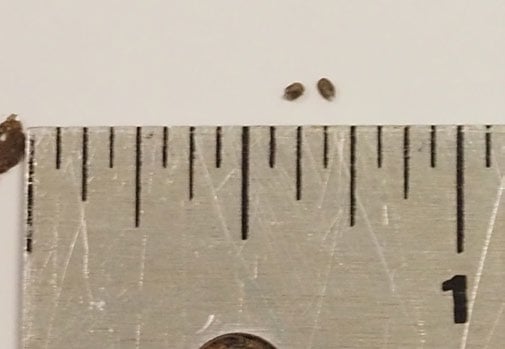
Spotted Horsemint. Clockwise from top L: Habit; flower; seeds; mature seedpod.
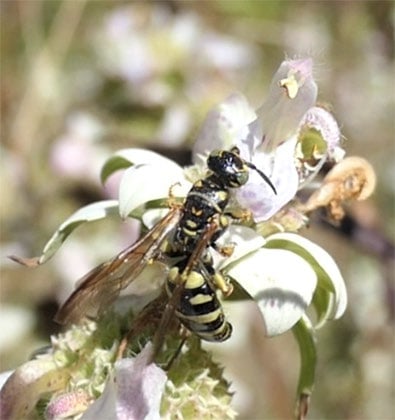
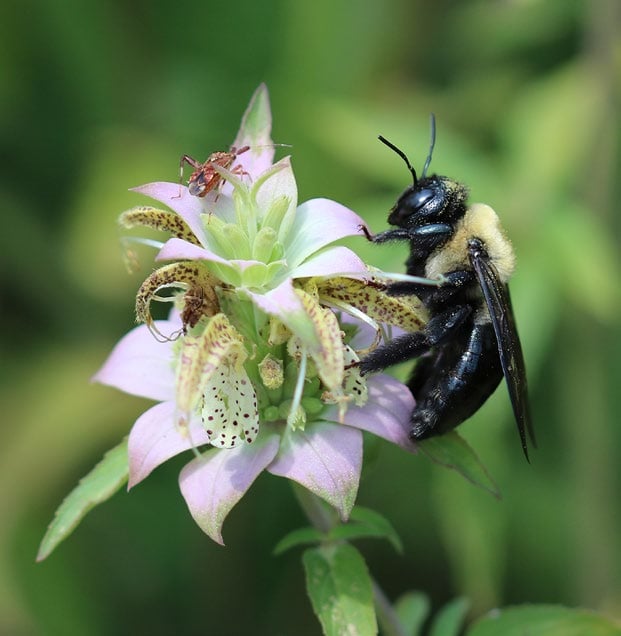
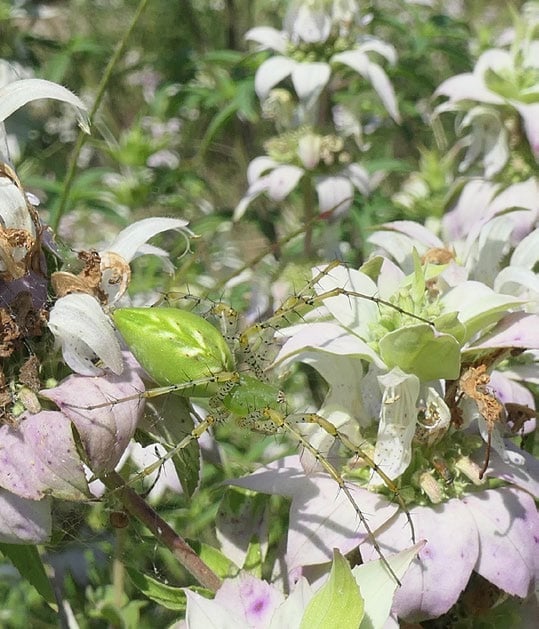
Arthropods on Spotted Horsemint. Left to right: Flower wasp; carpenter bee; spider.
Family: Lamiaceae
Life Cycle: Perennial (short-lived) or biennial
Description: Spotted horsemint has upright, branched, and very leafy stems up to 3 ft tall, four-angled, and covered in fine hair. It also hairy leaves up to 3 ½ in. long and 1 in. wide, opposite, elliptic to lance-shaped, strongly scented when crushed. There are dome-shaped flowers are borne in clusters stacked along the stem, forming whorls of pale yellow with brown spotted flowers up to an inch long, atop larger, showy bracts of various shades of pink. Seeds mature in October and November.
Bloom period: July to September
Cultural requirements: Sun, well-drained soil, low water requirement; prefers a near neutral pH of 6.8–7.2
USDA Plant Hardiness Zones: 3–9
Range: Florida west to New Mexico, north to Minnesota and Quebec (Chafin, 2016)
Distribution in Georgia: Uncommon in the mountains, Piedmont, and Coastal Plain (Weakley, 2015)
Habitat: Maritime forests, dunes, roadsides, rocky or sandy woodlands (Weakley, 2015)
Seed propagation: Seeds are ripe when spent flower heads turn brown. Collect seeds by cutting stems and placing entire seeding stems inside a paper bag with the seams sealed with tape. Seeds can then be shaken out of the heads by sealing the bag and shaking them vigorously. Chaff and stems can be removed with a seed sieve or a kitchen colander. Seeds from Georgia germinate without cold pretreatment, while seeds from further north may benefit from cold stratification. Seeds may require light to germinate, so do not cover them with soil. Technical information for commercial propagation is published by the USDA NRCS.
Garden tips: Spotted horsemint is a medium-sized plant that looks great in most sunny gardens. It has uniquely colored flowers, pink and yellow with brown flecks, that bloom during the flower lull of late summer. Since it is a biennial, leave the spent flowers in place to reseed, or scatter them where you want plants to return.
Pollinators and other beneficial insects: It is a host plant for specialist bees, bumblebees, predatory wasps, hummingbirds, and hawk moths (Adamson, et al., 2017). It is also a host plant for the orange mint moth (Pyrausta orphisalis) and hermit sphinx moth (Lintneria eremitus; South Carolina Exotic Pest Plant Council, n.d.). Supports the beebalm fairy bee (Perdita gerhardi), a specialist bee (Fowler & Droege, 2020).
Eastern Coneflower, Brown-Eyed Susans, Rudbeckia fulgida


Eastern Coneflower. Clockwise from top L: Habit and flower; mature seedpods; seeds.
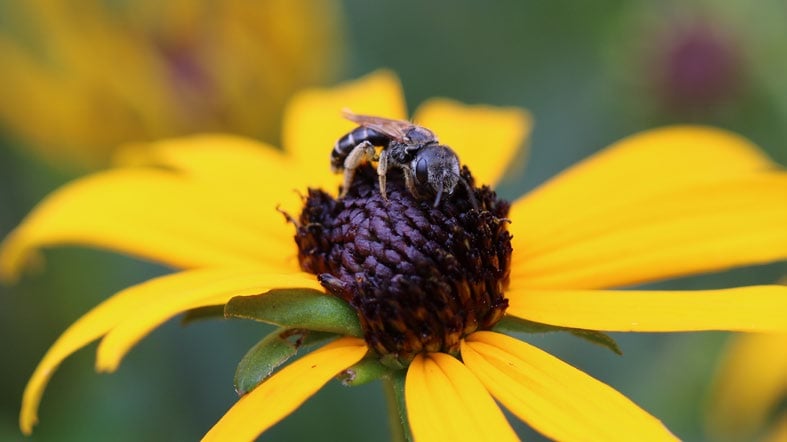
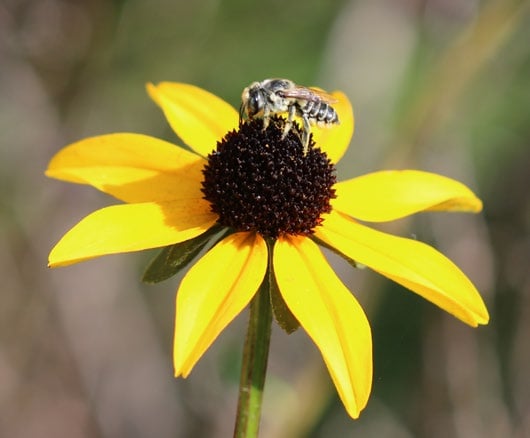
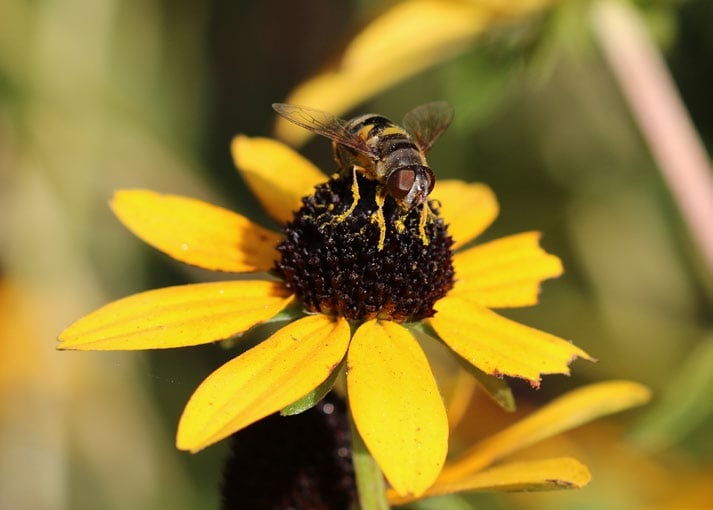
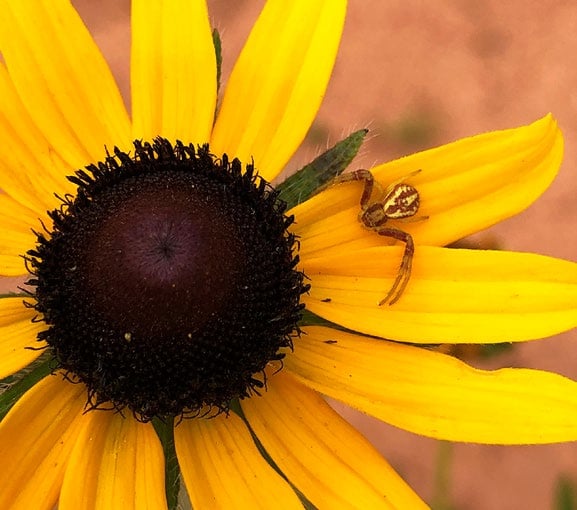
Insects on Eastern Coneflower. Clockwise from top L: sweat bee; leafcutter bee; spider; hoverfly.
Family: Asteraceae
Life Cycle: Perennial
Description: Eastern coneflowers feature a basal rosette 6–10 in. wide, with individual leaves that are oval or lance-shaped, up to 12 in. long and 3 in. wide. They have bristly hair, resembling sandpaper. Stems range from 2 to 4 ft tall, branched and topped with daisy-like flowers 1 ½ to 2 ½ in. wide with 10 to 15 yellow-orange outer ray petals. Disk flowers comprise a cone-shaped ‘eye’ from which the common name, brown-eyed Susan, was derived. Seeds ripen September through November (Chafin, 2016).
Bloom period: August to October
Cultural requirements: Full or partial sun. Moist to average, well-drained soils, average water.
USDA Plant Hardiness Zones: 3–9
Range: Florida west to Texas, north to Wisconsin, Ontario, and Massachusets (Chafin, 2016)
Distribution in Georgia: Common in North Georgia (Chafin, 2016)
Habitat: Dry to wet meadows, roadsides, rights-of-way (Weakley, 2015)
Seed propagation: Seed heads are best collected in the fall using paper bags. To detach seeds from seed heads, roll over them with a rolling pin or tin can. Cold moist stratification for 60–90 days, depending on ecotype, with longer times for seeds from the northern areas to break seed dormancy for germination. Alternatively, seeds may be sown outside in the fall or early winter.
Garden tips: Brown-eyed Susans are very versatile and can be used as specimens, planted in mass, or as ground cover. They are among the most beneficial perennials for insects. They do best with even moisture and will bloom again if they are deadheaded. They will reseed if flowers are left in place, but not aggressively so.
Pollinators and other beneficial insects: Eastern coneflower is very attractive to a diversity of pollinators, including wasps, bees, hoverflies, and butterflies. Serves as a larval host plant for the silvery checkerspot (Chlosyne nycteis) and the wavy-lined emerald moths (Synchlora aerata). It supports numerous specialist bees, including certain mining, longhorn, sunflower, and leafcutter bees (Fowler & Droege, 2020).
Helmet Skullcap, Scutellaria integrifolia


Helmet Skullcap. Left, habit and flower; Right, mature seedpod and seeds.
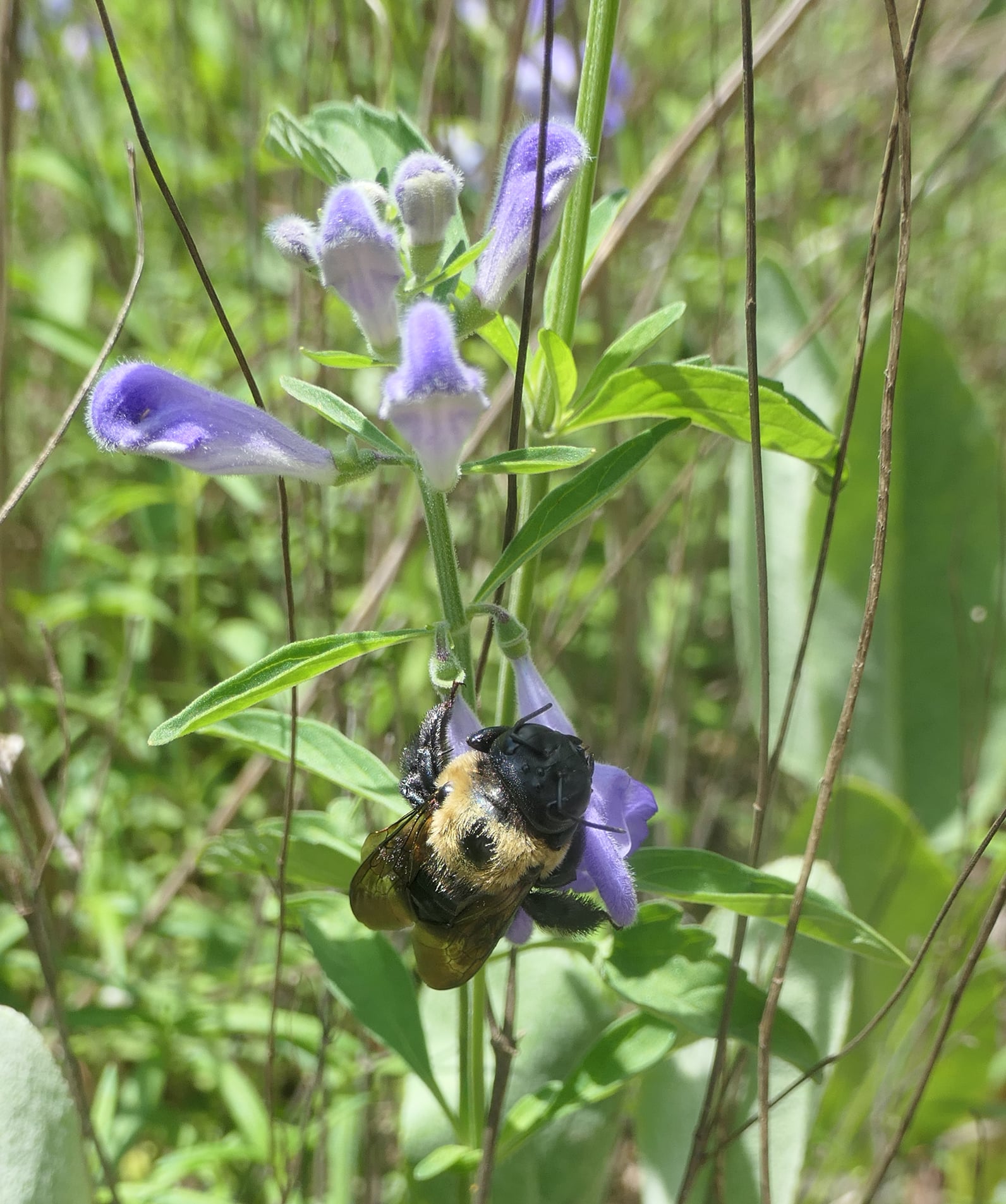
Carpenter Bee on Helmet Skullcap.
Family: Lamiaceae
Life Cycle: Perennial
Description: Helmet skullcap has upright, square, hairy stems up to 32 in. tall, branching at the base. Leaves are opposite, oval to lance-shaped, and up to 2 ½ in. long and ¾ in. wide. Bottom leaves may be smaller and coarsely toothed, while upper leaves are larger and may be untoothed. Tubular, bluish-lavender flowers have a prominent helmet-shaped upper lip and a flat fan-shaped lower lip with two white markings. The flowers are present singly or in clusters at the end of the stems. Seeds ripen August through September (Chafin, 2016).
Bloom period: May to July
Cultural requirements: Full to partial sun, moist to wet, well-drained soil, slightly acidic to neutral
USDA Plant Hardiness Zones: 6–9
Range: Florida west to Texas, north to Missouri and Massachusetts (Chafin, 2016)
Distribution in Georgia: common in mountains, Piedmont, and Coastal Plain (Weakley, 2015)
Habitat: Wet pine savannas, pine flatwoods, seeps in forests, bottomlands, other moist sites (Weakley, 2015)
Propagation: Collect seed pods when they turn brown. Different sources suggest that one week of moist stratification is beneficial, while others indicate that stratification is not necessary. Light is required for germination. Germination is sporadic over time. Alternatively, seeds may be sown outside in the fall or early winter.
Garden tips: Helmet skullcap does best in moist meadow or prairie plantings. Benefits from afternoon shade in the Deep South. It spreads by seeds, but not aggressively so. It tends to stay in place and does not spread by rhizomes. It blooms earlier than the similar plant Scutellaria incana.
Pollinators and other beneficial insects: It is an excellent source of nectar for wild bees, flies, and wasps during early summer when much else is not in bloom. It is a larval hosts for several moth species, including the wavy-lined emerald moth (Synchlora aerata), skullcap caloptilla moth (Caloptilia scutellariella), and the skullcap skeletonizer moth (Prochoreutis inflatella).
Late Purple Aster, Symphyotrichum patens


Late Purple Aster. Left, flower; Right, mature seedpod and seeds.

Monarch Butterfly on Late Purple Aster.
Family: Asteraceae
Life Cycle: Perennial
Description: Late purple aster grows upright or sprawling up to 4 ft and is spread by rhizomes. It has rough-hairy leaves that are lance or oval shaped, up to 2 ½ in. long and ¾ in. wide, with lower stem leaves nearly clasping the stem. It has daisy-like flowers, up to 1 ¾ in. wide with 12–24 blue to purple ray petals surrounding small yellow disk flowers. Seeds are borne within achenes (dried fruit coating) approximately the size of a rice grain. Seeds ripen October through November (Chafin, 2016).
Bloom period: August to October
Cultural requirements: Full sun to partial shade, average, well-drained soil, medium moisture
USDA Plant Hardiness Zones: 4–8
Range: Florida west to Texas, north to Kansas and Maine (Chafin, 2016)
Distribution in Georgia: Common throughout Georgia (Weakley, 2015)
Habitat: Dry woodlands, longleaf pine sandhills, roadsides, woodland edges, clearings, road banks (Weakley, 2015)
Seed propagation: These are easy to propagate from seed. Collect seeds when the pappus (tufts) appear fluffy and the seeds pull away with ease. Ripe seeds are dry and tan in color. The pappus may or may not be removed from the seeds. Seeds begin to lose viability over time, with different sources reporting storability between 3 and 7 years, but the decline in viability begins within 1 year.
To germinate, cold-moist stratify the seed in 35–40 °F for 30–60 days, depending on the origin of the seeds. More northern Georgia ecotypes require longer stratification than southern Georgia ecotypes, which may require little or no stratification. Furthermore, seeds from the northeastern U.S. may require 3 months of cold stratification.
Check seeds in refrigerated stratification weekly in case they germinate in the refrigerator. If this happens, move seeds to a warm greenhouse or indoors. Alternatively, seeds can be sown outdoors in fall or winter, where they will receive cold stratification naturally and germinate when soil temperatures warm in the spring. Technical information for commercial propagation of Symphyotrichum species is published by the USDA NRCS and through the USDA Native Plant Network.
Garden tips: Of the numerous fall-blooming asters, late purple aster is among the best suited for gardens because it is more compact and upright, staying under 4 ft tall. It is not an aggressive underground spreader like some other species of aster. It is a great choice for meadow-inspired gardens, pairing perfectly with fall-blooming species like goldenrod, ironweed, and warm-season grasses. Cut back after flowering for more compact growth.
Pollinators and other beneficial insects: Symphyotrichums are superlative host plants, supporting over 100 known species of butterflies and moths, numerous specialist bees (Fowler & Droege, 2020), and other beneficial insects. Symphyotrichum species’ stems provide nesting sites for certain solitary wild bees.
Narrowleaf Sunflower, Swamp Sunflower, Helianthus angustifolius

Swamp Sunflower Habit with Flowers.

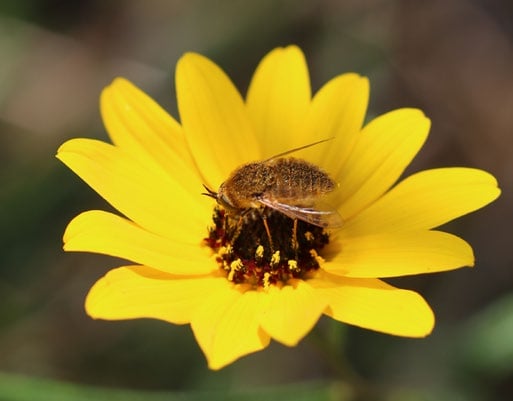


Insects on Swamp Sunflower. Clockwise from top L: Monarch butterfly; bee fly; leaf cutter bee; wasp.
Family: Asteraceae
Life Cycle: Perennial
Description: Sunflowers grow upright, multi-branched stems generally ranging from 2 to 5 ft tall but can grow up to 8 ft tall, spreading by underground rhizomes. Dark green leaves are rough, lance-shaped, oppositely arranged, ranging from 3–6 in. long and ½ in. wide with little or no stalk, with a prominent mid-vein and curled under margins. Composite flower heads are 1 ½ to 3 in. wide with ray petals surrounding the maroon center disk flowers. Seeds ripen from October to November. Seeds are tear-drop shaped, 1/10 in. long, strongly resembling edible sunflower seeds (Chafin, 2016).
Bloom period: July to October
Cultural requirements: Full sun to part shade, moist soil.; adaptable to various soil types but prefers acidic soil. Does not like dry sites.
USDA Plant Hardiness Zones: 5–9
Range: Florida west to Texas, north to Iowa and New York (Chafin, 2016)
Distribution in Georgia: common in the mountains, Piedmont, and Coastal Plain (Weakley, 2015)
Habitat: Savannas, ditches, marshes, other wet habitats (Weakley, 2015)
Propagation: Seeds are ripe when the heads turn brown and dry. Collect entire seed heads in paper bags, preferably early after ripening, as birds will eat the seeds. Each seed head tends to have only a few seeds. Some seeds will fall from the seed head when shaken in a bag. Tweezers may be needed to dislodge all seeds. Cold-moist stratification for 30 days may improve germination. Alternatively, seeds may be sown outside in the fall or early winter. Technical information for commercial propagation is published by the USDA NRCS.
Garden tips: Narrow-leaf sunflower is large and spreads by underground stems, so plant where it has plenty of room in the background of the garden. To curtail its spread, place in a drier spot. It may be pruned to 2 or 3 ft tall mid-summer to control height while still allowing time for flowers to develop in time for fall blooms. Great for attracting birds in the winter.
Pollinators and other beneficial insects: Sunflowers are valuable late-season nectar and pollen sources for pollinators. They are larval host plants for numerous butterfly and moth species, including the silvery checkerspot (Chlosyne nycteis), gorgone checkerspot (Chlosyne gorgone), bordered patch (Chlosyne lacinia), and painted lady (Vanessa cardui). Helianthus are used by numerous pollen specialist bees, including mining bees, long-horned bees, plasterer bees, and sunflower bees (Fowler & Droege, 2020).
Purple Love Grass, Eragrostis spectabilis
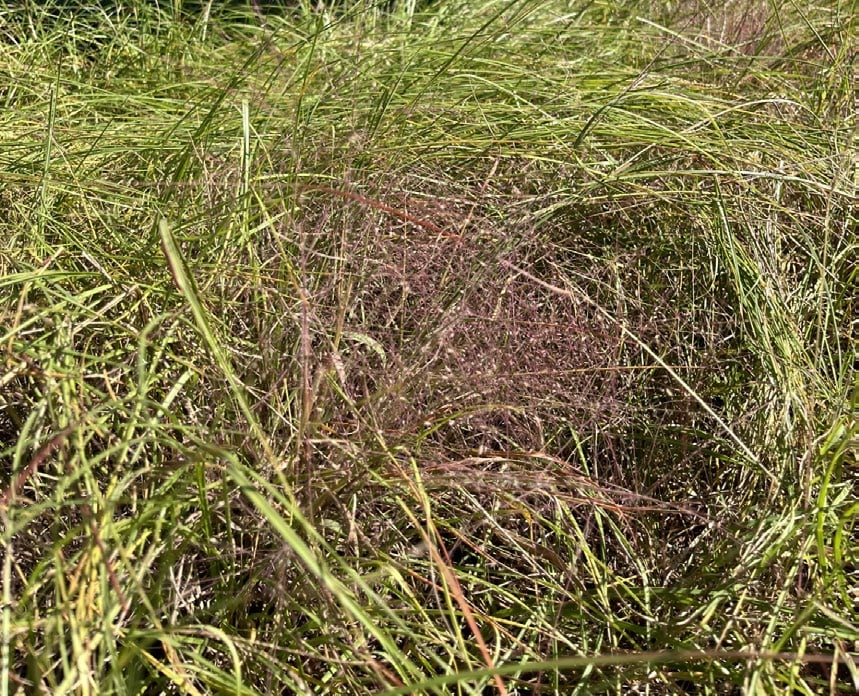
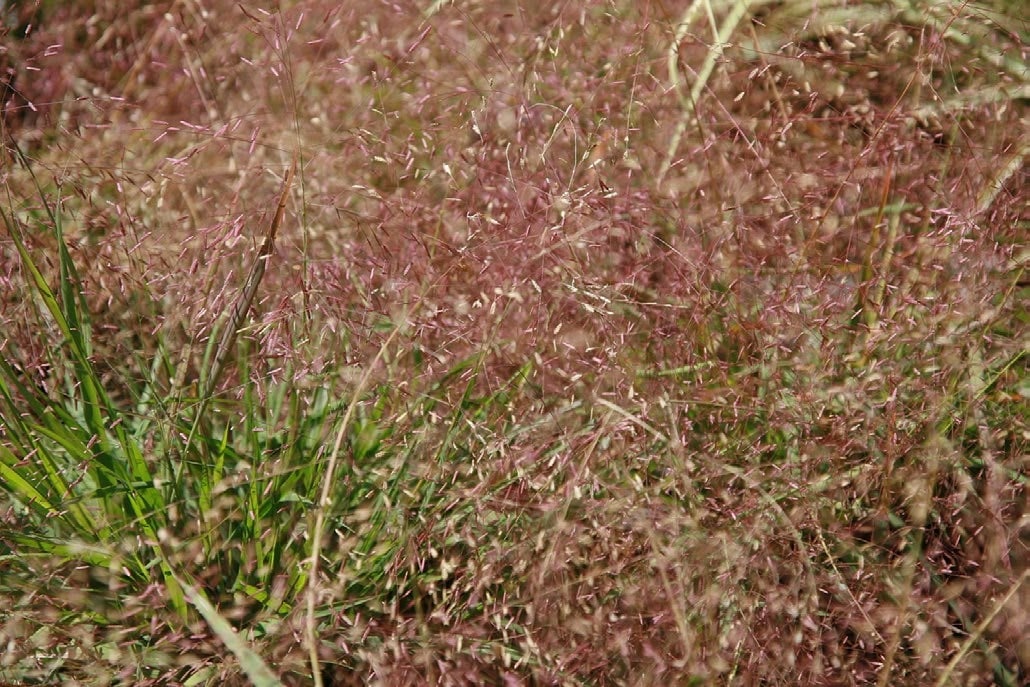
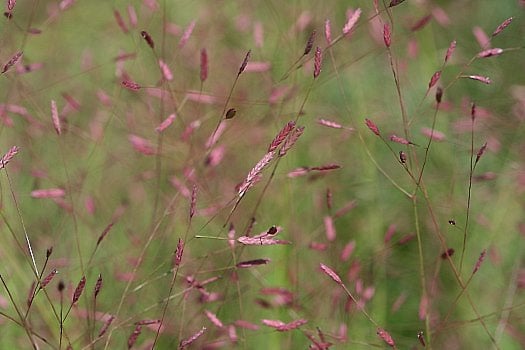
Purple Love Grass. Clockwise from top L: Habit; flower; developing seeds.
Family: Poaceae
Life Cycle: Perennial
Description: Purple love grass is a bunch-type grass reaching up to 2 ft tall with a basal rosette of blades up to 13 in. long and 1/3 in. wide. The leaves can be smooth or hairy with long, white hair marks. It has open, airy flower panicles up to 15 in. tall and wide, create a purple haze effect (Chafin, 2016).
Bloom period: August
Cultural requirements: Full sun to partial shade; performs well on a variety of soil types: sand, loam, and clay; refers dryer, well-drained soil. It can tolerate periodic drought and infertile soil; it is intolerant of wet, heavy soil.
USDA Plant Hardiness Zones: 5–9
Range: Florida west to New Mexico, north to North Dakota and Maine (Chafin, 2016)
Distribution in Georgia: Common in the mountains, Piedmont, and Coastal Plain (Weakley, 2015)
Habitat: Sandy fields, prairies, roadsides, woodlands (Chafin, 2016; Weakley, 2015)
Propagation: Collect mature seed stems when they begin to turn brown at the ends (usually October through December). Seeds are tiny, black, and round, and less than 0.06 in. They may be scraped or rubbed off of their stems with a card or dull knife. Needs cold-moist stratification for 60–90 days, depending on ecotype, with longer times for seeds from the northern areas to break seed dormancy for germination. Alternatively, seeds may be sown outside in the fall or early winter. Technical information for commercial propagation is published through the USDA NRCS fact sheets and the USDA Native Plant Network.
Garden tips: Purple love grass is a smaller bunch grass that is most attractive when planted in groups near the forefront of a perennial garden. Pairs well with little bluestem, splitbeard bluestem, and fall-blooming wildflowers. Birds use the dry panicles for nesting.
References
Adamson, N. L., Borders, B., Cruz, J. K., Jordan, S. F., Gill, K., Hopwood, J., Lee-Mäder, E., & Vaughan, M. (2017). Pollinator plants Southeast region. Xerces Society for Invertebrate Conservation. https://xerces.org/sites/default/files/2018-05/17-053_03_XercesSoc_PollinatorPlants_Southeast-Region_web-3page.pdf
Anderson, M. K. (2003). Plant guide: Dotted horsemint Monarda punctata L. U.S. Department of Agriculture, Natural Resources Conservation Service. https://plants.usda.gov/DocumentLibrary/plantguide/pdf/cs_mopu.pdf
Biota of North America Program. (2014). County distribution map for Penstemon laevigatus. https://bonap.net/MapGallery/County/Penstemon%20laevigatus.png
Blessman, G., Flood, R. M., & Horvath, D. J. (2001). Protocol information Baptisia (alba). Native Plant Network. https://npn.rngr.net/renderNPNProtocolDetails?selectedProtocolIds=fabaceae-baptisia-254&referer=wildflower
Brakie, M. (2021a). Plant guide: Button eryngo Eryngium yuccifolium. U.S. Department of Agriculture, Natural Resources Conservation Service. https://plants.usda.gov/DocumentLibrary/plantguide/pdf/pg_eryu.pdf
Brakie, M. (2021b). Plant guide: Swamp sunflower Helianthus angustifloius. U.S. Department of Agriculture, Natural Resources Conservation Service. https://plants.sc.egov.usda.gov/DocumentLibrary/plantguide/pdf/pg_hean2.pdf
Broyles, P. J. (2006). Plant guide: Baptisia australis. U.S. Department of Agriculture, Natural Resources Conservation Service. https://plants.usda.gov/DocumentLibrary/plantguide/pdf/cs_baau.pdf
Chafin, L. G. (2016). Field guide to the wildflowers of Georgia and surrounding states. University of Georgia Press. https://www.ugapress.org/9780820348681/field-guide-to-the-wildflowers-of-georgia-and-surrounding-states/
Fowler, J., & Droege, S. (2020). Pollen specialist bees of the Eastern United States. https://jarrodfowler.com/specialist_bees.html
Magee, P. (2005). Plant fact sheet: Purple lovegrass Eragrostis spectabilis. U.S. Department of Agriculture, Natural Resources Conservation Service. https://plants.usda.gov/DocumentLibrary/factsheet/pdf/fs_ersp.pdf
Moranz, R., Gill, K., Adamson, N., & Hopwood, J. (2023). Native plants for pollinators & beneficial insects: Southeast. The Xerces Society for Invertebrate Conservation. https://xerces.org/publications/plant-lists/native-plants-for-pollinators-and-beneficial-insects-southeast
Natural Resources Conservation Service. (n.d.). Liatris spicata (L.) Willd. U.S. Department of Agriculture. https://plants.sc.egov.usda.gov/plant-profile/LISP
South Carolina Exotic Pest Plant Council. (n.d.) Featured native plant: Monarda (Beebalm) – presently in bloom (summer)! https://bugwoodcloud.org/CDN/sceppc/publications/monardaArticleSCNLA.PDF
Stevens, M. (2006). Plant guide: Asclepias tuberosa. U.S. Department of Agriculture, Natural Resources Conservation Service. https://plants.usda.gov/DocumentLibrary/plantguide/pdf/cs_astu.pdf
Stritch, L. (n.d.). Plant of the week: Asclepias tuberosa. U.S. Department of Agriculture, Forest Service. https://www.fs.usda.gov/wildflowers/plant-of-the-week/asclepias_tuberosa.shtml
Weakley, A. S. (2015). Flora of the southern and mid-Atlantic states. University of North Carolina at Chapel Hill. https://ncbg.unc.edu/wp-content/uploads/sites/963/2019/04/WeakleyFlora_2015-05-29.pdf
Weakley, A. S. (2020). Flora of the southeastern United States. University of North Carolina at Chapel Hill. https://fsus.ncbg.unc.edu/
Wheeler, J. (2017a). Plants for pollinators: Beardtongue. The Xerces Society for Invertebrate Conservation. https://xerces.org/blog/plants-for-pollinators-beardtongue
Wheeler, J. (2017b). Plants for pollinators: Blazingstar. The Xerces Society for Invertebrate Conservation. https://xerces.org/blog/plants-for-pollinators-blazingstar
Wheeler, J. (2017c). Plants for pollinators: Wild bergamot. The Xerces Society for Invertebrate Conservation. https://xerces.org/blog/plants-for-pollinators-wild-bergamot