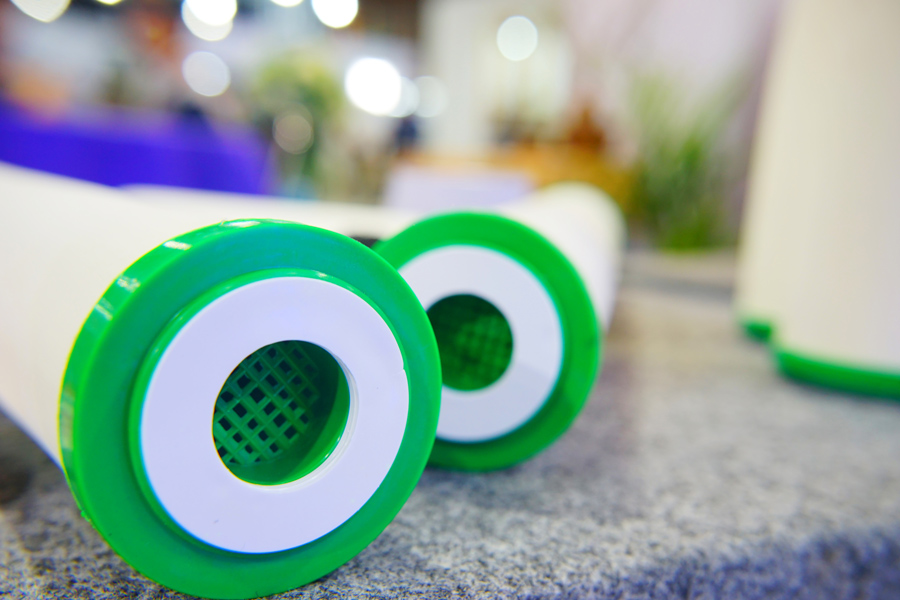

Activated carbon (AC), also called activated charcoal, is usually produced from charcoal in granular or powdered form. It is a form of carbon that has been processed (activated) to make it highly porous and thus to have a very large surface area available for physical adsorption or chemical reactions. Most ACs are made from raw materials such as nutshells, coconut coir, wood, coal, etc. Typically, 1 ounce of AC may have a surface area of 30,000 square yards, about five times the size of a football field (AC may have a surface area of 1000 square meters per gram).
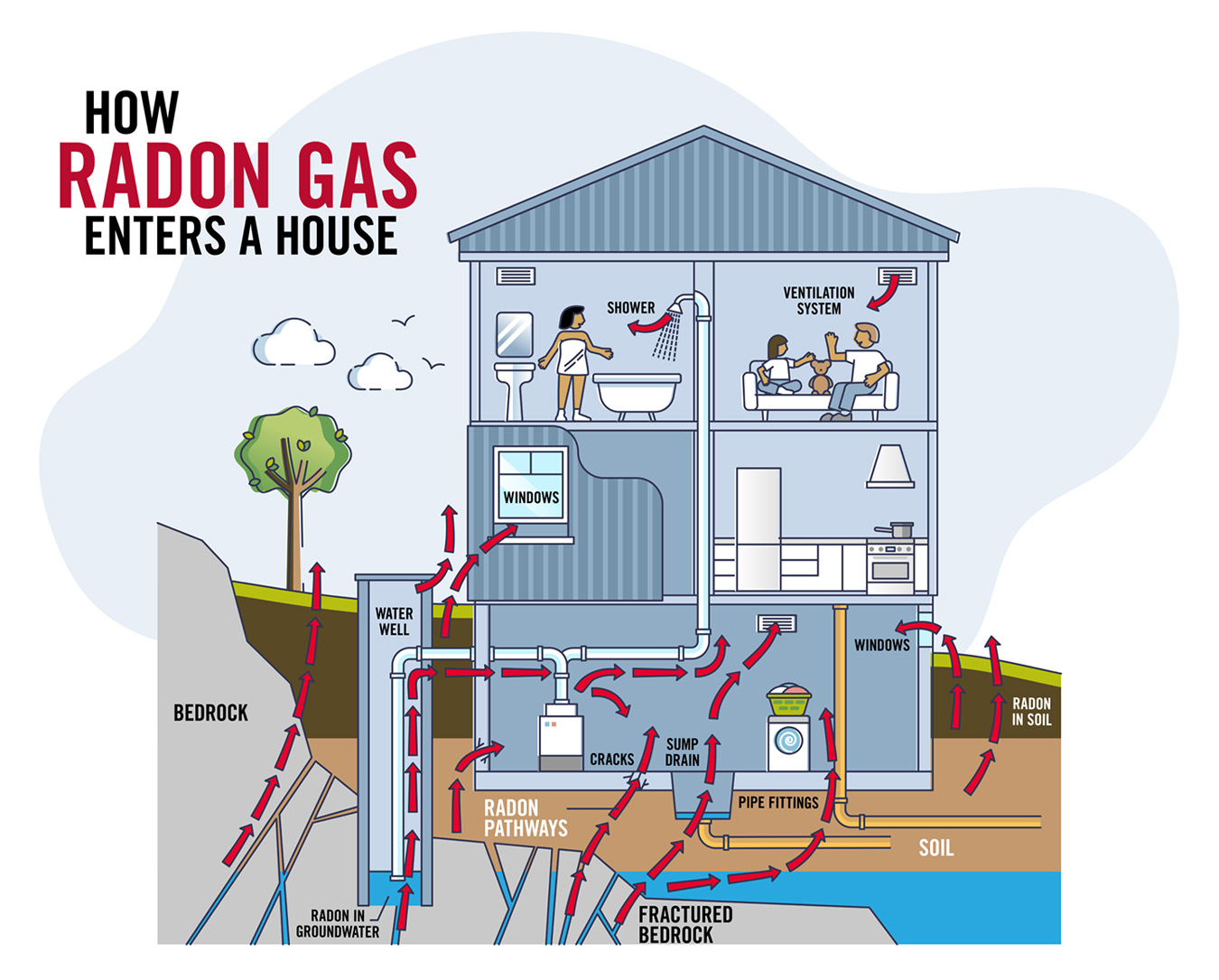
Water treatment is an important application of AC. AC filters treat general taste and odor problems, including chlorine residue. AC filters are reported to be the best method available for removing organic chemicals. Studies have also shown that granular activated carbon (GAC) adsorption is an effective method for radon removal.
Contaminants removed: AC removes unpleasant taste, odors (e.g., hydrogen sulfide), residual chlorine, a few metals like mercury, many organic compounds (e.g., volatile organic compounds), some pesticides, gasoline, trihalomethanes, benzene, and radon gas. AC will also remove metals bound to organic molecules. Solid block activated carbon (described later) filters can remove Cryptosporidium and Giardia cysts as well.
Contaminants not removed: AC does not remove bacteria, nitrate-N, fluoride, chloride, hardness (calcium, magnesium), or most metal ions.
Sediment prefilters: Sediment is a common problem in household water and can adversely affect the function and longevity of AC filters. It is highly advised that homeowners installing an AC filter consider installing a sediment filter at the point of entry into the house.

HOW ACTIVATED CARBON TREATMENT WORKS
The two principal mechanisms by which AC removes contaminants from water are adsorption (or sticking) and catalytic reduction. For example, organics are removed by adsorption and residual disinfectants are removed by catalytic reduction. Some chemicals adsorb onto AC because they “dislike” (or tend to stay away from) water and have an attraction to AC. Adsorption of most contaminants occurs from a combination of these two reasons. When water flows through AC filters, some contaminants adsorb or stick to the surfaces of the carbon particles. The efficiency of the unit depends on the:
- Type of AC used, since smaller AC particles generally show higher adsorption rates
- Filter bed depth, because a deeper bed means more carbon in the cartridge, longer contact time, higher capacity for chemical removal, and longer cartridge lifetime
- Type and concentration of contaminants in the water
AC can destroy residual disinfectants such as chlorine and chloramine through a catalytic reduction reaction where AC acts as a reducing agent. The end product of this reduction reaction is a chloride ion. Reduction of chlorine to chloride is very fast, occurring in seconds as water flows through the first few inches of a new AC bed, but conversion of chloramine to chloride is a relatively slower reaction.
Most people can smell hydrogen sulfide in water with a concentration of 0.5 ppm or higher. An AC filter alone can remove trace amounts of hydrogen sulfide gas from water (less than 0.3 ppm). In this process, the AC simply adsorbs the gas on its surface area. Using an AC filter can be economical when just a small amount of this gas is present. Otherwise it should be used in combination with other treatment options. To learn more, refer to UGA Cooperative Extension Circular 858-8, “Hydrogen Sulfide and Sulfate,” and Circular 858-15, “Removal of Hydrogen Sulfide and Sulfate,” from the “Household Water Quality” series.
Generally, an AC filter is used with a mechanical pretreatment filter to remove sediment or iron particles that may be present and can clog the carbon filter. These are often used in combination with other water treatments such as reverse osmosis, chlorination, and ozonation.
TYPES OF ACTIVATED CARBON USED IN WATER FILTERS
Two major types of activated carbon used in the water treatment industry are:
Granular activated carbon (GAC) filter media are composed of loose granules of carbon. GAC filters are most commonly used for household water treatment. Some limitations of GAC filters are:
- GAC filters accumulate the organic contaminants they remove from the water, which often serve as food for bacteria, stimulating bacterial growth.
- When the filter becomes saturated with organics, they can be released back and come out with treated waters.
- Channels can form between the granules in the filter, which reduces contact time between the water and carbon, resulting in less effective filtration.
Solid block activated carbon (SBAC) filter media are composed of a compressed block of AC. SBAC is very tightly compressed so that it can filter out some parasites such as Giardia and Cryptosporidium in addition to removing the chemicals mentioned above. Some limitations of SBAC filters are:
- SBAC filters easily become clogged with particulate matter because they are very fine, so they frequently need to be replaced.
- They are more expensive than GAC filters.
Bone char activated carbon (BCAC) is one of the methods recommended by the U.S. Environmental Protection Agency and Water Quality Association for the removal of fluoride from drinking water. BCAC is produced by charring ground animal bones. The process removes all organic matter and leaves calcium carbonate, calcium phosphate, and AC in the end product. Fluoride removal takes place through the replacement of the carbonate in the BCAC with the fluoride ion. A number of factors can affect the fluoride removal capacity of the BCAC from raw water. Among these factors are: (i) the method of preparation and quality of the char, as a low-grade bone char may add bad taste and odor to the treated water; (ii) the presence of other interfering ions, especially arsenic ions, in the raw water decreases the fluoride uptake capacity; and (iii) the amount of acid added to neutralize the excess base used in the regeneration step because bone char dissolves in acids. In addition, the efficiency of the fluoride removal process depends on the size of the BCAC media, temperature, pH of raw water, contact time, and concentration of fluoride in the raw water.
Silver impregnated activated carbon (SIAC) has antimicrobial property. Impregnation on the carbon surface involves finely distributing chemicals or metals on the carbon surface. Different metals—like silver, copper, nickel, or aluminum—can be impregnated on the carbon surfaces. Among these, silver impregnation develops the carbon surface as an antimicrobial agent, so SIAC has an important role in the decontamination or sterilization of aqueous solutions. However, in the water treatment industry, SIAC is primarily used for inhibiting microbial growth on or in the AC filter rather than for killing the microbes in the raw water (though technically it can serve both purposes).
TYPES OF ACTIVATED CARBON FILTRATION DEVICE
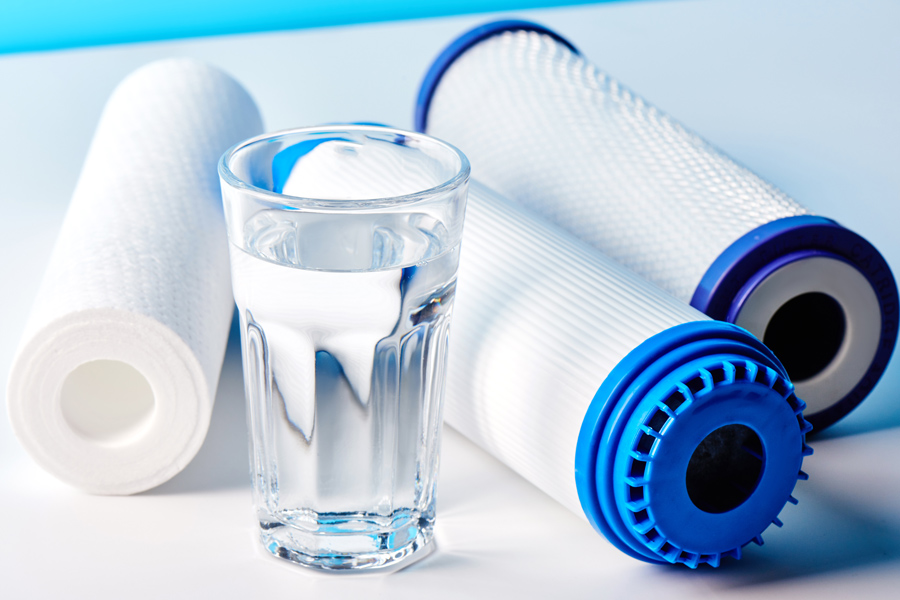
Activated carbon (AC) filtration devices for household water treatment are quite simple.
The AC filter medium is normally packaged in the filter cartridges and inserted into the treatment device. Water needing treatment passes through the cartridge, comes in contact with the AC, and loses some contaminants on its way to the faucet. AC treatment devices could be a point-of-use (POU) system or a point-of-entry (POE) system, also known as a whole-house system. POU systems are suitable for houses supplied by public water systems, whereas POE systems are needed for houses supplied by private wells where removal of contaminants are usually needed on a whole-house scale.
Five basic types AC treatment devices
Pour-through units
Pour-through AC filters are similar to drip coffee makers and are the simplest and least expensive type of device. These units are not connected to the water supply. A smaller quantity of untreated water is poured through AC, and the treated water is collected in a storage container. They are portable, require no installation, and are convenient for camping, picnicking, or similar uses. However, because they do not contain enough AC or provide sufficient contact time between the carbon and the water they are not as efficient at removing impurities as other types of carbon filters. Significant bacterial growth can occur on the carbon in these units, so they should be flushed thoroughly for at least five minutes if unused for more than a few days.
Faucet-mount units
Faucet-mounted AC filters are attached to the faucet (usually in the kitchen) where drinking and cooking water comes out. They can also be placed on the counter and connected to the faucet. There are two basic designs:
- The bypass option, which has a valve to filter water used only for cooking and drinking but diverts water for other uses untreated to prolong the life of the cartridge, and
- The nonbypass option, which filters all water passing through the faucet.
Because the quantity of AC contained in a faucet-mount unit is not large enough to provide extensive contact time with the water, these devices are not recommended for removing organic chemicals. Significant bacterial growth can occur on AC in these units, so they should be flushed thoroughly for at least five minutes if unused for more than a few days.
In-line device
The in-line device is installed beneath the kitchen sink in the cold water supply line to treat water, generally for drinking or cooking. This device does not allow water to bypass treatment for uses other than drinking and cooking. If both hot and cold water come out of a single faucet, the treated (cold) water can mix with the untreated (hot) water. Treated water is assured only when using cold water for drinking and cooking.
Line-bypass unit
Line-bypass AC filters are also attached to the cold water supply line, but a separate faucet is installed at the sink to provide treated water for drinking and cooking. The regular tap delivers untreated water. The carbon filter lasts longer because only water used for drinking and cooking is treated. The separate faucet system slows the flow rate, which increases contact time and adsorption effectiveness. Neither in-line nor line-bypass units are recommended for removing radon or volatile organic chemicals.
Whole-house treatment or point-of-entry
Whole-house treatment or point-of-entry AC devices are installed where the water enters the house, so they treat all the water used in the home. A point-of-entry (POE) system is more appropriate if:
- Large quantities of contaminants exist, and
- Contaminants like volatile organic compounds (VOCs), radon, and some other contaminants that should be treated before entering the house pose a health threat from general use as well as from consumption.
Since VOCs easily vaporize from water into the air, point-of-entry treatment prevents inhalation and skin contact of hazardous vapors from the shower, dishwasher, washing machine, or other times when large amounts of water are used. If the unit is treating VOCs, the systems should be vented to the outside atmosphere to prevent or minimize buildup of harmful vapors inside the home. There is no bypass option, although water can be diverted for outdoor use prior to treatment. These are the most expensive AC filters to purchase and maintain.
Apart from the various types of AC filters described above, there are some specialty AC filters for attachment to the cold water supply line to some household appliances. For example, ice maker filters are placed on the supply line to refrigerators, and scale filters are placed on the supply line to water heaters or humidifiers.
Although the best equipment often comes at a higher cost, it will not perform satisfactorily unless the installation and maintenance (cleaning and part replacement) guidelines suggested by the manufacturer are properly followed. Keep a log book to record water test results, equipment maintenance, and repairs.
MAINTENANCE
Most activated carbon filter units require changing the filter media periodically. For most units, cartridge filters are changed, but for some small specialty units, the entire unit is normally replaced.
Carbon filter cartridges must be replaced when taste or odor problems reappear. Small units with heavy loads of contaminants may need to be replaced monthly or more often, while a six-month service interval is frequently advised for cartridge filters. Some filters are guaranteed to treat a particular amount of water. A water meter installed on the filter can help judge when filter media replacement is necessary.
Inadequately maintained AC filters can become breeding grounds for bacteria, so the filters need to be kept clean. Follow the manufacturer recommendations for maintenance. If a filter is unused for several days, run water through it for a few minutes to flush any bacteria. As a precaution, however, filters are recommended for use only on microbiologically safe (bacteria-free) water.
OTHER CONSIDERATIONS
- Various AC units differ in level of treatment, installation, space requirements, maintenance and cost. Some devices are better at treating certain contaminants than others. The AC device that would be appropriate for a given situation is determined by the type and concentration of the contaminant and the unit’s design, including how much carbon it contains. Discuss options with a treatment specialist.
- Confirm that the treatment unit has been tested by NSF (www.nsf.org) or WQA (www.wqa.org) to validate the manufacturer’s claims.
- Before purchasing a unit, consider the ease of opening the filter housing and the amount of space required to change the filter.
- Depending on the type and concentration of the contaminant being removed, some carbon filters may require special hazardous waste handling and disposal, which can be costly. An example would be carbon filters used to remove radon in drinking water.
- It is important to establish beforehand how handling and disposal of hazardous waste (if any) will work and whether alternative treatment methods or locating alternative water sources (such as installing a new well in a new location, tying into a public water supply if available, or using bottled water) would be more effective in the long run.
- Before buying a costly POE AC device, carefully consider the type of AC used, flow rate of water to the AC, contact time between the water and AC, and the concentration of contaminant(s) that can be handled.
- Many small devices use SBAC, which may result in a significant drop in home water pressure. These devices also clog easily if the water is cloudy or contains particles.
It is important to get answers to a number of pertinent questions from the water treatment company. For a set of such questions, see the “Questions to Ask When Purchasing Water Treatment Equipment” section in UGA Extension Bulletin 939, “Water Quality and Common Treatments for Private Drinking Water Systems.”
References:
Daniels, B., & Mesner, N. (2010). Drinking Water Treatment Systems. Utah State University Cooperative Extension.
DeSilva, F. (2000). Exploring Multifunctional Nature of Activated Carbon Filtration. Water Quality Product Magazine, 17, January 2000.
Dvorak, B. I., & Skipton, S. O. (2014). Drinking Water Treatment: An Overview. EC703. Institute of Agriculture and Natural Resources at the University of Nebraska-Lincoln.
Herman, G. M., & Jennings, G. D. (1996). Home Drinking Water Treatment Systems. North Carolina Cooperative Extension Service, Publication Number: HE-419.
Michigan State University Extension, (1997). A Guide to Home Water Treatment. MSU Extension Water Quality Bulletins-WQ219201. Lansing, Michigan.
Minnesota Department of Health. (2008). Water Treatment Using Carbon Filters: GAC Filter Information. St. Paul, MN.
Parrott, K., Ross, B., & Woodard, J. (2009). Household Water Treatment. Virginia Cooperative Extension, College of Agriculture and Life Sciences, Virginia Polytechnic Institute, Blacksburg and State University, Petersburg, VA.
Purdue University Extension. Home Water Treatment Using Activated Carbon, WQ-13. Lafayette, ID.
Scherer, T., & Johnson, R. (2015). Filtration: Sediment, Activated Carbon and Mixed Media. WQ1029 (Revised), NDSU Extension Service, North Dakota State University, Fargo, ND.
University of Missouri Extension. Understanding Home Water Treatment Systems. Columbia, MO.
Water Systems Council (2009). Wellcare® Information for You About Well Water Treatment Options and Costs. Washington, DC.
The original manuscript was prepared by Uttam Saha, Pamela Turner, Gary Hawkins, and Joel Burnsed. Reviewed by Uttam Saha.