

Dollar spot, caused by Clarireedia spp., is a major turfgrass disease typically managed with frequent fungicide applications, which can be costly and contribute to resistance development.
Abstract
In our latest findings, we highlight the growing prevalence of fungicide resistance in turfgrass pathogen populations and the need for improved monitoring and management strategies. Our recent research explores the use of blue light as a nonchemical control strategy, showing potential to suppress turfgrass pathogens and offering a more sustainable alternative to traditional fungicides.
UV-C radiation was also evaluated as a nonchemical approach to manage dollar spot in seashore paspalum and was found to effectively reduce Clarireedia growth and disease severity without causing phytotoxicity. Field and controlled environment results also showed improvements in turf quality, supporting UV-C as a promising tool for integrated turfgrass disease management.
We will highlight current integrated management approaches that emphasize preventive strategies, accurate diagnosis, cultural practices, biological controls, and judicious fungicide use to reduce disease pressure and improve turf resilience.
Results
Fungicide-Resistant Problems
This project was funded by USDA NIFA IPM.
We investigated fungicide insensitivity in Clarireedia spp., the causal agents of dollar spot in turfgrass in Georgia. Overall, our findings highlight the increasing prevalence of fungicide resistance in Clarireedia populations and underscore the need for ongoing monitoring and improved resistance management strategies in turfgrass systems.
We evaluated in vitro sensitivity of 79 isolates to the SDHI fungicide boscalid and characterized mutations in key target genes. Approximately one-third of the isolates exhibited reduced sensitivity to boscalid, and nearly a quarter showed multiple fungicide insensitivities across SDHI, MBC (thiophanate-methyl), and DMI (propiconazole) classes.
Molecular analyses revealed specific mutations associated with resistance, including R61K and E63A substitutions in the SdhD gene linked to boscalid insensitivity and the E198A mutation in the β-tubulin gene associated with thiophanate-methyl resistance, while no target-site mutations were detected in the Cyp51 gene for propiconazole. Structural modeling and docking analyses supported the functional impact of these mutations.
Light-Based Treatment Solutions
These projects were funded by USDA SCBG and GGEF.
Recent advances in physical control technologies, including light-based treatments, offer environmentally friendly and cost-effective alternatives for disease management, but their use in turfgrass remains limited.
Our research demonstrates that blue-light treatments can significantly reduce the growth of Clarireedia spp. (causal agent of dollar spot) and Rhizoctonia solani (causal agent of large patch) in vitro without harming turfgrass. This suggests strong potential for integrated management, particularly against fungicide-resistant and highly virulent strains.
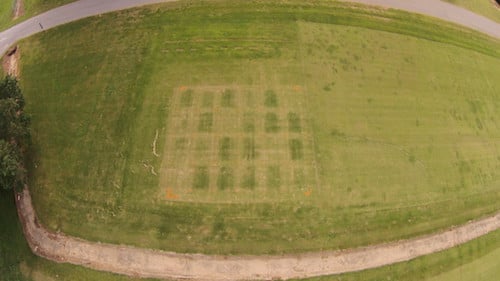
We also evaluated UV-C radiation as an alternative control strategy in seashore paspalum. Results showed that UV-C significantly reduced C. monteithiana mycelial growth in vitro, with stronger effects under dark conditions. In growth chamber trials, daily UV-C treatment reduced disease severity without causing phytotoxicity. Field experiments using a robotic UV-C application system also confirmed significant disease suppression.
Overall, UV-C improved turf quality parameters, suggesting strong potential as a sustainable tool for integrated dollar spot management.
Biological Agents and Fungicide Combination Programs
This project was funded by GGEF.
In this ongoing project, we are evaluating combinations of contact and biological fungicides to improve dollar spot management in creeping bentgrass and bermudagrass in Georgia. Greenhouse trials consist of 12 treatments, including contact fungicides (such as mancozeb, captan, and thiram), plant defense elicitors (Chitosan), and biocontrol agents (B. subtilis: Rhapsody, T. harzianum/T. virens: Rootshield Plus WP), using controlled inoculations of the dollar spot pathogen C. jacksonii and C. monteithiana, and standardized disease assessments over time.
Disease severity, measured every 14 days, will be used to determine treatment effectiveness under controlled conditions. The most effective treatments will be advanced to field trials in 2027 to further evaluate integrated management strategies.
For More Information on Fungicide Resistance
Aktaruzzaman, M., Ghimire, B., Saxena, H., Majumdar, M., Oliver, J. E., Buck, J. W., Martinez-Espinoza, A. D., & Bahri, B. A. (2026). In vitro SDHI fungicide insensitivity and mutations in Sdh, β-Tubulin and Cyp51 of Clarireedia spp., causing dollar spot in turfgrass in Georgia, USA. Plant Pathology, 75(4), e70220. https://doi.org/10.1111/ppa.70220
Ghimire, B, Aktaruzzaman, M, Chowdhury, S. R., Spratling, W. T., Vermeer, C. B., Buck, J. W., Martinez-Espinoza, A. D., & Bahri, B. A. (2023). Sensitivity of Clarireedia spp. to benzimidazoles and dimethyl inhibitors fungicides and efficacy of biofungicides on dollar spot of warm season turfgrass. Frontiers in Plant Science, 14, 1155670. https://doi.org/10.3389/fpls.2023.1155670
For More Information on UV-C and Blue Light
Spratling, W. T., Raymer, P. L., Fan, Q., Rowe, S., Jespersen, D., Waltz, C., Martinez-Espinoza, A., & Bahri, B. A. (2025). Assessing UV-C radiation treatments for dollar spot suppression in seashore paspalum. Plant Disease. Advance online publication. https://doi.org/10.1094/PDIS-08-24-1610-RE
We thank the granting agencies for their financial support.