
The sugarcane beetle (Euetheola humilis, family: Scarabaeidae) has been a significant pest of many crops, including sugarcane, corn, sweet potato, and rice, for more than 100 years.
It is a native species commonly found in turfgrass. While low numbers of beetles in an area generally are not regarded as pests, increasing numbers of adult beetles have been causing damage to turfgrass stands throughout the Southeastern U.S.
Description
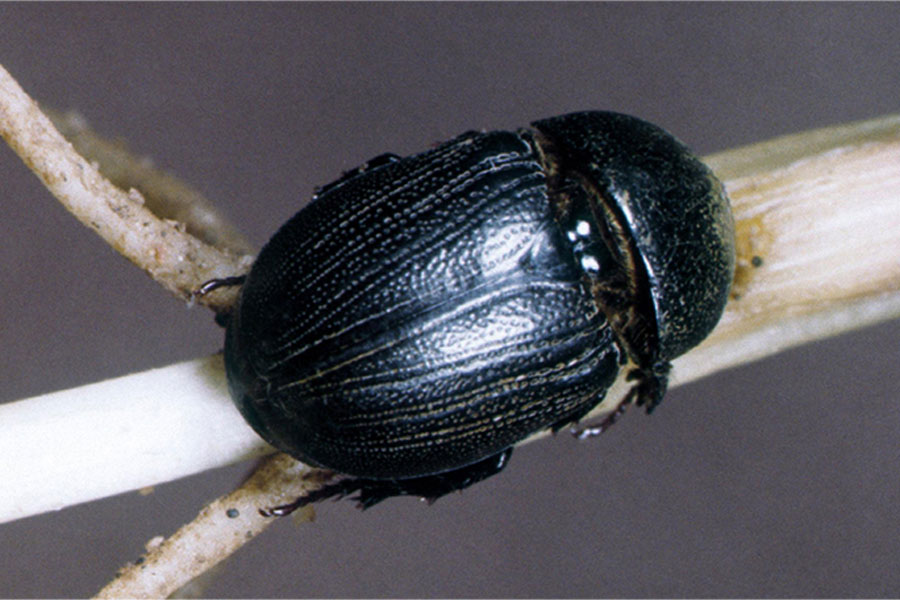
The adult sugarcane beetle is about ½ in. long, and is black with small punctures along the elytra, or wing covers, that create long, lengthwise stripes. Its first pair of legs have four serrations that make the beetle a strong digger. As a result, adults are known to damage asphalt roofs, door gaskets, and other soft structural elements when lights attract them to buildings.
The larvae of sugarcane beetles are C-shaped grubs, which are similar in appearance to other white grub species. Third-instar larvae can reach up to 1¼ in. long and are identified by their creamy white bodies with reddish- brown head capsules.
Life Cycle and Biology
The sugarcane beetle has four stages: egg, larva, pupa, and adult. The beetle overwinters as an adult and emerges in early April. The activity of overwintered adults can be observed from April until early June. During this time, the adults mate and the females lay eggs in the soil.
Overwintered adults die after eggs are laid, and the eggs hatch into white grubs. About 75 days after hatching, the larvae pupate. The larval stages are found from June to August, and they feed on roots and organic matter in the soil. Grubs have been found up to 1 ft underground. It takes 15–20 days for an adult to emerge from the pupa, and the activity of summer adults can be observed again beginning in August. They feed through October, and then overwinter until spring. There is one generation per year.

Photo: C. Sorenson, North Carolina State University.
Sugarcane beetles primarily are found on warm-season turfgrasses (Figure 1), especially bermudagrass and zoysiagrass. Adults usually are active during the early nighttime hours, and as daylight breaks, adults will attempt to dig away from the sunlight. However, adult beetles are attracted to lights at night; researchers have relied on this trait to sample and monitor beetles.
Lighting control or switching to less attractive bug-light bulbs may reduce problems with beetles in many situations. They can be found within the turfgrass canopy, at the soil surface, or just under the surface, feeding on turf roots and crowns. The larvae can be found in similar locations, infesting bermudagrass and zoysiagrass. Organic matter in the thatch and roots are the main component of their diet.
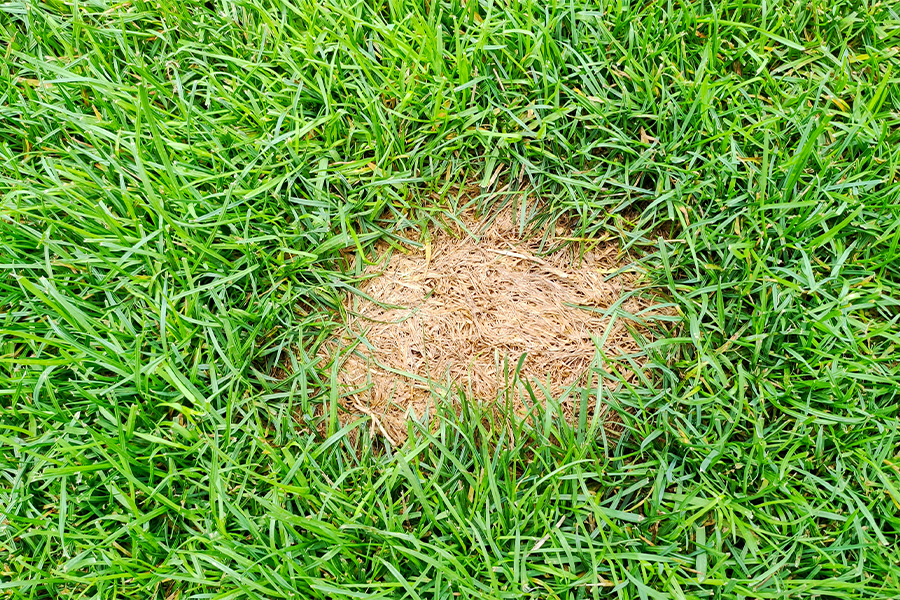
Damage to turfgrass is believed to be caused by the adults tunneling, digging, and feeding on the roots. Birds also may cause some damage when they prey on these beetles during the day. Beetle concentrations can exceed 50 per square foot, and at that density they will destroy turfgrass quickly (Figure 2). These aggregations are not necessarily associated with nighttime lighting, but do usually occur in grassy areas with plentiful organic matter in the soil.

Photo: Terri Billeisen, North Carolina State University.
Management
You need an understanding of any pest’s biology to effectively manage them. Unfortunately, the sugarcane beetle’s life cycle and biology are not well understood. However, we know that adults are active from April through early June and from August through October. Cultural practices, such as reduced irrigation and the use of sodium vapor lights instead of mercury vapor bulbs, may reduce the adult beetles’ attraction to turf during flights.
Pyrethroid insecticides—such as bifenthrin (Talstar, Menace, etc.), lambda-cyhalothrin (Scimitar or Battle), deltamethrin (Deltagard), cyfluthrin (Tempo), and other pyrethroids—are effective against adult sugarcane beetles. Applying insecticides late in the day is likely more effective, given the beetle’s nighttime feeding habits. A high spray volume (e.g., 75–100 gallons per acre) can improve the efficacy of the insecticides.
Because the adults often are concentrated in a relatively small area, applying the insecticide on a large area usually is not necessary. Instead, thoroughly drenching the affected area may improve insecticidal control, reducing turfgrass damage with minimal cost and insecticide use.
In affected areas of bermudagrass and zoysiagrass, the soil can be core-aerified to stimulate turfgrass growth from belowground rhizomes if the adult beetles are effectively controlled. If infestation is severe, resodding may be necessary.
References
Billeisen, T. L., & Brandenburg, R. L. (2014). Biology and management of the sugarcane beetle (Coleoptera: Scarabaeidae) in turfgrass. Journal of Integrated Pest Management, 5(4), B1–B5. https://doi.org/10.1603/ IPM14008
The original manuscript was prepared by Shimat V. Joseph, Department of Entomology, Will Hudson, Department of Entomology, Clint Waltz, Department of Crop and Soil Sciences, and J. B. Workman, Department of Crop and Soil Sciences.