Valuable Vidalias
Producing Georgia’s unique sweet onion takes layers of ingenuity

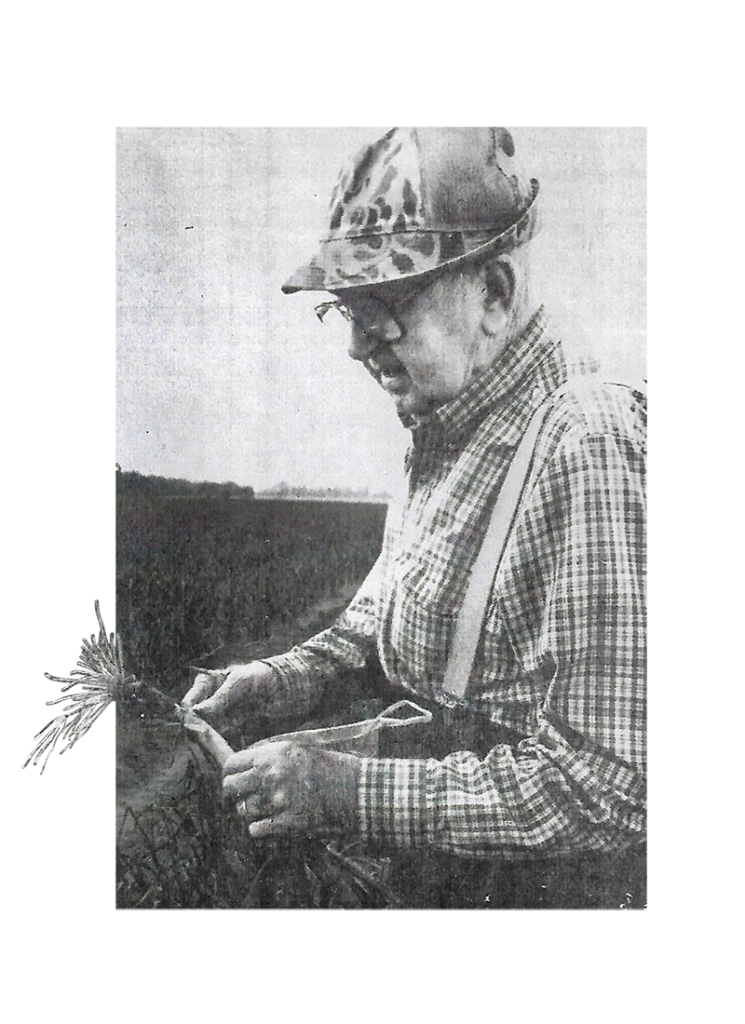
A framed clipping from the March 17, 1989, edition of The Statesboro Herald hangs on the wall of Chris Tyson’s office at the University of Georgia’s Vidalia Onion and Vegetable Research Center (VOVRC).
The photo shows an older man wearing large, black-framed glasses, a plaid flannel shirt and a camouflage bucket hat. He stands in a field of young onions, peering down at one in his hand. The caption reads: “Herbert Deal, who has farmed in Bulloch County for 50 years, still keeps a concerned eye out for grandson Lemuel Deal Jr.’s crops. Here, he examines Vidalia onions to check for freeze damage.”
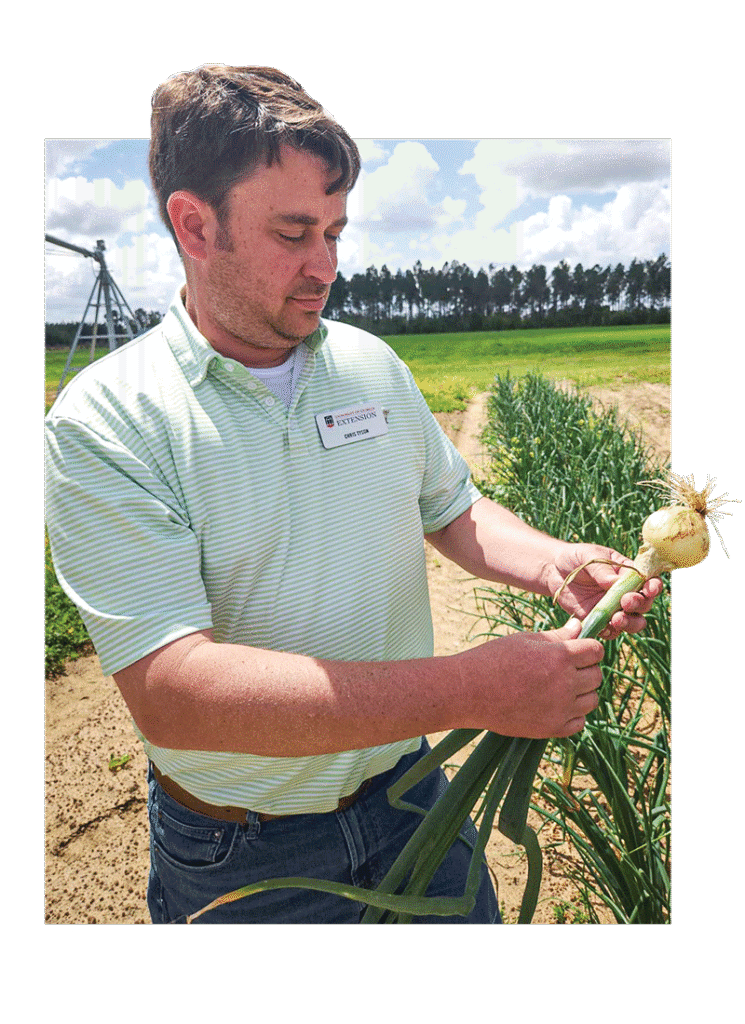
The man is Tyson’s great-grandfather, a Vidalia onion grower, decades before his great-grandson became the area onion agent for University of Georgia Cooperative Extension.
A legacy rooted in the soil
Tyson grew up in Statesboro, within Georgia’s strictly regulated, 20-county Vidalia onion-growing region, where several family members farmed onions in the 1980s. While his family stopped farming in the 1990s, the experience left Tyson familiar with the crop. He wanted a career in agriculture but did not initially plan to work with onions.
He earned a bachelor’s degree in agriscience and environmental systems from the UGA Tifton campus in 2006, then began his Extension career working with peanuts and cotton in Worth County. In 2012, he became the Agriculture and Natural Resources agent in Tattnall County, neighboring Toombs County and the city for which the famous onions are named.
“Because Vidalia onions are such a niche crop grown in a very specific way, growers really depend on local, unbiased research. A lot of what we do here can’t just be looked up in a book. The way we grow Vidalia onions is different from onions anywhere else in the world, and we’re constantly looking for ways to make them even better,” Tyson said of the multidisciplinary research at the VOVRC.

According to UGA Extension’s Vidalia Onion Production Guide, the Vidalia onion industry began in 1931 when a grower named Mose Coleman planted the first short-day onions in Toombs County. The mild onions quickly became popular with customers, even during the Great Depression, when $3.50 for a 50-pound bag was a considerable sum.
Other growers took interest, and the industry grew steadily for decades. Production skyrocketed in the 1970s and 1980s, and the industry gained formal recognition with the Georgia Vidalia Onion Act of 1986 and a federal marketing order in 1989. These measures defined the growing region and established a trademark for Vidalia onions to ensure authenticity.

Since then, the industry has shifted from many small growers selling to centralized packers to a few large-scale producers. Total acreage today is comparable to past decades, but most onions are grown by large operations supplying retail markets. Smaller growers remain, often serving niche or local outlets such as roadside stands or specialty shops.
“Growers have always relied on Extension, and Vidalia onions are no different. We started doing Vidalia onion research in the area back in the 1980s,” Tyson said. “The center was built in 2008, and, through my predecessors, we established ourselves as a reliable source of unbiased, research-based information right here in their backyard.”

Farm workers harvest Vidalia onion transplants from seed beds at Bland Farms in Lyons, Georgia, in December 2025. The tops of the onions are cut, and the seedlings are bundled and packaged for transplanting into growing plots where they will reach maturity. (Photo by Katie Walker)
The high cost of clean fields
The onions’ mild sweetness largely results from the sandy soils and high rainfall of southeast Georgia. Sandy soil doesn’t retain sulfur well, and sulfur is responsible for onions’ pungency. With less sulfur available, the onions develop a sweeter flavor. The defined growing region was established to protect those growing conditions and product integrity.
While onions are grown across the United States and around the world, cultivation practices vary widely. Unlike most onion-producing regions, where onions are direct-seeded, Vidalia onions are typically grown from transplants. Growers raise seedlings in dense seed beds before transplanting young onions into production fields. About 95% of Vidalia acreage uses this method.
Related Content
The approach serves two purposes: increasing plant survival and helping seedlings compete against intense weed pressure in south Georgia.
“You can grow enough plants in 1 acre of seed bed to transplant onto 20 acres,” said Tyson, who earned a master’s degree in plant protection and pest management from CAES in 2017. “The primary reason we use that system is weed control. It’s very difficult to grow onions direct-seeded here because of the weeds we have in our environment.”
Stanley Culpepper, a professor of crop and soil sciences and UGA Extension weed specialist, said weed control is far easier in transplant systems than in direct-seeded onions.
“We have very good herbicide programs available for transplant production, and because transplants are more established, they can tolerate more aggressive treatment. Seeded onion production, on the other hand, is the most difficult weed management challenge I encounter among the more than 35 crops that I work with,” Culpepper said. “The onion seedling is extremely weak and tiny — you almost have to get on your knees to see it at 3 weeks of age. Herbicides that work well on transplants would often kill seeded onions outright. Thus, a completely different weed management program approach is required for seeded production.”
Because seeded onions are especially vulnerable early in their growth when weeds must be managed, Culpepper described herbicide decisions as a “dynamic dance” involving soil type, water availability, humidity and air temperature.
“All of these environmental factors play a critical role in whether you damage the onion or successfully control the weed. If I am off by 10%, I might kill the crop,” he said. “I have tested more than 200 herbicide treatments and 99% of them either kill the onion or do not control the weed. It is a truly exploratory effort.”


While eight to 15 weed species typically require management in each field, two remain especially challenging for onion producers: cutleaf evening primrose and wild radish. “These weeds are extremely difficult to control without harming a seeded onion,” Culpepper said. “Our farmers start at a disadvantage because we are in a hotspot for pest and weed challenges.”
Growers are also testing AI-driven technologies such as precision sprayers and laser weeders capable of identifying and targeting weeds while minimizing crop damage. These tools are often expensive and require collaboration between growers, researchers and manufacturers to adapt them to local crops and weed species.
“The LaserWeeder™ is an exciting technology, and our work with it has clearly developed better programs in seeded onions as well as other crops,” Culpepper said. “The technology itself is outstanding, but the cost could be limiting to some growers, at least currently.
“There are also practical limits. For example, our weed populations are so intense that a slow pace with these newer technologies is often needed when traveling across the field, and there is also the need for repeated trips across the field to manage continually emerging weeds in the non-competitive seeded onion crop,” he added. “On their own, laser technologies are likely not yet a complete solution in large-scale production for our growers, but a few years down the road, I am optimistic that it might be a great solution, as the technology hopefully becomes more economical.”
Switching to direct-seeded production could save growers $500 to $600 per acre in transplant costs, but weed control remains a major obstacle.
“Even if we solve the weed problem, growers still need the agronomic knowledge to grow a seeded crop successfully,” Culpepper said. “Uniformity, timing, stand establishment — all of that changes. It’s a team approach. We need breeders, agronomists, weed scientists and economists working together. We’re not there yet, but that’s where the research is headed.”

Farm workers hand-plant acres of onion seedlings at Sikes Farms in Cobbtown, Georgia, in December 2025. (Photo by Katie Walker)
Automating the harvest
To address rising labor costs, limited worker availability and pressure to use inputs more efficiently, Extension Precision Agriculture Specialist Luan Oliveira and his team are developing field-ready technologies that could help growers maintain productivity while reducing labor demands and production risk.
Supported by the Vidalia Onion Committee, the team is evaluating precision tools that match management decisions to real field variability and reduce reliance on manual processes. Researchers are currently testing different mechanical transplanters against traditional hand-transplanting systems.

Luan Oliveira hopes technology can alleviate some of the labor challenges farmers face. (Photo by Chamberlain Smith)
“One of our research topics was verifying the impacts of inefficiency in manual transplanting,” Oliveira said. “Preliminary results show that inconsistencies in commercial fields can cost up to 1,000 pounds per acre in yield reduction.”
The team is also testing ultra-high-precision sprayers capable of applying herbicides close to the onion plants without touching them. Preliminary results show chemical inputs can be reduced by 58% while maintaining the same level of weed control.
Ted McAvoy, a horticulture professor and vegetable production Extension specialist, is part of a team at CAES studying how mechanized harvesting affects onion quality after harvest.
“The cost of hand labor, limited worker availability in a compressed harvest window, and safety concerns about physical labor in April and May heat are all pushing the industry to seriously explore mechanization,” McAvoy said.
While commercial onion harvesters exist, they can damage bulbs.
“We’re studying variables such as drop height, bin padding, harvest maturity and curing time,” he said. “Even a quarter-inch of foam padding in a bin significantly reduces bruising compared to an unpadded surface.”
One complication is curing, a recommended practice that allows onions to dry in the field to extend storage life but may actually increase bruising risk. Research also shows that bruising susceptibility varies by variety.
“We’re identifying traits associated with lower bruising — high firmness, small bulb size, flat shape and increased sweetness — so we can predict how new varieties might perform mechanically,” McAvoy said.
Economists involved in the project are evaluating the financial implications of mechanization, including how many acres growers must harvest before equipment investments pay off.
“Ultimately, research showing bruising can be managed, combined with a clear economic case, is what will move the industry from skepticism to adoption,” McAvoy said.


Leveling the growing field
Daniel Jackson, research coordinator and manager of the crop quality lab at UGA’s Agricultural and Environmental Services Laboratories, studies how soil variability affects Vidalia onion flavor.
“Even within a single 25-acre field, you can have dramatic differences in soil characteristics — sometimes six soil types in one field,” Jackson said. “Those differences change sulfur availability to the crop, which can affect onion flavor profile.”
Fields in the region often contain a claypan layer beneath sandy topsoil. As sulfur moves downward through the sand, it can accumulate in the claypan. The shallower the claypan, the easier onion roots can access sulfur, which increases pungency.
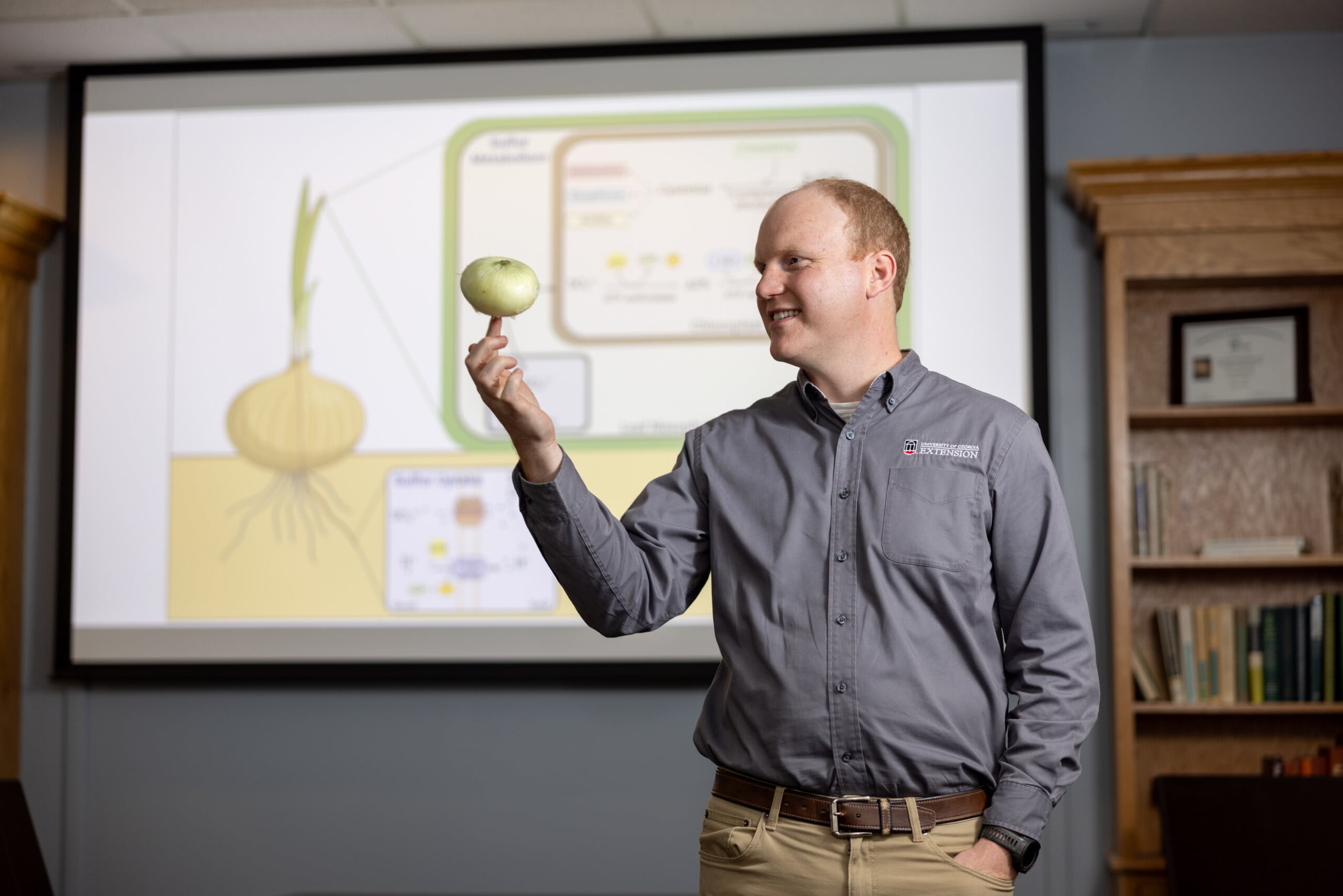
Daniel Jackson, research coordinator at the Agricultural and Environmental Services Lab, poses in front of a diagram showing sulfur metabolism in onions. The lab specializes in testing Vidalia onions for certification. (Photo by Chase Lanier)
In one field we studied, I found clay 1 inch below the surface in one spot and more than 50 inches deep elsewhere,” Jackson said. “The flavor difference between onions grown in those two locations, with identical management, was dramatic.”
Using drone-based imaging and soil samples from half-acre grids, CAES researchers are mapping soil conditions and plant health across fields in collaboration with IT colleagues and the Warnell School of Forestry and Natural Resources.
“We’ve established the scientific foundation,” Jackson said. “We know soil characteristics matter, we know claypan depth affects flavor and we know variable-rate sulfur application should be part of the solution.”
Related Content
The next step is replicated sulfur-rate studies across soil classifications to determine where flavor quality stabilizes.
“Once we have that data, growers could map their fields and automatically apply different sulfur rates to different zones,” Jackson said. “We’re on the path toward specific recommendations, but we’re not quite there yet.”
Vidalia onions must come from approved varieties of yellow Granex onions, known for their large, slightly flattened bulbs and papery yellow skin.
Yearly, Jackson’s team evaluates roughly 50 varieties in replicated trials, measuring disease resistance, yield, storability and flavor.
“Genetics accounts for roughly 70% to 80% of onion pungency, so variety selection matters enormously,” Jackson said.

Onion variety trials begin at the Vidalia Onion and Vegetable Research Center in Lyons, Georgia. (Photo by Katie Walker)
Breeding the next generation of sweetness
Genetics play a major role in onion flavor, and vegetable breeder Amol Nankar with the Department of Horticulture and UGA’s Institute for Plant Breeding, Genetics and Genomics is developing new varieties tailored for Vidalia production. Because onions are biennial, the breeding process is unusually slow, taking two years to produce seed for a single cycle.
“In crops like peppers, a breeding cycle — from initial breeding cross to cultivar development — might take 10 to 12 years,” Nankar said. “With onions it can take 20 to 25 years.”
Breeders must balance multiple priorities — flavor, yield, disease resistance and the distinctive qualities that define Vidalia onions. Maintaining the crop’s characteristic sweetness and bulb shape while improving performance in the field requires years of careful selection and testing.
Nankar’s program aims to develop improved short-day onion lines suited for Vidalia production, providing growers with varieties that perform consistently while preserving the sweetness and appearance consumers expect from the brand.
Disease pressure in the field
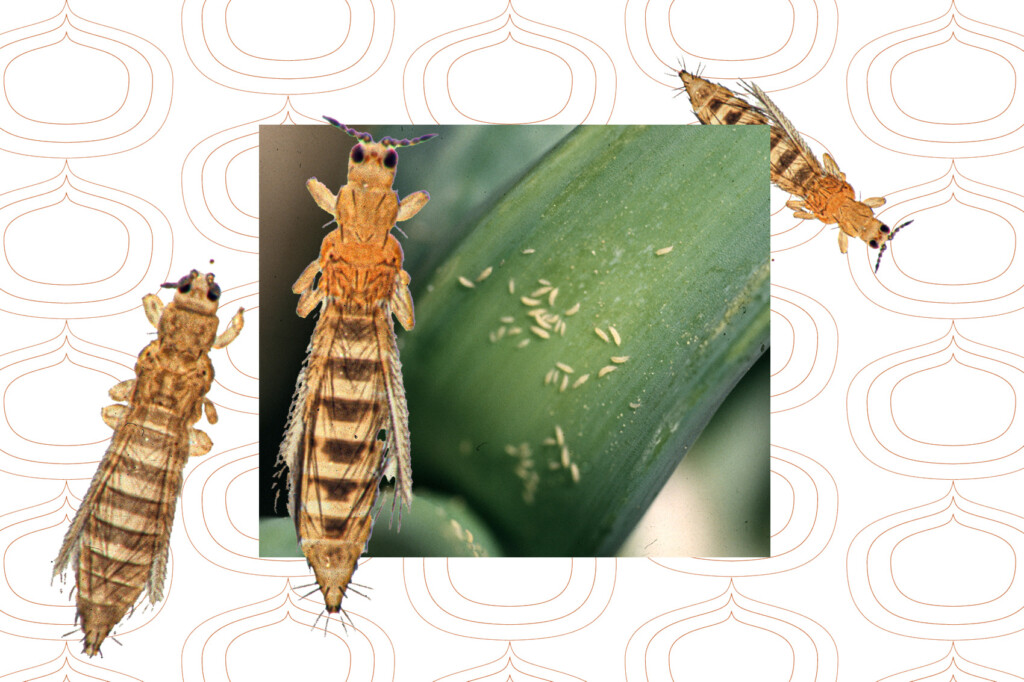
In south Georgia’s subtropical climate, disease pressure is a primary challenge for Vidalia onion producers. One of the most damaging threats is center rot (Pantoea ananatis), first identified in Georgia in 1997. By 2016, an epidemic had cost growers $3.5 million.
Because the bacteria can spread through thrips, weeds and even seed, controlling it requires multiple strategies.
“The pathogen can be carried by thrips, but it also resides on weeds and in some cases within the seeds themselves,” said UGA plant pathologist Bhabesh Dutta. “Because there are so many ways for the infection to start, you have to tackle every single source to be successful.”

With funding from a Specialty Crop Block grant, UGA Extension specialists and county agents developed an integrated pest management program targeting weeds, insects and the bacteria itself. Trials at VOVRC revealed that controlling reservoir weeds such as cutleaf evening primrose is a critical first step.
Researchers also found that bactericides applied during bulb initiation and bulb swelling — combined with season-long thrips management — reduced center rot and increased yields by about 2,400 pounds per acre, adding roughly $1,380 per acre in value. Across Georgia’s roughly 10,000 acres of Vidalia onions, the program could generate an estimated $ $13.8 million in added value for the industry.
Researchers are also working on long-term solutions. After screening 982 onion lines from around the world, Dutta identified the first known source of resistance to center rot.
“This is the first time in the world that resistance to center rot has been found in any type of cultivated onion (Allium cepa),” said Dutta, whose work includes comparing the virulence of different Pantoea bacteria strains and testing commercial onion cultivars grown in the Vidalia region for susceptibility to the disease.
The resistant line is a long-day onion, while Vidalia onions are short-day varieties, making breeding a complex process.
“When we cross a long-day variety with a short-day variety, we are not just transferring one trait,” Nankar said. “We are introducing an entirely different genetic background.”
Researchers are now working to transfer that resistance into Vidalia-type onions while preserving the crop’s sweetness and quality.
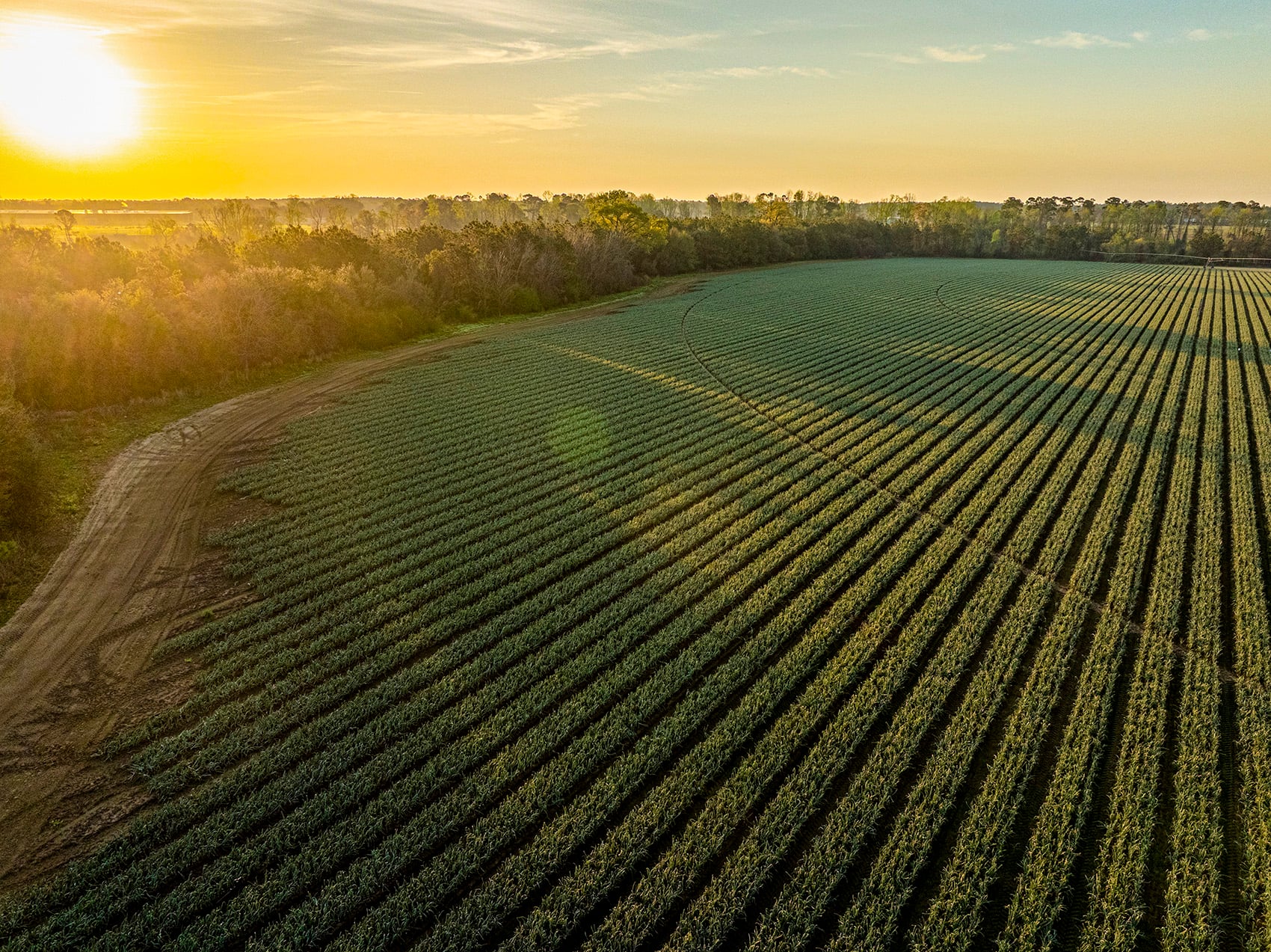
Acres of Vidalia onions glow in the sunrise at Bland Farms. (Photo by Benjamin Galland)
New threats, old lessons
Even as researchers battle center rot, they are tracking another emerging threat: guava root-knot nematode. First detected in Tattnall County in 2022, the pest can reproduce on every Vidalia cultivar tested and appears less sensitive to common non-fumigant treatments.
The pest is not yet widespread in Georgia, so prevention remains the best defense. Plant pathologist Intiaz Amin Chowdhury urges growers to buy transplants from trusted sources, inspect them carefully and sample fields regularly.
“Nematodes are stealing from growers undetected,” Chowdhury said. “Sampling broadly and consistently is key.”
Vigilance in the field
Back in the field at VOVRC, Tyson said all the research and technology still come back to one thing: grower vigilance.
“The best thing a grower can put on a field is their shadow,” Tyson said. “They still have to keep a close eye on their crop. But hopefully our work can help to make that just a little bit easier for them.”
News media may republish this story. A text version and art are available for download.