
An attractive lawn adds beauty and value to any property and is one of the most versatile and functional plants in the landscape. Turfgrass enhances the environment in ways that can be particularly important in urban environments. A turf area reduces heat by as much as 30 °F below that of a concrete or asphalt area and as much as 14 °F below that of bare soil. The cooling effect of the average lawn is equal to over eight tons of air conditioning, which is twice that of the average home central air conditioning unit. In most landscapes turf occupies the largest area and provides an ideal area for outdoor activities.
This series provides information on best adapted grass species and cultivars (short for cultivated varieties) for Georgia, proper establishment methods and techniques, and maintenance practices for a sustainable lawn. Once the proper species and cultivar have been selected, getting the site properly prepared for growing grass and getting it established is critical in creating a sustainable lawn.
Establishment
There are three distinct aspects of lawn establishment. The first step, soil preparation, is probably the most important. The second step, planting, may involve seeding, sodding, or sprigging. The final step is the care and maintenance during establishment for 2 to 4 weeks after planting.
Site Evaluation and Soil Preparation
The key to successful establishment is proper site evaluation and soil preparation. Visit UGA Extension Bulletin 1533-1, Lawns in Georgia: Selection and Species for more information on selecting the turfgrass species and their adaption to environmental conditions in the landscape. On new construction sites, topsoil is sometimes stripped and stockpiled (or hauled away). It may be necessary to redistribute remaining stockpiles or haul-in new topsoil. The soil should be prepared similarly whether planting by seed, sprigs, stolons, or sod. Ridding the lawn of debris, tilling, incorporating lime and fertilizer, and smoothing the surface are all necessary prior to establishment.
Add any amendments such as organic matter or topsoil for soil improvement and till thoroughly into the existing soil. After initial preparation is completed and the area is properly leveled, collect a soil sample to obtain soil fertilizer recommendations. Submit soil samples to the local Extension Office by visiting www.extension.uga.edu or directly to the UGA Agricultural & Environmental Services Laboratories by visiting www.soiltest123.com. Then incorporate the starter fertilizer and lime 3 to 4 inches into the soil before planting. If equipment permits, tilling deeper is always better. The following are the steps necessary for proper soil preparation.
Steps to site and soil preparation for establishing a new lawn:
- CLEAN PLANTING SITE – Remove all debris from the area to be planted. This includes rocks, tree stumps, construction trash, etc. Stumps not removed will eventually decay and leave depressions in the lawn.
- ROUGH GRADING – If extensive grading is done, remove the topsoil and replace it after the rough grade is set. Rough grading includes sloping the grade away from building foundations, reducing severe slopes, and filling low lying areas. A 1- to 2-percent slope (1- to 2-foot drop in elevation per 100 linear feet) away from all buildings provides good surface drainage. If adding or replacing topsoil, the slope of the rough grading should match the slope of the finished grade so that the thickness of the topsoil layer remains consistent.
This is the best time to install subsurface drainage, if needed, or an irrigation system. Also, the subgrade may become compacted by machinery during rough grading, especially if the ground is wet. This compacted layer should be broken-up and loosened before proceeding. - REPLACE TOPSOIL – Once the subgrade is established, spread the topsoil over the subgrade. On steep slopes or where rock outcrops exist, at least 12 inches of topsoil are needed for proper maintenance. If significant amounts of soil have been moved, wetting the area with water will help firm the seedbed and identify any low areas that can be fixed before planting.
For a sustainable lawn, all Georgia soils can use organic matter in the upper 4 to 6 inches to improve water and nutrient holding capacity. Incorporating an organic soil amendment, such as compost, prior to establishment has shown to benefit turfgrass. Till 500 to 1,000 pounds of compost per 1,000 square feet of lawn into the upper 4 inches. Other materials such as peat moss, well-rotted sawdust (at least 6 to 8 years old), or leaf litter can serve as organic materials too (Table 1).
Sand is not recommended as an amendment to Georgia soils. Generally, the expense of adding enough sand to change the native soil texture is cost prohibitive. In the Piedmont, adding sand to a clay-type soil can cause the soil to become restrictive to water movement and root growth. - TAKE SOIL SAMPLES – Fertilizer and lime applications should be based on soil test results. For more information on soil and pH, visit UGA Extension Circular 1058-1.
| Amendment | Volume (cubic yd /1,000 ft²) | Depth (inches)1 | C:N Ratio |
|---|---|---|---|
| Composted Sludge2 | 3 to 6 | 1 to 2 | – |
| Sawdust3 | 3 to 6 | 1 to 2 | 225:1 |
| Composted Yard Trimmings | 3 to 6 | 1 to 2 | 27:1 |
| Sphagnum Peat Moss | 3 | 1 | – |
| Rotted Farm Manure | 3 | 1 | 13:1 |
1 Depth of amendment, in inches, prior to incorporation into the upper 6 to 8 inches of soil.
2 With composted sludge and farm manure, do not apply additional nitrogen at establishment.
3 Additional nitrogen will be required with the use of sawdust. Apply 2 lbs of nitrogen for each cubic yard of sawdust to aid decomposition and to ensure an adequate supply of nitrogen for the grass.
- ADD FERTILIZER AND LIME – Once the topsoil is spread and graded, add fertilizer and lime as indicated by the soil test report. Lime and fertilizer should be thoroughly mixed within the top 4 to 6 inches of topsoil. Water-in the fertilizer lightly prior to planting. A general recommendation for a starter fertilizer is 20 to 30 pounds of a commercial grade fertilizer, such as 5-10-15, 6-12-12, 5-10-10, or 7-14-21 per 1,000 square feet of lawn. If a soluble source of nitrogen is used, do not apply more than 1 to 1.5 pounds of nitrogen per 1,000 square feet. If an insoluble source of nitrogen is used, such as urea-formaldehyde, apply 3 to 5 pounds of nitrogen per 1,000 square feet prior to planting.
If the soil test report showed a deficiency of calcium (Ca) or sulfur (S), gypsum (calcium sulfate) can be added to the soil. The calcium in gypsum is also helpful in neutralizing high levels of aluminum (Al). Unlike lime, gypsum does not affect soil pH. However, gypsum applications have been shown to reduce soil crusting, a significant problem in Piedmont soils, increase water infiltration, and improve the overall structure of the soil. Ground scrap wallboard can be beneficial in Piedmont and coastal soils but at varying rates (Table 2), and to maximize its benefits, ground wallboard should be incorporated into the upper 4 to 12 inches of soil. For more information on the use of scrap wallboard refer to UGA Extension Special Bulletin 1223 and UGA Extension Circular 857.
| Region | Recommended Rate1 |
|---|---|
| Piedmont, Mountains, and Ridge and Valley | 250 lbs / 1,000 ft² |
| Coastal Plain | 50 lbs / 1,000 ft² |
1 Rates are for dry ground wallboard.
- FINAL GRADING – Final grading and mixing of the fertilizer should be delayed until right before planting. If this is done too far in advance, some fertilizer may leach and the soil surface may become crusted. On sandy soils, the seedbed should be firmed. Rolled and firmed to prevent the soil just below the surface from drying out too quickly.
Care should be taken not to destroy or damage existing trees. Tilling under a tree may cut tree roots and can damage or kill the tree. Trees can also be suffocated by deeply covering the roots with soil. The preferred approach to protecting tree roots is to create a mulch apron around the tree, especially where tree roots are exposed above grade. If additional soil is needed, the use of a tree well at the base is recommended or removal of the tree may be necessary. For more information on shade trees for Georgia refer to UGA Extension Circular 1013, Shade Trees for Georgia.
Planting Cool-Season Grasses
The most effective seeding rates and times of the year are in Table 3. Always purchase certified seed, it has high percent germination and purity. Certified seed are identified by a “blue tag”. Cool-season grass seed are predominately grown in Oregon. Georgia recognizes the Oregon certification program and seed label. Furthermore, federal and state seed laws assures the label provides adequate and correct information about the seed quality. Inexpensive seed often ends up being quite expensive because of low germination and purity. Reputable seed dealers are always willing to help customers select quality seed.
| Turfgrass Species | Seeding Rate (pounds/1,000 ft²)1 | Ideal Planting Timing | Region Best Adapted |
|---|---|---|---|
| Cool-season Species | |||
| Tall Fescue | 5 to 6 | September to October, or late February through March | Mountain and Piedmont |
| Fine Fescues | 4 to 5 | September to October, or late February through March | Mountains |
| Kentucky Bluegrass | 1 to 3 | September to October, or late February through March | Mountains |
| Annual and Perennial Ryegrass2 | 5 to 10 | September to November | Statewide |
| Rough Stalk Bluegrass2 | 5 to 7 | September to November | Statewide |
| Warm-season Species | |||
| Bahiagrass | 3 to 8 | May to June | Piedmont to Coast |
| Common Bermudagrass | 1 to 2 (hulled) 3 to 6 (unhulled) | May to June | Statewide |
| Centipedegrass | ¼ to 1 | May to June | Piedmont to Coast |
| Zoysiagrass | 1 to 3 | May to June | Statewide |
1 Seeding rate for establishment of a new lawn.
2 Annual and perennial ryegrasses and rough stalk bluegrass are used for overseeding, not as a permanent grass species.
The best way to apply seed is with a mechanical spreader that will distribute the seed uniformly. There are four basic types of mechanical seeders available: (a) spinning broadcaster, (b) drop spreader / gravity, (c) drill, and (d) hydroseeder. For most areas, the broadcaster works best.
When seeding, divide the seed into two equal parts, and then seed in two directions at right angles to each other. Fertilizers and granular pesticides should also be applied in this manner to insure uniform distribution. To improve seed distribution of medium and small seeded coolseason grasses (such as fine fescue, Kentucky bluegrass and rough stalk bluegrass) see the seeding section in “Planting Warm-season Grasses” below. Larger seeded species like tall fescue and the ryegrasses generally do not need an amendment to improve distribution.
Once the seeds are spread, rake lightly to cover with about ¼-inch of soil. On small areas a hand rake works well. This increases the contact of the seed with the soil, thus increasing the chance of the seed germinating. After raking, roll the seedbed lightly to firm the soil. Then place a thin layer of mulch, such as pine or wheat straw, over the soil. Mulch helps prevent soil erosion and retains moisture for seed to germinate. While more expensive, pine straw can be applied at a lighter rate than wheat straw to achieve similar results. Also, pine straw tends to introduce fewer weeds into the new lawn but may contain sticks and cones which should be removed. If wheat straw is used, find a source that is free of weed seed. One bale of wheat straw (60 to 80 pounds) will cover approximately 1,000 square feet. Either straw can be left on the lawn to decompose if it is not spread too thick.
For cool-season species, like tall fescue, September and October are the ideal months to seed or sod (Table 3). Grass established earlier is subject to heat stress and diseases, while planting later leaves the plants vulnerable to cold weather. When seeded under favorable environmental conditions, tall fescue seed will germinate in 5 to 10 days and be ready for its first mowing between 2 and 3 weeks. However, if tall fescue is to be seeded after mid-November, it is suggested to wait until mid-February to plant, as air and soil temperatures should be on the rise. Seeding in December and mid- to late-spring (i.e. after April) is generally not recommended because the plant does not have adequate time to develop a deep root system needed to survive Georgia’s hot summers.
It is common for tall fescue lawns to thin and need periodic reseeding. Turf thinning is usually caused by climatic stresses, insufficient irrigation, too much nitrogen fertilizer, or mowing too low. Pests, such as crabgrass, white grubs, or disease problems like brown patch, can also contribute to a loss in tall fescue canopy density. Soil related problems like a compacted rootzone, and environmental conditions where tree shade and other plants compete for light, water, space, and nutrients can also contribute to thinning. Often these factors can be mitigated with proper site preparation prior to establishment and management.
If the lawn needs reseeding, estimate the percentage of tall fescue loss and multiply that number by the establishment seeding rate of 6 pounds per 1,000 square feet. For example, if 50 percent (0.5) of the stand is lost, reseed with 0.5 x 6 = 3.0 pounds per 1,000 square feet. The practice of “aerification and seeding” is a common tall fescue lawn practice sold by landscapers in September and October, an optimal time to reseed.
Getting the seed in contact with the soil is necessary to assure successful reseeding. First, mow the lawn at a height of 1 to 1.5 inches and remove any clippings or debris that may prevent seed from reaching the soil surface. If possible, disturb the soil preferably by coring or vertical mowing before and/or after seed distribution. This equipment is often available at rental or garden centers. Reseed thin areas at 2 to 6 pounds per 1,000 square feet. Germination is improved by getting the seed below the existing turfgrass canopy, to the soil surface. A starter fertilizer at 1.0 pound of nitrogen per 1,000 square feet can be applied to help the new seedings and to encourage growth of the existing tall fescue. Finally, keep the soil moist as discussed for new lawn establishment.
If a preemergence herbicide was applied within the previous 60 to 90 days, either do not seed or wait until as late as possible to seed. Preemergence herbicides will prevent turfgrass seed emergence, just as they prevent weed seed emergence.
Because tall fescue sod begins with a mature plant, sodding during the winter months is an acceptable establishment option. In Georgia, where soils tend not to freeze root systems from sodded tall fescue can quickly develop to sustain the plant.
Planting Warm-season Grasses
Many of the warm-season grasses in Georgia are established by planting vegetative plant parts (e.g. sod, sprigs, and plugs). Centipedegrass, most common bermudagrasses, and some zoysiagrass cultivars (e.g. Compadre and Zenith) can be established from seed. Other than timing, in general the steps for seeding warm-season species are like the cool-season species. Warm-season grasses should be seeded when the soil temperatures at the 4-inch depth are consistently 65 °F and rising, typically mid- to late-spring. The latest seeding date is variable depending on the location within the state but in general, seeding no later than first- to mid-August gives new seedlings sufficient time to establish a supportive root system prior to cold weather and frost. For proper planting rates, see Table 3.
When seeding warm-season grasses, it may be helpful to mix seed with a carrier such dry sand or grits to help distribute the seed evenly. Playground sand is a common, easy to find, inert material for mixing with seed. For sand, mix ¼-pound seed per one gallon of dry sand. During distribution, frequently mix to prevent separation of the seed and sand due to differences in density (density of sand is approximately 1.6 gram per cubic centimeter and density of centipedegrass seed is approximately 0.8 grams per cubic centimeter). Using a carrier material, such as grits (approximately 0.7 grams per cubic centimeter), with a similar density as seed will reduce separation and improve seed distribution. A mixing ratio of 1 pound of seed to 4 pounds of grits for a total mixture weight of 5 pounds works well and makes calibration easier. To avoid skips and improve surface coverage, divide the seed mixture into two equal parts, and then seed in two directions at right angles to each other.
Hydroseeding
A method of distributing warm- or cool-season grass seed through a water-based slurry that may contain serval ingredients such as cellulosic fiber mulch, fertilizer, lime, tackifiers, and other additives. Seed are mixed with water and additives in a large tank and then sprayed under high pressure onto the areas being planted. Hydroseeding is commonly reserved for large, severely sloping, or inaccessible areas (e.g. roadsides) where worker safety and speed of coverage are primary concerns. Hydroseeding requires specialized equipment and is an establishment method best done by professionals.
Sodding
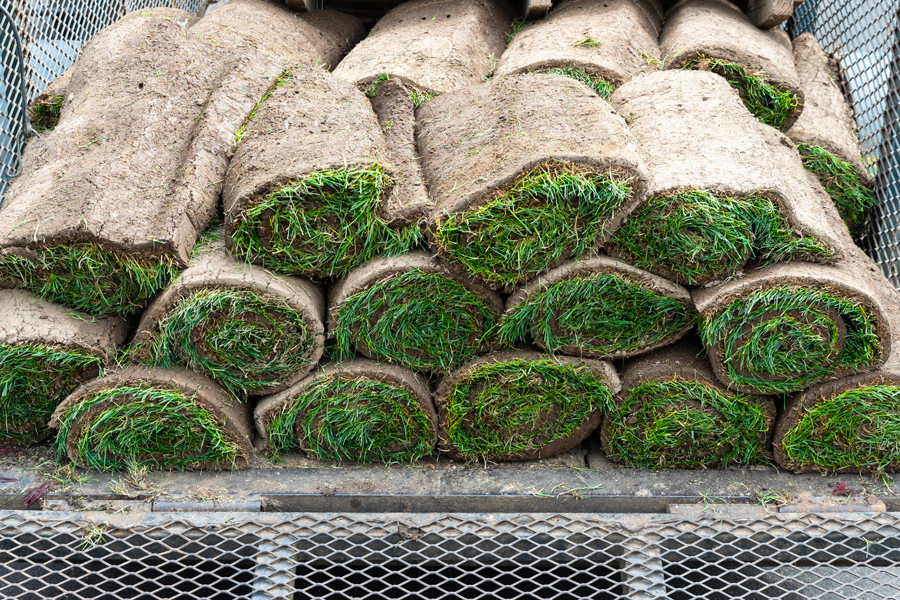
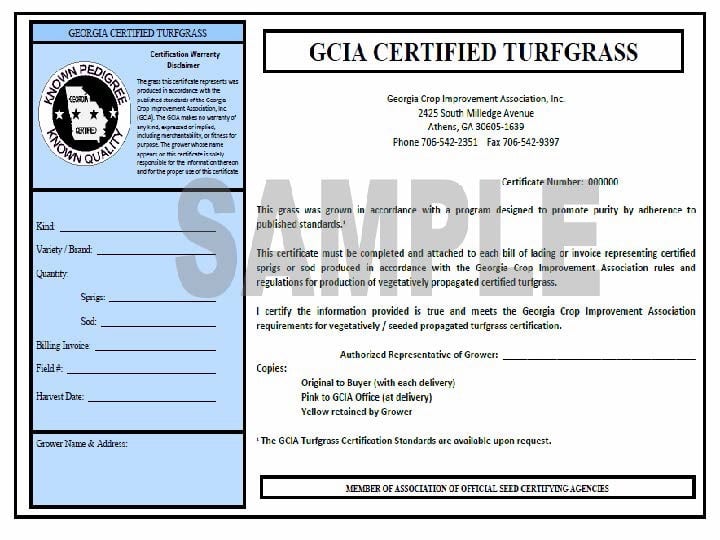
Popular because it produces an instant lawn. Quality sod that is free of weeds, diseases, and insects should be used. Certified sod (www.GeorgiaCrop.com) ensures a grass is true-to-type, meaning the user is getting the specified grass, and it is free of noxious weed species (e.g. nut sedge) and other contaminating grasses. Georgia sod producers who choose to grow certified grasses follow a rigid set of specifications and have their fields inspected three times per year by the Georgia Crop Improvement Association (GCIA), a third-party inspection service. By using only GCIA “blue tag” certified grass is the end-user assured of getting varietal purity and uniformity (Figure 1).
Be sure the soil grade is correct before laying the sod. Use freshly harvested sod and store it in the shade until used, since sod that becomes hot will be damaged. Begin installing sod along the longest straight line such as a driveway or sidewalk. Push, or butt, sod ends against each other tightly without stretching. Avoid gaps or overlaps. Stagger the joints in each row in a brick like fashion, using a large sharp knife to trim corners. On slopes, place sod across, or perpendicular to, the slope. To avoid causing a rough surface or air pockets, avoid walking or kneeling on sod while it is being installed or just after watering. After installing sod, roll the area to improve sod-to-soil contact and remove air pockets. Begin to apply 0.25- to 0.5-inch of water within 30 minutes of installation. Lightly irrigate daily, or more often if necessary, to keep the sod moist until it has firmly rooted (about 2 weeks). Then begin less frequent and deeper watering.
Dormant sodding
In the Southeastern United States, horticulturalist routinely recommend transplanting trees and ornamentals when they are dormant during the late fall or early winter. This works well for large root-balls, where subsurface soil temperatures are conducive for continued root growth during the cooler months. This practice allows the plant’s root system time to establish when there is little demand for water and nutrients from the plant’s canopy. For turfgrass sod where the roots originate at the soil surface, dormant sodding is a riskier endeavor. Soil temperatures at or near the soil surface are more likely to fluctuate, closely mimicking the ambient air temperatures. If the air temperature is at or below freezing temperatures, there is a risk that roots of newly laid sod will freeze. Cooler climates may adversely influence some species. Increased winter injury has been observed on zoysiagrass and centipedegrass compared to bermudagrass sodded late in the year. For various reasons, dormant sodding of warm-season grasses is not an uncommon practice. If grasses, like bermudagrass, centipedegrass, St. Augustinegrass, and zoysiagrass, are going to be established while dormant there are management practices that can improve the chances of success. Visit www.GeorgiaTurf.com for information on success with installation of dormant sod.
Sprigging
Sprigging is the placing of grass plants, runners, rhizomes, stolons, or small sod pieces (2- to 4-inch plugs) into the soil surface then growing-in the turf as these plant propagules root and spread. Because most warm-season species have rhizomes and/or stolons, they establish well by sprigging. It is more labor intensive and takes more time than sodding but requires less plant material and is generally done for large areas (e.g. sports fields, golf courses, etc.) where the cost of sod may be restrictive due to the size of the area to be planted. Establishment (i.e. having greater than 80% surface coverage) from sprigs is dependent on several factors (e.g. turfgrass species, planting timing, soil temperature, sprigging rate, site preparation, post-sprigging care, etc.) but can range from 45 to 90 days.
Typically, sprigs are broadcast by hand or by a mechanical spreader over the prepared “seedbed.” For proper sprigging rates, see Table 4. After broadcast, sprigs are either topdressed lightly (0.15- to 0.25-inch of sand or soil) or sliced, or pressed, into the soil. Machines with vertical blades for slicing the stolons into the soil may be available for this purpose. Sprigging machines can distribute and “cut” the sprigs 1 to 2 inches deep into the soil. The closer together the sprigs, the quicker the grass will cover. Rolling the sprigs after they have been topdressed or sliced into the soil ensures good soil contact, firms the soil, and helps maintain the surface grade. To ensure survival, apply water immediately after planting.
| Turfgrass Species | Sprigging Rate (bushels/1,000 ft²)1 | Ideal Planting Timing | Common Rate of Establishment2 |
|---|---|---|---|
| Bermudagrass | 5 to 10 | May to June | 45 to 90 days |
| Seashore Paspalum | 5 to 10 | May to August | 45 to 90 days |
| Zoysiagrass | 1 to 3 | May to June | 60 to 120 days |
1 Based on estimates 1 ft2 of sod = 1 linear foot of sprigs; 1 yd2 of sod (9 ft2) = 1 bushel of sprigs ≈ 2,000 sprigs. Broadcast sprigging or stolonizing is used for planting large areas such as golf courses and athletic fields.
2 Dependent on post-sprigging management practices.
Plugging
The planting of 2- to 4-inch squares or sod pieces into holes the same size as the plug (Table 5). Plugs are planted every 6 to 12 inches in a row, and rows are spaced 6 to 12 inches apart. Roll or tamp plugs firmly into the soil. Keep the soil moist until the grass is well rooted and spreading vigorously.
During the first 3 weeks, avoid heavy use of the new lawn. This gives the grass time to become established, and helps the surface remain smooth. Mow the newly laid sod at the upper end of its recommended height as needed to maintain a proper mowing program (Table 6).
| Turfgrass Species | Spacing (inches) | Amount of Sod (ft²) per 1,000 ft² of Lawn1 | Common Rate of Establishment2 |
|---|---|---|---|
| Bermudagrass | 12 | 30 to 50 | May to June |
| Centipedegrass | 6 | 100 to 150 | May to June |
| St. Augustinegrass | 6 to 12 | 30 to 50 | May to June |
| Zoysiagrass | 6 | 100 to 150 | May to June |
1 Based on estimates of 1 yd² of sod yields 324 two-inch plugs. The amount of sod refers to the square feet of solid sod from which two-inch plugs can be obtained.
| Turfgrass Species | Mower | Height (inches) | Frequency (days) |
|---|---|---|---|
| Cool-season Species | |||
| Tall Fescue | Rotary | 2 to 3 | 5 to 7 |
| Fine Fescues | Rotary | 3 to 4 | 5 to 7 |
| Kentucky Bluegrass | Rotary or Reel | 3 to 4 | 5 to 7 |
| Annual and Perennial Ryegrass | Rotary or Reel | 1 to 3 | 4 to 7 |
| Rough Stalk Bluegrass | Reel | 1 to 3 | 4 to 7 |
| Warm-season Species | |||
| Common Bermudagrass | Rotary | 1 to 2 | 5 to 7 |
| Hybrid Bermudagrass | Rotary or Reel | 1 to 1½ | 4 to 7 |
| Centipedegrass | Rotary | 1 to 2 | 5 to 10 |
| St. Augustinegrass | Rotary | 2 to 3 | 5 to 7 |
| Zoysiagrass | Rotary or Reel | 1 to 2 | 4 to 7 |
1 Seeding rate for establishment of a new lawn.
2 Annual and perennial ryegrasses and rough stalk bluegrass are used for overseeding, not as a permanent grass species.
Care After Planting
Irrigate newly planted turf lightly and often enough to prevent the soil surface from drying. After seeding, sodding, sprigging, or plugging, keeping the upper 1 to 2 inches of soil moist, not wet, is necessary for uniform establishment. This usually means daily watering of about ⅛- to ¼-inch for the first 2 to 3 weeks. As roots develop, irrigate less frequently but wet the soil profile deeper. As seedlings develop, or as the sod, sprigs, or plugs begin to take root and grow, decrease the frequency of irrigation and increase the amount applied until well rooted and normal irrigation practices can be followed. The Georgia Water Stewardship Act of 2010 (SB 370) permits irrigation of newly installed plants, seeds or turf during a 30-day establishment period after the initial planting date. For additional information on the Act and outdoor water use, visit UGA Extension Circular 995.
Mow grass when it reaches 1.5 times its recommended mowing height (Table 6). Do not mow young grass when it is wet. Mowing wet seedlings can pull them from the soil and rut the soil. Similarly, mowing wet sod, sprigs, or plugs can cause scalping and disturb the grading.
Newly planted turfgrasses should be fertilized according to soil test recommendations. In the absence of these recommendations, and in order to obtain rapid cover, monthly applications of a complete fertilizer like 12-4-8, 16-4-8, 32-3-8, or similar at the rate of 1-pound of nitrogen per 1,000 square feet should be used. For additional information on turfgrass fertility, visit UGA Extension Circular 1058-2.
Post-establishment management practices encourage weeds to germinate and grow too. Weeds are plants that compete for light, water, space, and nutrients. To improve rate of establishment, controlling competition is suggested. Many weeds can be controlled by manual extraction (i.e. hand pulling) or frequent mowing. If chemical weed control is necessary, consult the current Georgia Pest Management Handbook or www.GeorgiaTurf.com.