

Chemicals are sometimes the best treatment for aquatic weed control, fish disease control, or pond water quality improvement. Proper use of chemicals for pond management can save time and money, but alternatives such as biological and mechanical control methods should be considered as part of your pond management plan.
The information provided here should help you to select the right chemical, calculate the proper amount of chemical for treatment, and choose the correct way to apply chemicals to a pond.
Selecting the Right Chemical
Can a chemical solve your pond problem in an acceptable way? Chemicals, when selected properly, can provide quick results with limited non-target effects. But the wrong choice can be ineffective, costly, or cause unforeseen consequences. Each chemical, approved for use in ponds by the U.S. Environmental Protection Agency (EPA), has a label that provides a wealth of information regarding the performance of the chemical as well as precautions to take when using it. Carefully read the entire chemical label so that you can be aware of the limitations of the chemical and the best ways to use it. Remember that you are legally required to read chemical labels and to follow the directions. Chemicals that have recent labels for aquatic use may control pests that are resistant to older chemicals. Some chemicals act in a particular way and control specific pests. For those reasons, accurately identify your aquatic pest or water quality problem before you buy and apply a chemical to a pond. Your county Extension agent can help you with identification or direct you to specialized information.
Once you have accurately identified the problem, look for the best control measure, and apply corrective treatment as early as possible. Consider preventative measures if the situation allows time to get ahead of the problem. Preventative measures should be part of a pond management program, because even when prevention is only partially successful, it can make chemical treatment easier or less costly. For example, pond water depth of at least 3 feet, established when the pond is constructed or dredged, will discourage aquatic weed growth by reducing the sunlight that reaches the pond bottom. Therefore, aquatic plant growth is less in ponds without shallow-water areas.
Consider the effect a chemical may have on non-target organisms. For example, some aquatic chemicals used to treat fish disease may also be toxic to aquatic plants. Killing plants that produce oxygen may increase the risk of a fish-kill due to oxygen depletion. Oxygen is required for the plant biomass to decompose, further depleting the dissolved oxygen available to fish. Use chemicals that are toxic to aquatic plants in cooler weather when decomposition is slower and the concentration of pond water oxygen is higher. Consider how pond water chemistry affects the action of the aquatic chemical. Some chemicals break down rapidly in the presence of bright sunlight, high pH, or high temperature. Chemicals that contain copper may kill fish in low alkalinity waters. Muddy water may limit the chemical effectiveness (Table 1).
| Chemical | Intended Use | Possible Effect |
|---|---|---|
| Formalin | Parasite Control | Kills algae, consequently lowering dissolved oxygen |
| Clipper (Flumioxazin) | Aquatic Herbicide | Less effective at pH 7 and above than in acidic water |
| Diquat | Aquatic Herbicide | Ineffective in muddy water |
| Sodium percarbonate | Algicide | Inactivated by sunlight |
| 2,4-D | Aquatic Herbicide | Better in spring after water temperature reaches 70° F |
Consider other water uses and how the chemical may affect them. Using pond water for irrigating crops, watering animals, fishing, or swimming restricts the use of certain chemicals or requires time to pass between treatment and resumption of activities. Also consider possible effects downstream from the treated pond. What would happen if a heavy rain washed the chemical from the treated pond into a stream or downstream pond? Chemicals should not be used in flowing water unless they are permitted for that use, as indicated on the label. Most aquatic chemicals, permitted for use in static ponds with no water exchange or very little outflow, stay in the pond area until they degrade. Some chemicals require approval from regulatory agencies before treating springs, streams, or ponds with flow-through. Obtain proper permissions before treating a pond or lake with multiple property owners.
When using a chemical for pond management, it must be applied according to the label, following all warnings and cautions with a full understanding of the implications of using the chemical. In some cases, the pond manager may choose to hire a pond consultant or aquatic applicator capable of applying the chemical properly. Anyone who uses a chemical should read and understand the label. Further information is available in the Georgia Pest Management Handbook on the pages addressing aquatic environments.
Aquatic herbicides are mixed with other chemicals, called adjuvants, to make treatment more effective. Non- ionic surfactants, sticker/spreaders, and buffers are some of the common adjuvants used with aquatic herbicides. Add the adjuvant to the diluted tank mix before applying to the pond water. Herbicide labels describe the adjuvants that are compatible with the chemical along with instructions for mixing. Adjuvants have labels with additional mixing information. Table 2 describes some commonly used adjuvants.
| Adjuvant Type | Action |
|---|---|
| 80-20 non-ionic surfactant | Spreads the chemical over the leaf surface |
| Crop oil | Sticks and spreads the chemical over the leaf surface |
| Cide Kick II (citrus-based adjuvant) | Sticks and spreads the chemical over the leaf surface |
| Foliar fertilizer | Works through the leaf to make herbicides more effective on emergent aquatic weeds |
| Sinker | Carries the herbicide through water to plants near the pond bottom |
| Buffer | An acid or base used to change tank mix pH according to the chemical requirements |
Calculating Chemical Treatments Applied to Pond Water
The following information is essential in computing the amount of chemical to apply to a pond: the pond water volume (Figure 1), the chemical formulation, and the effective concentration of the chemical needed in the pond water to correct the problem.

Determining Pond Water Volume
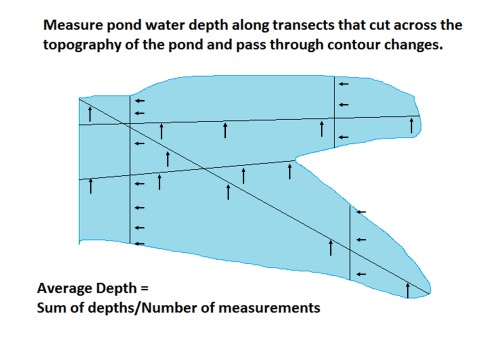
Every pond owner should know the water volume of his/her pond. Calculate large pond volumes in acre-feet and small ponds in gallons for chemical treatments. For example, a pond with eight surface acres and an average depth of four feet would contain 32 acre-feet (Figure 1). That volume is about 10,427,000 gallons of water, as one acre-foot of water contains about 325,851 gallons. Most county Natural Resources Conservation Service offices can assist pond owners in determining the water volume of their ponds by estimating the surface area from aerial photographs. Certain handheld Global Positioning System (GPS) methods can be used to estimate pond area by taking readings at waypoints and applying an area calculator. After measuring the pond’s average depth, the owner can calculate the pond volume. Measure average depth using a sounding line at regular intervals along several transects of the pond. Include both deep and shallow areas of the pond when measuring depth. Errors in average depth estimates are often made when too few measurements are made in shallow water. Include measurements in areas where bottom contours change. Compute the estimated average depth by adding all the depth measurements and dividing by the number of measurements. To get a useful estimate of the pond water volume, multiply the average depth by the surface area. In very large ponds and lakes, contour maps should be made of the pond bottom before estimating the average depth. Some use uniform grid lines to more accurately locate the points where soundings should be made.
| 1 acre foot = |
|---|
| 43,560 cubic feet |
| 325,872 gallons |
| 2,719,000 pounds (approximately at 39° F or 4° C) |
It’s important to know your pond’s water volume before a chemical treatment is needed. Perform measurements ahead of time, confirm pond size using reports by previous owners, and reduce pond volume if dry weather has lowered the water level. Use the pond volume to estimate the amount of chemical to purchase.
Chemical Formulations
Commercial products useful for pond management contain different amounts of active ingredient. The active ingredients are the chemicals that kill the pest or correct the undesirable water quality problem. Inert ingredients are added to improve the convenience, safety, and handling of the chemical. Product labels have the chemical formulation printed on the first page of the label, bottle, or product packaging. For a particular chemical, the application rate is based on the amount of active ingredient in the chemical formulation.
Effective Chemical Concentration
An effective concentration of the active ingredient should eliminate the pest or correct the water quality problem when applied according to label directions. The common method to express chemical concentrations in the U.S. is parts per million, usually written as “ppm.” One part per million is equivalent to the ratio of one pound of chemical to 999,999 pounds of water— or one gram of chemical to 999,999 grams of water. In other words, one part per million equals one pound or one gram in one million pounds or grams of a solution or mixture, respectively.
| 1 ppm = |
|---|
| 2.72 pounds per acre-foot of water |
| 1,233 grams per acre-foot |
| 0.326 gallons per acre-foot |
| 0.0000624 pounds/cubic foot |
| 0.038 grams per gallon |
| 1 milligram per liter |
| 0.001 gram per liter |
| 0.133 ounce per 1,000 gallons |
Notice that parts per million is a weight- to-weight relation. Units of volume used with units of weight will not express the correct relationship. That is because an equal volume of two different chemicals may have considerably different weights. For example, one gallon of liquid fertilizer weighs more than one gallon of water.
Calculating Pond Water Treatments
The following formula can be used to determine the amount of chemical needed to treat a pond:
Amount of chemical needed = Volume x CF x ECC x AI, where:
Volume = Volume of water to be treated. Although the unit of measure can be in gallons, liters, cubic feet, cubic yards, etc., when treating ponds, the more common expression is acre-feet.
CF = Conversion factor, a figure that equals the weight of a chemical to be used to give one part per million (ppm) in a given unit volume of water. Table 4 lists conversion factors (CF) for various measures of volume. Select the CF that corresponds to the unit of measure used for pond volume. For example, if the pond volume is in acre-feet, the appropriate CF is 2.72 if the chemical weight is measured in pounds or 1,233 if weight is measured in grams.
ECC = Effective chemical concentration of active ingredients needed in the pond water to eliminate the pest or correct a water quality problem. This unit of measure must be in ppm.
AI = Active plus other ingredients divided by active ingredients. Products, which are liquid formulations, may list active ingredients as pounds active per gallon. For such products, AI = 1 gallon divided by the pounds per gallon of active ingredients. A few chemicals are liquids in their pure forms, and to calculate AI, you must know their specific gravity. See Example 4 to calculate AI using specific gravity. Non- liquid formulations usually list active ingredients as a percentage of the total formulation. For non-liquid formulations, AI = 100% divided by the percentage of active ingredients.
Example 1:
Calculate the amount of chemical A needed to treat a pond that has 4.0 surface acres and an average depth of 3.0 feet with a rate of 0.5 ppm active ingredient (effective chemical concentration) when chemical A is 100% active (for example, powdered copper sulfate).
First: Volume = 4 acres x 3 feet = 12 acre-feet
Next use the conversion factor: CF = 2.72 pounds per acre-foot per ppm (from Table 4)
ECC = 0.5 ppm (active ingredient needed in the water)
AI = 100% ÷ 100% (chemical A is 100% active)
Using these values in the formula for amount of chemical need,
Volume x CF x ECC x AI, or
12 acre-feet x 2.72 pounds/acre-feet/ppm x 0.5 ppm x (100/100) = 16.32 pounds of chemical A.
Example 2:
Calculate the amount of (liquid) chemical B (28% active in the liquid concentrate; for example, in a liquid copper formulation) needed to treat a pond measuring 1,000 feet long by 50 feet wide by 3.0 feet deep with a concentration of 0.25 ppm active ingredient.
Volume = 1000 feet x 50 feet x 3 feet= 150,000 cubic feet or 150,000 cubic feet/43,560 cubic feet/acre-feet = 3.44 acre-feet
CF = 0.326 gallon per acre-foot/ppm (from Table 4)
ECC = 0.25 ppm (active ingredient needed for effective treatment)
AI = 100% ÷ 28%
Substitute values in the equation, Volume x CF x ECC x AI:
3.44 acre-feet x 0.326 gallon/acre-foot x 0.25 ppm x 100/28 = 1.0 gallon of chemical B (28%).
Example 3:
Calculate the amount of chemical C (2.0 pounds active per gallon; for example, as DiquatTM or RewardTM) needed to treat a pond that has 6.0 surface acres and an average depth of 4.0 feet with 0.5 ppm active ingredient.
Volume = 6 acres x 4 feet = 24 acre-feet
CF = 2.72 pounds/acre-foot/ppm (from Table 4)
ECC = 0.5 ppm (active ingredient needed in water)
AI = 1 gal/2 pounds
Substitute values in the equation, Volume x CF x ECC x AI:
24 acre-feet x 2.72 pounds/acre-foot/ppm x 0.5 ppm x 1 gallon/2 pounds AI = 16.32 gallons of chemical C.
Example 4:
Calculate the amount of chemical D needed to treat a pond measuring 180 feet long by 90 feet wide by 5 feet deep with a concentration of 15 ppm active ingredient (for example Parasite-S formalin). Chemical D is a liquid and is 100% active.
Volume = 180 feet x 90 feet x 5 feet = 81,000 cubic feet
CF = 0.0000624 pounds/cubic foot/ppm (from Table 4)
ECC = 15 ppm
AI = 100% ÷100%
Substitute values in the equation, Volume x CF x ECC x AI:
81,000 cubic feet x 0.0000624 pounds/cubic foot of water/ppm x 15 ppm x 100/100 = 75.8 pounds of chemical D.
However, chemical D is a liquid, and 71.8 pounds of water converts to a unit of volume by the following method. Since parts per million is a weight-to-weight relation, it is necessary to know how chemical D compares in weight with water. Chemical D weighs about 9.1 pounds per gallon and water weighs 8.34 pounds per gallon, so chemical D is 1.09 times as heavy as water. Obtain the relative density from the Material Safety Data Sheet of the chemical. In this example, the amount of chemical D needed is:
75.8 pounds based on water/ (8.34 pounds water/gallon x 1.09 SG of chemical D) = 9.9 gallons of chemical D.
Treatment Methods
Selecting the best treatment method depends on the specific conditions that exist near or in the pond or tank and the properties of the chemical used in treatment. Carefully observe the weather; water temperature; water quality; fish condition and population; upstream and downstream land uses; uses of the pond water; and all conditions of possible concern that appear on the label.
Some labels indicate that a chemical can be poured into the pond and allowed to diffuse throughout the pond, but most chemicals are applied to the weed bed and evenly distributed. Carefully read the label to determine the amount of active ingredient percentage or weight per gallon. The treatment charts provided on the label are helpful for measuring chemical quantities needed for treatment, but recommended amounts are often given in broad ranges. Choose your chemical amount after carefully reading the label. County Extension agents and pond consultants may provide advice to explain proper chemical use and label interpretation.
Treatments Applied to Pond Water
Surface-Applied Treatments:
Contact pesticides, inorganic fertilizers, lime, and a few other water quality control chemicals have rates based on the surface acreage of the pond—not the pond’s water volume. These chemicals are either sprayed or broadcast over the pond surface.
Example: 1,500 pounds of lime per acre is needed to treat a ½-acre pond.
Knowing the pond area and knowing that the lime treats the pond soil as well as the pond water, the application is made using the following equation:
Pond area x chemical amount needed x amount of active ingredient = treatment amount
0.5 acre x 1,500 lb/acre x 100% = 750 lb lime to treat ½ acre of pond area
Total Water Column Treatments:
This is the most common technique of chemical treatment used in a pond. Treat the whole volume of water (water column) in the pond and the chemical reaches a specific dilution in the water column. An alternative—practiced in hot weather or with heavy weed infestation—is to calculate the entire volume and then treat only one-fourth or one-third of the total water column based on surface area, confining the treatment to selected sections of the pond where weed infestation may be more intense. Specific application techniques include injection directly into the water with undiluted chemical or some dilution of the chemical sprayed or broadcast upon the surface of the water. With either method, further dispersal throughout the water column depends on water currents.
Bottom Treatments:
This application technique is intended primarily for control of submersed aquatic vegetation. A boat carrying application equipment drags a hose or boom over and just above the pond bottom. The chemical disperses through nozzles, and the specific gravity of the chemical causes the treatment to remain near the bottom near the weeds. Special adjuvants may be needed to perform bottom treatments and equipment may include specialized pumps and tank mix agitators.
Other Specialized Treatments
Dip Method:
This involves exposing the fish to a strong solution of chemical for a short period. Fish are usually netted, dipped into a chemical, and then returned to the culture area.
Flush Method:
This method is only applicable in tanks, raceways, or egg incubators. A stock solution of a chemical is applied to the upper end of the unit and allowed to flush throughout the system. The chemical must flush through the system in a predetermined time.
Bath Treatments:
Bath treatments involve applying a chemical, usually in a relatively high concentration, directly to the culture area and, after a specified time, diluting with fresh water to remove it from the rearing unit. Bath treatments are used in culture tanks, but they are difficult to apply in ponds. Most water supplies are not adequate to flush large volumes of water contained in ponds.
| Measure | Equivalent |
|---|---|
| 1 cubic foot | 62.4 pounds |
| 1 cubic foot | 7.481 gallons |
| 1 liter | 1,000 grams |
| 1 liter | 0.264 gallons |
| 1 pound | 453.6 grams |
| 1 gallon | 8.34 pounds |
| 1 gallon | 3,785 milliliters |
| 1 fluid ounce | 29.57 grams of water |
| 1 fluid ounce | 1.043 ounces of water |
| 1 acre-foot | 43,560 cubic feet |
| 1 acre-foot | 325,872 gallons |
| 1 acre-foot | 2,719,000 pounds |
References
Burtle, G.J. (2016). Aquatic Environments. In, Dan Horton, ed., UGA Extension Special Bulletin 28, Georgia Pest Management Handbook—2016 Commercial Edition. 118-127.
Masser, M.P., & Jensen, J.W. (1991). Calculating treatments for ponds and tanks. Southern Regional Aquaculture Center. Publication No. 410, 8 p.
Seldon, G. (2015). Aquatic herbicide mode of action and use implications. Southern Regional Aquaculture Center, Publication No. 3602. 5 p.
Taube, C. M. (2000). Instructions for winter lake mapping. Chapter 12 in Schneider, James C. (ed.) 2000. Manual of fisheries survey methods II: with periodic updates. Michigan Department of Natural Resources, Fisheries Special Report 25, Ann Arbor.
Wetzel, R.G., & Likens, G.E. (2000). Limnological analyses. Third edition. Springer Science and Business Media, Inc. New York, NY. 429 p.
The original manuscript was prepared by George W. Lewis, Warnell School of Forestry and Natural Resources.