
Annual ryegrass (Lolium multiflorum), also referred to as Italian ryegrass, is the most problematic winter annual weed in Georgia hayfields. Seed germinates from September to November when soil temperatures drop below 70 degrees F. Seedlings mature in the fall, overwinter in a vegetative state, and resume active growth in the spring. Annual ryegrass grows well under cool conditions when pasture grasses are dormant or if there is limited competitive growth. Plants exhibit erect growth that reaches approximately 3 feet in height upon maturity (Pictures 1 and 2). As a result, annual ryegrass may interfere with pasture grasses during spring green-up and beyond.

Picture 1. Annual ryegrass clumps in a field in the spring.
Photo by P. McCullough.
Annual ryegrass may absorb potassium (K) and other important plant nutrients during the spring. This nutrient absorption can negatively influence the summer forage’s production because it may cause nutrient deficiencies in the pasture grass long after the annual ryegrass has died. There is also significant evidence that drought stress, late-season disease pressure, and/or other stressors may cause annual ryegrass to release allelopathic compounds (natural plant chemicals that inhibit the growth of other plants in their vicinity) that are active against bermudagrass and other desirable forages. Research in North Carolina has indicated that this interference from ryegrass may reduce the yield of hayfields by as much as 50 percent. Furthermore, areas with heavy infestations of annual ryegrass are prone to invasion by summer annual weeds, which may further worsen the yield reduction and speed up the decline of hayfield stands.

Picture 2. Annual ryegrass plant.
Photo by P. McCullough.
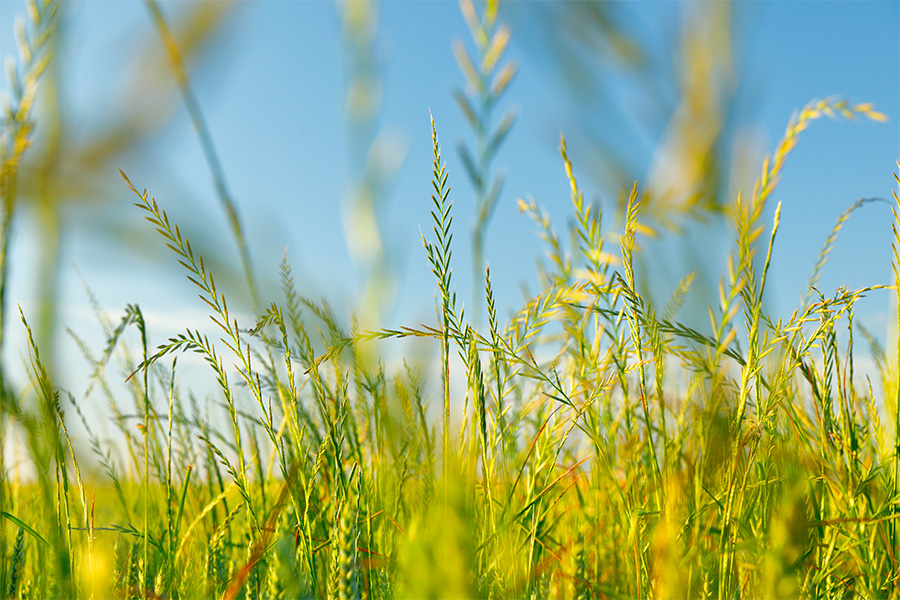
Annual ryegrass is a prolific seed producer that contributes to annual infestations. The seedhead is a long spike with at least 10 alternating florets (Picture 3). The florets contain long awns (hair- or bristle-like parts) that are not present on perennial ryegrass (Lolium perenne).

Picture 3. Seedheads of annual ryegrass.
Photo by P. McCullough
Plants typically produce seedheads in March in most parts of Georgia. Seed dispersed in late spring can remain dormant in the soil for years. Another key characteristic to help identify annual ryegrass, without seedheads, is the clasping auricles (structures that project from either side of the leaf collar) at the junction of the leaf sheath and blade (Picture 4). The auricle may help growers identify annual ryegrass from other weedy grasses, such as tall fescue.
Cultural Control
Growers can make modifications to their management programs to reduce annual ryegrass establishment in the fall. For example, nitrogen fertilization should be reduced during peak germination and periods of vigorous growth. High nitrogen rates in winter and spring will encourage annual ryegrass seed production, dispersal, and survival. Mowing is an important cultural practice that can reduce the competitive growth of problematic weeds with hayfield grasses. Mowing before seedhead formation can suppress annual ryegrass growth and inhibit the production of viable seed in the spring. However, the costs and benefits of mowing should be weighed against the costs and benefits of preventative or curative chemical applications.
Practices that disrupt soil, such as aeration, sub-soiling, or tilling operations, should be conducted when tall fescue, bermudagrass, or bahiagrass stands are actively growing. Voids left in fields with exposed soil may allow for annual ryegrass invasion during periods of peak germination. Timing these operations during favorable periods for quick recovery promotes competition with weeds. In tall fescue hayfields, growers can promote recovery from summer stresses before annual ryegrass germination in the fall. Reseeding tall fescue in thinned areas to promote a dense stand promotes competition with annual ryegrass seedlings in the fall to reduce infestations.
Chemical Control
Growers may use Prowl H2O 3.8SC (pendimethalin) in established bermudagrass, bahiagrass, and alfalfa for preemergence control of annual ryegrass in hayfields (Table 1). Treatments should be applied prior to rainfall, to enhance soil incorporation and herbicide activation. Prowl may be applied to bermudagrass pastures used for grazing, but it is not labeled for hayfields that consist of tall fescue or other cool-season grasses. Prowl is also not labeled for perennial peanut or forage legumes, other than alfalfa, grown for hay.
| WSSA Groupa | Herbicide | Labeled Species | Labeled Rate | Controlb |
|---|---|---|---|---|
| Preemergence | ||||
| 3 | pendimethalin (Prowl H2O 3.8SC) | Alfalfa Bahiagrass Bermudagrass | 3.1 to 4.2 qt/acre | G |
| Postemergence | ||||
| 2 | imazapic (Impose 2AS) | Bermudagrass | 6 to 10 oz/acre | P – F |
| 2 | nicosulfuron + metsulfuron (Pastora 71.2DF) | 1 to 1.5 oz/acre | G | |
| 9 | glyphosate (Roundup, Accord, others) | see label | G – E | |
aWSSA group numbers: 2 = acetolactate synthase (ALS) inhibitor, 3 = mitotic inhibitor, 9 = EPSP synthase inhibitor.
bEfficacy for control ratings: P = poor (less than 70%), F = fair (70 to 79%), G = good (80 to 89%), E = excellent (90 to 100%).
The best timing for postemergence control of annual ryegrass is when plants are less than 6 inches in height in the fall. Bermudagrass growers may use Impose 2AS (imazapic) or Pastora 71.2DF (nicosulfuron + metsulfuron) for annual ryegrass control, but these products are not labeled for bahiagrass and tall fescue due to excessive injury potential (Table 1). Postemergence herbicides are more effective in early winter, compared to spring timings, because of the size and maturity of plants at application. Annual ryegrass is generally susceptible to postemergence herbicides in early winter prior to the onset of freezing temperatures and before seedhead emergence.
Pastora is more effective than Impose at labeled use rates in bermudagrass hayfields. Pastora 71.2DF at 1 to 1.25 ounces per acre is recommended in November or early December in bermudagrass. Impose 2AS (imazapic) controls annual ryegrass in the fall, but requires high rates (8 to 10 ounces per acre) on plants greater than 6 inches in height. Bermudagrass is also more susceptible to injury from Impose than Pastora, especially at rates required for annual ryegrass control. Both herbicides require a non-ionic surfactant at 0.25 percent volume of solute/volume of solution (1 quart per 100 gallons).
If growers must apply herbicides in January or February, it is recommended that Pastora treatments have a tank-mixture with glyphosate to enhance control. Moderate rates of glyphosate in bermudagrass, such as 0.125 to 0.25 pound acid equivalent (a.e.) per acre, generally do not affect spring transition when applied in winter. However, glyphosate use in the spring could cause delayed green-up and growth inhibition to bermudagrass. Poast (sethoxydim) controls ryegrass in legumes, but it is not labeled for grassy hayfields.
Growers have no selective herbicides available for postemergence control of annual ryegrass in bahiagrass or tall fescue grown for hay. Spot treatments of glyphosate are recommended in these species for control. A 0.5 to 1 percent solution of glyphosate should be sprayed to annual ryegrass shoots until runoff occurs. Growers should check the product label of certain glyphosate products, and include an adjuvant at 1 percent v/v if needed.
Herbicide Resistance
A major limitation to postemergence control of annual ryegrass is herbicide resistance. Resistance of annual ryegrass to acetolactate synthase inhibitors (for example, Impose or Pastora), acetyl CoA-carboxylase inhibitors (for example, sethoxydim), and glyphosate has been confirmed in Georgia. Resistance develops from selection pressure by repeated use of the same herbicide or mode of action over years. Many biotypes of annual ryegrass may be present in a population. Genetic differences among biotypes contribute to susceptibility levels to herbicides through altered target-site binding or enhanced degradation. Other resistance mechanisms for annual ryegrass may include reduced absorption, herbicide sequestration, or overproduction of the target site enzyme.
As susceptible biotypes are controlled by a particular herbicide over years, resistant biotypes may spread in these fields. This type of selection pressure will shift an annual ryegrass population from susceptible to resistant biotypes over years. Growers should have an appreciation for the potential development of resistance to Pastora and glyphosate in annual ryegrass populations. Preemergence control of annual ryegrass with Prowl will help delay resistance to herbicides available in hayfields.