

Additional authors
Mark Hoffmann, North Carolina State University; Mizuho Nita, Virginia Tech; Doug Pfeiffer, Virginia Tech.
How to use this calendar: Select one or more section checkboxes to show only those topics, such as Cultural Practices, Diseases, or Insects. Select one or more stage checkboxes to limit the calendar to those growth stages. If all section boxes are checked, all topics are shown. If no stage boxes are checked, all stages are shown. You can combine both filters at the same time—for example, you can view only Diseases at Bloom and Veraison. Uncheck boxes to hide information you do not need.
159 activities shown
| Stage | Management Activities |
|---|---|
Dormant |
Cultural Practices
Cane and Spur PruningShould be completed during vine dormancy. Pruning is typically completed from December through March in Southeastern U.S. vineyards. Pruning sets the crop potential by retaining buds that are anticipated to bear fruitful shoots. Pruning is also used to remove dead or diseased grapevine wood. Any final pruning should be completed during bud swell. Bud swell alarms growers of impending bud break, a critical stage for frost protection and the first stage when green tissues are observed.Diseases
Botryosphaeria cankerRemove and destroy diseased canes and vines. Apply active fungicides after each day of pruning. Delay pruning as much as is practical.Crown gallRemove dead vines.AnthracnoseRemove and destroy diseased canes and vines during the dormant period. Spray lime sulfur at late dormancy. Apply active fungicides until berry touch. Berries are resistant at ~50 days after bud break as soluble solids rise above 5-7%.PhomopsisRemove diseased canes through pruning during the dormant period. Spray lime sulfur at late dormant. Apply active fungicides as soon as green tissue emerges in the spring, and continue through veraison. Fruit infections mainly occur between cluster emergence and early postbloom, and generally cease at green pea size.Powdery MildewRemove diseased canes through pruning during the dormant period. Spray lime sulfur at late dormancy. Apply active fungicides as soon as green tissue emerges in the spring, and continue through postharvest. During the period from prebloom to fruit set, the fruit is particularly susceptible to powdery mildew infection, but fruit infection is still a risk until approximately four weeks after bloom.Insects
MealybugExamine under bark and twigs using a hand lens to identify mealy bugs. Scout for mealybugs by looking under the bark and near base of vine. Peel back loose bark on canes and look for the presence of grape mealybug crawlers.MiteExamine twigs using a hand lens for European red mite eggs, which are round and reddish orange. |
Bud Swell |
Cultural Practices
Cane and Spur PruningShould be completed during vine dormancy. Pruning is typically completed from December through March in Southeastern U.S. vineyards. Pruning sets the crop potential by retaining buds that are anticipated to bear fruitful shoots. Pruning is also used to remove dead or diseased grapevine wood. Any final pruning should be completed during bud swell. Bud swell alarms growers of impending bud break, a critical stage for frost protection and the first stage when green tissues are observed.Diseases
AnthracnoseRemove and destroy diseased canes and vines during the dormant period. Spray lime sulfur at late dormancy. Apply active fungicides until berry touch. Berries are resistant at ~50 days after bud break as soluble solids rise above 5-7%.PhomopsisRemove diseased canes through pruning during the dormant period. Spray lime sulfur at late dormant. Apply active fungicides as soon as green tissue emerges in the spring, and continue through veraison. Fruit infections mainly occur between cluster emergence and early postbloom, and generally cease at green pea size.Powdery MildewRemove diseased canes through pruning during the dormant period. Spray lime sulfur at late dormancy. Apply active fungicides as soon as green tissue emerges in the spring, and continue through postharvest. During the period from prebloom to fruit set, the fruit is particularly susceptible to powdery mildew infection, but fruit infection is still a risk until approximately four weeks after bloom.Insects
MealybugExamine under bark and twigs using a hand lens to identify mealy bugs. Scout for mealybugs by looking under the bark and near base of vine. Peel back loose bark on canes and look for the presence of grape mealybug crawlers.Climbing CutwormMonitor bud feeding in early spring. If damage is present, look for cutworms under bark, on cordons, trunk, and at soil level.Grape Flea BeetleCheck for feeding on unfolding leaves and buds from small, metallic blue-green beetles. |
Bud Break |
Cultural Practices
Shoot ThinningShould occur when shoots are about 3-7” long, preferably as early as it’s possible to identify fruitful vs. non-fruitful shoots and before tendrils grab neighboring shoots. Shoots should be thinned to roughly 3-5 shoots per linear foot of cordon or cane.Frost DamageIs of concern once buds have broken. Air mixing (via wind machine) and delayed pruning are commonly implemented in an attempt to avoid frost injury to vine tissues.Diseases
AnthracnoseRemove and destroy diseased canes and vines during the dormant period. Spray lime sulfur at late dormancy. Apply active fungicides until berry touch. Berries are resistant at ~50 days after bud break as soluble solids rise above 5-7%.PhomopsisRemove diseased canes through pruning during the dormant period. Spray lime sulfur at late dormant. Apply active fungicides as soon as green tissue emerges in the spring, and continue through veraison. Fruit infections mainly occur between cluster emergence and early postbloom, and generally cease at green pea size.Powdery MildewRemove diseased canes through pruning during the dormant period. Spray lime sulfur at late dormancy. Apply active fungicides as soon as green tissue emerges in the spring, and continue through postharvest. During the period from prebloom to fruit set, the fruit is particularly susceptible to powdery mildew infection, but fruit infection is still a risk until approximately four weeks after bloom.Downy MildewLeaves are always susceptible to infection. Fruit, rachises, and pedicels are resistant at about four weeks after bloom. Apply active fungicides in rotation. Fungicide resistance, particularly to the strobilurin fungicides, is prevalent.Black RotRemove mummified fruit and any diseased tissues during dormant pruning. Apply active fungicides from bloom until veraison. Prebloom until six weeks postbloom is a critical infection period.Pierce’s DiseaseSpray insecticides as soon as sharpshooter vectors are detected in the spring; early infections are more likely to result in mortality. Cold winters reduce the impact of the disease, and winter pruning is important to remove infected canes. Destroy infected vines as soon as symptoms confirm the disease.Insects
MealybugExamine under bark and twigs using a hand lens to identify mealy bugs. Scout for mealybugs by looking under the bark and near base of vine. Peel back loose bark on canes and look for the presence of grape mealybug crawlers.Sharpshooter/LeafhopperPlace several double-sided yellow sticky traps per block and check traps weekly for sharpshooters/leafhoppers.Climbing CutwormMonitor bud feeding in early spring. If damage is present, look for cutworms under bark, on cordons, trunk, and at soil level. |
Prebloom |
Cultural Practices
Shoot ThinningShould occur when shoots are about 3-7” long, preferably as early as it’s possible to identify fruitful vs. non-fruitful shoots and before tendrils grab neighboring shoots. Shoots should be thinned to roughly 3-5 shoots per linear foot of cordon or cane.Shoot PositioningIs more efficient when implemented before tendrils strongly grab to wires and neighboring shoots. Shoots should be positioned to accommodate the intended training system—doing so will maximize leaf exposure and limit leaf shading.Diseases
AnthracnoseRemove and destroy diseased canes and vines during the dormant period. Spray lime sulfur at late dormancy. Apply active fungicides until berry touch. Berries are resistant at ~50 days after bud break as soluble solids rise above 5-7%.PhomopsisRemove diseased canes through pruning during the dormant period. Spray lime sulfur at late dormant. Apply active fungicides as soon as green tissue emerges in the spring, and continue through veraison. Fruit infections mainly occur between cluster emergence and early postbloom, and generally cease at green pea size.Powdery MildewRemove diseased canes through pruning during the dormant period. Spray lime sulfur at late dormancy. Apply active fungicides as soon as green tissue emerges in the spring, and continue through postharvest. During the period from prebloom to fruit set, the fruit is particularly susceptible to powdery mildew infection, but fruit infection is still a risk until approximately four weeks after bloom.Downy MildewLeaves are always susceptible to infection. Fruit, rachises, and pedicels are resistant at about four weeks after bloom. Apply active fungicides in rotation. Fungicide resistance, particularly to the strobilurin fungicides, is prevalent.Black RotRemove mummified fruit and any diseased tissues during dormant pruning. Apply active fungicides from bloom until veraison. Prebloom until six weeks postbloom is a critical infection period.Bitter RotRemove mummified fruit and any diseased tissues during dormant pruning. Apply active fungicides from prebloom until harvest.Pierce’s DiseaseSpray insecticides as soon as sharpshooter vectors are detected in the spring; early infections are more likely to result in mortality. Cold winters reduce the impact of the disease, and winter pruning is important to remove infected canes. Destroy infected vines as soon as symptoms confirm the disease.Insects
Sharpshooter/LeafhopperPlace several double-sided yellow sticky traps per block and check traps weekly for sharpshooters/leafhoppers.Grape Flea BeetleCheck for feeding on leaves and buds from small, metallic blue-green beetles and larvae that are brown with black dots.Grape Berry MothFlight periods of grape berry moth can be monitored using commercially available pheromone-baited traps. For the first three flights, expect 50% emergence at 187, 869, and 1094 degree days above a base of 47 °F after first male catch. |
Bloom |
Cultural Practices
SamplingInvolves collecting leaf tissues (petioles and/or blades) from opposite flower clusters at the bottom of the shoot. Tissues should be submitted for nutritional analyses, particularly in suspect cultivars or blocks. If needed, administer ground-applied fertilizer.Shoot PositioningIs more efficient when implemented before tendrils strongly grab to wires and neighboring shoots. Shoots should be positioned to accommodate the intended training system—doing so will maximize leaf exposure and limit leaf shading.Diseases
AnthracnoseRemove and destroy diseased canes and vines during the dormant period. Spray lime sulfur at late dormancy. Apply active fungicides until berry touch. Berries are resistant at ~50 days after bud break as soluble solids rise above 5-7%.PhomopsisRemove diseased canes through pruning during the dormant period. Spray lime sulfur at late dormant. Apply active fungicides as soon as green tissue emerges in the spring, and continue through veraison. Fruit infections mainly occur between cluster emergence and early postbloom, and generally cease at green pea size.Powdery MildewRemove diseased canes through pruning during the dormant period. Spray lime sulfur at late dormancy. Apply active fungicides as soon as green tissue emerges in the spring, and continue through postharvest. During the period from prebloom to fruit set, the fruit is particularly susceptible to powdery mildew infection, but fruit infection is still a risk until approximately four weeks after bloom.Downy MildewLeaves are always susceptible to infection. Fruit, rachises, and pedicels are resistant at about four weeks after bloom. Apply active fungicides in rotation. Fungicide resistance, particularly to the strobilurin fungicides, is prevalent.Black RotRemove mummified fruit and any diseased tissues during dormant pruning. Apply active fungicides from bloom until veraison. Prebloom until six weeks postbloom is a critical infection period.BotrytisCanopy management is very important. Highly active fungicides should be applied at early bloom to fruit set, just before berry touch, veraison, and two weeks after veraison through preharvest. Resistance is common, so rotate fungicide classes. Use Captan often during the season to further suppress this disease.Ripe RotRemove mummified fruit and any diseased tissues during dormant pruning. Infected fruit do not show symptoms until they ripen. Apply active fungicides from bloom until harvest.Bitter RotRemove mummified fruit and any diseased tissues during dormant pruning. Apply active fungicides from prebloom until harvest.Pierce’s DiseaseSpray insecticides as soon as sharpshooter vectors are detected in the spring; early infections are more likely to result in mortality. Cold winters reduce the impact of the disease, and winter pruning is important to remove infected canes. Destroy infected vines as soon as symptoms confirm the disease.Insects
Sharpshooter/LeafhopperPlace several double-sided yellow sticky traps per block and check traps weekly for sharpshooters/leafhoppers.ThripsOn cool days after budbreak, open shoots or gently tap buds over white paper to check for thrips. |
Fruit Set |
Cultural Practices
Leaf RemovalShould be implemented immediately after fruit set, optimally before the growth of BB-sized berries. Leaf removal at this early stage acclimates grapes to ambient radiation and temperatures, reducing the threat of severe fruit sunburn relative to leaf removal after berries reach pea size. Fruit zone leaf removal hastens cluster drying, improves spray penetration, and therefore offers better bunch rot control relative to unmanaged fruit zones.Shoot PositioningIs more efficient when implemented before tendrils strongly grab to wires and neighboring shoots. Shoots should be positioned to accommodate the intended training system—doing so will maximize leaf exposure and limit leaf shading.Diseases
AnthracnoseRemove and destroy diseased canes and vines during the dormant period. Spray lime sulfur at late dormancy. Apply active fungicides until berry touch. Berries are resistant at ~50 days after bud break as soluble solids rise above 5-7%.PhomopsisRemove diseased canes through pruning during the dormant period. Spray lime sulfur at late dormant. Apply active fungicides as soon as green tissue emerges in the spring, and continue through veraison. Fruit infections mainly occur between cluster emergence and early postbloom, and generally cease at green pea size.Powdery MildewRemove diseased canes through pruning during the dormant period. Spray lime sulfur at late dormancy. Apply active fungicides as soon as green tissue emerges in the spring, and continue through postharvest. During the period from prebloom to fruit set, the fruit is particularly susceptible to powdery mildew infection, but fruit infection is still a risk until approximately four weeks after bloom.Downy MildewLeaves are always susceptible to infection. Fruit, rachises, and pedicels are resistant at about four weeks after bloom. Apply active fungicides in rotation. Fungicide resistance, particularly to the strobilurin fungicides, is prevalent.Black RotRemove mummified fruit and any diseased tissues during dormant pruning. Apply active fungicides from bloom until veraison. Prebloom until six weeks postbloom is a critical infection period.BotrytisCanopy management is very important. Highly active fungicides should be applied at early bloom to fruit set, just before berry touch, veraison, and two weeks after veraison through preharvest. Resistance is common, so rotate fungicide classes. Use Captan often during the season to further suppress this disease.Ripe RotRemove mummified fruit and any diseased tissues during dormant pruning. Infected fruit do not show symptoms until they ripen. Apply active fungicides from bloom until harvest.Bitter RotRemove mummified fruit and any diseased tissues during dormant pruning. Apply active fungicides from prebloom until harvest.Pierce’s DiseaseSpray insecticides as soon as sharpshooter vectors are detected in the spring; early infections are more likely to result in mortality. Cold winters reduce the impact of the disease, and winter pruning is important to remove infected canes. Destroy infected vines as soon as symptoms confirm the disease.Insects
MealybugSigns of mealybugs are sticky honeydew and black sooty mold, and mealybugs are often associated with the presence of ants on the vines. For further evidence of mealybugs, check clusters for waxy, white residue between berries and on rachises.Sharpshooter/LeafhopperPlace several double-sided yellow sticky traps per block and check traps weekly for sharpshooters/leafhoppers.MiteCheck leaves for chlorotic spots and bronzing. Using a hand lens, check the underside of the leaf along the leaf veins. Manage if more than 10 mites per leaf.Grape Berry MothMonitor grape berry moth using pheromone-baited traps and look for webbing in the clusters when berries are small—larvae will web multiple berries together. |
BB-sized Fruit |
Cultural Practices
Leaf RemovalShould be implemented immediately after fruit set, optimally before the growth of BB-sized berries. Leaf removal at this early stage acclimates grapes to ambient radiation and temperatures, reducing the threat of severe fruit sunburn relative to leaf removal after berries reach pea size. Fruit zone leaf removal hastens cluster drying, improves spray penetration, and therefore offers better bunch rot control relative to unmanaged fruit zones.Diseases
AnthracnoseRemove and destroy diseased canes and vines during the dormant period. Spray lime sulfur at late dormancy. Apply active fungicides until berry touch. Berries are resistant at ~50 days after bud break as soluble solids rise above 5-7%.PhomopsisRemove diseased canes through pruning during the dormant period. Spray lime sulfur at late dormant. Apply active fungicides as soon as green tissue emerges in the spring, and continue through veraison. Fruit infections mainly occur between cluster emergence and early postbloom, and generally cease at green pea size.Powdery MildewRemove diseased canes through pruning during the dormant period. Spray lime sulfur at late dormancy. Apply active fungicides as soon as green tissue emerges in the spring, and continue through postharvest. During the period from prebloom to fruit set, the fruit is particularly susceptible to powdery mildew infection, but fruit infection is still a risk until approximately four weeks after bloom.Downy MildewLeaves are always susceptible to infection. Fruit, rachises, and pedicels are resistant at about four weeks after bloom. Apply active fungicides in rotation. Fungicide resistance, particularly to the strobilurin fungicides, is prevalent.Black RotRemove mummified fruit and any diseased tissues during dormant pruning. Apply active fungicides from bloom until veraison. Prebloom until six weeks postbloom is a critical infection period.BotrytisCanopy management is very important. Highly active fungicides should be applied at early bloom to fruit set, just before berry touch, veraison, and two weeks after veraison through preharvest. Resistance is common, so rotate fungicide classes. Use Captan often during the season to further suppress this disease.Ripe RotRemove mummified fruit and any diseased tissues during dormant pruning. Infected fruit do not show symptoms until they ripen. Apply active fungicides from bloom until harvest.Bitter RotRemove mummified fruit and any diseased tissues during dormant pruning. Apply active fungicides from prebloom until harvest.Pierce’s DiseaseSpray insecticides as soon as sharpshooter vectors are detected in the spring; early infections are more likely to result in mortality. Cold winters reduce the impact of the disease, and winter pruning is important to remove infected canes. Destroy infected vines as soon as symptoms confirm the disease.Insects
MealybugSigns of mealybugs are sticky honeydew and black sooty mold, and mealybugs are often associated with the presence of ants on the vines. For further evidence of mealybugs, check clusters for waxy, white residue between berries and on rachises.Sharpshooter/LeafhopperPlace several double-sided yellow sticky traps per block and check traps weekly for sharpshooters/leafhoppers.MiteCheck leaves for chlorotic spots and bronzing. Using a hand lens, check the underside of the leaf along the leaf veins. Manage if more than 10 mites per leaf.Grape Berry MothMonitor grape berry moth using pheromone-baited traps and look for webbing in the clusters when berries are small—larvae will web multiple berries together.Japanese Beetle and Green June BeetleCheck for shiny green- and copper-colored beetles. Feeding skeletonizes leaves and is concentrated in the upper part of the vine canopy. The large, green June beetles may feed on the fruit. Severe feeding by beetles after veraison can have significant impact on fruit quality. |
Pea-sized Fruit |
Cultural Practices
Canopy HedgingIs typically first necessary when berries reach pea size. Hedging should be implemented repeatedly as needed through veraison, after which it is often not required. To ensure optimal canopy sunlight and spray penetration, lateral shoots should be hedged from the side of primary shoots, and primary shoots should be hedged at their apex before they bend over and shade the canopy.Diseases
AnthracnoseRemove and destroy diseased canes and vines during the dormant period. Spray lime sulfur at late dormancy. Apply active fungicides until berry touch. Berries are resistant at ~50 days after bud break as soluble solids rise above 5-7%.PhomopsisRemove diseased canes through pruning during the dormant period. Spray lime sulfur at late dormant. Apply active fungicides as soon as green tissue emerges in the spring, and continue through veraison. Fruit infections mainly occur between cluster emergence and early postbloom, and generally cease at green pea size.Powdery MildewRemove diseased canes through pruning during the dormant period. Spray lime sulfur at late dormancy. Apply active fungicides as soon as green tissue emerges in the spring, and continue through postharvest. During the period from prebloom to fruit set, the fruit is particularly susceptible to powdery mildew infection, but fruit infection is still a risk until approximately four weeks after bloom.Downy MildewLeaves are always susceptible to infection. Fruit, rachises, and pedicels are resistant at about four weeks after bloom. Apply active fungicides in rotation. Fungicide resistance, particularly to the strobilurin fungicides, is prevalent.Black RotRemove mummified fruit and any diseased tissues during dormant pruning. Apply active fungicides from bloom until veraison. Prebloom until six weeks postbloom is a critical infection period.BotrytisCanopy management is very important. Highly active fungicides should be applied at early bloom to fruit set, just before berry touch, veraison, and two weeks after veraison through preharvest. Resistance is common, so rotate fungicide classes. Use Captan often during the season to further suppress this disease.Ripe RotRemove mummified fruit and any diseased tissues during dormant pruning. Infected fruit do not show symptoms until they ripen. Apply active fungicides from bloom until harvest.Bitter RotRemove mummified fruit and any diseased tissues during dormant pruning. Apply active fungicides from prebloom until harvest.Pierce’s DiseaseSpray insecticides as soon as sharpshooter vectors are detected in the spring; early infections are more likely to result in mortality. Cold winters reduce the impact of the disease, and winter pruning is important to remove infected canes. Destroy infected vines as soon as symptoms confirm the disease.Insects
MealybugSigns of mealybugs are sticky honeydew and black sooty mold, and mealybugs are often associated with the presence of ants on the vines. For further evidence of mealybugs, check clusters for waxy, white residue between berries and on rachises.MiteCheck leaves for chlorotic spots and bronzing. Using a hand lens, check the underside of the leaf along the leaf veins. Manage if more than 10 mites per leaf.Japanese Beetle and Green June BeetleCheck for shiny green- and copper-colored beetles. Feeding skeletonizes leaves and is concentrated in the upper part of the vine canopy. The large, green June beetles may feed on the fruit. Severe feeding by beetles after veraison can have significant impact on fruit quality. |
Berry Touch |
Cultural Practices
Canopy HedgingIs typically first necessary when berries reach pea size. Hedging should be implemented repeatedly as needed through veraison, after which it is often not required. To ensure optimal canopy sunlight and spray penetration, lateral shoots should be hedged from the side of primary shoots, and primary shoots should be hedged at their apex before they bend over and shade the canopy.Diseases
AnthracnoseRemove and destroy diseased canes and vines during the dormant period. Spray lime sulfur at late dormancy. Apply active fungicides until berry touch. Berries are resistant at ~50 days after bud break as soluble solids rise above 5-7%.PhomopsisRemove diseased canes through pruning during the dormant period. Spray lime sulfur at late dormant. Apply active fungicides as soon as green tissue emerges in the spring, and continue through veraison. Fruit infections mainly occur between cluster emergence and early postbloom, and generally cease at green pea size.Powdery MildewRemove diseased canes through pruning during the dormant period. Spray lime sulfur at late dormancy. Apply active fungicides as soon as green tissue emerges in the spring, and continue through postharvest. During the period from prebloom to fruit set, the fruit is particularly susceptible to powdery mildew infection, but fruit infection is still a risk until approximately four weeks after bloom.Downy MildewLeaves are always susceptible to infection. Fruit, rachises, and pedicels are resistant at about four weeks after bloom. Apply active fungicides in rotation. Fungicide resistance, particularly to the strobilurin fungicides, is prevalent.Black RotRemove mummified fruit and any diseased tissues during dormant pruning. Apply active fungicides from bloom until veraison. Prebloom until six weeks postbloom is a critical infection period.BotrytisCanopy management is very important. Highly active fungicides should be applied at early bloom to fruit set, just before berry touch, veraison, and two weeks after veraison through preharvest. Resistance is common, so rotate fungicide classes. Use Captan often during the season to further suppress this disease.Ripe RotRemove mummified fruit and any diseased tissues during dormant pruning. Infected fruit do not show symptoms until they ripen. Apply active fungicides from bloom until harvest.Bitter RotRemove mummified fruit and any diseased tissues during dormant pruning. Apply active fungicides from prebloom until harvest.Pierce’s DiseaseSpray insecticides as soon as sharpshooter vectors are detected in the spring; early infections are more likely to result in mortality. Cold winters reduce the impact of the disease, and winter pruning is important to remove infected canes. Destroy infected vines as soon as symptoms confirm the disease.Insects
MealybugSigns of mealybugs are sticky honeydew and black sooty mold, and mealybugs are often associated with the presence of ants on the vines. For further evidence of mealybugs, check clusters for waxy, white residue between berries and on rachises.Sharpshooter/LeafhopperPlace several double-sided yellow sticky traps per block and check traps weekly for sharpshooters/leafhoppers.MiteCheck leaves for chlorotic spots and bronzing. Using a hand lens, check the underside of the leaf along the leaf veins. Manage if more than 10 mites per leaf.Grape Berry MothMonitor grape berry moth using pheromone-baited traps and look for webbing in the clusters when berries are small—larvae will web multiple berries together.Japanese Beetle and Green June BeetleCheck for shiny green- and copper-colored beetles. Feeding skeletonizes leaves and is concentrated in the upper part of the vine canopy. The large, green June beetles may feed on the fruit. Severe feeding by beetles after veraison can have significant impact on fruit quality. |
Bunch Closure |
Cultural Practices
Canopy HedgingIs typically first necessary when berries reach pea size. Hedging should be implemented repeatedly as needed through veraison, after which it is often not required. To ensure optimal canopy sunlight and spray penetration, lateral shoots should be hedged from the side of primary shoots, and primary shoots should be hedged at their apex before they bend over and shade the canopy.Leaf RemovalAmounting to a “cleanup pass” may be required around bunch closure to remove foliage that has regrown into the fruit zone.Diseases
PhomopsisRemove diseased canes through pruning during the dormant period. Spray lime sulfur at late dormant. Apply active fungicides as soon as green tissue emerges in the spring, and continue through veraison. Fruit infections mainly occur between cluster emergence and early postbloom, and generally cease at green pea size.Powdery MildewRemove diseased canes through pruning during the dormant period. Spray lime sulfur at late dormancy. Apply active fungicides as soon as green tissue emerges in the spring, and continue through postharvest. During the period from prebloom to fruit set, the fruit is particularly susceptible to powdery mildew infection, but fruit infection is still a risk until approximately four weeks after bloom.Downy MildewLeaves are always susceptible to infection. Fruit, rachises, and pedicels are resistant at about four weeks after bloom. Apply active fungicides in rotation. Fungicide resistance, particularly to the strobilurin fungicides, is prevalent.Black RotRemove mummified fruit and any diseased tissues during dormant pruning. Apply active fungicides from bloom until veraison. Prebloom until six weeks postbloom is a critical infection period.BotrytisCanopy management is very important. Highly active fungicides should be applied at early bloom to fruit set, just before berry touch, veraison, and two weeks after veraison through preharvest. Resistance is common, so rotate fungicide classes. Use Captan often during the season to further suppress this disease.Ripe RotRemove mummified fruit and any diseased tissues during dormant pruning. Infected fruit do not show symptoms until they ripen. Apply active fungicides from bloom until harvest.Bitter RotRemove mummified fruit and any diseased tissues during dormant pruning. Apply active fungicides from prebloom until harvest.Pierce’s DiseaseSpray insecticides as soon as sharpshooter vectors are detected in the spring; early infections are more likely to result in mortality. Cold winters reduce the impact of the disease, and winter pruning is important to remove infected canes. Destroy infected vines as soon as symptoms confirm the disease.Insects
Sharpshooter/LeafhopperPlace several double-sided yellow sticky traps per block and check traps weekly for sharpshooters/leafhoppers.MiteCheck leaves for chlorotic spots and bronzing. Using a hand lens, check the underside of the leaf along the leaf veins. Manage if more than 10 mites per leaf.Grape Berry MothMonitor grape berry moth using pheromone-baited traps and look for webbing in the clusters when berries are small—larvae will web multiple berries together.Japanese Beetle and Green June BeetleCheck for shiny green- and copper-colored beetles. Feeding skeletonizes leaves and is concentrated in the upper part of the vine canopy. The large, green June beetles may feed on the fruit. Severe feeding by beetles after veraison can have significant impact on fruit quality.Grape Root BorerMonitor flight activity of grape root borer using commercially available pheromone-baited traps and examine soil near base of vine for empty pupal skins. |
Veraison |
Cultural Practices
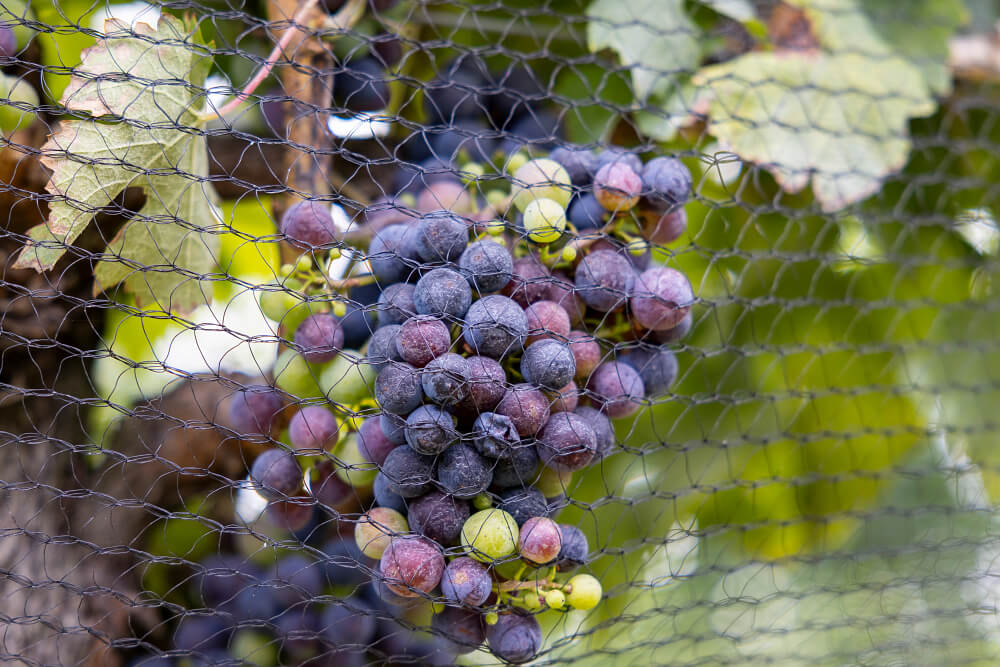
Canopy HedgingIs typically first necessary when berries reach pea size. Hedging should be implemented repeatedly as needed through veraison, after which it is often not required. To ensure optimal canopy sunlight and spray penetration, lateral shoots should be hedged from the side of primary shoots, and primary shoots should be hedged at their apex before they bend over and shade the canopy.SamplingInvolves removing leaf tissues from fully expanded leaves at the tops of primary shoots for nutritional analyses. Growers can choose to sample specific vines or regions if deficiency symptoms are evident at veraison.Bird NettingShould be placed immediately upon berry softening and color change to prevent bird depredation. Do not underestimate the amount of crop that can be damaged or removed by wildlife.Diseases
PhomopsisRemove diseased canes through pruning during the dormant period. Spray lime sulfur at late dormant. Apply active fungicides as soon as green tissue emerges in the spring, and continue through veraison. Fruit infections mainly occur between cluster emergence and early postbloom, and generally cease at green pea size.Powdery MildewRemove diseased canes through pruning during the dormant period. Spray lime sulfur at late dormancy. Apply active fungicides as soon as green tissue emerges in the spring, and continue through postharvest. During the period from prebloom to fruit set, the fruit is particularly susceptible to powdery mildew infection, but fruit infection is still a risk until approximately four weeks after bloom.Downy MildewLeaves are always susceptible to infection. Fruit, rachises, and pedicels are resistant at about four weeks after bloom. Apply active fungicides in rotation. Fungicide resistance, particularly to the strobilurin fungicides, is prevalent.Black RotRemove mummified fruit and any diseased tissues during dormant pruning. Apply active fungicides from bloom until veraison. Prebloom until six weeks postbloom is a critical infection period.BotrytisCanopy management is very important. Highly active fungicides should be applied at early bloom to fruit set, just before berry touch, veraison, and two weeks after veraison through preharvest. Resistance is common, so rotate fungicide classes. Use Captan often during the season to further suppress this disease.Ripe RotRemove mummified fruit and any diseased tissues during dormant pruning. Infected fruit do not show symptoms until they ripen. Apply active fungicides from bloom until harvest.Bitter RotRemove mummified fruit and any diseased tissues during dormant pruning. Apply active fungicides from prebloom until harvest.Pierce’s DiseaseSpray insecticides as soon as sharpshooter vectors are detected in the spring; early infections are more likely to result in mortality. Cold winters reduce the impact of the disease, and winter pruning is important to remove infected canes. Destroy infected vines as soon as symptoms confirm the disease.Sour RotLate-season fruit injury and drosophila invasion are critical to establishment and spread of this disease caused by yeasts and acetobacter bacteria. Sour rot generally does not start prior to 10 brix or veraison.Insects
Sharpshooter/LeafhopperPlace several double-sided yellow sticky traps per block and check traps weekly for sharpshooters/leafhoppers.MiteCheck leaves for chlorotic spots and bronzing. Using a hand lens, check the underside of the leaf along the leaf veins. Manage if more than 10 mites per leaf.Spotted Wing Drosophila (SWD)Berries become attractive to SWD at 15 brix. SWD presence in vineyards can be monitored with homemade traps, commercial lures, and larvae in fruit. Control decisions should be influenced by the farm’s history of SWD infestations.Grape Berry MothMonitor grape berry moth using pheromone-baited traps and look for webbing in the clusters when berries are small—larvae will web multiple berries together.Japanese Beetle and Green June BeetleCheck for shiny green- and copper-colored beetles. Feeding skeletonizes leaves and is concentrated in the upper part of the vine canopy. The large, green June beetles may feed on the fruit. Severe feeding by beetles after veraison can have significant impact on fruit quality. |
Preharvest |
Cultural Practices
ScoutingFor nutrient disorders and systemic infections should occur throughout the entire post veraison to preharvest period, when vines become stressed and are allocating resources away from leaves to ripening fruit. Red leaves are indicative of nutrient disorders but can also indicate systemic infections. If time is limited, flag vines and plan to tend to them after harvest.Diseases
Powdery MildewRemove diseased canes through pruning during the dormant period. Spray lime sulfur at late dormancy. Apply active fungicides as soon as green tissue emerges in the spring, and continue through postharvest. During the period from prebloom to fruit set, the fruit is particularly susceptible to powdery mildew infection, but fruit infection is still a risk until approximately four weeks after bloom.Downy MildewLeaves are always susceptible to infection. Fruit, rachises, and pedicels are resistant at about four weeks after bloom. Apply active fungicides in rotation. Fungicide resistance, particularly to the strobilurin fungicides, is prevalent.BotrytisCanopy management is very important. Highly active fungicides should be applied at early bloom to fruit set, just before berry touch, veraison, and two weeks after veraison through preharvest. Resistance is common, so rotate fungicide classes. Use Captan often during the season to further suppress this disease.Ripe RotRemove mummified fruit and any diseased tissues during dormant pruning. Infected fruit do not show symptoms until they ripen. Apply active fungicides from bloom until harvest.Bitter RotRemove mummified fruit and any diseased tissues during dormant pruning. Apply active fungicides from prebloom until harvest.Pierce’s DiseaseSpray insecticides as soon as sharpshooter vectors are detected in the spring; early infections are more likely to result in mortality. Cold winters reduce the impact of the disease, and winter pruning is important to remove infected canes. Destroy infected vines as soon as symptoms confirm the disease.Sour RotLate-season fruit injury and drosophila invasion are critical to establishment and spread of this disease caused by yeasts and acetobacter bacteria. Sour rot generally does not start prior to 10 brix or veraison.Insects
Sharpshooter/LeafhopperPlace several double-sided yellow sticky traps per block and check traps weekly for sharpshooters/leafhoppers.MiteCheck leaves for chlorotic spots and bronzing. Using a hand lens, check the underside of the leaf along the leaf veins. Manage if more than 10 mites per leaf.Spotted Wing Drosophila (SWD)Berries become attractive to SWD at 15 brix. SWD presence in vineyards can be monitored with homemade traps, commercial lures, and larvae in fruit. Control decisions should be influenced by the farm’s history of SWD infestations.Grape Berry MothMonitor grape berry moth using pheromone-baited traps and look for webbing in the clusters when berries are small—larvae will web multiple berries together.Yellow JacketThe key to yellow jacket management is keeping the fruit intact, for example, by minimizing disease, fruit splitting, and bird damage. Scout for wasp nests in the vineyard, in nearby buildings, or in nearby trees. Manage through nest removal or traps. |
Harvest |
Cultural Practices
HarvestDecisions are cultivar-, region-, and site- specific. Use grape chemistry analyses, sensory perception (taste, color, fruit integrity), intended wine style, and predicted weather patterns to make judicious harvest decisions.Diseases
Powdery MildewRemove diseased canes through pruning during the dormant period. Spray lime sulfur at late dormancy. Apply active fungicides as soon as green tissue emerges in the spring, and continue through postharvest. During the period from prebloom to fruit set, the fruit is particularly susceptible to powdery mildew infection, but fruit infection is still a risk until approximately four weeks after bloom.Downy MildewLeaves are always susceptible to infection. Fruit, rachises, and pedicels are resistant at about four weeks after bloom. Apply active fungicides in rotation. Fungicide resistance, particularly to the strobilurin fungicides, is prevalent.Pierce’s DiseaseSpray insecticides as soon as sharpshooter vectors are detected in the spring; early infections are more likely to result in mortality. Cold winters reduce the impact of the disease, and winter pruning is important to remove infected canes. Destroy infected vines as soon as symptoms confirm the disease.Insects
Yellow JacketThe key to yellow jacket management is keeping the fruit intact, for example, by minimizing disease, fruit splitting, and bird damage. Scout for wasp nests in the vineyard, in nearby buildings, or in nearby trees. Manage through nest removal or traps. |