
Overview
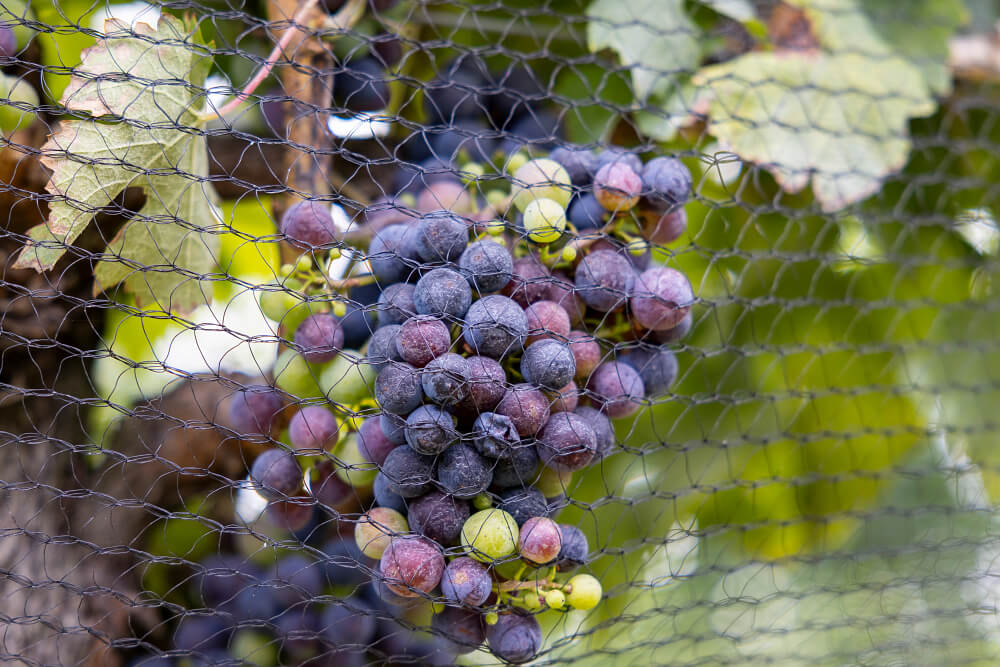
‘Blanc du Bois’ is a white hybrid grape cross developed by John A. Mortensen at the University of Florida’s Central Florida Research and Education Center in 1968. In Mortenson’s original release document, he indicated three descriptors of significance for ‘Blanc du Bois’: (a) early ripening; (b) grows well on its own roots (though rootstocks may be necessary on some soils); and—of greatest significance—(c) resistance to Pierce’s disease. Notably, ‘Blanc du Bois’ also has very good winemaking qualities. It was named in recognition of Emile DuBois, an immigrant from France to Florida, who planted more than 150 grape cultivars in the Tallahassee area and produced award-winning wines in his time.
‘Blanc du Bois’ is considered one of the best southeastern cultivars for premium wine because of its balanced flavor and resistances to both Pierce’s disease and powdery mildew. It grows vigorously with a semi-erect growth pattern and produces medium-sized clusters with large berries. ‘Blanc du Bois’ ripens mid- to late July in areas of Georgia west of Atlanta and will yield 1.8–4.5 metric tons (2–5 tons) per acre with good viticultural practices. It is grown throughout the Southeast but is most common in Florida, Georgia, Louisiana, and Texas. Though well adapted to the southeastern climate, it still is highly susceptible to anthracnose. The soluble solids content is on average lower than Vitis vinifera cultivars.
Origins and History
‘Blanc du Bois’ is a hybrid between native Florida grape cultivars and V. vinifera selections. It originated from the grape breeding program at the Central Florida Research and Education Center from a cross between ‘Florida D6-148’ and ‘Cardinal’ in 1968 (Figure 1). The resulting hybrid was first transplanted to a vineyard in 1970 and was selected in 1974 for further testing under the name H18-37. The cultivar was named ‘Blanc du Bois’ and officially released in 1987. The main selling point for the cultivar is resistance to Pierce’s disease, a fatal vascular disease of V. vinifera, numerous hybrids, and some native grapes. Pierce’s disease is prevalent in the Southeast at lower elevations and latitudes, as warmer winter temperatures allow for winter survival of Xylella fastidiosa, the bacterium that causes the disease. The introduction of ‘Blanc du Bois’ allowed for production of a white wine with vinifera-like qualities in regions where vinifera grapes could not be grown previously because of Pierce’s disease.

Note. As a hybridized product of breeding from Vitis vinifera and native grapes, a palatable grape was produced that is also resistant to Pierce’s disease (Xylella fastidiosa) and powdery mildew (Erysiphe necator; Mortensen, 1987). However, it remains susceptible to anthracnose (Elsinoë ampelina), downy mildew (Plasmopara viticola), and several other diseases.
Vine and Fruit Characteristics
As originally reported, ‘Blanc du Bois’ has a semi-erect growth habit and grows vigorously, requiring a Watson training system or similar (high-wire bilateral cordon). The leaves average 9 cm (3.5 in.) long by 12 cm (4.7 in.) wide. The adaxial (upper) leaf is dark green and moderately rugose, while the abaxial (lower) leaf surface is dull green and sparsely covered by hairs. Teeth on the leaf margins are bilaterally convex. Internodes vary from 4–10 cm (1.6–3.9 in.; Figure 2), and fruit usually is borne on the second and third nodes of the shoot.

Note. Upper (adaxial) leaf surfaces (A) are described as dark green and moderately rugose (wrinkled), while the lower (abaxial) leaf surface (B) is dull green with sparse hairs. Mature leaves average 9 cm long by 12 cm wide. Internodes are 4–10 cm apart (C), and tendrils are discontinuous and branched (Mortensen, 1987).
Photos: W. Sanders, University of Georgia.
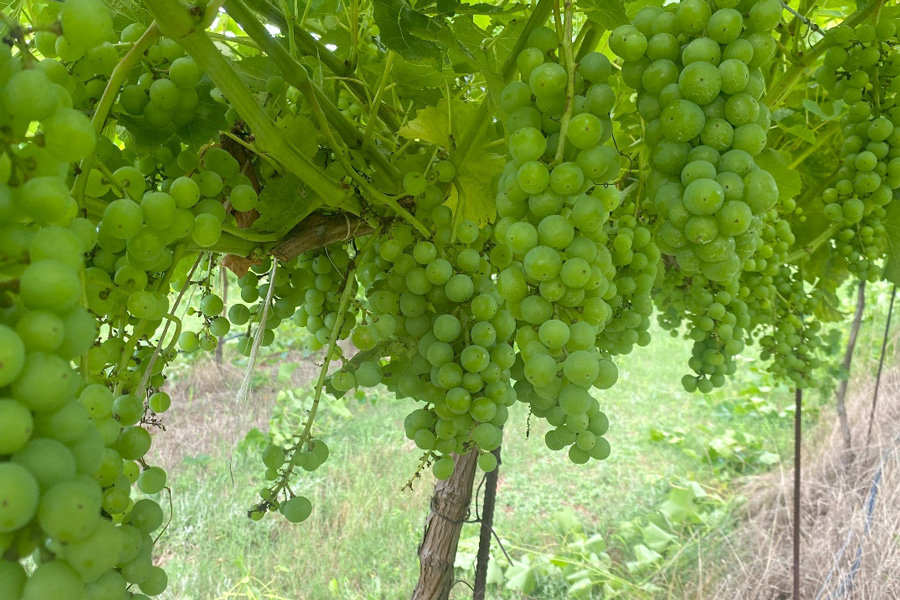
‘Blanc du Bois’ wood ripens to brown. This cultivar is self-fertile (Figure 3) and fruit clusters have medium compactness, allowing for good spray penetration (Figure 4).
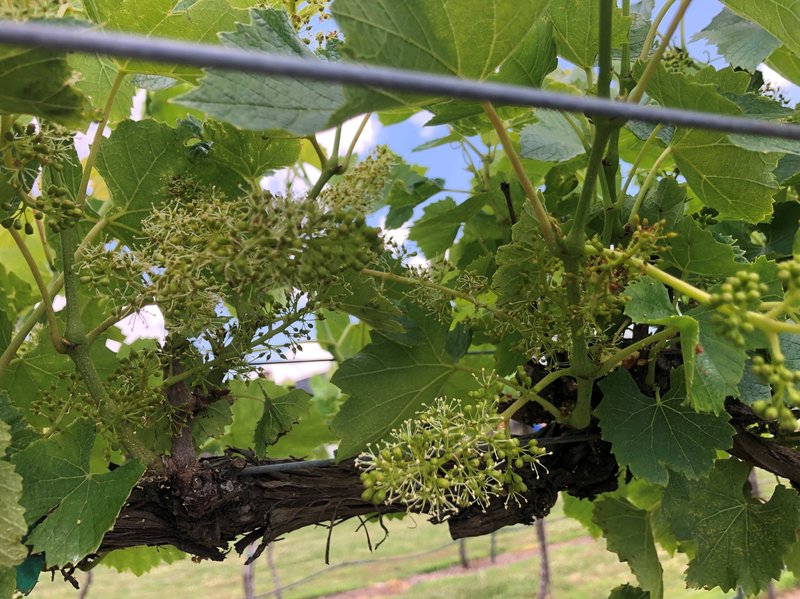
Note. ‘Blanc du Bois’ is self-fertile and produces prolific flowers for subsequent fruit production. However, poor fruit set and/or uneven ripening can occur in some years in some regions, either from frost/freeze damage or from poor pollination because of wet conditions.
Photo: P. Brannen, University of Georgia.
Clusters are medium-sized and have an average weight of 133 g (0.3 lb) and 45–55 berries per cluster, with each berry averaging 2.9 g (0.1 oz). Individual fruit are round, light green, and juicy, with skins slipping easily from the pulp when ripe. Like most wine grapes, ‘Blanc du Bois’ berries have large seeds that render them undesirable as table grapes; berries contain an average of 3.2 seeds.

Photo: Paula Burke, University of Georgia.
In the Vineyard
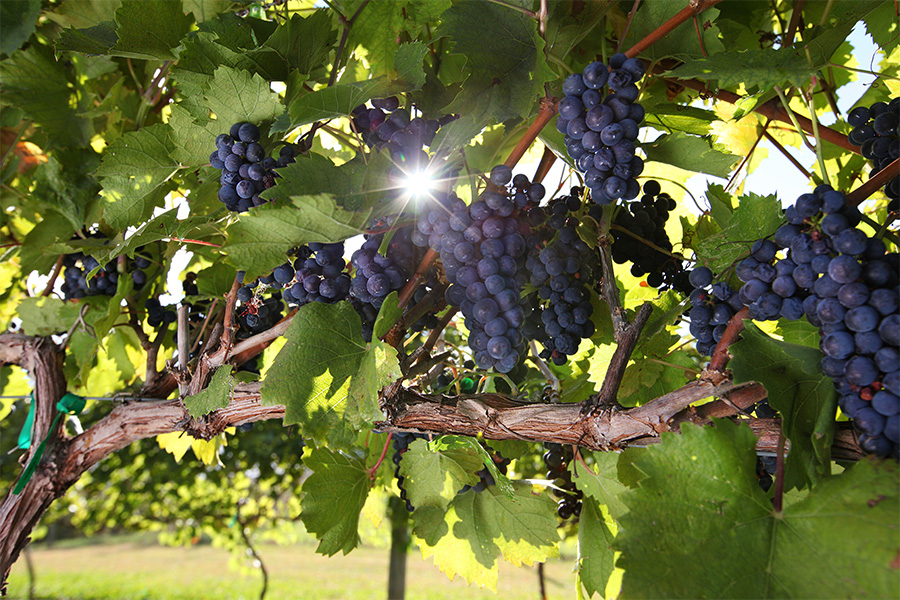
‘Blanc du Bois’ readily roots from cuttings, and rooted cuttings can be grown out and planted in a wide variety of soils. For good growth and optimum fruit production, it prefers more acidic soils in the 5.5–6.5 range, though it can tolerate more alkaline (calcareous) soils with pH of 7.0 or greater with the aid of rootstocks (e.g., 1103P or 5C). Appropriate training systems for this cultivar are high trellises of around 1.7 m (1.8 yards) with a divided canopy to account for its vigorous growth (Figure 5).

Photo: P. Brannen, University of Georgia.
As mentioned, a Watson training system of a high-wire bilateral cordon with a horizontally divided canopy works well. ‘Blanc du Bois’ normally breaks bud in March, and harvest occurs in mid- to late July in areas west of Atlanta and a week or two earlier in southern Georgia; however, these parameters may vary based on latitude and other parameters. In northern Florida, harvest dates range from June 30 to July 7. Since budbreak occurs early, ‘Blanc du Bois’ is susceptible to cold and frost damage in many areas. This cultivar is self-fruiting and very productive; when a full crop is possible, yields are projected at 11.9 metric tons per hectare (5.3 tons per acre). ‘Blanc du Bois’ ripens well even with hot days and warm nights, making it suitable for areas at low latitudes. However, producers should be cautious and test plots at higher elevations and latitudes since early, severe cold conditions may limit productivity. ‘Blanc du Bois’ is a short-season grape, requiring 110–125 days from bud break to fruit maturation. With extended hang time, grapes can “shell” from the clusters, resulting in lost production.
In the Cellar
‘Blanc du Bois’ has the capacity to make premium white wines that are similar to some vinifera wines. The berry flavor profile originally was described as similar to Muscat cultivars. Muscat is in the heritage of ‘Blanc du Bois’, and the taste profile of ‘Blanc du Bois’ wines likely derives in part from this background. Wine-tasting panels have put it in the very good range for its favorable sugar-to-acid balance and spicy notes. ‘Blanc du Bois’ will make a spicy wine with floral, citrus flavors. It also can make a sparkling wine or a sweet wine fortified in the style of Madeira. Harvest generally takes place at 16° to 22° Brix, 6–10 g/L titratable acidity, and pH 3.2–3.3 in Georgia, although Texas reports a juice pH of 3.4–3.8. By comparison to V. vinifera, ‘Blanc du Bois’ does not have high soluble solids. The juice oxidizes within an hour after pressing to a dark brown color, but it will lighten during fermentation. It can serve as a blending grape as well.
Diseases and Pests
‘Blanc du Bois’ is highly tolerant to Pierce’s disease, meaning that the bacterium can be found in the xylem without producing symptoms, death, or yield reductions. Based on observations wherever grown, it appears to have strong resistance to powdery mildew as well. However, it is highly susceptible to anthracnose. Other common diseases observed on ‘Blanc du Bois’ are black rot, bitter rot, ripe rot, sour rot, and downy mildew, but all of these diseases can be managed by cultural practices and proper use of fungicides.
Cultural management is important for control of most grape diseases. Nursery plants should be inspected and be free of viruses and crown gall. Among the various cultural practices of particular importance in the vineyard, dropping mummified fruit to the ground during pruning operations is critical. Diseased canes should be pruned out each winter, and these should then be destroyed outside of the vineyard. Both of these practices will reduce carryover inoculum that can initiate new infections in the spring of the following year. Throughout the year, any practice that increases airflow and reduces drying time within the canopy or clusters will assist with disease management. To adequately control diseases, fungicides should be applied every 10–14 days when conditions are dry and every 7–10 days when conditions are wet.
Common insect pests include Japanese beetles and grape root borers. Bees and wasps can be problematic in rotted clusters as well. Grape berry moth is reported as a primary pest in Texas, but it’s been reported that two to three insecticide applications will provide control where needed. Mortensen (1987) originally reported that ‘Blanc du Bois’ is tolerant of nematodes, and though not mentioned by Mortensen, there is no report of phylloxera damage on self-rooted vines—precluding the need for rootstocks in most venues. However, recent research in Georgia indicates that several nematode species build up to levels that could be damaging. In the absence of more defined research, rootstocks should at least be considered for nematodes.
Downy Mildew
In an early publication, Mortenson (1987) reported that ‘Blanc du Bois’ was resistant to downy mildew, but this is not the case; it is not as susceptible to disease development as V. vinifera cultivars, but downy mildew definitely is a significant pathogen of ‘Blanc du Bois’. Caused by the oomycete Plasmopara viticola, downy mildew can cause extreme crop loss, as it attacks both leaves and fruit.
Infected leaves have oily yellowish spots on top and a subsequent white downy growth on the bottom—the fruiting structures and spores that provide inoculum for secondary infections (Figure 6).
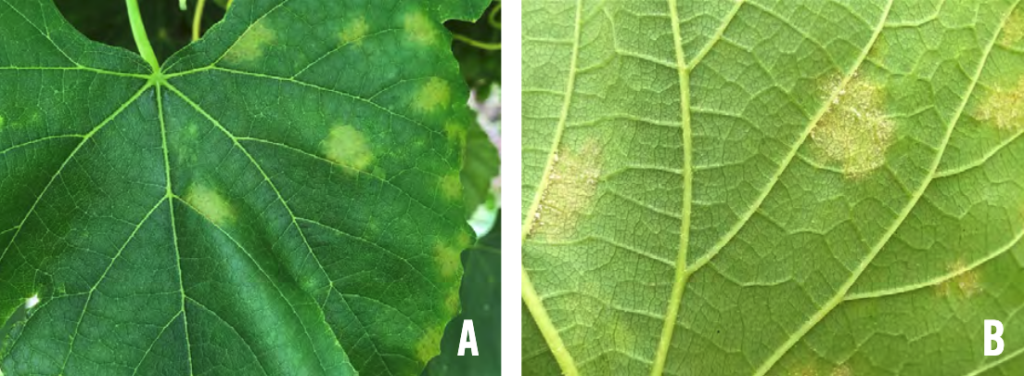
Note. Initial symptoms of downy mildew are “oil spots” on the upper leaf surface (A), with sporulating lesions on the lower leaf surface (B). Since powdery mildew generally is not associated with this cultivar, any mildew symptoms likely are related to downy mildew. If left untreated, vines will defoliate. Early fruit infection also is possible, though ontogenic resistance is observed—meaning that fruit are largely resistant once they have reached pea-size development.
Photos: P. Brannen, University of Georgia.
Young berries are very susceptible to infection, but berries develop ontogenic (age-related) resistance as they develop, meaning that roughly pea-size berries start to become resistant to infection. The vines must be sprayed throughout the season to preserve leaves, as complete defoliation can occur on unsprayed vines. Premature defoliation can result in issues with quality fruit production, but winter injury and kill also can be observed in vines that are weakened because of a lack of carbohydrate production and storage.
Several fungicides are registered for downy mildew management. Among these, mancozeb and captan products provide the backbone for any downy-mildew management program. Phosphonate fungicides also are active, but phytotoxicity can result at higher concentrations; following the label’s relative final fungicide-concentration limits should help to prevent damage.
Anthracnose
The fungus Elsinoë ampelina causes anthracnose and will attack all green plant tissues, but the most important damage is observed on fruit (Figure 7).

Note. Anthracnose is a major disease of ‘Blanc du Bois’. Also called “bird’s-eye spot,” this disease is particularly problematic on this cultivar. However, optimized fungicide spray programs can provide excellent management.
Photo: Justin Scheiner and Fran Pontasch, Texas A&M University.
‘Blanc du Bois’ is very susceptible to anthracnose, and anthracnose is particularly problematic in warm, wet climates—like those where ‘Blanc du Bois’ often is grown. Anthracnose forms black leaf spots that eventually make shot-holes in the leaves. On the berries, lesions start as small, purple spots that eventually encompass the berry. Complete losses are possible on unsprayed plants. Use of calcium polysulfide (lime sulfur) products during the late-dormant period just prior to bud break provides one of the major means of disease management for this fungus. Calcium polysulfide products also provide significant control of Phomopsis cane and leaf spot. As with downy mildew, mancozeb and captan products provide the backbone for management of anthracnose, Phomopsis, and black-rot diseases. However, there are numerous other fungicides available, so consult spray guides for your region when developing spray programs.
Black Rot
The current scientific name for the pathogen that causes black rot is Phyllosticta ampelicida. Until recently it also was known as Guignardia bidwellii, so much of the scientific literature will reference the former name. The fungus can infect all new growth, but it is predominantly a problem on leaves and fruit (Figure 8).

Note. Symptoms on fruit initially present as brown spots that rapidly turn to black, engulfing the fruit and forming a hard, raisinlike black mummy (A). Leaf symptoms are relatively easy to identify—brown spots with pepper-like fruiting bodies (pycnidia) are scattered throughout the spots (B).
Photos: Justin Scheiner and Fran Pontasch, Texas A&M University.
Lesions can occur on petioles, pedicels, shoots, and tendrils of the grape plant. Symptoms include discolored lesions that are brown to black, with pepper‐like pycnidia showing up in the lesions. On leaves, round to irregular spots are tan to brown and also contain pepper‐like pycnidia (fruiting bodies) within the spot. Tan to brown discolored spots on fruit will expand to cover the entire fruit and will eventually produce mummies that are bluish‐black and appear as raisins. Pepper‐like, raised pycnidia also are observed in the spots on fruit as they develop and mature. Under a hand lens or dissecting scope, these pycnidia appear as pimple‐like structures arising from the fruit skin. Mancozeb and captan products provide the backbone for black-rot management, although mancozeb is more active than captan. Several other fungicides are registered, and use of these can provide increased disease control when needed, especially under wet conditions.
Bitter rot
This rot is difficult to distinguish from black rot on fruit clusters. Caused by the fungus Greeneria uvicola, it is yet another of a series of rots that can impact ‘Blanc du Bois’ production. The acervuli (small asexual fruiting bodies) fruiting structures appear similar to those of black rot, though they do look different to the trained eye when viewed under a hand lens or microscope. As the berry rots, it forms a hard, black, raisinlike structure that is virtually indistinguishable from that formed by black rot (Figure 9).

Note. Acervuli, small asexual fruiting structures, are seen on newly infected and mummified fruit. Bitter rot can be easily confused with black rot, though the fruiting structures do appear different when viewed under a hand lens or microscope.
Photo: Justin Scheiner, Texas A&M University.
Sour rot
This disease is caused by Acetobacter (acetic acid) bacteria and yeasts that enter wounds in the fruit. Wounding can be caused by fruit flies, birds, machines, excessive rain resulting in splits, etc. When sour rot occurs, the juice in berries essentially forms vinegar, resulting in a vinegar-like smell that attracts more insects (Figure 10). Overall loss of fruit quality is observed, and harvested sour-rotted fruit will severely reduce wine quality. Use of insecticides for control of drosophilid fruit flies has shown promise in reducing this disease.
Ripe rot
This disease is caused by fungal species in the genus Colletotrichum. Again, mancozeb and captan products are critical for management. However, under wet conditions, additional fungicides should be considered. Symptoms of the disease are reddish-brown spots on fruit that eventually develop salmon-colored oozing spore masses (Figure 10). As with black rot, berries shrivel to form mummified fruit.
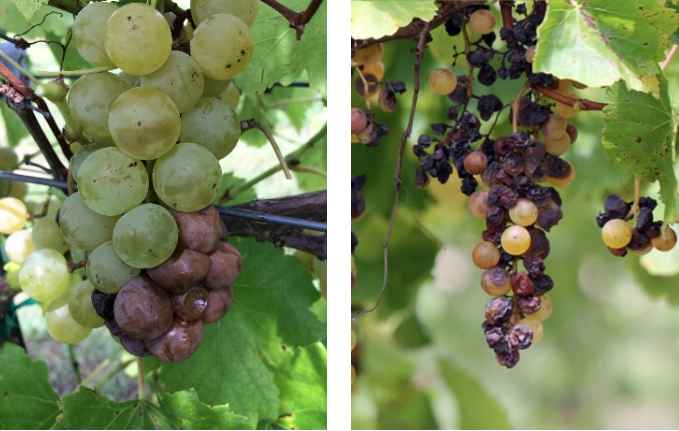
Note. Sour rot initially resembles black rot, but sour rot is a soft rot that produces vinegar-like smells in rotted fruit. Salmon-colored spore masses give ripe rotting fruit an orange color, but once fruit is mummified, ripe rot is difficult to distinguish from other rots like black or bitter rot.
Photo: Justin Scheiner and Fran Pontasch, Texas A&M University.
Viruses
Limited information is available related to viruses that infect ‘Blanc du Bois’, but they do occur. Grapevine leafroll-associated virus and grapevine red blotch virus are commonly observed on V. vinifera, though symptoms may appear moderately different on ‘Blanc du Bois’. Viral leaf symptoms include crinkling to curling, tattered leaves with red to necrotic discoloration, and mosaic to yellow spotting (Figure 11).

Note. Leaf symptoms of viruses can range from crinkling to curling (grape leaf roll; A), tattered leaves with red to necrotic discoloration (red blotch; B), or mosaic to yellow spotting (C–D; mixed infections).
Photos: Justin Scheiner, Texas A&M University.
Unfortunately, virus symptoms can easily be confused with nutritional issues, though nutritional issues are often more uniform across a vineyard block, whereas virus symptoms initially may be confined to limited numbers of scattered vines. Diagnostic clinic testing may be required to confirm whether viruses are present, as well as which viruses are involved. Clean plant material should always be utilized to start vineyards, and vector management (e.g., mealybug control for grapevine leafroll-associated viruses) may be considered.
Bunch stem necrosis
Some regions have experienced bunch stem necrosis (Figure 12), an ill-defined condition that results in significant yield losses. No definitive cause has been determined, but nutritional imbalance, cold damage, insect damage, etc. have been implicated. Shatter or necrosis of the blooms can occur early, and fruit set and total fruit number are reduced.
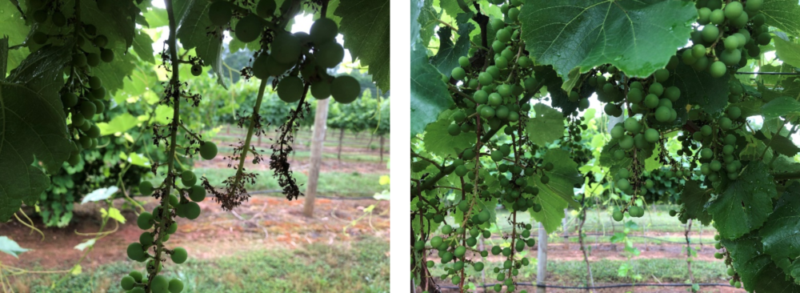
Note. Some locations have experienced bunch-stem necrosis, an ill-defined condition that results in significant yield losses. No definitive cause has been determined, but nutritional imbalance, cold damage, insect damage, and other factors have been implicated. Shatter or necrosis of the blooms can occur early (A), and fruit set and total fruit number are reduced (B). The issue appears to be regional.
Photo: P. Brannen, University of Georgia.
Grape root borer
Larvae of the grape root borer (Vitacea polistiformis) attack the root system and crown (Figure 13).
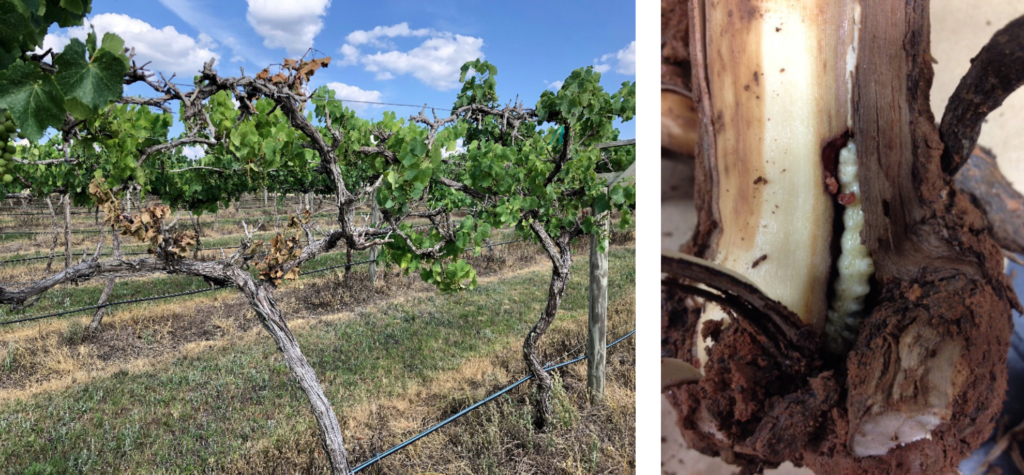
Note. ‘Blanc du Bois’ vines with grape root borers (Vitacea polistiformis) in the plant crown gradually will collapse over time as borer damage increases (A). Damage develops randomly throughout the vineyard, with initial symptoms presenting as chlorotic, yellowed leaves with reduced growth. Trunk diseases can cause similar symptoms. In symptomatic plants, grape root borers can be found under the bark and root tissue at the plant crown (B).
Photo: P. Brannen, University of Georgia.
They are not visible, so they often go unnoticed for some time until vines decline and die. Control is limited, with mating disruption being one of the few tools that remain for managing this insect. As compared to muscadines and some other hybrids, ‘Blanc du Bois’ succumbs readily to a limited infestation of grape root borer—resulting in dieback and death in 1–2 years on unmanaged vines.
Japanese beetle
Occurring yearly, Japanese beetles (Popillia japonica) attack foliage and will skeletonize leaves if left untreated (Figure 14). They are very active in the summer, and though vines can take a considerable amount of damage without affecting yields, damage in ‘Blanc du Bois’ can be extreme. Japanese beetles prefer smooth-leaf cultivars, so that may be a reason for excessive damage in ‘Blanc du Bois’. Foliar insecticides can provide effective management of this insect. In addition to Japanese beetles, June beetles also can feed on the fruit and become problematic in some locations, such as southern Mississippi.

Note. Yearly infestations of Japanese beetles (A) and the resulting damage can be expected in ‘Blanc du Bois’ plantings, but the extent of the damage will vary from year to year. Japanese beetles skeletonize (eat leaf material between the veins; B) vines from the top down. Significant damage can result if left unchecked.
Photo: P. Brannen, University of Georgia.
Summary
‘Blanc du Bois’ has made a significant contribution to wine production in southeastern regions where Pierce’s disease is prevalent. Though possessing resistance or tolerance to Pierce’s disease, phylloxera, and powdery mildew, this cultivar is not without fault and requires an intensive integrated pest management (IPM) program. Weed management, with a weed-free strip under the vines and with mowed row middles, is also important in order to decrease drying times and reduce diseases. This publication covers the major issues observed with this cultivar to date, but other periodic pests such as spider mites may also be observed. Scouting is always of value, and should you come across new issues or have trouble identifying diseases, insects, or weeds associated with your vineyard, do not hesitate to contact your local county Extension agent. They possess a wealth of information and can apply numerous resources as needed to answer your questions.
References
Alabi, O. J., McBride, S., Appel, D., Rwahnih, M. A., & Pontasch, F. M. (2019). Grapevine virus M, a novel vitivirus discovered in the American hybrid bunch grape cultivar ‘Blanc du Bois’ in Texas. Archives of Virology, 164(6), 1739–1741. https://doi.org/10.1007/s00705-019-04252-7
Buzombo, P., Jaimes, J., Lam, V., Cantrell, K., Harkness, M., McCullough, D., & Morano, L. (2006). An American hybrid vineyard in the Texas Gulf Coast: Analysis within a Pierce’s disease hot zone. The American Society for Enology and Viticulture, 57(3), 347–355. https://doi.org/10.5344/ajev.2006.57.3.347
Mortensen, J. A. (1987). ‘Blanc du Bois’: A Florida bunch grape for white wine. University of Florida Agricultural Experiment Station.
Mortensen, J. A. (1988). ‘Blanc du Bois’ grape. Hortscience, 23(2), 418–419. https://doi.org/10.21273/HORTSCI.23.2.418
Ren, Z., & Lu, J. (2002). Muscadine rootstock increased the resistance of Florida hybrid bunch grape cv. ‘Blanc du Bois’ to Pierce’s and anthracnose diseases. Proc. Fla. State Hort. Soc., 115, 108–110. https://journals.flvc.org/fshs/article/view/86429/83345
Scheiner, J., & Pontasch, F. (2019). Grape variety profile: ‘Blanc du Bois’. Texas A&M AgriLife Extension Service. https://agrilifelearn.tamu.edu/s/product/grape-variety-profile-blanc-du-bois/01t4x000004Ofpo
Scheiner, J. J., Labay, A., & Kamas, J. (2020). Rootstocks improve ‘Blanc du Bois’ vine performance and fruit quality on alkaline soil. Catalyst: Discovery into Practice, 4, 63–73. https://doi.org/10.5344/catalyst.2020.19007
Westover, F. (2012, February). ‘Blanc du Bois’ takes root. Wines and Vines.
Wilcox, W. F., Gubler, W. D., & Uyemoto, J. K. (Eds.). (2015). Compendium of grape diseases, disorders, and pests (2nd ed.). American Phytopathological Society. https://doi.org/10.1094/9780890544815