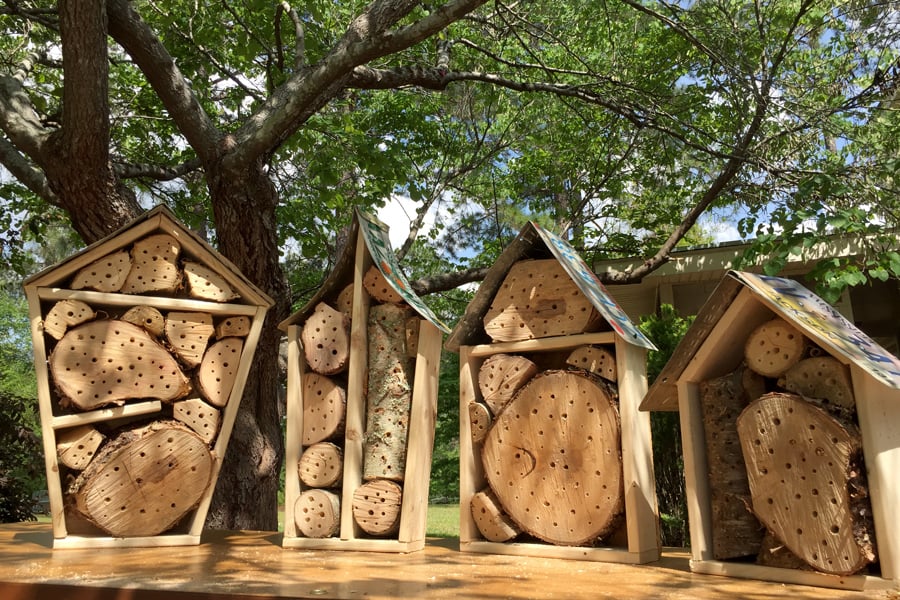


Over 50% of the world’s population currently resides in urban areas, which continue to expand. Bees are among the most populous, diverse, and effective pollinators. Approximately 70% of bee species nest in the ground, spending their larval and pupal stages underground (Figure 1). Continued urbanization threatens natural spaces, as land degradation, pollution, and habitat destruction present serious challenges to sustaining bee populations.

Biology of Ground-Nesting Bees
Ground-nesting bees are holometabolous (meaning they undergo complete metamorphosis) and go through four distinct life stages: egg, larva, pupa, and adult. All of the immature stages occur in soil, and only the adults emerge. The number of larval instars (stages or levels) varies by species, with most bee species having four or five instars. Ground-nesting bees are most active during the typical growing season for most landscape plants, but their activity varies by species and some are active during the winter.
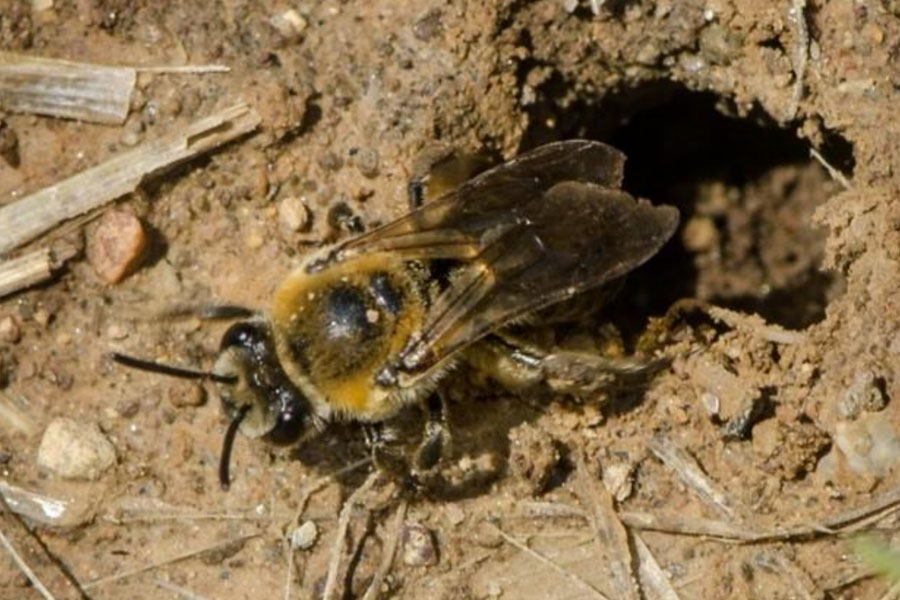
Upon emergence, females mate and dig tunnels into the soil to build nests (Figures 2 and 3). Males do not construct nests, but in rare cases, they may seek shelter in preexisting tunnels.

Female bees provide pollen balls in brood cells made from floral resources near the nest. The female bee then deposits eggs on top of the collected pollen. Within 7 to 10 days, the eggs hatch, and the larvae feed on the supplied food, gradually developing into pupae inside the brood cells.
The social structure of ground-nesting bees varies, with most species being solitary. Solitary ground-nesting bees and the females of social species overwinter within brood cells, either as prepupae or adults, before emerging from their nests in the spring.
Specific factors that influence nesting-site preference in ground-nesting bees are not well understood. Soil characteristics, such as texture, particle size, and compaction, are believed to impact preference for nesting sites, with ground-nesting bees commonly favoring sandy or loamy soils. Nest structures can vary significantly by species, ranging from intricate mazes of branching tunnels and brood cells to simple nests where brood cells connect to a main gallery (Figure 4). Some species line their brood cells with a waterproof film, while others create “chimneys” by excavating soil and mounding it around the entrance.

Conservation of Ground-Nesting Bees
Preserving natural areas in urban and suburban environments can help conserve ground-nesting bees. Additionally, studies have shown that naturalistic urban green spaces—such as parks, botanical gardens, and gardens that mimic natural ecosystems—tend to support greater bee diversity and abundance compared to formal, highly managed flower beds and backyard gardens. Like all bees, ground-nesting bees depend on floral resources and likely benefit from increased floral diversity and abundance. Furthermore, some species may rely on specific plants to complete their life cycles, making the conservation of these plants essential for bee preservation.
Impervious surfaces such as concrete and pavement are significant factors affecting the habitat of ground-nesting bees and other organisms in urban areas. The soil compaction associated with impervious areas can inhibit the establishment of bee nests in the ground. Therefore, even small patches of bare soil, such as those found next to container plants in suburban yards, can offer suitable locations for nest construction.
Conclusion

Bees are one of our most effective pollinators. While bees can adapt and thrive in urban environments (Figure 5), urban bees—especially ground-nesting species—may face risks from human activities, including limited nesting sites, habitat loss, habitat fragmentation, increased impervious surfaces, and inadequate floral resources. Since around 70% of the world’s bee species are ground-nesting, it is crucial to preserve them, which in turn helps maintain healthy ecosystems and ensure thriving pollination.
References
Antoine, C. M., & Forrest, J. R. (2021). Nesting habitat of ground‐nesting bees: A review. Ecol. Entomol., 46(2), 143–159. https://doi.org/10.1111/een.12986
Cane, J. H. (2005). Bees, pollination, and the challenges of sprawl. In E. Johnson & M. Klemens (Eds.), Nature in fragments: The legacy of sprawl (pp. 109–124). Columbia University Press. https://www.researchgate.net/profile/Jim-Cane/publication/256458842_Bees_pollination_and_the_challenges_of_sprawl/links/5aaf1b9ea6fdcc1bc0bc78a1/Bees-pollination-and-the-challenges-of-sprawl.pdf
Christmann, S. (2022). Regard and protect ground‐nesting pollinators as part of soil biodiversity. Ecol. Appl., 32(3), e2564. https://doi.org/10.1002/eap.2564
Danforth, B. N., Minckley, R. L., & Neff, J. L. (2019). The solitary bees: Biology, evolution, conservation. Princeton University Press. https://doi.org/10.2307/j.ctvd1c929
Frankie, G. W., Thorp, R. W., Schindler, M., Hernandez, J., Ertter, B., & Rizzardi, M. (2005). Ecological patterns of bees and their host ornamental flowers in two northern California cities. J. Kans. Entomol. Soc., 78(3), 227–246. https://doi.org/10.2317/0407.08.1
López-Uribe, M. M., Morreale, S. J., Santiago, C. K., Danforth, B. N. (2015). Nest suitability, fine-scale population structure and male-mediated dispersal of a solitary ground nesting bee in an urban landscape. PLOS One, 10, e0125719. https://doi.org/10.1371/journal.pone.0125719
Neame, L. A., Griswold, T., & Elle, E. (2013). Pollinator nesting guilds respond differently to urban habitat fragmentation in an oak-savannah ecosystem. Insect Conservation and Diversity, 6, 57–66. https://doi.org/10.1111/j.1752-4598.2012.00187.x
Winfree, R. (2010). The conservation and restoration of wild bees. Annals of the New York Academy of Sciences, 1195(1), 169–197. https://doi.org/10.1111/j.1749-6632.2010.05449.x