Blueberries Resources
-
This circular is a review of water quality standards, calculations, and recommendations for water that will be used for irrigation of blueberries.
|
-

This publication provides Southeast-specific information on approved National Organic Program (NOP) disease and pest management options for blueberry production and addresses the issues most commonly encountered under the unique growing conditions of the Southeast U.S. This publication is not intended to provide all details on organic blueberry production, although it does include the production methods that reduce the impact of plant disease and pest issues. Emphasis in an organic system should be on cultural practices that reduce disease and pest pressure rather than pesticide applications. NOP-approved pesticides are usually less efficacious than conventional products. The pesticide label is the law and supersedes any information on pesticide use contained in this guide. Because environmental conditions and grower application methods vary widely, suggested use does not imply that performance of the pesticide will always conform to the pest control standards indicated by experimental data.
|
-

Fertilization is an important practice of maintaining plant health. The blueberry plant is no exception, but there are important considerations when fertilizing blueberries. The rates, timing, and type of fertilizer should be common knowledge for the grower. In this circular, how to fertilize blueberry plants is described with text, diagrams, and calculations to provide growers, Extension agents, and anyone interested with the knowledge to successfully grow blueberries, from newly established to mature plantings. This publication was written to address commercial growers’ need for a reference to avoid costly mistakes such as over-fertilization, discussing both granular and liquid fertilization.
|
-

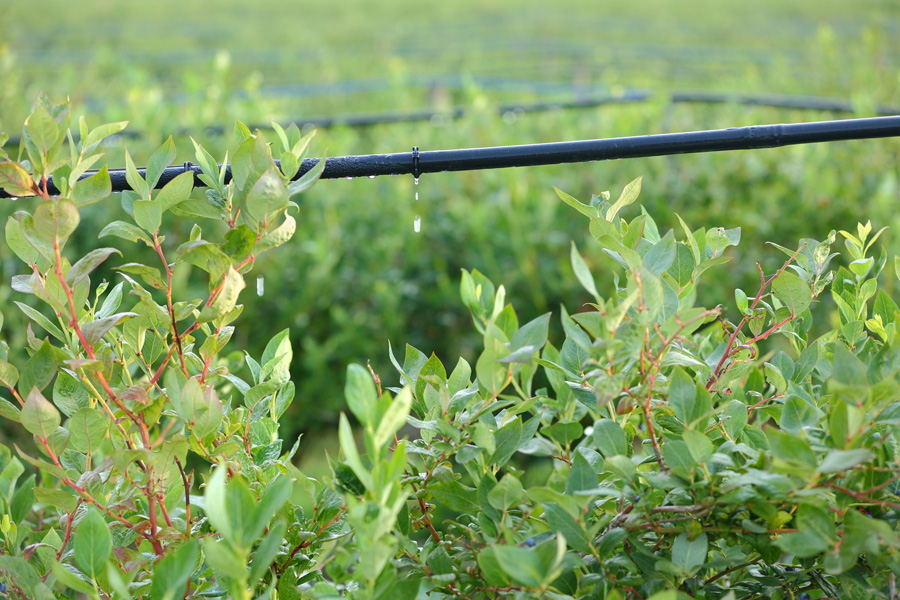
Drip, trickle, microemitters, and subsurface irrigation systems are considered low-volume irrigation. Low-volume irrigation systems are designed to improve irrigation efficiency, delivering water to the crop accurately with minimal water loss. Irrigation efficiency can be categorized into two main concepts: water loss and uniform application. If water loss is significant, or application uniformity is poor, efficiency will be low. Generally, the most significant loss of irrigation water is from overwatering, where the water percolates below the root zone, or from runoff. With good management, losses due to leaks, system drainage, and flushing of filters and lateral lines should not exceed 1%. Low-volume systems have the opportunity to achieve efficiency, and under careful management, will minimize losses from overirrigation. However, using low-volume systems requires increased irrigation frequency and soil moisture monitoring should be used to improve water-use efficiency. This publication covers system design, system efficiencies, components, chemical applications, diseases related to irrigation, and soil moisture monitoring.
|
-

This publication outlines the sampling procedure for irrigation water to be used in blueberry production. Follow the outlined steps to provide a certified lab with a sample that is representative of the irrigation water to be used for growing blueberry plants.
|
-

This publication provides Southeast-specific information on approved National Organic Program (NOP) disease and pest management options for blueberry production and addresses the issues most commonly encountered under the unique growing conditions of the Southeast U.S. This publication is not intended to provide all details on organic blueberry production, although it does include the production methods that reduce the impact of plant disease and pest issues. Emphasis in an organic system should be on cultural practices that reduce disease and pest pressure rather than pesticide applications. NOP-approved pesticides are usually less efficacious than conventional products. The pesticide label is the law and supersedes any information on pesticide use contained in this guide. Because environmental conditions and grower application methods vary widely, suggested use does not imply that performance of the pesticide will always conform to the pest control standards indicated by experimental data.
|
-

Both rabbiteye and highbush blueberries are produced in Georgia. The plants can produce a commercially viable crop for years. The long-term nature of the investment in the blueberry orchard calls for periodic updates on the situation of the blueberry industry. Information about the location of plants, varieties, plant age, and the use of cultural practices are important in decisions to allocate resources. This report provides insights otherwise unavailable to the industry and an overview of the Georgia blueberry industry, which helps to shape the production and marketing strategies that extend beyond our state boundaries. Summaries included in this report help in accurate assessment of potential economic losses from damages to blueberry plants and the feasibility of programs protecting the value represented by orchards.
|
-

Grower experiences have proven milled pine bark to be an excellent growing substrate for southern highbush blueberries. Although milled pine bark shares many characteristics with good blueberry soil, fundamental differences exist and need to be understood for rapid growth of young plants and high blueberry yields.
|