
Scale insects are very common pests of landscape trees and shrubs, yet they often are overlooked when scouting. They can, however, be responsible for chlorosis (loss of green coloration of plants due to lack of chlorophyll), branch dieback, or death of the plant. Wax scales are part of the soft scale group as they produce soft, cottony, powdery, or waxy covers that cannot be separated from the scale body.

Photo: United States National Collection of Scale Insects Photographs, USDA Agricultural Research Service, Bugwood.org.
Indian wax scale (Ceroplastes ceriferus); Figure 1) and Florida wax scale (Ceroplastes floridensis; Figure 2) are the common wax scale species that occur in Georgia.

Photo: Joseph LaForest, University of Georgia, Bugwood.org.
Indian wax scale is prevalent in the eastern U.S. from Florida to Maryland. Florida wax scale is found from Florida to New York and westward to New Mexico.
General Description and Biology
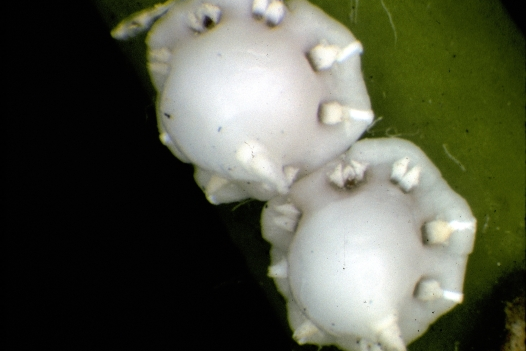
There are no male wax scale insects. Female wax scale insects are brownish-purple or reddish-brown, and they have a white or pinkish-white wax covering their bodies. Adults are about 1/4 in. long and often produce sticky wax. They lay pale purple ovoid-shaped eggs under scale cover (Figure 3).
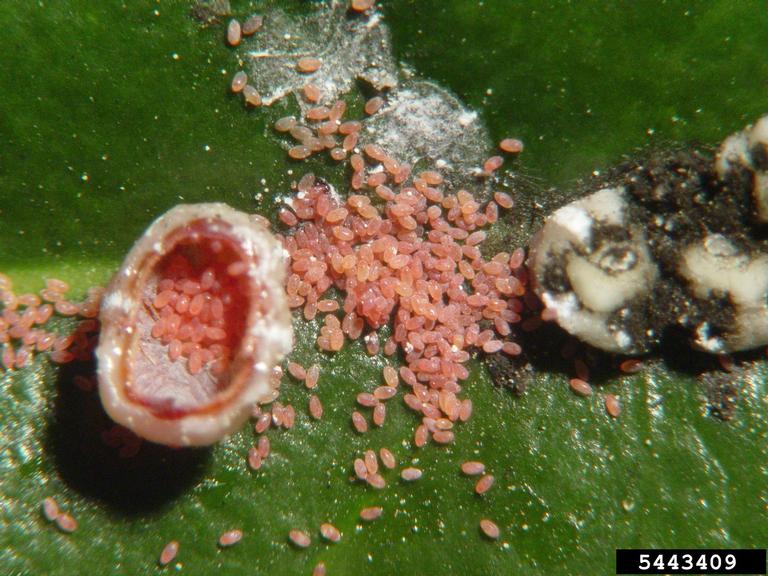
Photo: Chazz Hesselein, Alabama Cooperative Extension System, Bugwood.org.
Indian wax scale females lay 1,200–2,000 eggs during late winter and early spring. They hatch into the first nymphal stage, often referred to as crawlers, from mid-May to early June in Georgia. Wax scales often settle on the upper surface of leaves as crawlers but move down to the stem later. The crawlers are pinkish-red or red and flat, and they have functional legs. Once the crawlers settle on the stems, they molt into the second instar stage by inserting their tube-like mouthparts. Once their piercing and sucking mouthparts are inserted into plant tissue, they hardly move from that spot and they lose their legs. The second instars subsequently molt into third instars. Both the second and third instars secrete waxy material, covering their bodies. The second instars have a tiny star- shaped appearance (Figure 2), whereas the third instars resemble a cameo pin; this is referred to as the cameo stage (Figure 4).

Photo: United States National Collection of Scale Insects Photographs, USDA Agricultural Research Service, Bugwood.org.
The nymphs mature through the summer months. The third instars molt into adult females. They are covered with a gummy, white wax that looks like a thick cap (Figures 1 and 5).

Photo: John Ruter, University of Georgia, Bugwood.org.
In central and north Georgia, there is one generation of wax scale insects a year. Multiple generations are possible in the southern parts of Georgia. Adult females overwinter on the bark.
Damage
Nymphs and adult females feed on sugars by inserting their piercing and sucking mouthparts into the phloem vessels of the plant. If the infestation is severe, they suck up a large amount of nutrients vital to the growth and development of the plant, which can cause leaf discoloration, heavy leaf drop, and branch dieback. Affected plants may die in certain situations. Severely infested host plants often appear black (Figure 6) as the wax scale insects excrete excessive amounts of honeydew (the sugary substance they do not need) on which a black sooty mold fungus grows.

Photo: John Ruter, University of Georgia, Bugwood.org.
The sooty mold completely changes the appearance of the host plant with a black coating.
Host Plants
Wax scales feed on many shrubs and trees. For example: hemlock, azalea, blueberry, camellia, citrus, fig, eugenia, gumbo-limbo, yaupon, jasmine, mulberry, pear, persimmon, plum, sapodilla, and turk’s cap. However, they prefer Japanese holly, Chinese holly, euonymus, boxwood, firethorn, spirea, barberry, and flowering quince.
Monitoring
Beginning in May, examine female wax scales on leaves and twigs at 1–2 week intervals and determine when the eggs hatch. Crawlers begin to emerge in early summer in Georgia. The increased activity of foraging bees, wasps, hornets, and ants on dense shrubs may indicate heavy honeydew production and severe wax scale infestation. Look on twigs and small branches for all wax scale insect stages.
Management
Before installing hosts in the landscape, scout for the presence of any wax scale insects on them. If the wax scale insect infestation is found on twigs, remove heavily infested twigs or branches to reduce the number of insects on the plant. If the infestation is light, wax scale can be physically removed by handpicking. Avoid planting susceptible hosts, such as ‘Burford’ holly. A study showed that certain species of hollies, such as Ilex buergeri, Ilex crenata, Ilex glabra, Ilex myrtifolia, Ilex verticillata, and Ilex vomitoria have demonstrated a degree of resistance to wax scales.
The thick layer of wax on nymphs (except the crawlers) and adult females protect them from exposure to applied insecticides. The wax is thicker for females than for nymphs. Crawlers have no wax covering and are the most susceptible stage of the wax scale insect.
A thorough spray of contact insecticides, such as horticultural oil, insecticidal soap, or synthetic insecticide (e.g., pyrethroids, such as permethrin, bifenthrin, etc.) is necessaryf or effective control, especially when crawlers are present on twigs. Contact insecticides can harm beneficial insects, such as predators and parasitoids, which can cause problems with resurging secondary pests that otherwise would be regarded as minor pests. Systemic insecticides (e.g., neonicotinoids, such as acetamiprid, thiamethoxam, dinotefuran, etc.) can be soil- drenched or injected and can effectively reduce the densities of developing nymphs and females.
Dead wax scales may not naturally fall off the twigs, and it may be challenging to determine if the insecticide killed the scales. If no liquid oozes out when wax scale insects are squished, they are dead. Systemic insecticides generally are compatible with biological control agents, such as predators, but they could harm pollinators, such as foraging bees seeking pollen and nectar from the plant. Insect growth regulators, such as pyriproxyfen, novaluron, buprofezin, etc., also are effective control options. They reduce the egg hatch or viability and normal development of the nymphs.
Before using insecticides for wax sale insect control, it is critical to read the insecticide label, including the precautionary statements. The insecticide label is the law.
References
Hamon, A. B., & Williams, M. L. (1984). Arthropods of Florida and neighboring land areas (vol. 2). Florida Department of Agricultural & Consumer Services, Division of Plant Industry.
Hodges, G., Ruter, J. M., & Braman, S. K. (2000). Susceptibility of Ilex Species, hybrids and cultivars to Florida wax scale. Journal of Environmental Horticulture, 19(1), 32-36. https://doi.org/10.24266/0738-2898-19.1.32