

Click on the Save PDF button above to download the entire production guide.
Short-Day Onions
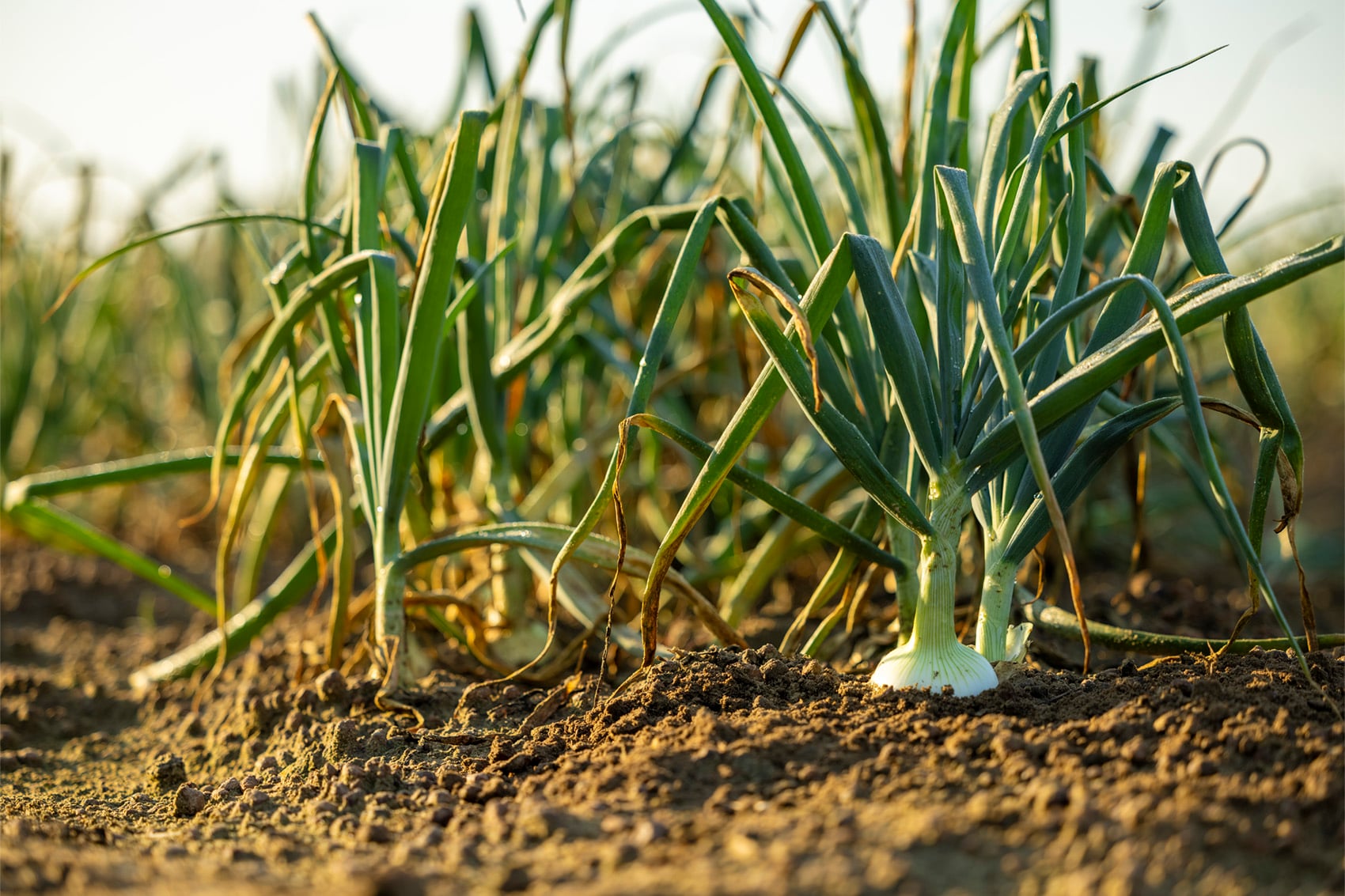
Onions are among the most widely adapted vegetable crops, as they can be grown from the tropics to subarctic regions. This adaptation is primarily due to differing responses to day length. Unlike most other species, day length influences bulbing in onions as opposed to flowering. Onions are grouped into three groups based on their response to hours of daylight. The short-day varieties bulb with daylengths of 10–13 hr; intermediate varieties bulb with day lengths of 13–14 hr and are found in the mid-temperate regions of this country. Finally, long-day onions are adapted to the most northern climes of the United States as well as Canada, and they bulb with daylengths greater than 14 hr.
Onions were first brought to this country by early European settlers. These onions were adapted to the temperate climate found throughout the Northeast where the first European settlements occurred. Varieties from warmer regions of the Mediterranean eventually made their way to the Southeastern United States. In particular, varieties from Spain and Italy would become important to the Vidalia onion industry. The first of these varieties came through Bermuda and were thus referred to as Bermuda onions.
‘Yellow Granex’, the standard for Vidalia onions, has its origin from ‘Early Grano’. The variety ‘Early Grano 502’ resulted in the ‘Texas Early Grano 951C’, which became one of the parents for ‘Yellow Granex’ hybrid. The other parent was ‘YB986’, which was selected from ‘Excel’, which in turn was derived from ‘White Bermuda’. The ‘Granex’ name is a combination of ‘Grano’ and ‘Excel’, the original parents.
The Vidalia onion industry began in 1931 when a grower by the name of Mose Coleman grew the first short-day onions in Toombs County. These mild onions were immediately popular with customers. At the beginning of the depression, these onions sold for $3.50 a 50-lb bag, a considerable amount of money at the time. Soon other growers became interested in these mild onions. The industry grew slowly and steadily for several decades.
Its growth was fueled by the fact that the city of Vidalia sat at the intersection of important roads prior to construction of the interstate highway system. In addition, the supermarket chain Piggly Wiggly maintained a distribution center in Vidalia and would buy the onions and distribute them through their stores. Slowly the industry began to gain a national reputation.
To help promote the onions further, onion festivals were started in both Vidalia and Glennville in the mid-1970s. At this time, approximately 600 acres of onions were produced. Growth continued during the next decade. In 1986, the state of Georgia gave Vidalia onions official recognition and defined the geographic area where these onions could be grown. There had been some problems with onions being brought in from other areas and bagged as Vidalia onions, but the state recognition did not give the industry the national protection it needed. Finally, in 1989, the industry was able to obtain Federal Market Order 955, which gave the industry national protection.
The Vidalia Onion Committee was formed to oversee the federal market order. Growers are required to register and give check-off funds to support the industry. Growers should check the Georgia Department of Agriculture Vidalia onions website (https://www.agr.georgia.gov/vidalia-onions) or call the department for information about growing Vidalia onions. Growers are required to be within the defined growing regions, use specific approved varieties, and register with the state of Georgia.
The collected money from the check-off is used for national and international promotional campaigns, as well as for research on onion production. The adoption of the federal market order has allowed the Vidalia onion industry to grow to its current level of approximately 10,000 acres.