

This resource provides details about the importance of the southeastern blueberry bee as an economically valuable pollinator in commercial blueberry production in Georgia and the need for its conservation.
Takeaways
- The southeastern blueberry bee is one of the most efficient blueberry pollinators.
- Southeastern blueberry bee populations appear low in some commercial fields, raising conservation concerns.
- Growers can significantly support southeastern blueberry bee populations through thoughtful habitat and pesticide management.
Introduction
Bees are essential for pollination and fruit set in blueberries (Vaccinium spp.; MacKenzie & Eickwort, 1996), and their health is important to the long-term sustainability of fruit production and the environment (Rogers et al., 2014). A growing body of research has found that diverse pollinator communities provide more stable and productive ecosystem pollination services and are more resilient to environmental fluctuations (Rogers, 2012).
In addition, research has shown that wild native bee diversity improves ecosystem functioning in commercial blueberry plantings by enhancing blueberry pollination services with increased productivity and pollinator visitation stability in variable climate conditions (Rogers et al., 2014). Having a diverse population of wild bees improves the pollination of commercial blueberries even when environmental factors limit other pollinator activity in the fields.
Blueberry pollinators in southeastern U.S. crops consist of managed bees, including the nonnative managed European honeybee (Apis mellifera) and native managed common eastern bumblebee (Bombus impatiens), and four major groups of wild native bees: southeastern blueberry bee (Habropoda laboriosa), bumblebees (Bombus spp.), large carpenter bees (Xylocopa virginica and Xylocopa micans), and various small bees (e.g., species from Andrenidae, Apidae, Halictidae, Colletidae, and Megachilidae families; Rogers, 2012).
Unique among the recognized group of native blueberry pollinators is the southeastern blueberry bee (SBB). Despite the common name, the species ranges from Illinois to the New England states, south to Mississippi and Florida, overlapping broadly with the distribution of numerous blueberry species in the eastern U.S.
About Southeastern Blueberry Bees
Georgia is home to the SBB, an important host-plant pollen specialist of blueberries (Vaccinium spp.; Cane & Payne, 1988). This native solitary bee has developed an intimate and unique symbiotic relationship with blueberries, as their life cycles have become mutually adapted through thousands of years of partnership.
As a specialist bee, the southeastern blueberry bee is dependent on and highly attracted to blueberries, often foraging exclusively on them. It is an indigenous pollinator of native blueberry plants, including at least 10 native blueberry species that commonly occur in Georgia (including at least nine in the coastal plain) and SBB is an economically important wild pollinator of the native commercial rabbiteye blueberry (V. virgatum; formerly V. ashei) and highbush blueberry (V. corymbosum) cultivars (Cane, 1994; Cane & Payne, 1988; Payne et al., 1989, 1991).
Scientists revealed that over the course of her entire short adult lifespan, a single adult female southeastern blueberry bee can visit up to 50,000 rabbiteye blueberry flowers, producing more than 6,000 ripe blueberries, equated in 1997 to a yield valued at more than $20 (Cane, 1997). Adjusted for inflation, that comes to $40.25 in 2025 dollars, and truly underscores the meaning of its scientific name, Habropoda laboriosa, which roughly translates to “graceful-footed hardworking bee.”
The species is a master of efficient blueberry pollination because of the synchrony between adult emergence from winter hibernation and early blueberry flowering, innate specialized preference and fidelity for wild and cultivated blueberries, buzz-pollination of the blooms, rapid, efficient foraging, flight strength, consistent local abundance, and strong performance in cooler weather.
Numerous studies support SBB’s invaluable role in blueberry pollination. On a per-bee basis, they are regarded as the most efficient pollinator of southern rabbiteye blueberries, followed by bumblebees and honeybees (Cane & Payne, 1990). They have also been proven to be an especially effective pollinator of highbush blueberries (Cane & Payne, 1988). A 2021 study on 20 southern highbush blueberry farms in north-central Florida determined that SBB had the highest estimated per-visit contribution (compared to managed honeybees and managed bumblebees) for all measurements, including fruit set, yield, and seed number per berry (Mallinger et al., 2021). These contributions were attributed to their specialization in blueberries and ability to buzz-pollinate. Additional studies have determined that SBB’s pollination efficiency, based on the percentage of fruit, is a consistent indicator of its ability to reliably enhance blueberry crop yield.
However, SBB is not always present in high numbers in blueberry fields. Recent work conducted in commercial blueberry fields in South Georgia indicates that out of over 2,100 wild bees captured over two seasons at eight farms, only 17 were SBB (Rezende et al., 2025). Although this does not necessarily indicate the actual abundance of SBB around these fields, it is concerning that the SBB was not detected in higher numbers. This also underscores the urgent need for conservation of this native blueberry pollinator.
Identification
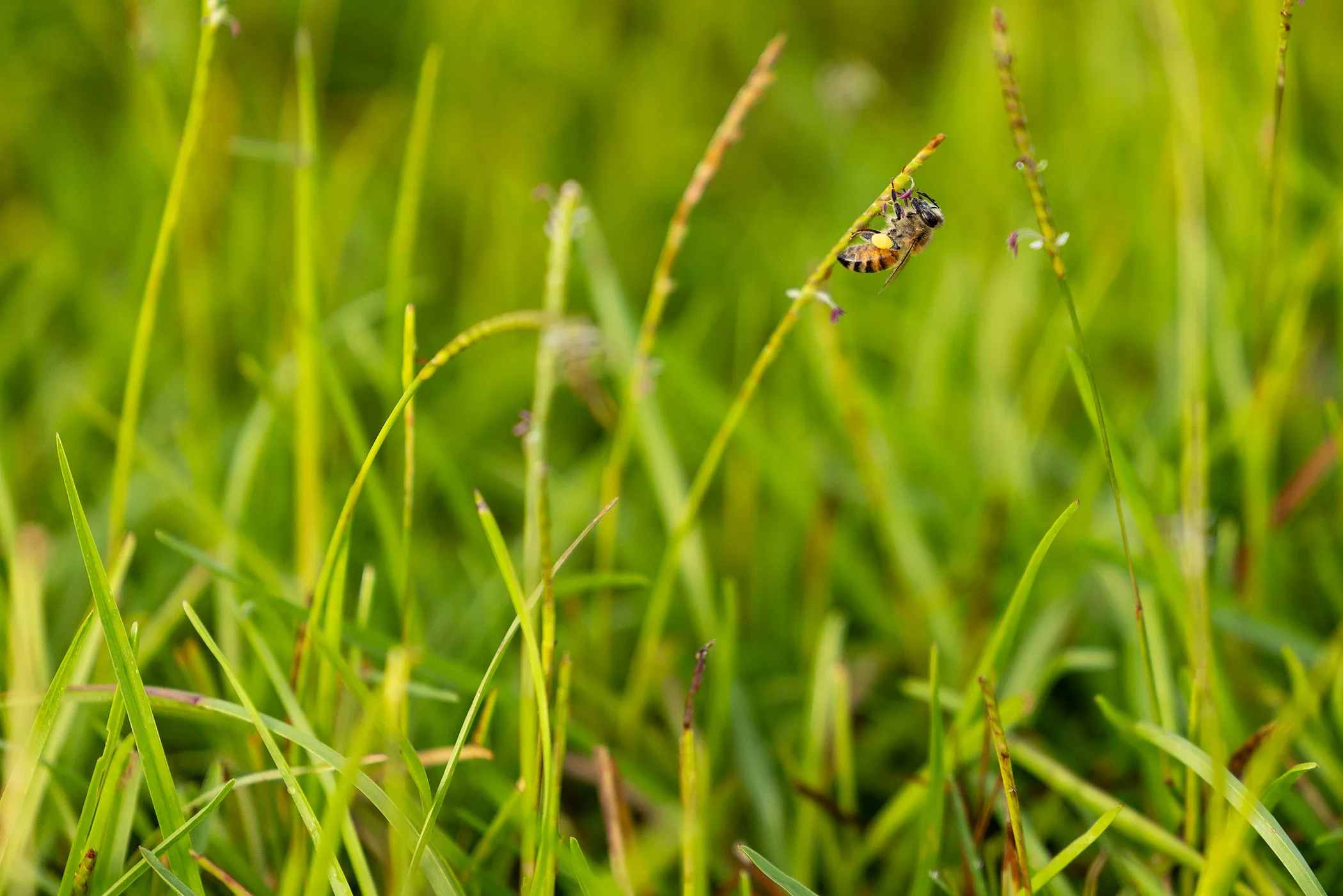
Southeastern blueberry bees have the following characteristics (Figure 1):


- The overall hair patterns and banding resembles that of bumblebees, but SBB are smaller in size.
- They have a bald, black abdomen with the first segment covered in light yellow hair and a tan thorax.
- Females have a completely black head, while in contrast, males are black with pale yellow or white face patches (located on the clypeus, the lower part of the face).
- The heads of both males and females are heart-shaped when viewed from the front.
- Both sexes have medium-length antennae.
- The females have hairs on their legs for collecting pollen.
- It’s a relatively large bee that measures approximately 0.4–0.6 in. (13–16 mm) in length, with wingspans of 0.75–1 in. (19–25 mm). There are differences in the body size/length of females (15.5–16 mm) versus males (12–14 mm). For size comparison, the average honeybee is 13 mm long.
For additional identification photos, visit these websites: Bees of Georgia (Schlueter & Stewart, 2020), Discover Life (n.d.), and Bees of Florida (Pascarella & Hall, n.d.).
Life Cycle
Most of an SBB’s life is spent underground as a larva and a pupa. The adult emerges in early spring (February–April) in Georgia and Alabama (Cane & Payne, 1988), coinciding with the early spring bloom season for blueberries in the Southeast. Adult bees are only active during this time to pollinate blueberry plants.
Adult males emerge before females. Males patrol nest aggregation sites, especially in the morning when females are most likely to emerge. During a short active adult lifetime of 3 to 5 weeks, they must mate, and the female must dig nesting chambers, lay eggs, and store enough pollen and nectar for each larva. SBB produces only one generation of offspring per year (they are univoltine; Cane, 1994). After those few weeks, the adults die. They are not seen again until the following spring when the new cycle begins.
The SBB is a solitary ground-nesting bee, meaning that each female digs her own nest and collects food for her own brood (Cane, 1994). Females prefer to dig an entrance tunnel into the soil that is slightly wider than their own bodies. At the end of the main tunnel in underground nesting chambers, she builds individual brood cell chambers for each larva. She lines the cell walls with a waterproof coating and provisions each brood cell with enough nectar and pollen for one bee to grow from egg to adult. She lays a single egg on each pollen mass and seals the main chamber shut. She may add branches to the main tunnel and outfit other cells at the end of each branch.
Females prefer underground nesting chambers in deep, well-drained, sandy or loose soil in sunny (and often bare) open areas, including along the periphery of blueberry fields. They choose spots where there is a low chance of flooding. Sometimes they burrow beneath shaded thick hardwood forest leaf litter, rotting wood, beneath bark chips spread as a mulch amid rows of blueberries, or in the walls of earthen holes, perhaps where a tree was uprooted, exposing a hole and soft soil. Although they are solitary bees that live alone, they often nest communally (Figure 2) in large aggregations near other nests of their species (Cane, 1994).


If a nest has been invaded or disturbed by other organisms (e.g., ants, brood parasites), often the females will relocate to a new nest. When searching, southeastern blueberry bees prefer areas that have already been dug but are uninhabited by other organisms. These nesting sites are usually near blueberry orchards with previously plowed areas (Cane, 1994).
Buzz Pollination of Blueberry Flowers
Blueberry flowers have evolved to rely on buzz pollination, which is achieved when certain wild bee species—including the SBB, bumblebees, and some smaller wild bees—move their flight muscles rapidly, causing the flower anthers to vibrate and release their pollen. This behavior is especially important for the extraction of pollen in blueberry plants because they require these vibrations to efficiently release their pollen. Since blueberry plants have naturally heavy and adherent pollen, it is harder for non-buzz-pollinating bees (such as the honeybee) to extract pollen.
A bee attaches itself to a blueberry flower and vibrates its strong flight muscles very rapidly to shake the pollen loose. Pollen is ejected downward out of the anther, through the narrow opening in the corolla (petals), and subsequently lands on the bee’s body. When the bee moves on to the next blueberry flower for additional nectar and pollen, the bee’s buzz pollination not only shakes out the pollen but also causes pollen clinging to its body to attach to the stigma of the new flower, resulting in pollination of the flower.
Compared to bumblebees, the female H. laboriosa are quicker at finding pollen and nectar, and they spend most of the day collecting it when the weather is in their preferred range of temperatures. Individual behaviors of male and female bees differ when foraging for pollen and nectar. Males stay a shorter amount of time on each plant and range farther out. Females stay longer on each plant to collect resources for their brood and to meet their own nutritional needs.
Under high humidity, blueberry flowers may not shed pollen as readily, making them more dependent on buzz pollination for pollen release. Under such conditions, buzz pollinators such as the SBB may be especially crucial in stimulating pollen release.
Foraging Host Plant Preference
Southeastern blueberry bees exhibit a narrow, specialized foraging preference to collect pollen from blueberries (Vaccinium spp.), Carolina jessamine vine (Gelsemium sempervirens, Figure 3), and other trumpet flower species (Gelsemium spp.; see Table 1; Cane & Payne, 1988; Pascarella, 2007; Fowler & Droege, 2020).

More recently, lupines (Lupinus spp.) were also included as important host plants (Fowler & Droege, 2020; see Table 1).
It is important to note that southeastern blueberry bees are less likely to visit alternative flowers in the region compared to other bees, such as the nonnative managed honeybee and bumblebees, and are often observed foraging exclusively on blueberries.
| Primary pollen hosts | Scientific name | Common name |
|---|---|---|
| cultivated blueberry (Vaccinium species) | Vaccinium virgatum (formerly V. ashei) | rabbiteye blueberry or smallflower blueberry |
| V. corymbosum | highbush blueberry | |
| common native blueberry (Vaccinium species) | V. arboreum | farkleberry or sparkleberry |
| V. corymbosum | highbush blueberry | |
| V. darrowii | Darrow’s blueberry | |
| V. elliottii | Elliott’s blueberry | |
| V. formosum | southern blueberry | |
| V. fuscatum | black highbush blueberry | |
| V. myrsinites | shiny blueberry | |
| V. stamineum | deerberry | |
| V. tenellum | small black blueberry | |
| V. virgatum (formerly V. ashei) | rabbiteye blueberry / smallflower blueberry | |
| trumpet flowers (Gelsemium species) | Gelsemium sempervirens | Carolina jessamine |
| G. rankinii | Rankin’s trumpet flower or swamp jessamine | |
| lupine (Lupinus species) | Lupinus perennis | sundial lupine or wild lupine |
| L. diffusus | skyblue lupine | |
| L. villosus | lady lupine or hairy lupine | |
| All plants in this table provide both pollen and nectar | ||
| Minor alternate host – pollen/nectar | Scientific name | Common name |
|---|---|---|
| Provides nectar and pollen | ||
| redbud (pollen only in early season) | Cercis canadensis | eastern redbud |
| Styraceae family | Styrax americanus | American snowbell / mock orange |
| oak | Quercus alba (e.g.) | white oak |
| thistle | Cirsium spp. | thistle |
| wild plum | Prunus umbellata | flatwood plum |
| Provides nectar | ||
| wild plum | P. angustifolia | Chickasaw plum |
| Rosaceae family | Rubus argutus | sawtooth blackberry / tall blackberry |
| spiderwort | Tradescantia ohiensis | Ohio spiderwort |
| betony | Stachys floridana | Florida betony |
| azalea | Rhododendron spp. | azalea |
| toadflax | Linaria canadensis (annual) | Canadian toadflax |
| false rosemary | Conradina canescens | false rosemary |
| Fabaceae family | Trifolium carolinianum | Carolina clover / wild white clover |
| T. reflexum | buffalo clover | |
| dogbane family | Apocynum spp. | Dogbane or Indian hemp |
| honeysuckle family | Lonicera spp. | honeysuckle |
| Provides nectar, maybe pollen | ||
| chokeberry | Aronia arbutifolia | chokeberry |
| viburnum | Viburnum acerifolium | mapleleaf viburnum |
| V. dentatum | southern arrowwood | |
| V. nudum | possumhaw | |
| V. obovatum | small-leaf arrowwood | |
| V. prunifolium | blackhaw | |
| V. recognitum | southern arrowwood | |
| V. rufidulum | rusty blackhaw | |
Males visit a wider range of plants for nectar; they have been recorded on a variety of early spring flowers that serve as minor alternate pollen hosts (Table 2), such as the eastern redbud (Cercis canadensis, Figure 4), chokeberry (Aronia arbutifolia), wild plum (Prunus spp.), viburnums (Viburnum spp.), azalea (Rhododendron spp.), oak (e.g., Quercus alba, Quercus spp.), Ohio spiderwort (Tradescantia ohiensis), Florida betony (Stachys floridana), and clover (Fabaceae family; Cane & Payne, 1988; Pascarella, 2007).

Practices Commercial Growers Can Implement to Conserve Southeastern Blueberry Bees
Important practices that can help protect the SBB while maintaining or increasing blueberry production include:
- leaving adjacent habitat intact, which can provide long-term undisturbed ground nesting sites;
- providing dependable food sources (see Tables 1 & 2); and
- reducing or eliminating pesticide exposure (particularly to adjacent native habitats) by following label recommendations and practicing integrated pest and pollinator management (IPPM) conservation practices.
Provide Undisturbed Bee Sanctuaries
Greater populations of ground-nesting southeastern blueberry bees can be achieved by paying special attention to their nesting requirements. Growers are encouraged to seek out bee nesting areas and preserve them as undisturbed bee sanctuaries. Review the nesting information provided under the “Life Cycle” section of this resource.
Care should be taken to preserve and/or provide nesting habitats on the edges of commercial blueberry fields and woodlands near the edge of their fields for the bees to provide for and raise their young.
Provide Floral Resources
Given that the southeastern blueberry bee is a specialist on blueberries and the adult is short-lived, the species may not benefit from additional diverse native floral resources like other longer-lived wild blueberry pollinators. A dependable diet for this bee is usually not a problem with more-or-less permanent blueberry orchards.
However, studies have determined that the bee also prefers trumpet flower (Gelsemium spp.) pollen (Pascarella, 2007; Cane & Payne, 1988). Because trumpet flowers may bloom earlier or in tandem with blueberries in the Coastal Plain region of Georgia, provisions and/or allowance of this native vine should be considered. Planting the edges of blueberry fields with trumpet flowers (e.g., growing among the tree line) may attract foraging southeastern blueberry bees and increase population sizes (Pascarella, 2007). Trumpet flower is readily available in commercial native nurseries. The species is found in a broad range of habitats, including mesic to xeric hardwood forests and upland mixed forests, secondary woods, bluffs, floodplains, flatwoods, and a variety of disturbed habitats.
Recently, lupines (Lupinus spp.) were also acknowledged as a host plant family (Fowler & Droege, 2020). None of the three existing lupine species that naturally occur in the Coastal Plain region of Georgia (Figure 5) are easy to propagate and are therefore not readily available in commercial native nurseries.
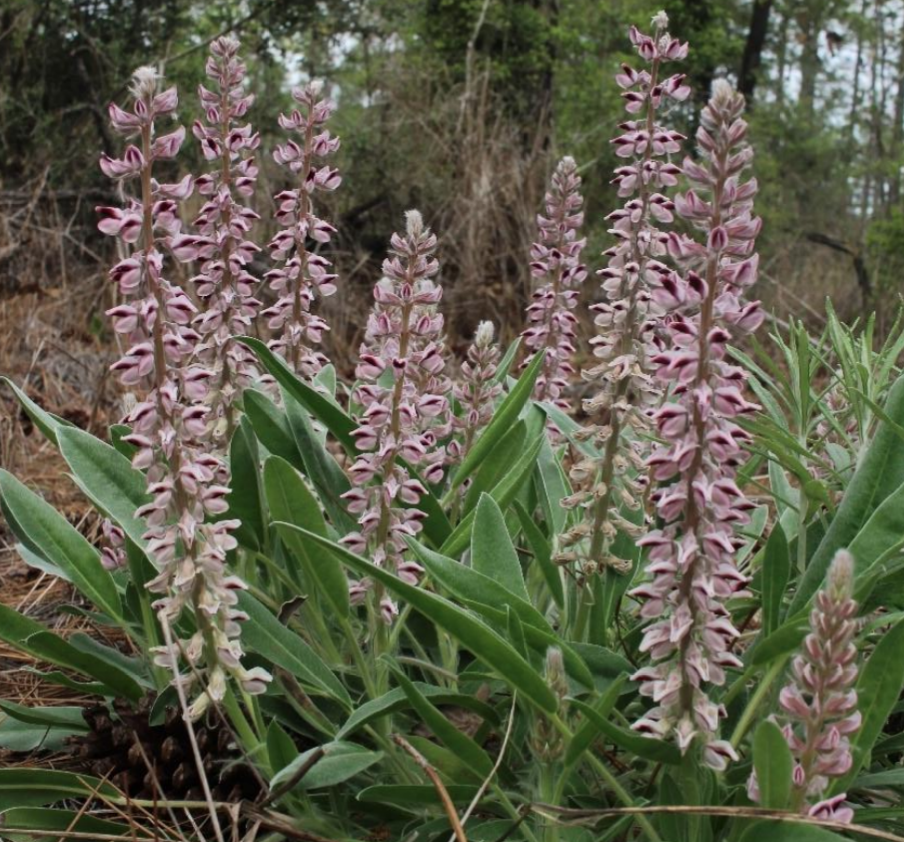
Photo: Scott Ward, https://fsus.ncbg.unc.edu.
Lupines are difficult to transplant and grow commercially because of their deep taproots; these plants dislike root disturbance and being moved from their deep soils. Seeds require scarification and are resistant to being started in pots. They are more likely to germinate if the soil they land on is like their original soil.
Therefore, the availability of lupines to the southeastern blueberry bee is mostly limited to natural occurrence in their native habitats, where preservation is encouraged and needed. Lupines tend to prefer well-drained, sandy soils of sandhills, pine flatwoods, and scrub ecosystems.
Reduce or Eliminate Pesticide Exposures
Balancing the need for pollinator-dependent crop protection with pollinator health calls for practices that result in resilient and productive blueberry systems. By reducing bee exposure to pesticides, growers can help bee populations be more robust and healthier in the face of multiple stressors.
Some pollinator-conscious practices include applying pesticides early in the morning or late in the evening when pollinators are less active, using appropriate pesticide label rates, and being aware of honeybee hive locations in the local area.
These practices are part of integrated pest and pollinator management (IPPM), a framework that combines and balances the management of pests (such as insects, weeds, and diseases) through integrated pest management (IPM) methods with tactics that prioritize pollinators and natural enemies of pests (predators and parasitoids). IPPM focuses on a more conservation-forward approach to promote beneficial insect diversity by incorporating both landscape-scale pest-resistant and pollinator-attractive native plantings and pollinator-friendly pest management techniques. The annual Southeast Regional Blueberry Integrated Management Guide provides detailed information on IPPM practices.

By protecting or restoring natural habitats in the farm landscape (Figure 6) and providing increased diverse native floral resources within and adjacent to blueberry crops, IPPM directly suppresses pests and supports diverse and abundant communities of natural enemies that promote biodiversity-based pest control (Gurr et al., 2017), while protecting and supporting pollinator services (Isaacs et al., 2017; Lundin et al., 2021). Ultimately, IPPM can help increase crop pollination, reduce pesticide usage, and decrease economic costs.
References
Southern Region Small Fruit Consortium. (2025). 2025 Southeast Regional Blueberry Integrated Management Guide (Publication No. AP 123-5). University of Georgia Cooperative Extension. https://fieldreport.caes.uga.edu/publications/AP123-5/
Cane, J. H. (1994). Nesting biology and mating behavior of the southeastern blueberry bee, Habropoda laboriosa (Hymenoptera: Apoidea). Journal of the Kansas Entomological Society, 67(3), 236–241. https://www.jstor.org/stable/25085519
Cane, J. H. (1997). Lifetime monetary value of individual pollinators: The bee Habropoda laboriosa at rabbiteye blueberry (Vaccinium ashei Reade). Acta Horticulturae, 446, 67–70. https://doi.org/10.17660/ActaHortic.1997.446.8
Cane, J. H., & Payne, J. A. (1988). Foraging ecology of the bee Habropoda laboriosa (Hymenoptera: Anthophoridae), an oligolege of blueberries (Ericaceae: Vaccinium) in the southeastern United States. Annals of the Entomological Society of America, 81(3), 419–427. https://doi.org/10.1093/aesa/81.3.419
Cane, J. H., & Payne, J. A. (1990). Native bee pollinates rabbiteye blueberry. Alabama Agricultural Experiment Station. Highlights of Agricultural Research, 37(4), 4. https://hdl.handle.net/11200/1789
Discover Life. (n.d.). Habropoda laboriosa. Sam Houston State University. https://www.discoverlife.org/20/q?search=Habropoda+laboriosa
Fowler, J., & Droege, S. (2020). Pollen specialist bees of Eastern the United States. https://jarrodfowler.com/specialist_bees.html
Gurr, G. M., Wratten, S. D., Landis, D. A., & You, M. (2017). Habitat management to suppress pest populations: Progress and prospects. Annual Review of Entomology, 62, 91–109. https://doi.org/10.1146/annurev-ento-031616-035050
Isaacs, R., Williams, N., Ellis, J., Pitts-Singer, T. L., Bommarco, R., & Vaughan, M. (2017). Integrated crop pollination: Combining strategies to ensure stable and sustainable yields of pollination-dependent crops. Basic and Applied Ecology, 22, 44–60. https://doi.org/10.1016/j.baae.2017.07.003
Lundin, O., Rundlöf, M., Jonsson, M., Bommarco, R., & Williams, N. M. (2021). Integrated pest and pollinator management – expanding the concept. Frontiers in Ecology and the Environment, 19(5), 283–291. https://doi.org/10.1002/fee.2325
MacKenzie, K. E., & Eickwort, G. C. (1996). Diversity and abundance of bees (Hymenoptera: Apoidea) foraging on highbush blueberry (Vaccinium corymbosum L.) in central New York. Journal of the Kansas Entomological Society, 69(4, Suppl. 2), 185–194. https://www.jstor.org/stable/25085716
Mallinger, R., Ternest, J. J., & Naranjo, S. M. (2021). Blueberry yields increase with bee visitation rates, but bee visitation rates are not consistently predicted by colony stocking densities. Journal of Economic Entomology, 114(4), 1441–1451. https://doi.org/10.1093/jee/toab111
Pascarella, J. B. (2007). Foraging patterns of the southeastern blueberry bee Habropoda laboriosa (Apidae, Hymenoptera): Implications for understanding oligolecty. Journal of Apicultural Research, 46(1), 19–27. https://doi.org/10.1080/00218839.2007.11101362
Pascarella, J. B., & Hall, H. G. (n.d.). Habropoda. University of Florida Entomology and Nematology Department. https://entnemdept.ufl.edu/HallG/Melitto/floridabees/Habropoda.htm
Payne, J. A., Amis, A. A., Cane, J. H., & Lyrene, P. M. (1989). Fruit size, seed size, seed viability and pollination of rabbiteye blueberries (Vaccinium ashei Reade). Acta Horticulturae, 241, 38–43. https://doi.org/10.17660/ActaHortic.1989.241.3
Payne, J. A., Horton, D. I., Cane, J. H., & Amis, A. A. (1991). Insect pollination of rabbiteye blueberries. In Proceedings of the Missouri Small Fruit Conference, 1991 (pp. 42–49). Southwest Missouri State University, Missouri Department of Agriculture, UMC University Extension, Lincoln University. https://cdm17307.contentdm.oclc.org/digital/collection/FruitPubs/id/1748
Rezende, S. M., Pennisi, S. V., Gariepy, T., Querejeta, M., Ulyshen, M., & Schmidt, J. M. (2025). Wild bees show local spatial and temporal dynamics in southeastern US blueberry farmscapes. Environmental Entomology, 54(1), 67–76. https://doi.org/10.1093/ee/nvae125
Rogers, S. R. (2012). Pollination ecology of highbush blueberry agroecosystems [Master’s thesis]. North Carolina State University. https://www.lib.ncsu.edu/resolver/1840.16/7822
Rogers, S. R., Tarpy, D. R., & Burrack, H. J. (2014). Bee species diversity enhances productivity and stability in a perennial crop. PLOS ONE, 9(5), e97307. https://doi.org/10.1371/journal.pone.0097307
Sampson, B. J., & Cane, J. H. (2001). Pollination efficiencies of three bee (Hymenoptera: Apoidea) species visiting rabbiteye blueberry. Journal of Economic Entomology, 93(6), 1726–1731. https://doi.org/10.1603/0022-0493-93.6.1726
Schlueter, M., & Stewart, N. (2020, April). Blueberry bees. Georgia Native Bee Biodiversity Assessment Project. https://native-bees-of-georgia.ggc.edu/?page_id=86
Funding Note
This material is based upon work supported by the U.S. Department of Agriculture, under agreement number USDA-NRCS NR204310XXXXC013 (awarded to the University of Georgia in joint venture with Woodward & Curran Inc.). Any opinions, findings, conclusions, or recommendations expressed in this publication are those of the author(s) and do not necessarily reflect the view of the U.S. Department of Agriculture. In addition, any reference to specific brands or types of products or services does not constitute or imply an endorsement by the U.S. Department of Agriculture for these products or services. USDA is an equal opportunity provider employer.