

Takeaways
- The U.S. economy is expected to grow by roughly 2% in 2026, consistent with growth rates in the second half of 2025. Inflation rates are likely to continue to fall toward the Federal Reserve’s target inflation rate of 2%.
- The latest USDA projections indicate increased net cash farm income of $180.7 billion and net farm income of $179.8 billion in 2025. Rising receipts from animal products offset losses in crop receipts.
- Production expenses, both nominal and inflation-adjusted, are expected to have increased in 2025. Increased costs are largely a result of higher prices for feed, livestock/poultry inputs, and labor, while costs for chemical inputs and fuel fell slightly.
- Stagnant prices and increasing costs suggest a negative outlook for most of Georgia’s major crops in 2026. The outlook for animals and animal products is generally positive.
- Changes to farm programs in the One Big Beautiful Bill Act, and ad-hoc disaster assistance programs, will be important in keeping farmers afloat; many commodities will continue to experience a cost-price squeeze in 2026. In terms of agricultural policy moving forward, trade actions and immigration concerns will continue to lead to uncertainty in the economic outlook for U.S. and Georgia agriculture.
2026 Economic Outlook for U.S. Agriculture
Statistics on the state of the U.S. agricultural economy are reported by the U.S. Department of Agriculture (USDA) Economic Research Service (ERS) in its annual U.S. agricultural outlook. ERS also projects and measures farm income. Additionally, U.S. and global forecasts for crops and livestock are reported monthly in the World Agricultural Supply and Demand Estimates. The following is an overview of what these reports indicate for 2026.
Increased U.S. Production of Major Grains, but Flat Livestock Production
- Outputs of wheat, corn, sorghum, and barley are expected to increase in 2026 relative to 2025. Production of cotton is expected to fall slightly to 14.12 million bales, although this still represents an increase over the 12 million bales produced in 2024. The volume of soybeans is also expected to fall.
- Production of beef and pork is expected to fall in 2026, though only slightly compared to the previous year. Both broilers and turkeys should see increased volumes along with the production of eggs and milk. High beef prices should see increased cattle production in the long term.
Little Encouragement on Crop Prices, Though Livestock Prices to Remain Strong
- Crop prices are projected to be almost uniformly lower, continuing the general decline from 2023 and 2024. One bright spot is in soybeans, where a modest increase is projected.
- Indications are that prices for steers will remain elevated and increase as we move into 2026. Prices for swine, broilers, and turkeys will remain mostly flat. Egg prices have fallen significantly over 2025, and further reductions are expected in 2026.
Net Returns Will Be Low With Projected Increases in Costs
- Total costs of production are expected to increase for all major U.S. field crops from 2025 to 2026. Reductions in fuel costs and interest on operating capital are more than offset by projected increases in other categories.
- While USDA projections are not yet available, flat output prices and increased costs of production suggest that the value of production less total costs will likely remain negative for many crops in 2026.
Farm Income is Projected to Have Increased in 2025, Though a Significant Portion is Direct Government Payments
- Both net cash farm income and net farm income are expected to have risen above their 20-year averages in 2025. Inflation-adjusted net cash farm income is projected at $180.7 billion, with inflation-adjusted net farm income projected at $179.8 billion.
- Direct government farm payments are included in income figures and are expected to be $40.5 billion in 2025, roughly a 300% increase over 2024.
- An overall increase in cash receipts results from a projected increase in animal and animal product receipts that exceeds a concurrent projected decline in crop receipts.
- Farm sector solvency is projected to have been essentially flat in 2025, with debt having grown at roughly the same rate as assets or equity. After adjusting for inflation, equity, assets, and debt are expected to have grown by 2.1%, 2.1%, and 2.4%, respectively.
An Upward Trend in Export Volumes for Many Crops, but a Downward Trend for Livestock
- Exports of crops are generally expected to increase going into 2026. Crops with rising export volumes include wheat, cotton, and rice, with a minor increase in coarse grains. Exports of oilseeds are expected to decline but will depend crucially on trade actions.
- Beef and pork export volumes are projected to decline. Exports of broilers are expected to rise, but not enough to recover to 2024 levels. The volume of eggs exported is expected to rise by about 15%.
The Georgia Agricultural Economy
Food and fiber production remains an important driver of Georgia’s overall economy. Production of agricultural commodities was directly valued at $17.6 billion in 2023, with production contributing to roughly $91.4 billion in total output and 381,200 jobs. The impact of the agricultural economy is particularly important in Georgia’s rural counties.
Poultry continues to comprise a significant portion of the state’s cash receipts, with the USDA indicating poultry’s share at 48% of all commodity cash receipts. Eggs account for 8% of cash receipts. In terms of crops, cotton and peanuts comprise roughly 7% of receipts each. Table 1 shows the cash receipts of Georgia’s top 10 commodities and their shares of state cash receipts, while Figure 1 shows the shares of various commodity groups in Georgia’s cash receipts.
Table 1. 2024 Cash Receipts for Top 10 Commodities in Georgia.
| Commodity | Rank | Receipts ($1,000) | Share of state total |
|---|---|---|---|
| Broilers | 1 | 6,092,914 | 48.2 |
| Eggs | 2 | 1,024,546 | 8.1 |
| Cotton | 3 | 868,199 | 6.9 |
| Peanuts | 4 | 824,416 | 6.5 |
| Miscellaneous | 5 | 692,305 | 5.5 |
| Cattle | 6 | 669,748 | 5.3 |
| Milk | 7 | 516,838 | 4.1 |
| Corn | 8 | 324,345 | 2.6 |
| Pecans | 9 | 164,220 | 1.3 |
| Onions | 10 | 159,898 | 1.3 |
Georgia remained a major exporter of agricultural commodities in 2025. Major exports in dollar value included poultry, largely shipped to China, Canada, and Taiwan, and cotton, exported mainly to Pakistan, Turkey, and Vietnam. There were also significant exports of feeds and meals, as well as prepared food. Outside of cotton and broilers, other important export commodities include eggs, peanuts, fruits and vegetables, and pecans. Fruits and vegetables are also increasingly exposed to import competition.
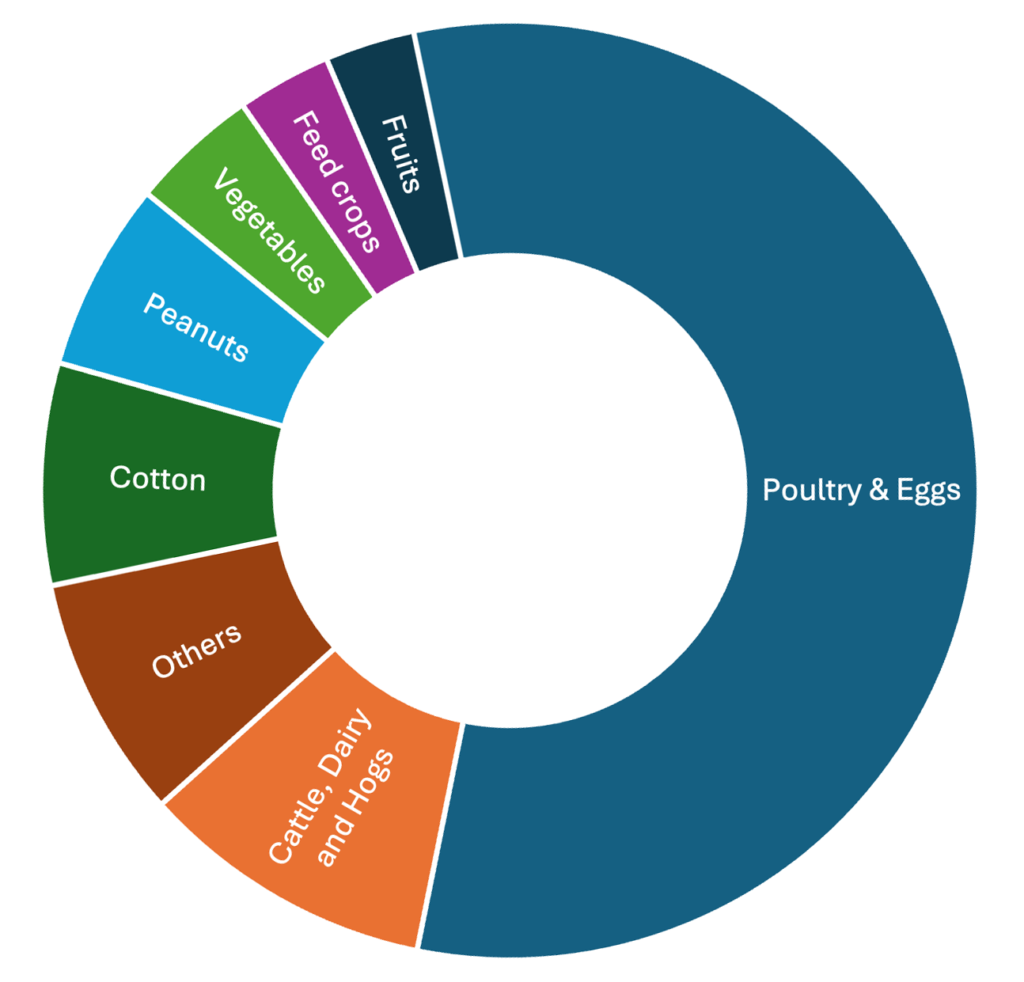
Figure 2 shows Georgia’s farm income, expenses, and direct government payments by year since 2015. Georgia’s net cash income is $4.6 billion in 2024, a $1.3 billion increase from 2023. Among states, Georgia ranks eighth in net cash income, a substantial move up from 17th in 2023. Figure 2 also shows a slight downturn in net cash expenses in 2024.

2026 Economic Outlook for Georgia Agriculture
Prices and Returns
Georgia farmers had a mixed year in 2025 with farm profits differing greatly across commodities. For most major crop commodities produced in the state, prices and profits were weak, if they were available at all. Unfortunately, with flat price projections for most Georgia crops in 2026, cash receipts are unlikely to see significant improvement. Stagnant prices combined with slightly increased production costs mean that the current cost-price squeeze is likely to continue through 2026.
Net returns above total costs will continue to be negative, particularly for cotton and peanuts. Many cotton farmers switched their acreage to peanut production in 2025, the first year that Georgia producers planted more peanut acres than cotton acres in several decades. This trend is unlikely to reverse in 2026 unless we see a major appreciation in cotton prices.
Livestock
Exceptions to the overall negative outlook are beef, dairy, and poultry. Biological limitations prevent the U.S. from significantly expanding cattle production in the next year. Prices should remain high with continued strong demand from consumers. Although margins for poultry weakened in the latter half of 2025, poultry growers should see fair returns in 2026. The same can be said of dairy; although milk prices are projected to be down, culling of dairy cows may help to moderate price declines.
Federal Programs
A bright spot going into 2026 is the One Big Beautiful Bill Act, which included several major changes to federal farm programs. These changes included adjustments to the Agriculture Risk Coverage (ARC) and Price Loss Coverage (PLC) programs. A major change for PLC was an update to the statutory reference prices. The newly updated reference prices for cotton and peanuts should generate substantial payments for producers enrolled in PLC. Producers will also have the opportunity to update base acres enrolled in these programs. Marketing assistance loan rates were set through 2031, providing producers with defined levels of federal price support. Although many producers do not use the Marketing Assistance Loan program, it has been somewhat popular with cotton producers.
Favorable changes were also made to the federal crop insurance program. However, most losses in the federal program are related to production. Crop insurance policies provide relatively little protection against sustained low prices.
The bill also directed the USDA to develop a poultry insurance program for contract poultry growers. This insurance could be an important risk-management tool for poultry producers. They have historically had limited participation in the federal crop insurance program. The sum of the changes in the One Big Beautiful Bill Act is improved support for Georgia agriculture. This support will prove useful as the state’s producers navigate economic uncertainty in 2026.
International Trade
International trade remains a major source of uncertainty for U.S. agriculture going forward. The One Big Beautiful Bill Act created a new Supplemental Agricultural Trade Promotion Program (starting in fiscal year 2027) with $268–$285 million annually, more than doubling current trade promotion funding levels. Total trade promotion funding will exceed $540 million—and with Food for Progress included, reach $825 million annually by FY2034.
However, retaliatory tariffs on Georgia’s agricultural exports could erode these increased exports as a result of more vigorous trade promotion. Exports are often on thin margins, and increased tariffs could make Georgia products uncompetitive in global markets. This is particularly the case for poultry, cotton, and feeds and meals, where a large part of the state’s production is sold in export markets.
Georgia Outlook Summary
Overall, Georgia producers will need to carefully consider their expected margins in 2026. For the state’s row crops, projected low prices and relatively high production costs indicate thin net returns. Livestock producers, particularly beef producers, will benefit from continued and increasing output prices. Poultry producers also are expected to have a fair year in 2026, barring any unforeseen trade disputes or natural disasters.