Artificial intelligence helps UGA researchers transform agriculture in Georgia
Illustration by Adrián Astorgano
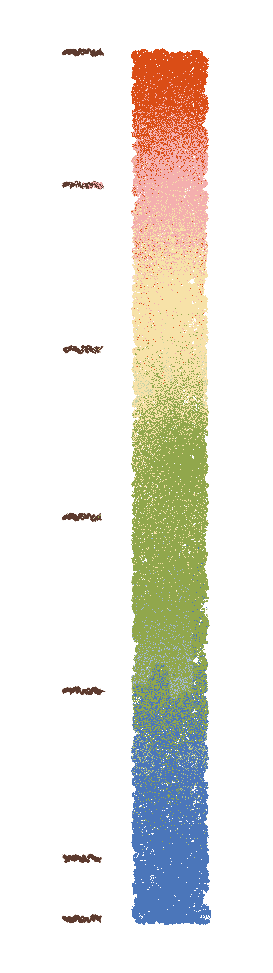

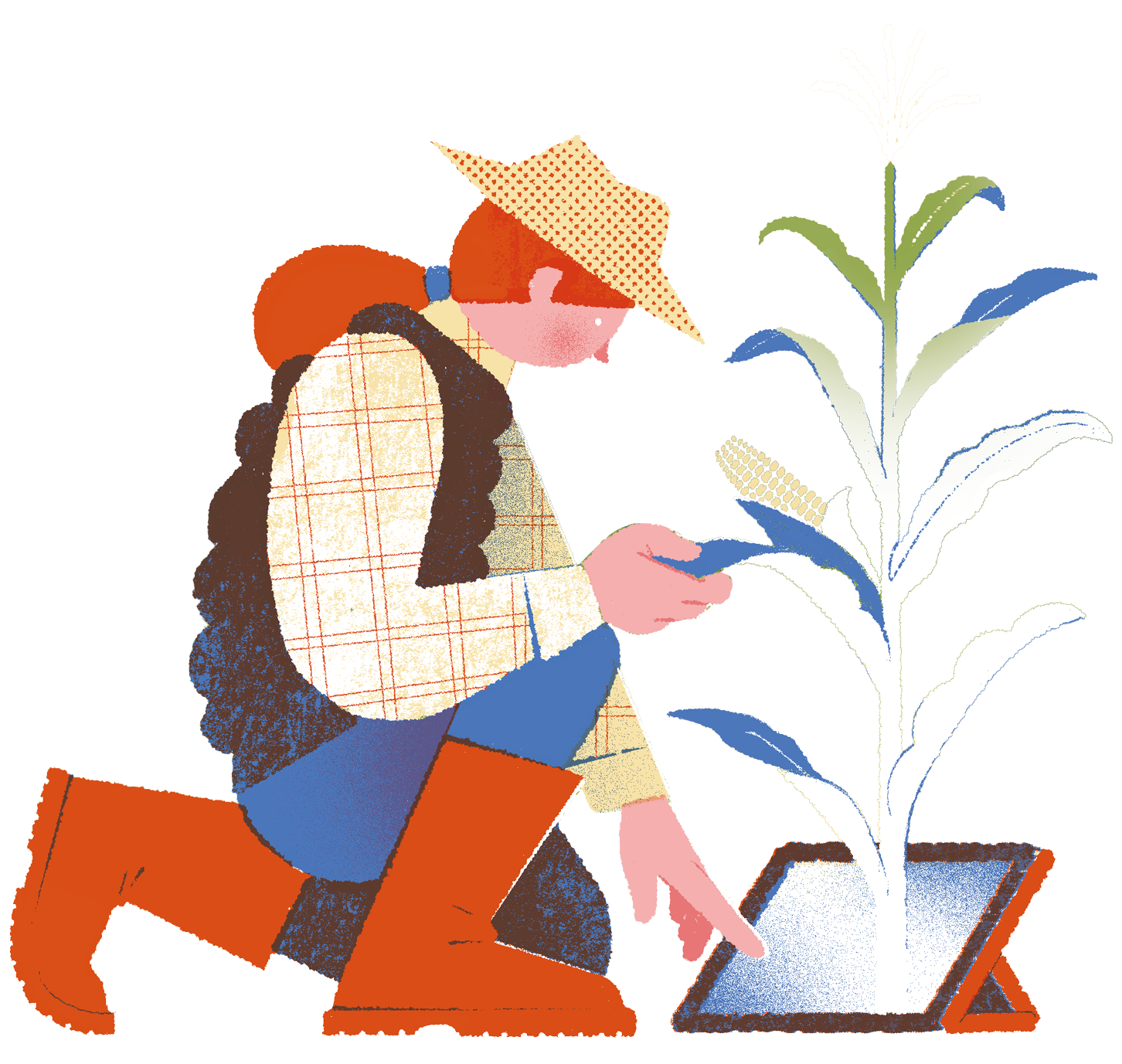
At the University of Georgia College of Agricultural and Environmental Sciences, precision agriculture technologies such as GPS, drones, machine vision, sensors and robots are increasingly complemented by artificial intelligence, which helps transform vast streams of data into actionable insights. UGA’s Institute for Integrative Precision Agriculture (IIPA) collaborates with faculty across the university, industry partners, and UGA Cooperative Extension to advance research, education, and technology-driven solutions for Georgia agriculture.
Expanding producers’ toolbox
AI can help Georgia farmers improve resource management and profitability by identifying solutions to specific challenges through generative AI chatbots and specialized software designed for agricultural applications, said George Vellidis, IIPA director and professor in the Department of Crop and Soil Sciences.
“If you ask an online AI agent a question that is specific to growing crops in Georgia, the most likely source of information will be UGA Extension materials that are available online,” said Vellidis, who uses university-licensed AI models for research.
For specific purposes — for example a peanut breeder managing 10,000 plots of peanuts for disease resistance or high yield — producers can use specialized AI software trained to process drone images of fields, drawing on terabyte-scale databases with sophisticated algorithms that can recognize objects, identify patterns and trends, make decisions, generate predictions, and prescribe actions in real time.
This information is manually cataloged by plant species and disease symptoms to build an AI software database that may contain millions of images for analysis. New images fed into the software are processed using AI algorithms to compare them against the annotated database to quickly determine the trending health status of each plant and recommend specific remediation steps as required.
It’s an expensive task requiring thousands of hours of painstaking work, but it is necessary because the quality of AI output depends on the quantity and detail of the data used to train the system. “We fly drones over a field and photograph plants at the centimeter scale. Each leaf image may consist of dozens of pixels,” Vellidis said. “We use AI tools to determine which of these 10,000 plots require human screening for further analysis. These specialized AI tools are trained using annotated images and are then able to recognize those plants in real time.”



Investing in AI innovation
This year, UGA’s Institute for Artificial Intelligence (IAI) has awarded seed grants to eight university-wide research projects designed to advance interdisciplinary AI research.
The grants are funded by the Office of the Senior Vice President for Academic Affairs and Provost and the Office of Research, with additional support from CAES. The funding provides faculty with critical resources to launch high-impact projects positioned to secure future external investment.
“We have CAES faculty doing interesting work with us in precision agriculture, poultry science, livestock, food systems and more,” said Prashant Doshi, executive director of the IAI and UGA Foundation Distinguished Professor of Artificial Intelligence.
Evaluating the technology
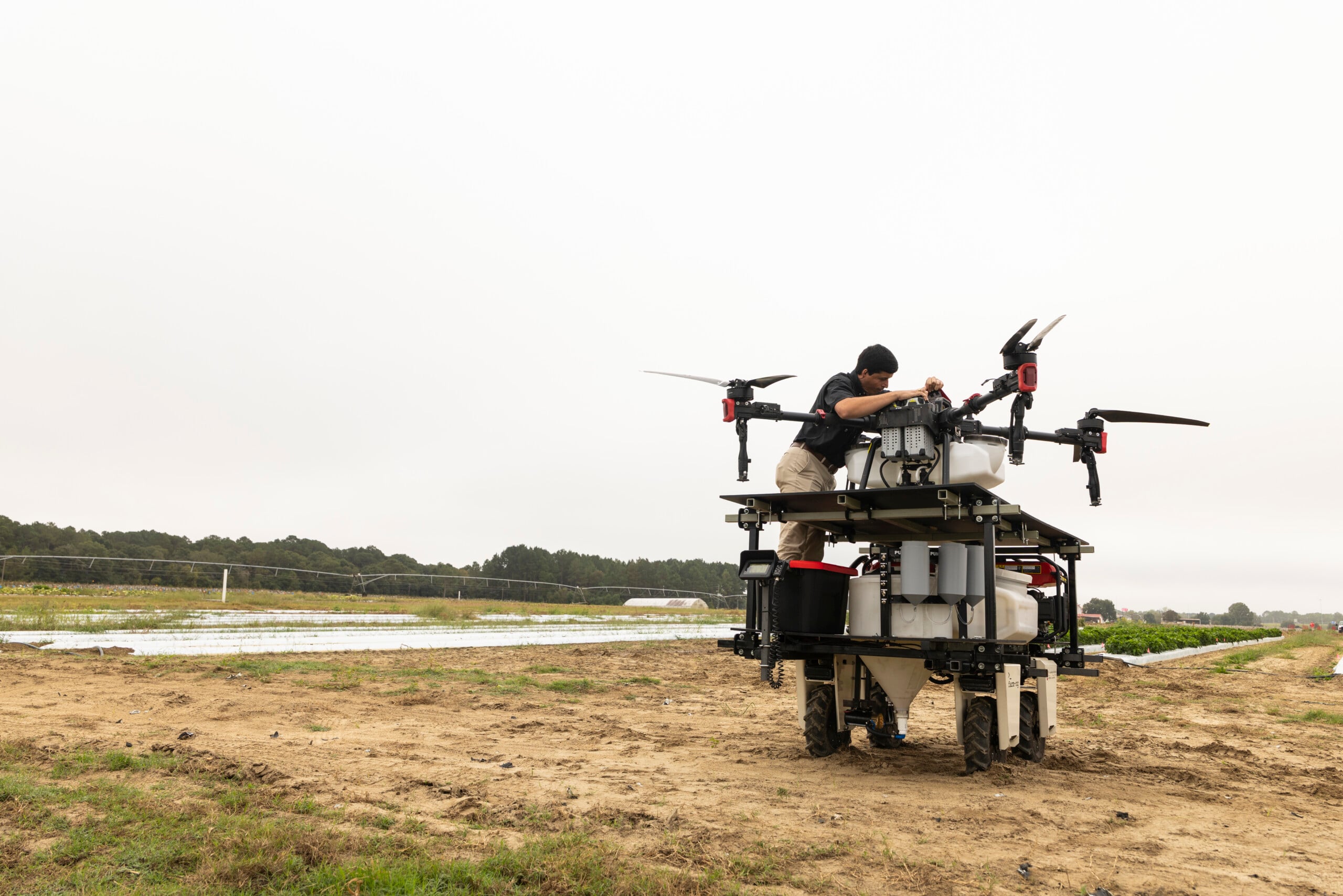
Agricultural engineer Luan Oliveira leads the Precision Horticulture Team on the UGA Tifton campus, where researchers field-test machinery for planting, spraying and harvesting vegetables and specialty crops.
To illustrate the benefits of smart machine-assisted production, Oliveira described the efficiency of a precision weed sprayer that features 156 nozzles spaced a half-inch apart compared with a conventional machine that uses one nozzle every 20 to 30 inches.
“Each of the 156 nozzles opens and closes independently,” Oliveira said. “When the sprayer’s AI-driven machine vision detects a weed as it moves across a field, the nozzle opens and sprays herbicide only on the weed, thereby saving money and avoiding chemical damage to the crop.”
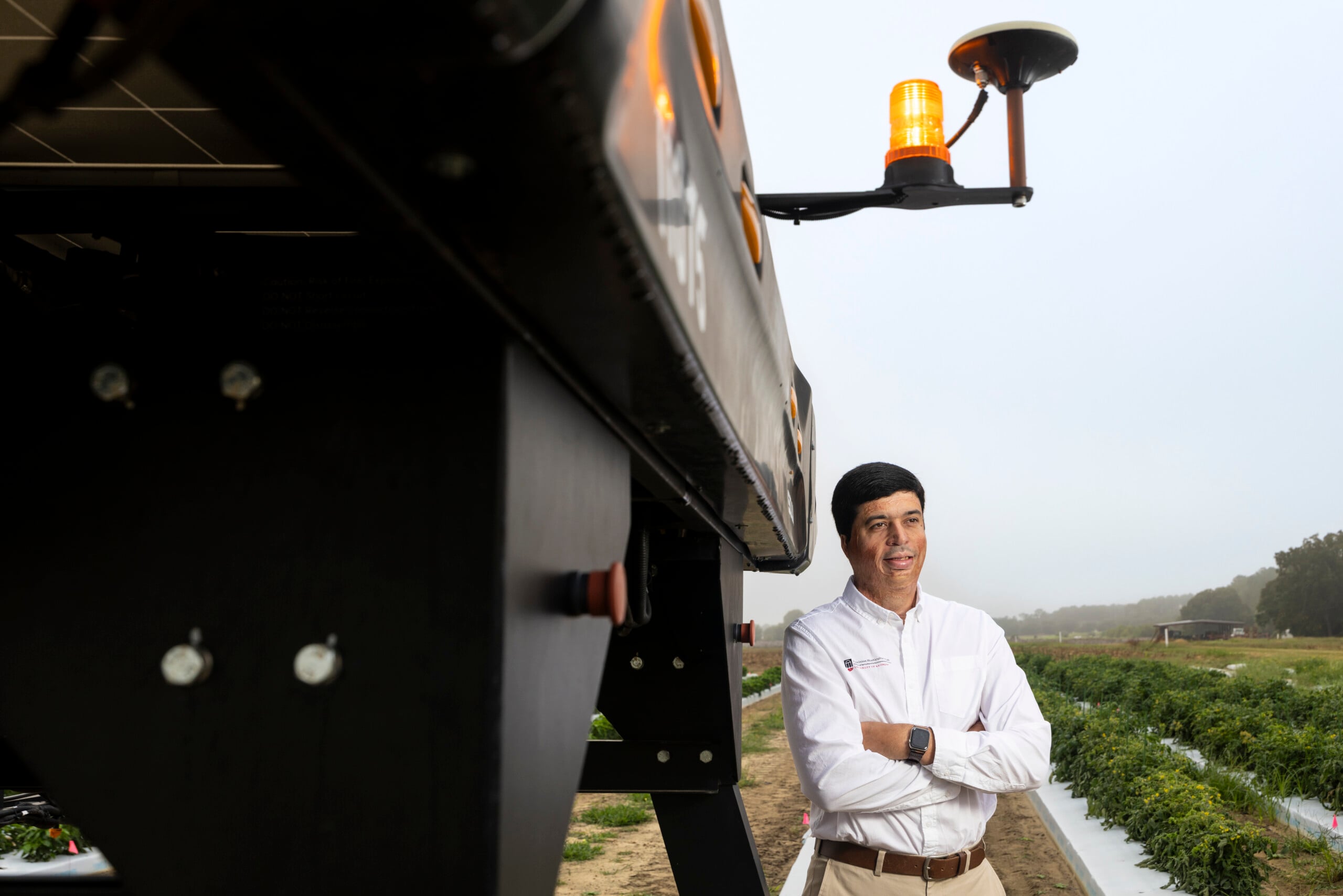
Oliveira’s team found a significant reduction in plant injury in a test case involving onions using the spot sprayer, with a 60% reduction in herbicide use compared with standard broadcast sprayers.
Another example of field testing involved a tool called Smart Apply®, which uses LiDAR — an active remote sensing technology that uses laser pulses to create highly accurate 3D digital maps — to identify and spray pecan tree canopies in orchards. The LiDAR sensor data is processed in real time by AI software, and nozzles open to spray and treat only the pecan tree canopies, not the rows or gaps between them.
“We finished a trial last year using that tool, and the savings on fungicide chemicals were around 60%,” Oliveira said.

Precision peanut flavor
The IIPA also attracts research talent from across UGA’s academic units through competitive IIPA seed grants, which support promising new technology-driven ideas to address agricultural concerns in Georgia.
The research relies exclusively on chemical data to evaluate the roasted flavor quality of peanuts, enabling breeders to rapidly and reliably select breeding lines with desirable flavor profiles.
One grant supports multidisciplinary work focused on breeding peanuts for improved roasted flavor. The project is led by Joonhyuk Suh, assistant professor in the Department of Food Science and Technology, along with co-investigators Nino Brown, a peanut breeder, and food scientists Koushik Adhikari and Abhinav Mishra.

Using three peanut varieties that had already undergone human sensory testing, the team identified key chemical variables responsible for preferred flavor using AI-assisted statistical correlation analysis. They then applied machine-learning algorithms — including artificial neural networks and decision-tree methods — to predict which chemicals were responsible for positive consumer sensory responses.
“We know many of the compounds involved in roasted peanut flavor, but we don’t yet know precisely which compounds — and at what levels — drive the ideal flavor profile,” Suh said. “Our goal is to identify those compounds and predict flavor quality from chemical analyses, which will be valuable in the early stages of breeding, when sample quantities are too limited for sensory evaluation.”
This approach is expected to provide a foundation for future big-data-driven models and a multidisciplinary AI research network spanning food science, crop and soil sciences, and related fields.
Separating chickens from the eggs
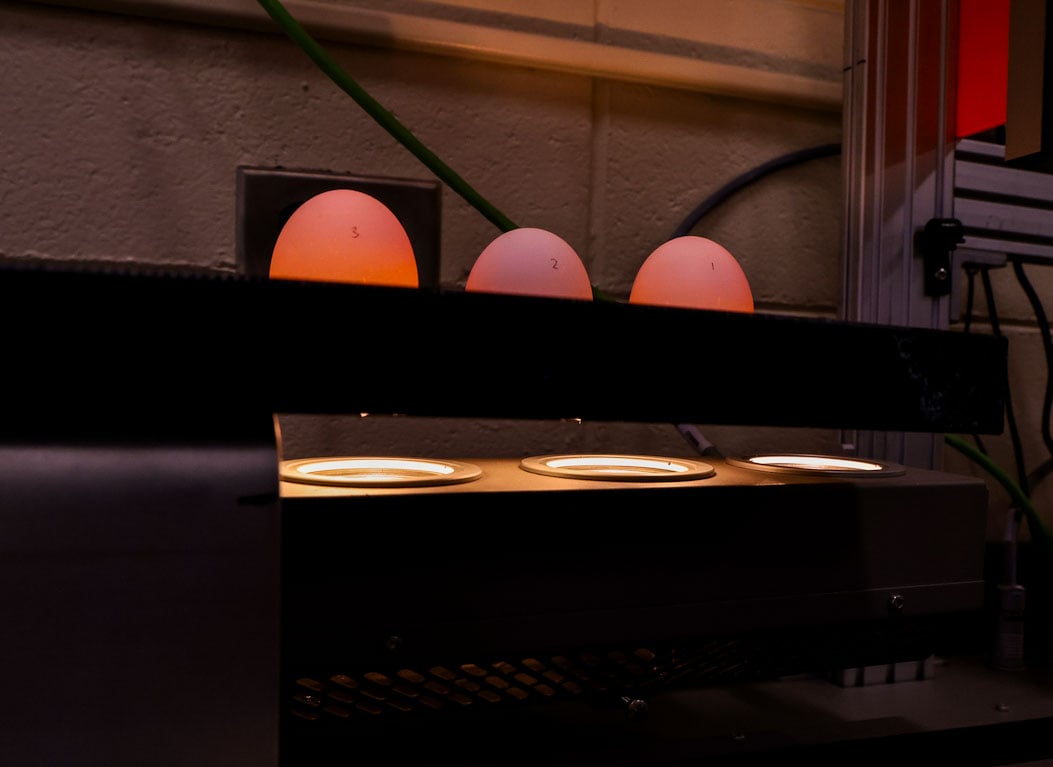
Every year, millions of infertile eggs are wasted in poultry industry incubators because the traditional method for separating them from fertile eggs relies on subjective visual judgment by humans, which can be inaccurate.
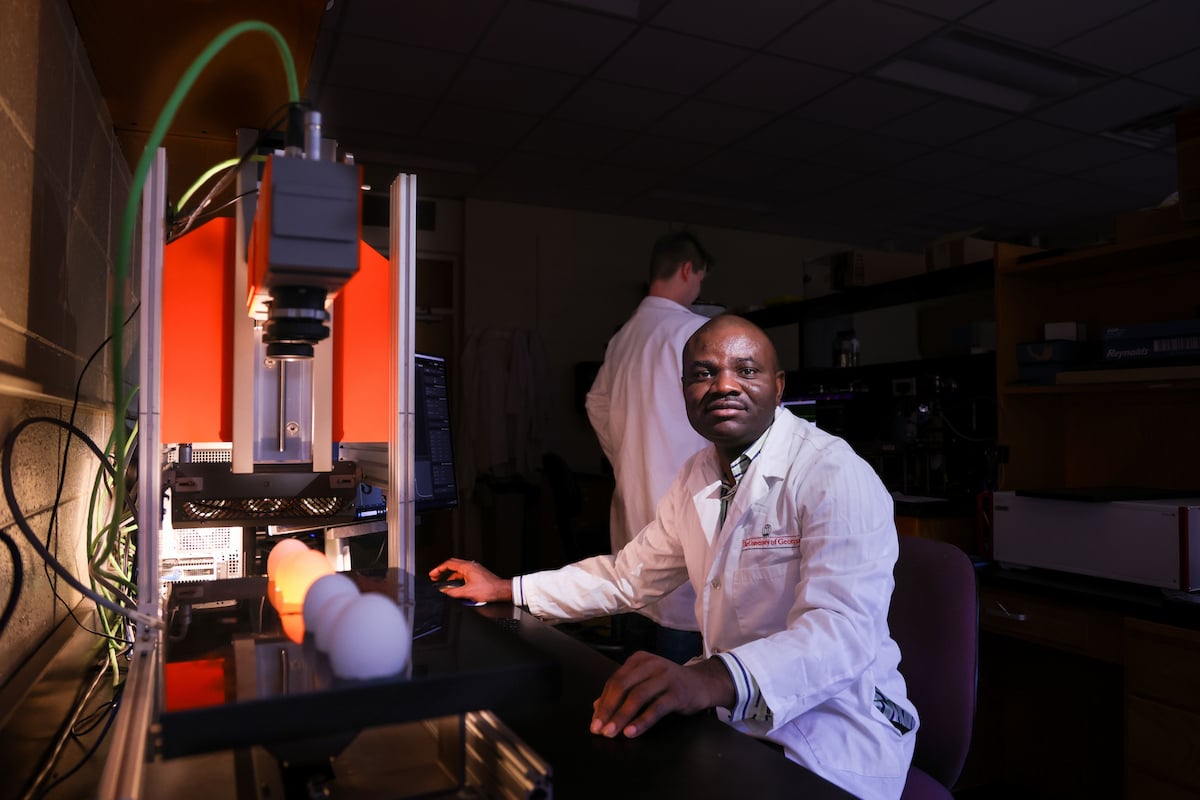
In the Department of Food Science and Technology, Assistant Professor Christopher Kucha has developed an AI-driven camera that interprets complex data rather than simply recording images.
Called PrecisionDetect, the instrument uses spectral imaging, which scans beyond the visible light spectrum to reveal the biochemical signature inside an egg that indicates whether it is fertile. The technology was developed in collaboration with Doshi.
The data produced by these scans is incredibly dense and far too subtle for the human eye to parse. AI algorithms apply deep learning to vast spectral datasets and identify the minute patterns that distinguish a fertile egg from an infertile one. This may allow for rapid and non-destructive screening that matches the speed of industrial operations and could contribute to a smarter and more sustainable food system.”
Christopher Kucha


“Living lab” showcases AI innovation
Last year, field trials began shortly after ground was broken on the 250-acre UGA Grand Farm site near Perry, Georgia, launching a collaborative partnership between CAES and the original Grand Farm in Fargo, North Dakota.
Grand Farm is a collaborative network of growers, corporations, startups, educators, researchers, government agencies and investors working together to solve agricultural challenges through technology and innovation. North Dakota’s Grand Farm served as the inspiration for UGA’s new facility.
UGA Grand Farm provides agricultural technology companies with opportunities to develop and evaluate their products under Georgia’s growing conditions. The site hosts field days, tech demonstrations and workshops that give growers, researchers and students the chance to see AI and emerging agricultural tools in action and share knowledge.


“Grand Farm is designed to be Georgia’s premier site for precision agriculture technology, research and education,” said Kaytlyn Cobb, regional assistant director. “One of our goals is to work with groups using AI to analyze field data in real time and explore autonomous equipment and predictive analytics that boost productivity and sustainability.”
Offering a preview of what the “living lab” will provide, the groundbreaking showcased innovative technologies, including solar-powered autonomous robotic weeders; tractor retrofit kits that enable driverless operations for row-crop farming; and autonomous, solar-powered robots that spot-apply herbicides and scout fields to collect real-time data on plant health and stand counts.
Cobb collaborates with the IIPA to engage students across UGA’s campuses with emerging technological solutions at UGA Grand Farm. “We look forward to expanding these opportunities and using this site as a place where students can gain hands-on experience with precision agriculture technologies,” she said.