
When a home is on a public water system, there are fewer concerns about water quality and safety because the water is routinely tested and treated for potential contaminants according to the EPA’s Safe Drinking Water Act of 1974. However, government agencies do not monitor or regulate water quality from private wells, nor is water testing required by any federal or state regulation.
Related Content
About 15% to 20% of private well waters in all regions of Georgia contain high levels of iron and manganese, and some develop hydrogen-sulfide gas. While these contaminants are not considered to have any human health consequences, they can cause various issues such as staining, impaired taste, and odor problems once their concentrations exceed certain levels, and homeowners need an appropriate system to remove them—such as an oxidizing filter. As the name indicates, oxidizing filters operate using oxidation, which occurs when a substance comes into contact with oxygen or another oxidizing substance. Everyday examples of oxidation are rust and the brown color that develops on a cut apple. Figure 1 shows a simplified flow chart of dissolved iron oxidation.

Oxidizing filters promote the oxidation of dissolved iron, manganese, and hydrogen sulfide to form insoluble particles which are subsequently removed by mechanical filtration. These are point-of-entry or whole-house treatment systems.
Contaminants Removed
Ferric (yellow cloudy) and ferrous (green clear) iron, manganese (black stains), and hydrogen sulfide gas (rotten egg odor) are contaminants that can be removed using oxidizing filters.
To address the presence or severity of these contaminants, have your water tested by a certified laboratory. A comprehensive water chemistry screening will include iron and manganese as well as other relevant parameters. If the iron concentration is higher than 0.30 mg/L (or ppm) and/or the manganese concentration is higher than 0.05 mg/L (or ppm), you may want to consider using an oxidizing filter.
Figure 2 is an example of a water chemistry test report from the University of Georgia laboratory.

It is not practical to test for hydrogen sulfide in a laboratory because it is a dissolved gas in water, which escapes quickly and likely will disappear by the time the water reaches the laboratory. However, kits are available for on- site hydrogen sulfide testing.
The rotten egg smell of hydrogen sulfide is unmistakable and can be smelled in water with a concentration as low as 0.5 ppm. Water with concentrations from 0.5 to 1 ppm also smells “musty” or “swampy.” Concentrations greater than 1 ppm are corrosive to plumbing.
The Filter Media
The four major types of filter media used in oxidizing water filters are:
- manganese greensand
- manufactured zeolite coated with manganese oxide
- silicon dioxide coated with manganese dioxide
- solid manganese dioxide
Greensand is a naturally occurring mineral, also referred to as glauconite, which has natural ion-exchange properties. Natural greensand is crushed, washed, and sieved to produce a uniform particle size that can serve as a filtration media.
Manganese greensand is a manganese-oxide-coated greensand prepared by washing with the material with potassium permanganate. This is a dual-purpose filter medium that can catalyze oxidation (by the manganese oxide coating) of dissolved iron, manganese, and hydrogen sulfide to insoluble particles which are subsequently filtered out through backwashing.
Zeolites are microporous, natural crystalline aluminosilicate and silicate minerals. The porous structure loosely holds a wide variety of cations such as Na+, K+, Ca2+, Mg2+, and others, which can be exchanged for other cations in water that is in contact with it. Zeolites are widely used as ion-exchange beds in domestic and commercial water purification, softening, and other applications. Manganese-oxide-coated zeolites are prepared by precipitating colloidal manganese oxides on the zeolite surface from a boiling solution of potassium permanganate assisted by the slow addition of hydrochloric acid. Filters made with synthetic zeolite require less backwash and will soften the water as it removes the iron and manganese.
Light silicon dioxide with a manganese dioxide coating is another oxidizing filter medium that is very effective for oxidizing iron but variably effective in oxidizing manganese. Although it also can oxidize hydrogen sulfide, the sulfur particles that form can foul the media bed, making them unsuitable for removing hydrogen sulfide. Birm® is an example of a federally registered commercial brand of light silicon dioxide filter media, which is manufactured from natural pumice mineral (primarily silicon dioxide, some aluminum oxide, and trace amounts of other oxides) coated with a very thin layer of manganese dioxide. It acts as an insoluble catalyst to enhance the oxidation reaction between dissolved oxygen and iron compounds. Therefore, the media is not consumed in the oxidation process and it does not need to be regenerated with a chemical, such as potassium permanganate. However, it does require periodic backwashing to remove the accumulated particles.
Solid manganese dioxide filter media for water treatment are made from naturally mined and processed manganese oxide ore with at least 80% purity. As these media use solid manganese oxide ores, they are not required to be coated like Birm and greensand. Available brands of this type of media include Pro-OX, Pyrolox, Filox, Catalox, MangOX, and others. This type of media usually is longer lasting than other types like Birm or greensand. Since they are heavier and more compact than Birm or greensand, backwashing these media require a higher flow of water. These media also work best combined with a chlorine-injection system installed as a prefilter.
How Oxidizing Filters Work
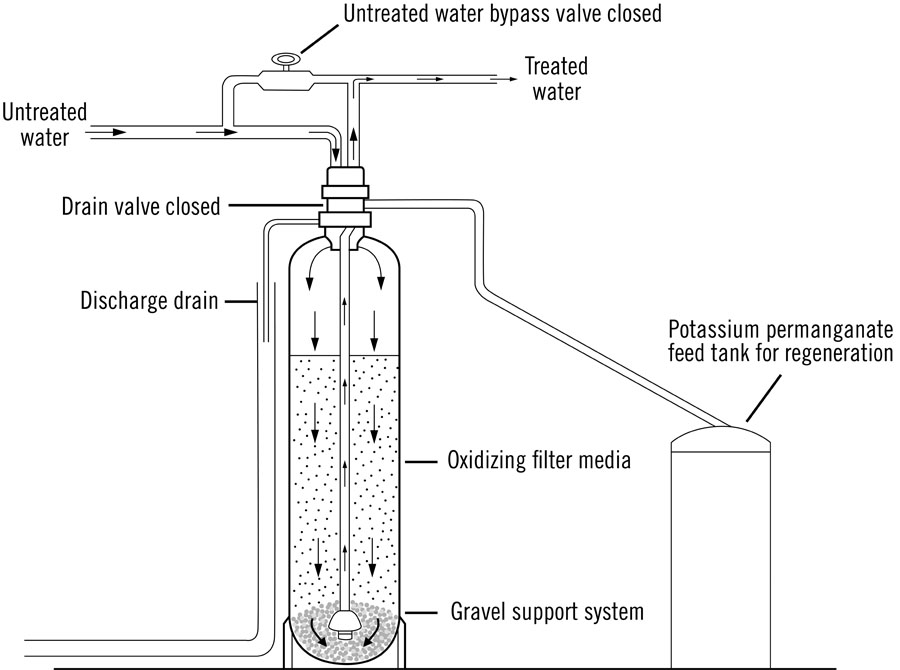
Figure 3 shows the schematic of a household oxidizing water filtration system. Soluble iron and manganese are oxidized by contact with a manganese oxide core or coating on the filter media and solid particles precipitate out. The dissolved hydrogen sulfide gas also undergoes oxidation and forms solid elemental sulfur particles. The solid particles formed are then trapped in the filter medium and are eventually flushed out by backwashing with water.
Note. Adapted from “Home water treatment,” by L. Wagenet, K. Mancl, and M. Sailus, 1995, Cornell
Cooperative Extension Publication No. NRAES-48, p. 55 (https://hdl.handle.net/1813/67139).
With continued operation, the filter medium gradually loses its oxidizing capacity. When the oxidizing capacity of the filter medium has declined substantially, the medium must be regenerated with a weak potassium permanganate (1% to 4%) solution to restore the oxidizing capacity.
It is important to note that the system selected and operated must be based on the amount of dissolved oxygen that is present in the water supply (see Table 1). The amount of dissolved oxygen can be determined at home by using a test kit.
| Parameter | Birm® | Filox-RTM | Manganese greensand |
|---|---|---|---|
| Service flow rate (gpm per square foot) | 5 | 5 | 3–5 |
| Backwash flow rate (gpm per square foot) | 10 | 15–18 | 12 |
| Minimum dissolved oxygen (DO) content required in water | 15% of iron concentration (e.g., if iron content is 10 ppm, DO should be at least 1.5 ppm) | None; works independent of DO content | None; works independent of DO content |
| pH range | 6.8+ | 3–12 | 6.2–8.8 |
| Bed depth (in.) | 30–36 | 30 | 30 |
| Bed expansion during regeneration | 50% | 50% | 50% |
| Regenerant | None | None | Potassium permanganate |
| Dissolved iron reduction capacity (mg per cubic foot bed volume) | 25,900–32,300 | 312,000 | 10,000 |
| Dissolved reduction capacity (mg per cubic foot bed volume) | Consult manufacturer | 1,040,340 | 1,040,340 |
| Dissolved hydrogen sulfide (H2S) reduction capacity (mg per cubic foot bed volume) | None | 610,000 | 2,000–3,000 |
| Note: Adapted from “Home water treatment,” by L. Wagenet, K. Mancl, and M. Sailus, 1995, Cornell Cooperative Extension Publication No. NRAES-48, p. 55 (https://hdl.handle.net/1813/67139). | |||
Uses
An oxidizing filter is an inline, point-of-entry device that treats the entire household water supply to remove iron, manganese, and hydrogen sulfide in water. At concentrations normally found in well waters, none of these are human health hazards, but they can cause unpleasant appearance, taste, or odor.
These filters are especially useful in removing iron and manganese if a homeowner doesn’t want a water softener, or when the combined concentration of iron and manganese is higher than 5 ppm. These filter media should not be used on water supplies with hydrogen sulfide over 5 ppm, iron exceeding 10 ppm, or combined iron and manganese exceeding 15 ppm.
The pH of the untreated water has a significant effect on the efficacy of these filters. See Table 1 for the optimum water pH ranges in which different oxidizing filter media function properly
With a hydrogen sulfide concentration in excess of 5 ppm, a prechlorination step can be used to oxidize most of the hydrogen sulfide and lengthen the lifespan of the oxidizing filter. Otherwise, the filter may become clogged by the excess sulfur particles and require an unusually high frequency of replacement or regeneration.
Capacity
Most oxidizing filters work satisfactorily for several weeks, accomplishing 75% to 90% reduction of iron or manganese from water when their combined concentration is as high as 10–15 ppm.
Hydrogen sulfide consumes the manganese oxide coating on the filter medium at a faster rate, exhausting the filtering capacity of the media more quickly. Depending on the media used, this may require regeneration every few days for some systems.
Maintenance
Regardless of the system purchased, it will not perform satisfactorily unless the installation and maintenance (e.g., cleaning, backwashing, and part replacement) guidelines suggested by the manufacturer are routinely followed. Keep a logbook to record water test results, equipment maintenance, and repairs. Here are a few important points:
- Particles can clog the filter within a few days to a few weeks, so regular backwashing is necessary to
ensure that the filter is working properly. For backwashing, a flow rate more than double the normal
service flow rate usually is required. - With oxidizing filters, the manganese oxide coating (when present) is gradually used up and the media
loses its oxidizing power. When a substantial portion of manganese oxide coating is consumed, the
medium has to be regenerated or recoated via backwashing with potassium permanganate. Concentrated
potassium permanganate can be diluted to 1% to 4%, and then loaded into the feeder or solution tank,
which typically dispenses the chemical automatically at predefined intervals. - For homes without the required backwash flow rate, many vendors offer a backwashing or regeneration
service. They will supply a fresh filter and take the exhausted filter off-site for regeneration. - It is very important that the filter be kept clean. If the filter is not completely cleaned by regular
backwashing, a reddish-brown sludge will enter the distribution system. - Do not use acid cleaners on zeolite, as the acid degrades the zeolite. Use chlorine instead.
Other Considerations
Test your water: Before purchasing a water treatment device, have your water tested to determine the contaminants present. This will help you determine if an oxidizing filter is an appropriate treatment method for your situation. The University of Georgia Agricultural and Environmental Services Laboratories (https://aesl.ces. uga.edu) and other accredited laboratories provide comprehensive water testing for a fee.
Choose your filter: Confirm that the treatment unit has been tested and certified by NSF (https://www.nsf.org) or Water Quality Association (WQA; https://wqa.org) to validate the manufacturer’s claims. The WQA has set voluntary performance standards for oxidizing filters. They specify that an oxidizing filter shall reduce:
- soluble iron to 0.2 ppm or below
- soluble manganese to 0.05 ppm or below
WQA has a directory of validated equipment that meets these standards (https://find.wqa.org/find-products#/). This directory also lists products that address other specific filtration needs. For additional information, email wqa@wqa.org, call 630-505-0160, or write 2375 Cabot Dr, Lisle, IL 60532.
WQA also recognizes that the following water treatment methods can be used to meet the EPA’s Secondary Drinking Water Standards for both soluble iron and manganese:
- oxidizing filters
- cation exchange
- chlorination with precipitation and filtration
Retesting: After installation, retest both the untreated and the treated water to determine whether the equipment is working properly. Continue to test the quality of both untreated and treated water once or twice a year. This will also help you determine how well your treatment system is working and whether maintenance or replacement of components may be necessary.
Low pH: Acid water, which has a pH below 6.2, will pick up manganese from greensand and reduce the filter’s capacity. Therefore, a neutralization pretreatment may be necessary. See the following UGA Extension publications for more information:
- C 858-3, Home Water Quality and Treatment (https://extension.uga.edu/publications/detail.html?number= C858-3)
- C 858-9, Corrosive or Scaling Water (https://extension.uga.edu/publications/detail.html?number=C858-9)
- B 939, Water Quality and Common Treatments for Private Drinking Water Systems (https://extension.uga.edu/publications/detail.html?number=B939)
Iron bacteria: Slime produced by iron bacteria will clog the filter. UGA Extension Bulletin 1457, Iron (Manganese) and Sulfur Bacteria in Your Water (https://extension.uga.edu/publications/detail.html?number=B1457), can provide more information.
Use potassium permanganate with caution: Concentrated potassium permanganate (which is diluted and used for regeneration) is poisonous and is a skin irritant. It should be stored in its original container away from children and animals, and handled with caution while wearing protective clothing, goggles and gloves. Unlike chlorine, there should be no excess potassium permanganate in the treated water. A faint pink tinge is evident if potassium permanganate is present in the water.
Maintenance: Follow the manufacturer’s recommendations for maintenance of the system and keep all maintenance records in a logbook.
References
Bagley, D. (2017). A guide to home water treatment (Publication No. E3342). Michigan State University Extension. https://www.canr.msu.edu/resources/a_guide_to_home_water_treatment_bulletin_e3342
Benham, B., & Ling, E. (2013). Virginia household water quality program: Household water treatment (Publication No. 442-670). Virginia Cooperative Extension. https://www.pubs.ext.vt.edu/content/dam/pubs_ext_vt_edu/442/442-670/442-670.pdf
Broz, B. (2017). Understanding your home water treatment systems (Publication No. EQ104). University of Missouri Extension. https://extension.missouri.edu/media/wysiwyg/Extensiondata/Pub/pdf/envqual/eq0104.pdf
Colter, A., & Mahler, R. L. (2015). Iron in drinking water (Publication No. PNW 589). Pacific Northwest Extension. https://www.landcan.org/pdfs/pnw589.pdf
Daniels, B., & Mesner, N. (2010). Drinking water treatment systems (Publication No. NR/WQ/2005-24). Utah State University Extension. https://extension.usu.edu/waterquality/files-ou/Publications/Drinking-water-treatment-systems.pdf
Dvorak, B., & Schuerman, B. (2021). Drinking water: Iron and manganese (Publication No. G1714) Nebraska Extension. https://extensionpubs.unl.edu/publication/g1714/pdf/view/g1714-2021.pdf
Dvorak, B. I., & Skipton, S.O. (2014). Drinking water treatment: An overview (Publication No. EC703). Nebraska Extension. https://extensionpubs.unl.edu/publication/ec703/pdf/view/ec703-2014.pdf
Ling, E. J., Benham, B., & Pollard Scott, J. (2011). Virginia household water quality program: Iron and manganese in household water (Publication No. 442-656). Virginia Cooperative Extension. https://digitalpubs.ext.vt.edu/vcedigitalpubs/9792182489352875/
UMass Extension. (2007). Healthy drinking waters for Massachusetts: Iron and manganese in private drinking water wells. https://www.capecod.gov/wp-content/uploads/2022/03/ironmanganese.pdf
Wagenet, L., Mancl, K., & Sailus, M. (1995). Home water treatment (Publication No. NRAES-48). Cornell Cooperative Extension. https://hdl.handle.net/1813/67139
The original manuscript was prepared by Uttam Saha, Pamela Turner, Gary Hawkins, Laurel Dunn, Laura Ney, and Brenda Jackson. Reviewed by Uttam Saha.