
This publication is the third in a series focusing on irrigation scheduling for vegetable crops. It contains basic information on water use and irrigation management using the crop water demand method for Solanaceae crops such as bell peppers, tomatoes, and eggplants.
Irrigation Scheduling
Growers have numerous available strategies of irrigation scheduling to supply vegetable crops with water. See UGA Cooperative Extension Bulletin 1511, “Principles of Irrigation and Scheduling for Vegetable Crops in Georgia,” for information. The crop water demand method is one of the simplest and most precise methods to determine irrigation events. Using the crop water demand method, also known as crop evapotranspiration (ETc), means irrigation is supplying the daily volume of water uptake by the crop. Consequently, when properly managed, irrigation events using the ETc will minimize crop water stresses caused by the lack or excess of soil water.
The ETc is calculated by multiplying a daily reference evapotranspiration (ETo) by a crop coefficient (Kc). The ETo represents the weather portion of the ETc, and daily ETo can be gathered from the Georgia Automated Environmental Monitoring Network for several locations in the state. The Kc represents the water required by the crop and varies according to stages of the crop development. Like most vegetable crops, the Kc of Solanaceae crops is divided into initial (Kcini; seedling stage), midseason (Kcmid), and end-season (Kcend; harvest stage), and the Kc values used for each stage of crop development are 0.6, 1.05, and 0.8, respectively (Allen et al., 1998); (Figure 1).

the early season (Kcini), mid-season (Kcmid), and end season (Kcend) in weeks after planting.
Figures 2 and 3 show stages of crop development (i.e., Kcini, Kcmid, and Kcend) for bell peppers and tomatoes, respectively. The Kcini (0.6) represents the early stage of crop development and is normally used during seedling production and from transplanting until root establishment, which takes about two weeks. After root establishment, Solanaceae crops enter into the vegetative stage and crop water requirements increase, and consequently, the Kcini gradually changes to Kcmid (1.05). The Kcmid is the most critical period of crop development and should be used from the vegetative stage, through the flowering stage, until the fruiting stage. The Kcmid on Solanaceae crops goes from three weeks after transplanting until 10 weeks after transplanting, but it can be extended if multiple harvests occur. When plants start to senesce, water uptake is used for maintenance instead of reproduction, reducing the water requirement of Solanaceae crops. Kcmid reduces to Kcend (0.8), as seen in Figures 2C and 3C. In Solanaceae crops for which multiple harvests can be conducted, the Kcend is recommended to be used only for the final harvest.


Scheduling Irrigation Events for Solanaceae Crops in Georgia
Bell peppers, tomatoes, and eggplants are the main Solanaceae crops grown in the state. They are planted in March and April for the spring growing season and August and September for the fall growing season. In both seasons, these Solanaceae crops are grown under plastic mulching systems with drip irrigation, which allow growers to maximize the irrigation water use efficiency and crop yield by spoon feeding water to plants.
Researchers calculated 18 years of historical information on the ETc of Solanaceae crops and used the data to schedule weekly irrigation strategies for four planting dates in the spring season (i.e., March 1, March 15, April 1, and April 15) and fall season (August 1, August 15, September 1, and September 15) in the southwest, southeast, northwest, and northeast regions of Georgia. Daily ETc from 2000 to 2017 was calculated using the average ETo of eight different locations in each of the four regions of Georgia (Figure 4), and the Kcini (0.6), Kcmid (1.05), and Kcend (0.8) for Solanaceae crops (Figure 1).

Spring
In spring, Solanaceae crops require low volumes of irrigation water early in the season in Georgia (Figure 5). This is due to both cold air temperatures and low crop water requirements. The fourth week after transplanting, plant leaf size rapidly increases (increase in Kc), which is associated with the constant increase in daily air temperature during the spring season. This may double the crop water requirement compared to the early season (Figure 5). Water stress during this period should be avoided. While a water deficit affects plant growth and reduces yield, excess water reduces the number of fruits per plant and fruit marketability (Smittle et al., 1994). In the case of multiple harvests, commonly seen in Solanaceae crops, irrigation must continue to ensure flowering and fruiting. It is important to highlight that the high temperatures of late spring in Georgia will stress plants if water is not sufficient. To prevent this, irrigation water should be reduced only a few days before the final harvest (Figure 5) when plants will start to senesce.
Table 1 presents a guideline for scheduling irrigation events on a weekly basis for Solanaceae crops planted March 1, March 15, April 1, and April 15 by location within the state of Georgia (i.e., southwest, southeast, northwest, and northeast). The weekly volume of water required for Solanaceae crops should assist growers to properly schedule irrigation events.

| Week after planting | Southwest | Southeast | Northwest | Northeast | ||||||||||||
|---|---|---|---|---|---|---|---|---|---|---|---|---|---|---|---|---|
| 3/1 | 3/15 | 4/1 | 4/15 | 3/1 | 3/15 | 4/1 | 4/15 | 3/1 | 3/15 | 4/1 | 4/15 | 3/1 | 3/15 | 4/1 | 4/15 | |
| inches of water per week | ||||||||||||||||
| 1 | 0.33 | 0.42 | 0.48 | 0.60 | 0.30 | 0.38 | 0.44 | 0.56 | 0.25 | 0.33 | 0.39 | 0.50 | 0.26 | 0.34 | 0.40 | 0.52 |
| 2 | 0.41 | 0.50 | 0.57 | 0.66 | 0.38 | 0.44 | 0.52 | 0.60 | 0.33 | 0.40 | 0.47 | 0.57 | 0.33 | 0.39 | 0.48 | 0.55 |
| 3 | 0.42 | 0.48 | 0.60 | 0.71 | 0.38 | 0.44 | 0.56 | 0.65 | 0.33 | 0.39 | 0.50 | 0.60 | 0.34 | 0.40 | 0.52 | 0.60 |
| 4 | 0.88 | 0.99 | 1.16 | 1.27 | 0.77 | 0.91 | 1.04 | 1.16 | 0.69 | 0.82 | 1.01 | 1.05 | 0.68 | 0.84 | 0.95 | 1.06 |
| 5 | 0.85 | 1.05 | 1.24 | 1.41 | 0.77 | 0.97 | 1.13 | 1.33 | 0.69 | 0.88 | 1.04 | 1.20 | 0.70 | 0.91 | 1.05 | 1.22 |
| 6 | 0.99 | 1.16 | 1.27 | 1.37 | 0.91 | 1.04 | 1.16 | 1.22 | 0.82 | 1.01 | 1.05 | 1.16 | 0.84 | 0.95 | 1.06 | 1.14 |
| 7 | 1.05 | 1.24 | 1.41 | 1.47 | 0.97 | 1.13 | 1.33 | 1.33 | 0.88 | 1.04 | 1.20 | 1.28 | 0.91 | 1.05 | 1.22 | 1.27 |
| 8 | 1.16 | 1.27 | 1.37 | 1.46 | 1.04 | 1.16 | 1.22 | 1.32 | 1.01 | 1.05 | 1.16 | 1.27 | 0.95 | 1.06 | 1.14 | 1.28 |
| 9 | 1.24 | 1.41 | 1.47 | 1.42 | 1.13 | 1.33 | 1.33 | 1.32 | 1.04 | 1.20 | 1.28 | 1.32 | 1.05 | 1.22 | 1.27 | 1.30 |
| 10 | 1.27 | 1.37 | 1.46 | 1.52 | 1.16 | 1.22 | 1.32 | 1.43 | 1.05 | 1.16 | 1.27 | 1.40 | 1.06 | 1.14 | 1.28 | 1.43 |
| 11 | 1.08 | 1.12 | 1.08 | 1.17 | 1.01 | 1.01 | 1.00 | 1.07 | 0.91 | 0.98 | 1.00 | 1.09 | 0.93 | 0.97 | 0.99 | 1.08 |
| 12 | 1.04 | 1.11 | 1.16 | 1.06 | 0.93 | 1.01 | 1.09 | 0.99 | 0.88 | 0.97 | 1.07 | 1.01 | 0.87 | 0.97 | 1.09 | 1.05 |
| Total | 10.7 | 12.1 | 13.3 | 14.1 | 9.8 | 11.0 | 12.1 | 13.0 | 8.9 | 10.2 | 11.5 | 12.5 | 8.9 | 10.2 | 11.5 | 12.5 |
Fall
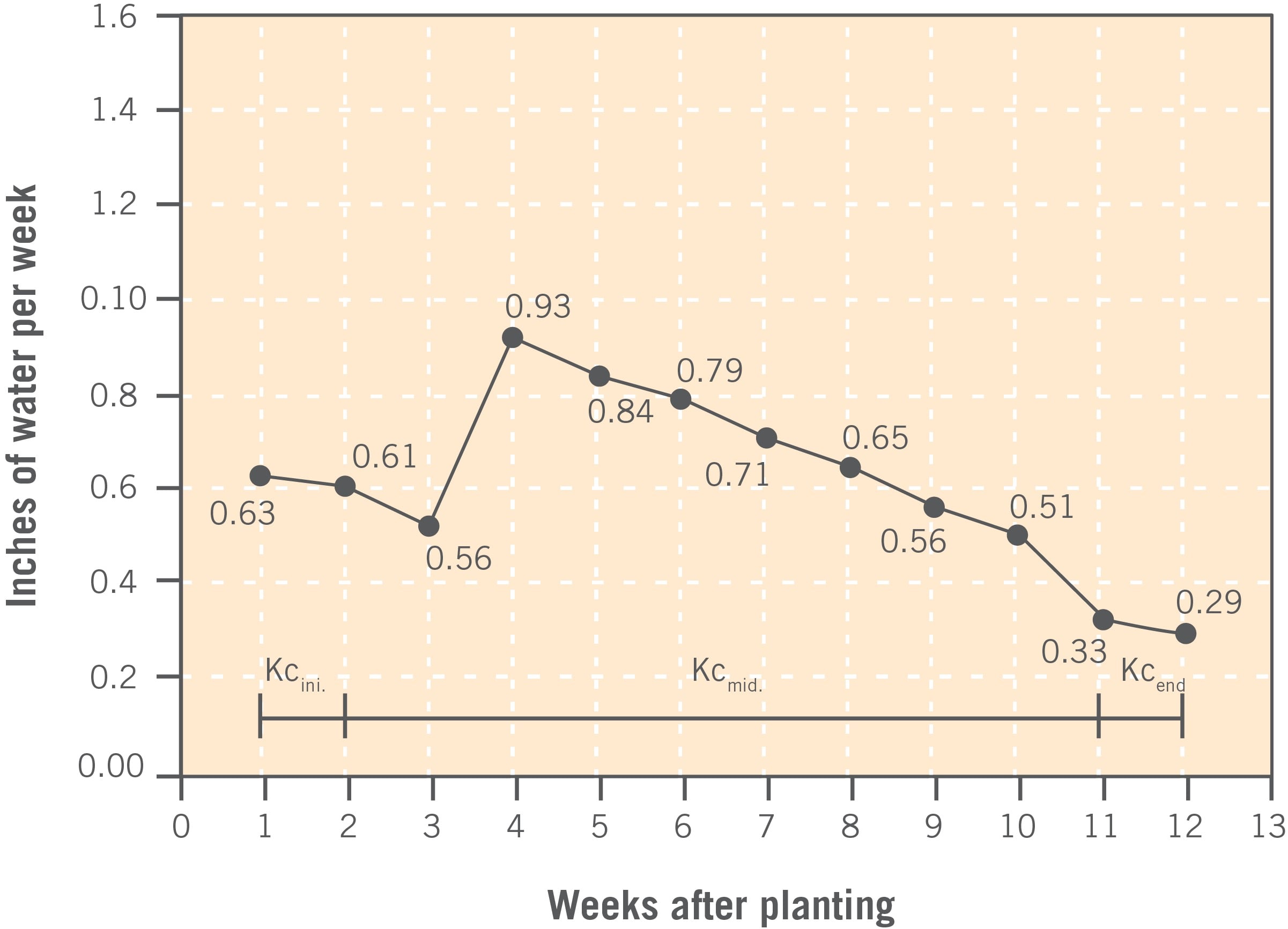
Unlike the spring season, irrigation water requirements for Solanaceae crops are high early on during the fall season (Figure 6). This is due to high daily air temperatures more than crop water demand. After transplanting, water demand is high and Solanaceae crops are still small with poorly developed root systems, so irrigation events should be more frequent in order to minimize water stress and ensure plant survival.
As Solanaceae crops develop into the fall season, irrigation water volumes peak due to fast canopy closure, which increases crop water demand (Figure 6). From four to 11 weeks, a decrease in daily air temperature (cooler temperatures) also decreases irrigation water volumes, but this does not mean there is a reduction in crop water demand. Contrarily, irrigation water during this period is crucial to ensure flowering and fruiting (Smittle et al., 1994; Dukes et al., 2003). During harvest, irrigation is also important to ensure continued fruit growth and quality. Similar to spring, growers should only reduce irrigation water a few days before the last harvest in the fall season (Figure 6).
The volume of water required weekly by Solanaceae crops is presented in Table 2 to assist growers in scheduling irrigation events according to planting date (i.e., August 1, August 15, September 1, and September 15) and location in Georgia (i.e., southwest, southeast, northwest, and northeast).
| Week after planting | Southwest | Southeast | Northwest | Northeast | ||||||||||||
|---|---|---|---|---|---|---|---|---|---|---|---|---|---|---|---|---|
| 8/1 | 8/15 | 9/1 | 9/15 | 8/1 | 8/15 | 9/1 | 9/15 | 8/1 | 8/15 | 9/1 | 9/15 | 8/1 | 8/15 | 9/1 | 9/15 | |
| inches of water per week | ||||||||||||||||
| 1 | 0.75 | 0.74 | 0.65 | 0.60 | 0.70 | 0.68 | 0.59 | 0.55 | 0.21 | 0.20 | 0.18 | 0.16 | 0.19 | 0.19 | 0.16 | 0.15 |
| 2 | 0.75 | 0.71 | 0.63 | 0.53 | 0.70 | 0.64 | 0.57 | 0.49 | 0.21 | 0.20 | 0.17 | 0.15 | 0.19 | 0.18 | 0.16 | 0.14 |
| 3 | 0.74 | 0.65 | 0.60 | 0.51 | 0.68 | 0.59 | 0.55 | 0.46 | 0.20 | 0.18 | 0.16 | 0.14 | 0.19 | 0.16 | 0.15 | 0.13 |
| 4 | 1.24 | 1.10 | 0.93 | 0.79 | 1.11 | 1.00 | 0.86 | 0.69 | 0.34 | 0.30 | 0.26 | 0.22 | 0.31 | 0.28 | 0.24 | 0.19 |
| 5 | 1.13 | 1.04 | 0.88 | 0.71 | 1.03 | 0.95 | 0.81 | 0.64 | 0.31 | 0.29 | 0.24 | 0.20 | 0.28 | 0.26 | 0.22 | 0.18 |
| 6 | 1.10 | 0.93 | 0.79 | 0.69 | 1.00 | 0.86 | 0.69 | 0.63 | 0.30 | 0.26 | 0.22 | 0.19 | 0.28 | 0.24 | 0.19 | 0.17 |
| 7 | 1.04 | 0.88 | 0.71 | 0.57 | 0.95 | 0.81 | 0.64 | 0.53 | 0.29 | 0.24 | 0.20 | 0.16 | 0.26 | 0.22 | 0.18 | 0.15 |
| 8 | 0.93 | 0.79 | 0.69 | 0.63 | 0.86 | 0.69 | 0.63 | 0.47 | 0.26 | 0.22 | 0.19 | 0.14 | 0.24 | 0.19 | 0.17 | 0.13 |
| 9 | 0.88 | 0.71 | 0.57 | 0.43 | 0.81 | 0.64 | 0.53 | 0.39 | 0.24 | 0.20 | 0.16 | 0.12 | 0.22 | 0.18 | 0.15 | 0.11 |
| 10 | 0.79 | 0.69 | 0.53 | 0.36 | 0.69 | 0.63 | 0.47 | 0.32 | 0.22 | 0.19 | 0.14 | 0.10 | 0.19 | 0.17 | 0.13 | 0.09 |
| 11 | 0.54 | 0.43 | 0.33 | 0.23 | 0.49 | 0.40 | 0.29 | 0.20 | 0.15 | 0.12 | 0.09 | 0.06 | 0.13 | 0.11 | 0.08 | 0.06 |
| 12 | 0.52 | 0.40 | 0.27 | 0.20 | 0.48 | 0.35 | 0.25 | 0.18 | 0.14 | 0.11 | 0.08 | 0.05 | 0.13 | 0.10 | 0.07 | 0.05 |
| Total | 10.4 | 9.1 | 7.6 | 6.1 | 9.5 | 8.2 | 6.9 | 5.5 | 2.9 | 2.5 | 2.1 | 1.7 | 2.6 | 2.3 | 1.9 | 1.5 |
Food Safety Considerations
Because most Solanaceae crops are drip irrigated, the U.S. Food and Drug Administration’s Produce Safety Rule (PSR) does not require irrigation water testing, as irrigation water is not likely to contact the harvestable portion of the crop. However, it is still recommended to periodically test microbial water quality of irrigation sources by collecting a 100 milliliter (ml) water sample in a sterile collection bottle for generic Escherichia coli analysis.
Growers who elect to collect water samples may use the PSR guideline of ≤ 126 colony forming units (CFU) or the most probable number (MPN) per 100 ml sample as a guideline (FDA, 2015). Growers that must comply with third-party audits (PRIMUS GFS, USDA GAP, etc.) should consult their auditor for testing frequency and E. coli level requirements. Your local UGA Extension office can provide you instructions on submitting a water sample for analysis by the UGA Agricultural and Environmental Services Laboratories.
Summary
Weather variabilities like temperature, solar radiation, relative humidity, and wind speed are the main factors impacting ETc (Allen et al., 1998). Consequently, irrigation water requirements for Solanaceae crops in both seasons (i.e., spring and fall) are more dependent on planting date than location in the state. While late planting dates will require higher volumes of irrigation water than early planting dates in the spring (Table 1), late planting dates require lower volumes of irrigation water than early planting dates in the fall (Table 2). Overall, irrigation water requirements reported in Tables 1 and 2 can be used for irrigation scheduling in Solanaceae crops.
However, increased water use efficiency, which means the ratio of crop yield per volume of water irrigated, can be achieved when ETc is combined with soil moisture monitoring. This way irrigation events will never apply more water than required by crops or the soil field capacity, which is the maximum water a soil can hold. More information on irrigation scheduling using soil moisture sensors can be found in UGA Extension Bulletin 1511, “Principles of Irrigation and Scheduling for Vegetable Crops in Georgia.” The efficiency of irrigation systems should also be considered before applying water. More information for drip irrigation systems can be found in UGA Extension Circular 1093, “Drip Irrigation Checklist: Start-Up.”
References
Allen, R. G., Pereira, L. S., Raes, D., & Smith, M. (1998). FAO Irrigation and drainage paper No. 56. Rome: Food and Agriculture Organization of the United Nations, 56, 97-156.
da Silva, A. L. B. R., Coolong, T., & Diaz-Perez, J. C. (2019). Principles of Irrigation and Scheduling for Vegetable Crops in Georgia (Publication No. B 1511). University of Georgia Extension. https://extension.uga.edu/publications/detail.html?number=b1511
Dukes, M. D., Simonne, E. H., Davis, W. E., Studstill, D. W., & Hochmuth, R. (2003). Effect of sensor-based high frequency irrigation on bell pepper yield and water use. In Proceedings of 2nd International Conference on Irrigation and Drainage (pp. 12-15).
Smittle, D. A., Dickens, W. L., & Stansell, J. R. (1994). Irrigation regimes affect yield and water use by bell pepper. Journal of the American Society for Horticultural Science, 119, 936-939.
U.S. Food and Drug Administration (2015). Standards for the growing, harvesting, packing, and holding of produce for human consumption. Federal Register, 80, 74353-642.