Departments and Units Resources
-
C 858-9
Corrosive or Scaling Water
Corrosiveness or scaling is an inherent property of some groundwater and is related to the type of rocks or sediments in contact with the groundwater. Corrosion is caused when water reacts with and dissolves metal plumbing. This resource provides nontreatment strategies for reducing problems and treatment methods to reduce the corrosion or scale caused by your water.
|
-
C 858-8
Hydrogen Sulfide and Sulfate
This publication describes hydrogen sulfide and sulfate and its effects on household water quality.
|
-
C 858-7
Coliform Bacteria in Your Water
This publication contains information about identifying and controlling coliform bacteria in household water.
|
-
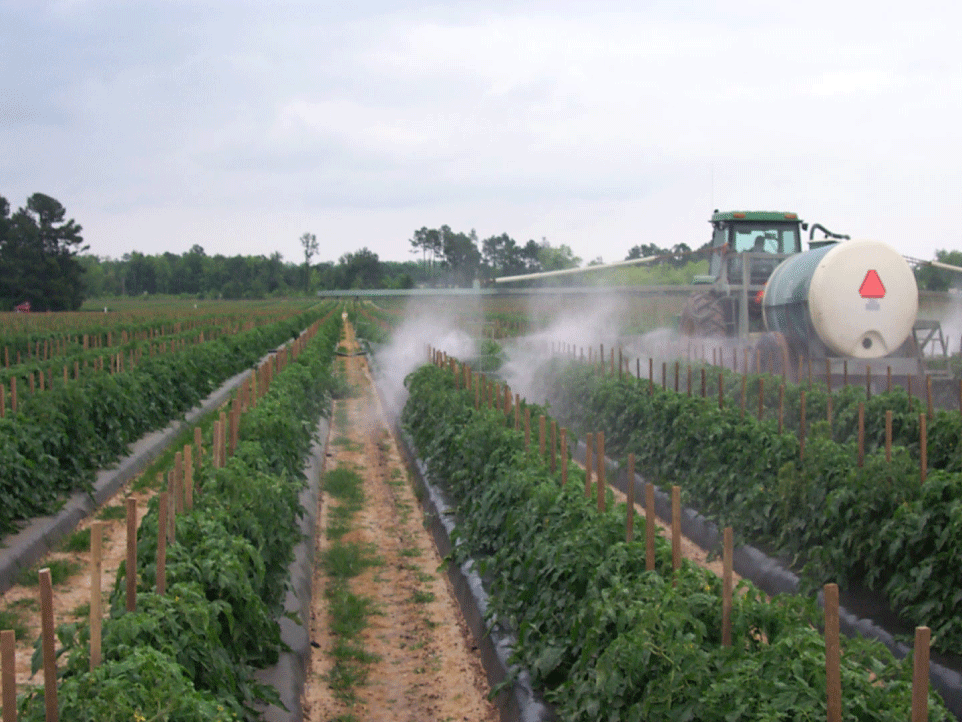
Municipal water systems are required by law to be monitored for many contaminants found in pesticides, solvents, and petroleum products. However, if your water comes from a private well or from a system that serves fewer than 25 people or has fewer than 15 connections, it is not regulated under these laws. The safety of water from these sources is the responsibility of the owners. If you suspect that your water supply may be contaminated, be sure to have your water tested. Contact your county Extension agent for more information. A home water treatment system can help to protect you from certain contaminants in your water supply.
|
-

C 858-5
Nitrate and Nitrite in Water
Private well owners are responsible for the safety of their drinking water. Maintaining a healthy well requires routine testing for possible contaminants, including nitrate and nitrite. To assist in water safety, the EPA has set standards for nitrate levels in public drinking water systems. Although private well owners are not required to meet these standards, they do serve as a reference for safe drinking water. The EPA Maximum Contaminant Level (MCL) nitrate is: 10 ppm (parts per million) or mg/L (milligrams per liter) nitrate-nitrogen or, if expressed as nitrate, 45 ppm. For nitrite, the MCL is: 1 ppm or mg/L nitrite-nitrogen or, 3.28 ppm if expressed as nitrite. Nitrite is not stable in water and rapidly transforms to nitrate fairly easy. Its presence is an indicator of high concentrations of either nitrate or ammonia.
|
-

Built-financial capital refers to the constructed environment (or infrastructure) and economic resources needed to support community activities and sustain successful community development. Considering the infrastructure as well as the financial resources within a community may provide an important perspective regarding needs as well as opportunities.
|
-

Cultural capital refers to the resources that make up a community’s tangible and intangible creative assets. Tangible assets can include historical buildings, sites, and other structures, as well as local art, sculptures, and crafts. Intangible assets include community traditions, customs, values, practices, music, and literature, which contribute to a community’s identity and distinguish community members. These items of cultural capital can contribute to the overall cultural value existing within a community. This publication provides additional details and insights how communities, citizens, and educators can use cultural capital to engage in productive dialogue and programs.
|
-

People represent one of the most important local assets available to a community. While a collection of individuals is needed to start and maintain a community, growth and prosperity largely depend on the talents these individuals possess and the contributions they make to ensure that the community thrives. The education, training, and personal characteristics that give rise to these talents are called human capital.
|
-

Political capital can increase communities’ productive capacity by helping them and their residents achieve specific goals that would be unattainable without it. Political capital refers to the power and influence of communities and groups that are organized around strong relationships and associations.
|