

Introduction
The use of pesticides in vegetable production is crucial for ensuring high crop yields and protecting crops from pests and diseases. Traditionally, mechanized ground systems have been employed for pesticide application, yet these conventional systems (e.g., boom sprayers without PMW or Green-on-green capabilities) may not provide the precision and efficiency required for sustainable agricultural practices (e.g., spot-spraying and drift reduction). Additionally, the manufacturer suggested retail price (MSRP) of a brand new, name-brand specialty crop tractor (~100 HP) is, on average, $100,000. Therefore, a brand-new tractor-sprayer set becomes an expensive addition to a farm.
With recent precision agriculture and artificial intelligence advances, the autonomous robotic spraying systems (e.g., robots and drones) have emerged as a potential alternative for pesticide application, specifically for vegetables. Such advancements aim to increase efficiency, reduce environmental impacts, and enhance operator safety, since most of those new platforms are remotely piloted and carry many sensors for several on-the-go measurements.
A comprehensive evaluation and comparison of these systems is essential for understanding their benefits and limitations, enabling informed decision-making for Georgia vegetable growers. The general objective of this study was to conduct a thorough comparative analysis of multiple spraying systems and platforms for vegetable production.
Material and Methods
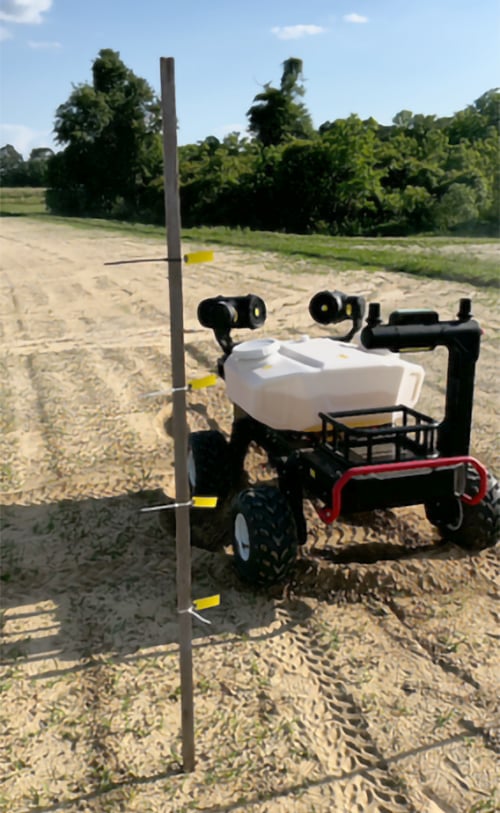
A spraying drone (XAG P100 Pro, 13-gallon tank) and an autonomous spraying robot (XAG R150, 42-gallon tank) were used as the aerial and ground-based application platforms, respectively. An Airtec sprayer was included as a control treatment for comparison with both autonomous systems.
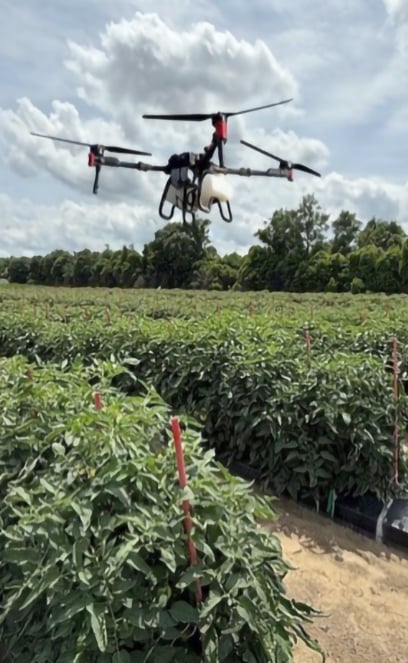
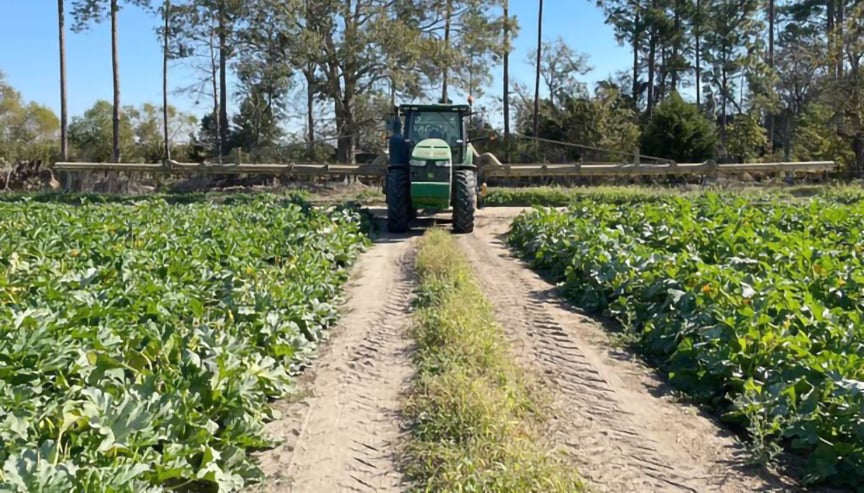
The study was conducted using a randomized complete block design and focused on evaluating spray application uniformity using water-sensitive paper. Field trials were carried out at the University of Georgia Coastal Plain Experiment Station in Tifton, GA, as well as at a commercial grower’s field. The Airtec sprayer and spray drone were evaluated in a commercial yellow squash field.
For spray-coverage assessment, water-sensitive paper cards were placed at the top and bottom canopy positions in six yellow squash rows, also spaced 6 ft apart. Additional drone applications were conducted in tomato fields to check coverage at the top, middle, and bottom of plants, with the aircraft flying both between rows and perpendicular to the row direction. Spray outputs were selected according to label recommendations. The spray drone desired output was set to 10 gpa (gallons per acre) for yellow squash and 5 and 10 gpa for tomatoes. The Airtec sprayer’s output was 22 gpa, and the autonomous robot 25 and 50 gpa.
Robotic platform evaluations were conducted under simulated crop conditions using stakes and water-sensitive paper to represent crop spacings of 6, 8, and 12 ft, and canopy heights of 1, 2, 3, and 4 ft. Different nozzle technologies were used across platforms. The autonomous robot was equipped with custom stainless-steel nozzle tips for both the bar and atomizer attachments, the drone was equipped with rotary atomizers, and the Airtec sprayer was fitted with factory air-nozzles. All droplet sizes were set to medium (226–325 nanometers) except the Airtec.
All results are shown in droplet density to better highlight the potential efficacy of pesticides. Syngenta Crop Protection AG (Basel, Switzerland) recommended at least 20–30 droplets/cm2 for insecticide or preemergence herbicide applications, 30–40 droplets/cm2 for contact post-emergence herbicide applications, and 50–70 droplets/cm2 for fungicide applications to provide satisfactory results (Zhu et al., 2011).
Results
Drone and Airtech
In yellow squash, the spray drone at 10 gpa showed acceptable droplet density for fungicide application with over 70 droplets/cm2 at the top and bottom of the plants in the center rows only (Figure 2). This indicates that the application swath can potentially control diseases within 12 ft of application, according to what is seen in the literature.

In tomatoes (Figure 3), testing two different outputs (5 and 10 gpa) at different parts of the plant (top, middle, and bottom), a higher droplet density was found at 10 gpa on the top of plants in comparison with 5 gpa at the middle and bottom parts.
Acceptable droplet density for fungicide applications was found only at the top at 10 and 5 gpa, and at the middle and bottom at 10 gpa. These results indicate that 10 gpa could be the best option for fungicide applications using spray drones.

Another question regarding spray drone operations is whether there are differences regarding the direction of the flight. Figure 4 shows a higher droplet density when the drone was spraying following the row direction. The Airtec platform was evaluated on a yellow squash field at 22 gpa (Figure 5). No differences were found between top and bottom, showing thorough coverage at an average of 600 nanometer droplets per square centimeter. This result indicates room for potentially reducing chemical output in applications.


Other results using the Airtec showed high variability within the air-boom, with droplet densities ranging from 200 to 1300 droplets/cm2.
Autonomous Robotic Platform
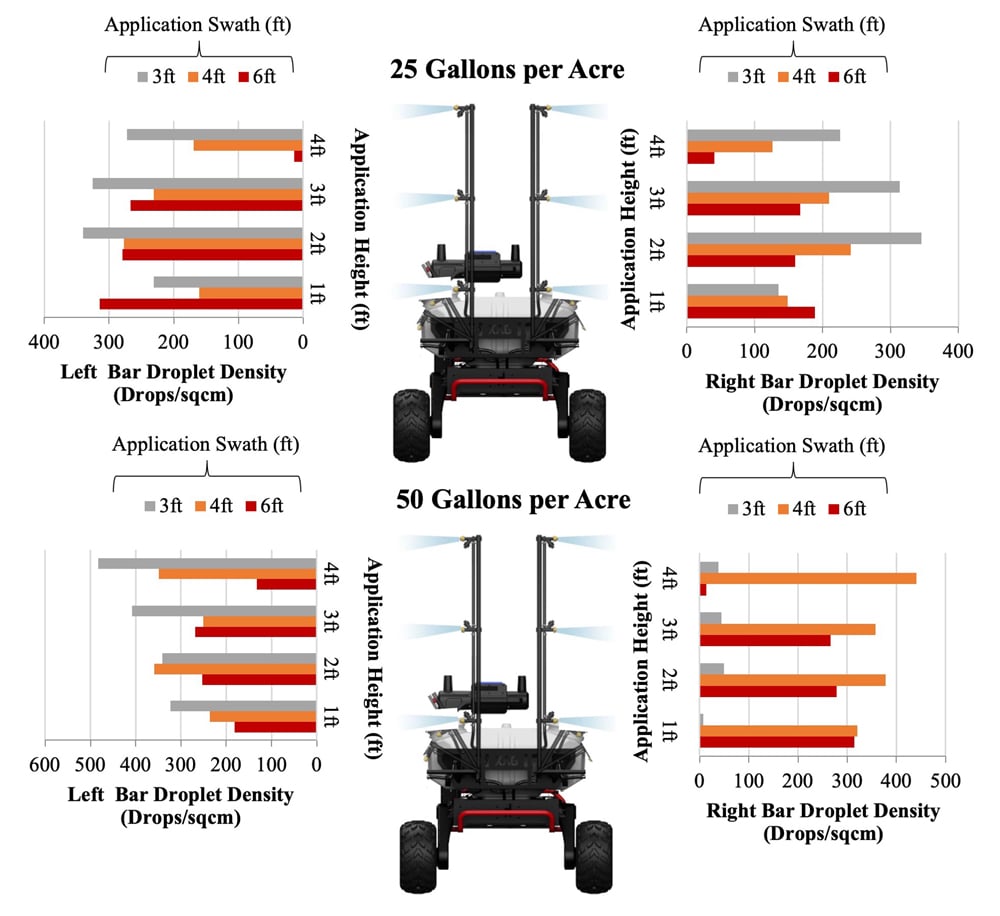
The robotic platform was evaluated using two spray attachments: a vertical boom (bar) and an air-assisted atomizer, each operated at 25 and 50 gpa. The bar attachment produced a uniform spray swath extending up to 6 ft on each side of the rover (12 ft total; Figure 6). At 25 and 50 gpa, acceptable droplet density fungicide applications (over 70 drops/cm2) were found at all heights (1, 2, 3, and 4 ft) at application swaths of 3 and 4 ft for each side of the robot (total 6 and 8 ft, respectively). Mean droplet size for the bar attachment was 280 nanometers at 25 gpa and 320 nm at 50 gpa.
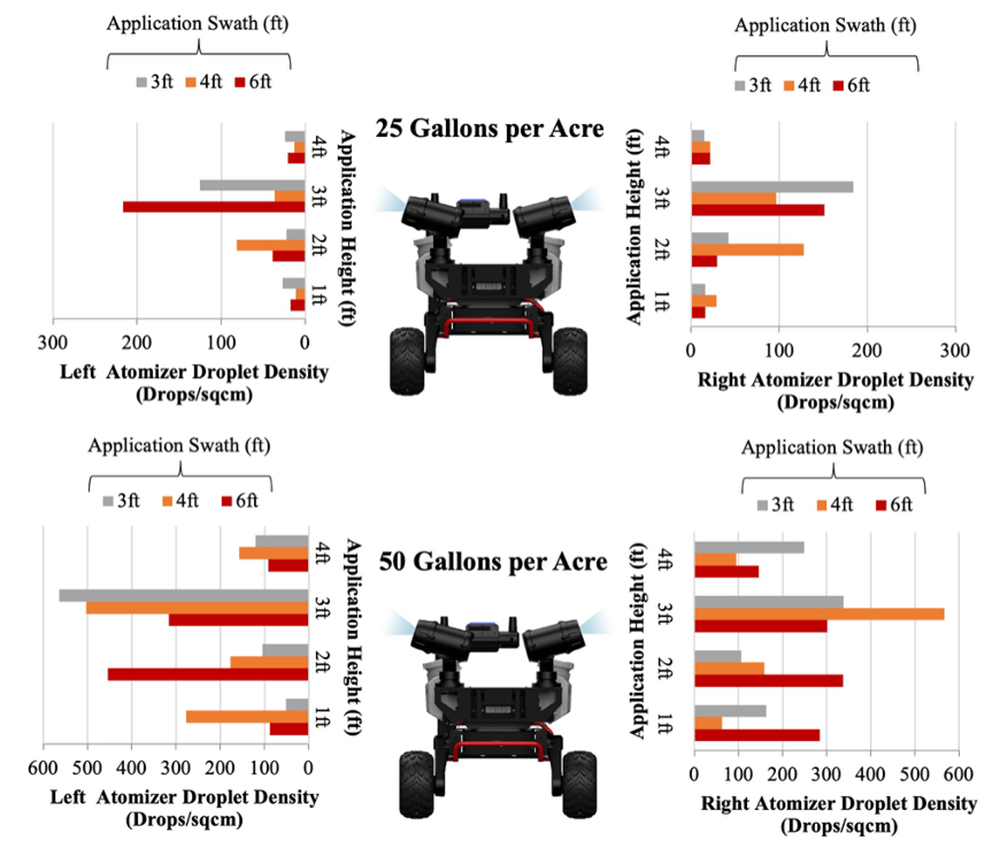
The air-assisted atomizer also achieved a 6-ft spray swath on both sides (Figure 7); however, overall droplet density was substantially lower at 25 gpa compared to the boom attachment. At 25 gpa, droplet density was acceptable only at 3-ft height for all swaths, while at 50 gpa, all heights and swaths provided good droplet density. Mean droplet size for the atomizer was 240 nanometers at 25 gpa and 170 nanometers at 50 gpa, indicating finer droplets at higher output.
Conclusion
Autonomous spraying platforms demonstrated effective but platform-specific performance compared with conventional spraying. Spray drones achieved acceptable fungicide coverage only when operated at 10 gpa, with coverage strongly influenced by canopy position and flight direction, indicating limitations for dense canopies.
The conventional air-assisted sprayer provided consistently high and uniform droplet density, though results suggest potential over-application and opportunities to reduce spray volume. The autonomous robotic sprayer, particularly with the boom attachment, delivered uniform and adequate coverage across canopy heights, while the atomizer required higher rates to achieve similar efficacy.
Reference
Zhu, H. Salyani, M. & Fox, R. D. (2011). A portable scanning system for evaluation of spray deposit distribution. Computers and Electronics in Agriculture, 76(1), 38–43. https://doi.org/10.1016/j.compag.2011.01.003