

Sport fish ponds provide significant opportunities to enjoy the outdoors and enhance property value. Properly managed ponds supply an abundance of fish for recreation and nutrition. The presence of water attracts wildlife of a variety not possible with dry land. Livestock can use ponds as a source of drinking water. Crops and lawns can use ponds as a source of irrigation water. Ponds can be adapted to provide a source of water for fire protection in rural areas. The calming effects of a body of water provide added value to real estate in urban and rural settings. These are some reasons why millions of ponds have been constructed in the United States and why pond construction and renovation continues.
Fish Stocking
Consider your goals for fish production and fishing preferences when choosing a fish stocking program. Balance can be managed for combinations of largemouth bass, sunfish, and channel catfish. Other species can be added as forage fish for the bass, but adding fish species that compete with the bass or sunfish can change the balance in a negative way. The initial stocking rates should consider your fertilization and feeding plans. More fish can be stocked when a routine fertilization schedule is followed than when a pond is not fertilized. High stocking rates and pond fertilization lead to the necessity of frequent fishing to harvest a higher fish production than when lower stocking rates are used.
Largemouth bass are carnivorous fish that usually depend on a natural food source. At least one forage fish species should be stocked with the bass to provide the necessary food for them to grow. In most cases the forage species are bluegill sunfish and red ear sunfish. However, fathead minnows and threadfin shad are sometimes stocked to supplement the sunfish forage base (Figure 1). In some cases hatchery-trained bass will eat pellets of a high-protein feed. Automatic feeders are used to dispense feed at regular intervals so that bass are not allowed to revert back to their forage feeding instincts.

Sunfish are also enjoyed as food and sport by many fishermen and complement the largemouth bass in a pond community. The combination of bluegill sunfish and red ear sunfish allows for diversity in the pond by recognizing that the red ear sunfish eat crustaceans and mollusks to a greater extent than the bluegill sunfish do. Snail control can be accomplished when the proper number of red ear sunfish are stocked and maintained in a pond. Sunfish spawn prolifically and reach spawning age within a few months after hatching. Without a carnivore, like the largemouth bass, sunfish would soon overpopulate the pond and become stunted.
Channel catfish are a fast-growing source of food and fishing enjoyment for the fisherman. Enough catfish are stocked to meet the fishing plans of the pond owner then restocked when most are caught. Small catfish may be eaten by largemouth bass and sunfish may eat catfish eggs if spawning occurs. However, catfish spawning may result in pond overcrowding if fishermen do not harvest enough catfish. Accumulations of large catfish or small catfish can cause serious pond imbalance. A commitment to catfish harvesting must be made before the channel catfish are stocked. Keep records of the catfish caught so that fishing can be increased or catfish can be restocked as needed.
Sources of Fish
Private hatcheries are the major source of fish for stocking private ponds in Georgia. Over the years, hatcheries have been developed throughout the state. These hatcheries provide fish to distributors for more complete coverage of the state. Delivery is available if the pond owner cannot transport fish from the hatchery (Figure 2). Small quantities of fingerling size fish can be transported in oxygen filled plastic bags. Some private hatcheries, usually from out-of-state, arrange to meet pond owners at a central location for fish pick-up.
The health and quality of fish should be excellent when considering the source for stocking. Check the fish quality by talking to past customers or visiting the hatchery before fish are purchased. Dead fish in holding tanks and fish with sores, discoloration, or ragged fins are signs of problems. When fish are delivered, check the fish before they are unloaded.
Fish should be tempered or acclimated to the receiving pond water before unloading in order to avoid adding stress to the transport experience. Change water temperature to match the receiving water at the rate of 10 degrees Fahrenheit over 20 minutes. Transfer the receiving water into the hauling tank by bucket or pump, and measure the temperature change with a thermometer. Cool weather and water reduce the possibilities of transport stress of fish.


Special strains of largemouth bass or bluegill sunfish may be obtained from private hatcheries. The Florida strain of largemouth bass (Micropterus salmoides floridanus) and its hybrid with the Northern largemouth (Micropterus salmoides salmoides) grow faster and have significantly better survival for the first three years than the Northern largemouth bass. Angling success is not different among these strains of bass. Bluegill (Lepomis macrochirus macrochirus) and coppernose bluegill (Lepomis machrochirus purpurescens) may be distinct strains or subspecies. The coppernose, native from the Atlantic Slope to Florida, has been reported to grow faster than bluegill, which is native to the central United States. The coppernose bluegill has a distinct copper colored band across the front of its head and 12 anal fin rays. Coppernose bluegill should not be confused with hybrid bream that are interspecific crosses.
Winter stocking rainbow trout (Oncorhynchus mykiss) has become a common practice in Georgia ponds. A large fingerling (6 inches) should be stocked in November or December for harvest during February to March after feeding and growth to catchable size (Figure 3). Catchable sized trout may be stocked in December for fishing till the end of March (See October stocking options.)
Fish for sport fish ponds should not be obtained from public lakes or streams. Wild fish may not be as adaptable to small static-water ponds as domesticated hatchery fish. Disease organisms may be found on any fish, but are more likely to be carried by wild fish. Transfer of diseased fish from one body of water to another is not legal in Georgia.
Stocking Rates


Bass-bream or bass-bream-catfish combinations are two popular stocking choices (Table 1). These fish combinations were made popular after research during the 1940s and 1950s showed that a balance between largemouth bass and bream (bluegill and redear sunfish) could produce good fishing (Figure 4). Some differences in the stocking numbers are reported for different locations, but this basic approach to sport fish pond stocking is widely accepted.
The sunfish (about 1 to 2 inches) are stocked first in the fall to early spring so that they can spawn before largemouth bass (4 inch) are stocked in early summer. Catfish (8 inches or larger) are usually stocked in the fall or winter, when they are most available. Triploid grass carp are utilized to control aquatic plant growth in ponds and should be stocked in new ponds and every five or six years thereafter. Small grass carp can be stocked in new ponds, but 12-14 inch grass carp should be stocked in older ponds where largemouth bass might eat a smaller fish.
The higher rates for bream stocking are used when trophy largemouth bass are preferred. Additional forage will be available for more rapid bass growth. When the Florida largemouth is stocked, 1,000 bream per acre should be stocked. When catfish are stocked at the highest rates, a regular feeding program should be utilized. Rainbow trout stocked at the higher rate should be fed a high quality trout or salmon feed. Rainbow trout stocked at small sized with large bass may be eaten by the bass as forage.
| Fish Species | Number per Acre of Fertilized Pond | Number per Acre of Unfertilized Pond |
|---|---|---|
| Bream (70-80% bluegill and 20-30% redear sunfish) | 500 to 1,000 | 500 |
| Largemouth Bass | 100 | 50 |
| Channel Catfish (optional) | 100 to 500 | 100 |
| Rainbow Trout (winter only) | 100 to 300 | 100 |
| Sterile Grass Carp (optional) | 5 to 10 | 5 |
Other Stocking Options
Fish production goals sometimes include hybrid bream, hybrid striped bass, crappie, bullhead catfish, or forage fish. Each of these fish would change the balance of a bass-bream population. Some can enhance the bass-bream balance, but most have undesirable consequences. For that reason, these fish are usually stocked alone in small ponds, or in ponds over 10 acres in size that may be large enough to allow them to coexist with largemouth bass and sunfish.
Hybrid bream need ponds with no outflow and no possibility of contamination with other sunfish. A common hybrid sunfish is produced by crossing male bluegill sunfish with the female green sunfish. Other hybrids are more complex crosses among a number of species (For example, Georgia giant sunfish and related crosses). The growth potential for the hybrid may depend on the genetic background of each parent strain or species. Most hybrid sunfish are reported to grow faster than the bluegill, however, not all hybrid sunfish parents may be from domesticated strains or be selected for fast growth. Therefore, investigate the source of hybrid sunfish carefully and obtain referrals from previous hatchery customers. Consider feeding the hybrid sunfish on a floating pellet feed in order to produce larger fish through better nutrition. Hybrid sunfish must be harvested on a regular schedule in order to allow for growth of trophy-size bream. Some individuals in the hybrid population will always reproduce, although not as prolifically as the bluegill or green sunfish parents.
Reproduction among the hybrid bream results in reversion to the adult species through a series of intergrades (progeny with varying degrees of the characteristics of the original species used to create the hybrid). This process continues for only a few generations before a population resembling green sunfish develops. Active harvest of hybrid sunfish can postpone development of a population of crowded intergrades. Reproduction can be controlled with some success by stocking largemouth bass with hybrid bream and allowing the pond to remain bass-overcrowded.
Hybrid striped bass are sometimes stocked as the carnivore species, but require a steady supply of forage fish or feed to be provided. When a good supply of food is available, hybrid striped bass will grow to 2 pounds in two years. The cross between striped bass (Morone saxatilis) and white bass (Morone chrysops) is most common. Bluegill sunfish are not a preferred forage species for hybrid striped bass and a balanced fish population may not occur when these species are stocked together. Fathead minnows or threadfin shad are better choices as forage for hybrid striped bass. Hybrid striped bass have been stocked with some success in ponds larger than five acres and into an established fish population, so that competition with largemouth bass is reduced. Hybrid striped bass have been reported to reduce populations of gizzard shad or golden shiners in ponds with overcrowded forage species. Hybrid striped bass have smaller mouth size than largemouth bass, so they will eat the smaller forage sizes.
Crappie or speckled perch (Pomoxis nigromaculatus) are favorite sport fish in Georgia. However, crappie can be difficult to balance with other fish species. Large ponds of 10 acres or more may be more suitable for crappie-bass-bream populations. Crappie spawning is inhibited by high fish densities. Crappie like relatively clear water in order to see their prey and may not grow well in fertilized ponds with limited visibility. Largemouth bass eggs and fry are eaten by young crappie that were spawned earlier and at cooler water temperatures. Many attempts to produce crappie with bass-bream populations end up as overcrowded crappie-bluegill ponds. For these reasons, a large pond is the best place for crappie (Figure 5) and successful populations can be found in unfertilized ponds with clear water.
Bullheads are traditional catfish species in Georgia that are common in slow moving streams and ponds. The brown bullhead (Ameiurus nebulosus) and yellow bullhead or butter cat (Ameiurus natalis) are preferred for their delicate meat. Bullheads rarely grow larger than 8 or 9 inches in length, although records indicate they can exceed 18 inches. In bass-bream populations, bullheads compete with bream for food and may reduce spawning success by eating eggs out of the nest. Bullheads can be stocked in small ponds by themselves for best fish production. Feed regularly to improve bullhead growth.
Forage fish may be stocked with bass-bream populations to obtain certain management goals. Ponds intended for production of trophy bass need extra forage and special management. When the forage base is bream, aggressive largemouth bass strains may be limited by a shortage of food. Bass in excess of 10 pounds may be produced with additional forage. Fathead minnows should be purchased at least twice a year as a forage supplement. Threadfin shad (Dorosoma petenense) may establish reproducing populations in some ponds. Obtain threadfin shad from knowledgeable sources who can supply a pure population of threadfin without gizzard shad (Dorosoma cepedianum) that look similar to the threadfin when small.
Channel catfish (Ictalurus punctatus) are often stocked alone in ponds that are too small (less than one acre) to balance bass-bream populations. When ponds are not fertilized, they can be stocked with 100 to 200 channel catfish per acre. Fertilization allows an increase to 300 to 500 catfish per acre. Regular feeding is needed to allow stocking between 500 and 2,000 channel catfish per acre. Catfish should be harvested four to six months after stocking when stocked as finglerlings or sooner if larger catfish are stocked. Aggressive harvests of catfish should be used to remove most of the initial stocking before the end of the second year. Channel catfish may begin to spawn during the third or fourth year and cause overcrowding in the pond. Once thought to be difficult to spawn in ponds, channel catfish are now likely to spawn with a minimum of structure, such as beside a board or piling, under a cement block, in a tire, or between tree roots.
Rainbow trout can be produced in earthen ponds as long as water temperatures are cool. At higher elevations in north Georgia, ponds may remain below 70 degrees F for the entire year. However, in south Georgia, rainbow trout can be raised between November and March. Best growth is achieved in ponds when fewer than 1,000 trout are stocked per acre. As many as 3,000 rainbow trout per acre are stocked for heavy fishing pressure. A high quality trout feed must be fed when trout are stocked at higher densities. Rainbow trout are predators and will eat small fish that are one-third of their size, as well as insects, crustaceans, and amphibians.
Fertilization


When the pond owner wants more fish to catch, fertilization allows a greater production capacity for the pond. Freshwater ponds are limited in the amount of phosphorus that is available for plants to use. Plants are the base of the food chain, so fish productivity is ultimately dependent on the amount of phosphorus in the water. Unfertilized ponds may produce less than 100 pounds of fish per acre. If you do not plan to fish often, fertilization may not appeal to you. Also, over-fertilization can cause excessive plant growth or pollute downstream waters.
Fertilization will increase the amount of plant growth in a pond and should cause a bloom of phytoplankton (microscopic algae). Normal blooms allow visibility of 12 to 18 inches into the pond water, using a Secchi disc or light colored object (Figure 6) held downward into the water. Phytoplankton and bacteria grow on the fertilizer nutrients and, in turn, feed zooplankton (microscopic animals). Zooplankton is a food for young fish and filter feeding fish, which provide the forage base for largemouth bass. In this way, inorganic nutrients in fertilizer are converted into extra fish mass.
Fertilizers are available in a variety of forms, and pond owners may develop their own preference. Granular fertilizers have been used to increase fish size and population numbers since the concept of bass-bream ponds was first developed. Liquid fertilizers are relatively affordable and may be easier to apply than granules. Powder fertilizers are more expensive, but do not require dilution before application. Timed or slow release fertilizers are most expensive but allow seasonlong fertility in one application.
Fertilizer rates for fish ponds were originally based on the rate of 8 pounds of soluble phosphate per surface acre (Table 2). Balanced nitrate and phosphate formulations were used to develop that recommendation. When liquid fertilizers became popular, a ration of 1:3, nitrate to phosphate, was used in order to maintain the liquid form of the fertilizer. Recently, nitrate to phosphate ratios have approached 1:5 in powdered fertilizers and slow release fertilizers. Fertilizer results will vary from pond to pond because of differences in pond water alkalinity and soil chemistry. High alkalinity water (greater than 150 ppm calcium carbonate) reduces the solubility of powdered fertilizer. Soil chemistry determines the amount of phosphate that can remain dissolved in the water column. That relationship will be presented in the section on liming.
| Form | Composition N – P – K (%) | Amount per Application |
|---|---|---|
| Granular | 20-20-5 | 20-40 lb/A |
| Granular | 10-10-10 | 40-80 lb/A |
| Granular | 8-8-8 | 50-100 lb/A |
| Granular (Floating Bucket) | 18-46-0 | 4-10 pounds/A |
| Liquid | 10-34-0 | 1 gallon/A |
| Liquid | 10-30-0 | 1 gallon/A |
| Liquid | 13-37-0 | 1 gallon/A |
| Powder | 12-48-8 | 4-10 pounds/A |
| Powder | 10-52-4 | 4-8 pounds/A |
| Coated Granule (Slow Release) | 10-50-0 | 25-40 pounds/A Annually |

Fertilizer application requires that the fertilizer be kept from contact with the pond soil. Platforms or water soluble fertilizers are used to dissolve the nutrients into the water column where algae can utilize them. Phosphate will bind to clay in soil if allowed to fall to the bottom of the pond. Application of fertilizer to turbid water is not recommended. Start fertilizing when water temperatures reach 70 degrees Fahrenheit, but stop in the fall as the water temperature drops below 70 degrees.
Granular fertilizers are usually placed on a platform where water currents can dissolve the nutrients into the pond water column. A platform can be constructed from decay resistant lumber that is 6 feet square and sets about 18 inches below the water surface. Some platforms may have a walkway to allow easier access.
An alternative method uses the plastic bag that fertilizers usually are shipped in. By laying the bag in shallow water and cutting an X across the upper flat side of the bag, nutrients will dissolve into the water column over time. Bags are staked to the pond bottom to prevent them from floating away when all of the fertilizer is dissolved. Slow release fertilizers may be sold with a plastic tray included. The tray is staked to the pond bottom and the fertilizer is placed inside.
Fertilization should begin when water temperature stabilizes above 60 degrees F, possibly in late February and no later than April. Application may be repeated at two-week intervals until a phytoplankton bloom develops. Applications are then based on the density of the bloom and are applied about once each month until October, whenever the visibility exceeds 18 inches. It is common to make 10 or 12 fertilizer applications per year. Liquid fertilizer application follows the same pattern. Powders also follow that pattern, unless they are used with slow release fertilizer. In static water, the slow release fertilizer will provide bloom-sustaining nutrients for the entire season. Do not fertilize until aquatic weeds or filamentous algae are controlled.
Liming
Ponds are limed in order to change the soil pH from acidic to slightly basic. Most soils in Georgia require some liming; however, soils with limestone or marl deposits will probably not need to be limed for fish pond management purposes. Also, ponds that are filled using well water from limestone aquifers need little or no liming. Changing the acidity of soils allows them to release phosphorus more easily so that plants can use this nutrient for growth. Calcium carbonate in lime buffers the pH in the pond water so that changes during the day may not be great enough to cause distress to the fish.
The amount of lime needed per acre can be determined by analysis of a soil or water sample. Soil pH can be checked by submitting a sample to your county Extension agent. Water is used to determine lime requirement by checking the pond water alkalinity or measuring water hardness. Water pH may not be a good indicator of lime requirement since the pH changes during the day due to the release and consumption of carbon dioxide by aquatic organisms. A pond with low alkalinity may change from pH 6.5 to pH 10 between morning and afternoon. Higher alkalinity buffers pH, so pH changes between 7 and 8.5 would be expected. In some cases pond water pH may indicate the presence of dissolved organic acids like tannic acid (pH between 4 and 6). Certain ponds may have deposits of peat or decaying leaves that lower pH (below 4) to levels that are too acidic to support fish life. In some cases, basic water is caused by hydroxide pollution or after hydrated lime is added to pond water.
When pond water hardness is above 20 parts per million, additional lime is not recommended (Figure 7). Enough phosphorus is released from the pond soil under those conditions to allow phytoplankton to grow, supplying the basis for the pond food chain. Phytoplankton blooms are stimulated by the fertilization schedules mentioned previously. Water alkalinity should also be above 20 ppm calcium carbonate. Hardness and alkalinity may each be taken into consideration to determine lime requirement. Both are reported as a measure of calcium carbonate (lime), however, alkalinity is described as the ability of water to neutralize acid while hardness is the concentration of minerals in the water. In Georgia, water samples are analyzed for specific minerals when submitted to University of Georgia Extension. The calculated hardness is used to recommend liming for ponds.
Lime requirement should be checked periodically in order to allow effective pond fertilization. Water hardness and alkalinity can decrease over time due to rainfall and dilution from runoff. Ponds constructed across streams may not be able to retain enough alkalinity or fertilizer to allow management of phytoplankton blooms. Most ponds are limed but once every four years. Checking water hardness can indicate a need for lime application.
Agricultural lime is the most common source of lime. Agricultural lime is a combination of calcium and magnesium carbonates. It is recommended that about 2 mg magnesium per liter of pond water should be available in fish ponds. Several types or grades of agricultural lime are available. The coarser types may be less soluble and lime from some sources may be hard to dissolve due to their mineral composition. A lime that passes through 400 mesh screen is best for ponds. Lime takes about three months to dissolve and should be applied that far in advance of the spring fertilization period. Liquid lime (a suspension of fine particles of agricultural limestone) is useful because it dissolves quickly and can be easier to apply than bulk granular limestone.
Hydrated lime (builders lime or calcium hydroxide) can be applied to ponds to satisfy the lime requirement. More soluble and finely powdered, hydrated lime may increase pond water pH rapidly, causing a fish kill. CAUTION: Hydrated lime is extremely caustic and can cause irreversible eye damage when the fine powder is blown into the eye or if the eye is wiped by a contaminated hand. Hydrated lime is not recommended for casual use and should be applied by experienced applicators.
It is best to apply less than 100 pounds of hydrated lime per surface acre at weekly intervals until the lime requirement is met. Hydrated lime applications may need to be repeated every six to eight weeks in order to prevent a decline in water hardness.
Liming ponds allows use of algicides that contain copper. Since copper is more toxic when pond water alkalinity is low, lime can be used to increase alkalinity and reduce the toxicity of copper to fish. Trout, koi carp, and blue catfish have a lower tolerance to copper than do sunfish, bass, grass carp, or channel catfish. It is important to avoid using copper unless the alkalinity of pond water is higher than 40 mg per liter.

Feeding
When channel catfish are stocked in ponds, supplemental feeding is very important. Stocking rates of less than 100 catfish per acre can be sustained for a few years without feeding, but feeding should begin after the third year. Channel catfish spawn readily in ponds using any shelter they can find or digging out under the pond bank. Over the years, domestication of catfish has overcome their reluctance to spawn in static water ponds. Therefore, catfish can restock themselves, and overstocking can occur with uncontrolled catfish spawning. Supplying adequate feed for the catfish until they can be caught is necessary to prevent stress and disease in undernourished catfish. In order to get rapid catfish growth, feed all they will eat in a 15 to 20 minute period each day. Avoid feeding during cloudy weather when oxygen depletion is a danger. Discontinue feeding during very cool weather when water temperatures are below 65 degrees F.
Supplemental feeding can improve bream growth under certain conditions, but do not think that all bass-bream ponds must be fed. Bluegill sunfish have been grown to over 1 pound in size by using supplemental feeding. A high quality fish feed of 1/8- to 1/4-inch diameter should be used to feed bream. The feed should also contain between 32 percent and 36 percent protein. As with catfish, feed what the fish will consume in less than 15 to 20 minutes. However, bream are not fed in the same manner as commercial fish farms that feed high densities of fish. Special feed formulations (sport fish diets) are used as a supplemental ration for bream. Automatic feeders (Figure 8) can be used to ensure regular feeding and allow several feedings per day. Hybrid sunfish will also benefit from supplemental feed. However, stunted bream populations cannot be improved by using supplemental feeding. Other methods for correcting bream overcrowding will be explained in the section on fishing methods.
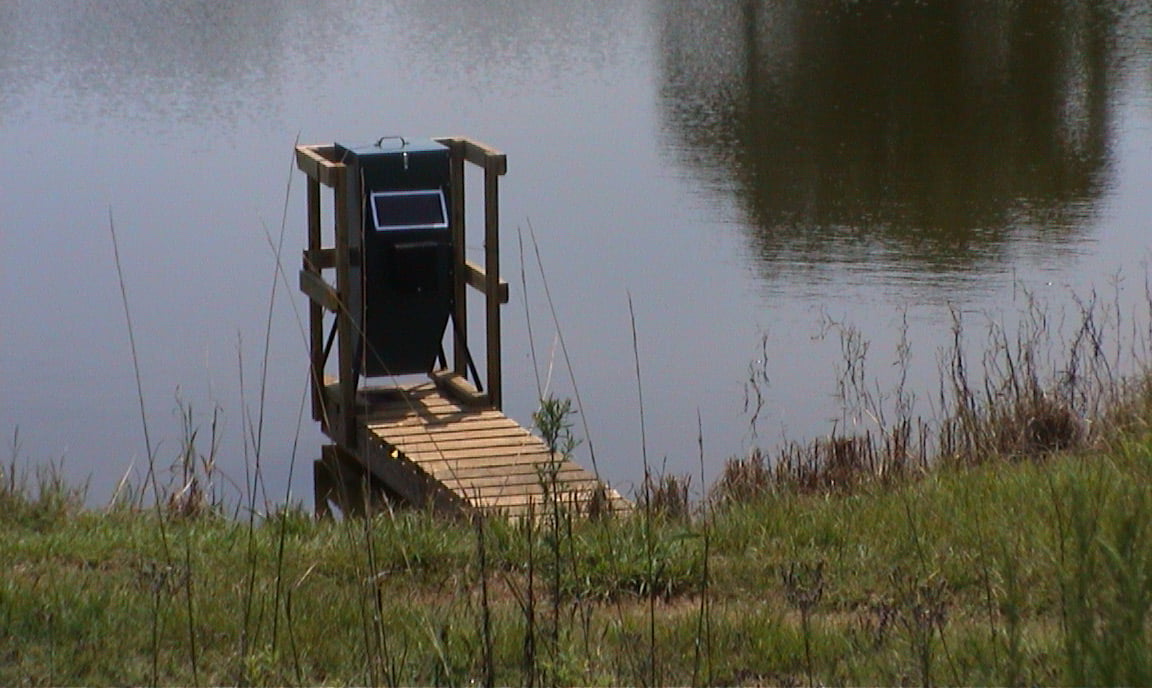
Feed amounts must be adjusted seasonally. Fish eat more in warm weather than in cold. It is not necessary to feed catfish or bream when water temperatures cool to less than 70 degrees F. Also, in the hottest part of summer, feed amount should be reduced to account for slower feed consumption and the risk of oxygen depletion. Some feed reduction during changes in weather may also be advisable. Feed quantity or frequency can be reduced for a few days as a low-pressure front passes by. Feed should be reduced or withheld after a few days of cloudy weather. When feeding more than 30 pounds of feed per acre per day, aeration should be available to protect from eventual oxygen depletion. In most bass-bream ponds, 10 pounds of feed per acre per day is adequate to support the fish.
It is important to remember that oxygen depletion can occur even when ponds are not fed.
Fishing Methods
The first step to good pond management is setting goals for the type of fishing that you want. Once a goal is established, rules for catching, releasing, feeding, or fertilizing can be set.
Fishing should not begin until June of the year following bream stocking and largemouth bass should not be removed until the second year after a successful spawn has been observed. This rule applies to any bass-bream pond since the biology of both species requires managed harvest to prevent overcrowding of bream or over-fishing of bass. Several points must be considered:
- Catching bream as soon as they become mature (three to four months into first growing season) starts the bream harvest and helps the bass control bream reproduction.
- Preserving bass until after their first spawn allows the bass to help manage bream numbers and provides bass replacements for the bass that are caught.
- Largemouth bass diminish in numbers even without fishing, and male largemouth bass seldom reach five years of age.
- Removal of intermediate sized bream (4-6 inches) and bass (14-18 inches) helps develop a population of trophy-sized fish by removing competition.
Bream serve as the forage base for largemouth bass and must be managed to provide enough food for bass growth but not allowed to overpopulate and stunt their own growth. Bream must be removed on a regular basis from the pond, either by the bass or by anglers. Set goals for bream fishing based on Table 3 and monitor the size of bream caught. It has been said, “Never return bream to the pond, regardless of size.” In overcrowded bream ponds, a bluegill may be only 3 inches long, but fully mature. Removal of intermediate sized bream, between 4 and 6 inches long, will encourage growth of the larger bream to trophy size (Figure 9).
| Species | Unfertilized Pond | Fertilized Pond |
|---|---|---|
| Bream (first year) | 40 pounds (120 fish) | 80 pounds (320 fish) |
| Bream (later years) | 40 pounds (120 fish) | 150 pounds (600 fish) |
| Largemouth bass (second year) | 10 pounds (8 fish) | 20 pounds (15 fish) |
| Largemouth bass (later years) | 10 pounds (5 to 8 fish) | 35 pounds (15 to 20 fish) |

Due to the relatively slow growth of bluegill sunfish, plan to wait four years until trophy bluegill, above 1 pound, are caught. Since bluegill seldom exceed six years of age, remove bluegill when they are caught; you may not get a chance to watch the big ones grow any larger if bluegill growth is slow due to overcrowding. Large ponds and lakes may develop larger bluegill because more food is available and more space is available to allow the fish to escape capture by bass or anglers while they grow to trophy size.
Largemouth bass management depends on control of the bass harvest. It takes a commitment to record keeping and catch limits in order to maintain a pond with bass that you may want to hang on your wall (10 pounds or larger). Use the catch limits in Table 4 to maintain control of the bass harvest. Catch and remove bass when they reach 14 to 18 inches. Also, check for signs of bass overcrowding, then remove any stunted 10 to 12 inch bass. Bass stunting from overcrowding (Figure 10) is an indicator of a pond that is under fished. Ponds with little fishing pressure will not produce the weights and numbers of fish that are listed in this publication.
| Catch | Population Condition |
|---|---|
| – Bluegill 6 inches and larger – Bass average 2 pounds, but other sizes are caught | Populations are balanced (Figure 9) |
| – Bluegill 3 to 5 inches – Bass are hard to catch | Bream population is overcrowded |
| – Bluegill larger than 1/3 pound – Bass less than 1 pound | Bass population is overcrowded |
| – Small crappie, sunfish, bullheads, carp, suckers, or shiners | Other species are competing with the bass and bream populations |


Abstaining from fish harvest will allow the pond to revert to a wild condition with low fish numbers of relatively small size. If a fertilization program is continued with limited fishing pressure, overcrowding may have disastrous consequences and possibly result in a fish kill.
Supplement the bream forage with other forage fish to get a few extra pounds on trophy bass. Managing for large bass allows intermediate and large bream to become prey to bass. A bass in the 10-pound range can easily eat a 1/3-pound bream. Bream reproduction in trophy bass ponds may diminish to a point that supplemental forage stocking is needed. Threadfin shad or fathead minnows are the common forage options for stocking Georgia ponds. These fish should be stocked in cooler months, when they handle easier, so that they may have an opportunity to spawn in the spring. Successful spawning can occur by stocking 600 threadfin shad or 2,000 fathead minnows per acre. When a decline in forage numbers is noticed, restock as needed.
Structure in a pond helps anglers harvest more fish. While structure will not increase the number of fish, it concentrates the ones that are there. If a pond is constructed with brush piles, ridges, or rock piles, locate the structure at different depths. After a pond has been filled, add structures such as Christmas trees, hardwood limbs, or man-made structures.
Fish populations should be monitored by angler catch records, electro-fishing, or seining. Most pond managers should be able to keep records of the size, number, and species caught from their ponds (Table 4). Use the harvest goals that were set when the pond was stocked, fish the pond accordingly. All anglers who fish the pond should leave a record of the fish they catch (Figure 11). Some ponds have a mailbox for depositing fishing records for the manager to check.
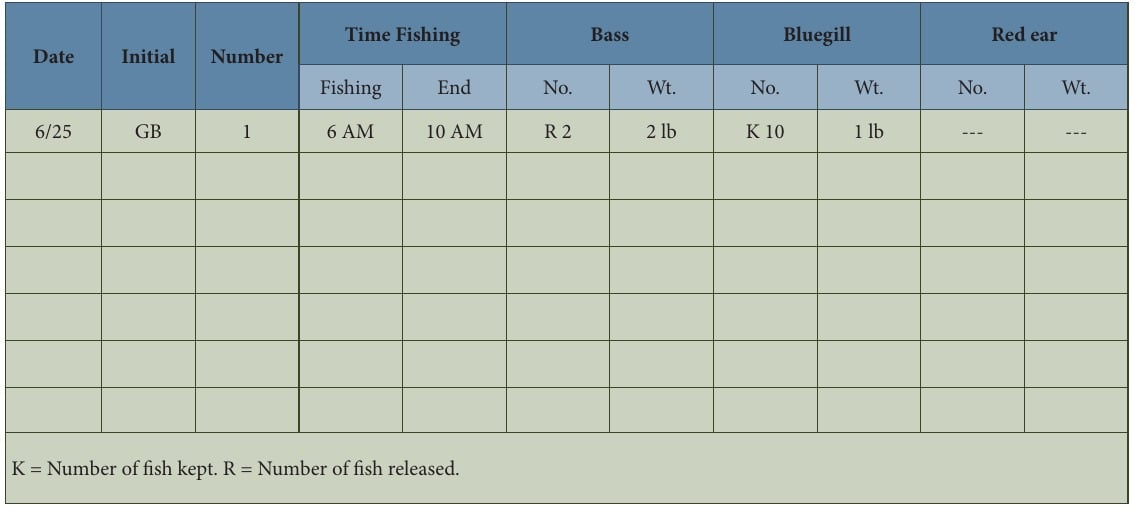
However, when angler catch records are not kept, electro-fishing (Figure 12) or seining can be use to check population balance. Electro-fishing requires a specially rigged boat that can navigate where the fish are to temporarily stun them causing them to float to the surface where they can be counted, weighed, and identified. Large mouth bass may be sampled more effectively if electro-fishing is done at night. Seining with 25- and 50-foot seines allows the shoreline fish to be sampled. Small fish can be caught in this manner to determine the success of fish spawning. Large fish are usually not caught by shore seining.

The weight of a fish relative to a standard weight shows if the fish is getting enough to eat or not. The condition of a fish can indicate the balance between that fish and other fish in the pond of its own species and predator or prey species. For example, if a bass is thin, there may be too many bass and too few bream. Use the tables 5, 6, and 7 to compare standard weights to the weight of fish caught from a pond. If the weight is within 90 percent of the standard weight, conditions are okay. If the fish are 80 percent or less of the standard weight, improvements should be made to correct the pond management system. Catch bass to remove completion and increase bass weight, or add more forage to improve bass nutrition. Stunted bream populations may require pond renovation.
| Length, inches | Weight, ounces (pounds) |
|---|---|
| 12 | 14.4 (0.9) |
| 14 | 20.8 (1.5) |
| 16 | 35.2 (2.2) |
| 18 | 51.2 (3.2) |
| 20 | 72 (4.5) |
| 22 | 99.2 (6.2) |
| 24 | 129.6 (8.1) |
| Length, inches | Weight, ounces (pounds) |
|---|---|
| 3 (first year) | 1.25 (0.075) |
| 4.5 (second year) | 2.5 (0.15) |
| 6 (third year) | 3.2 (0.2) |
| 7.5 | 4.9 (0.3) |
| Length, inches | Weight, ounces (pounds) |
|---|---|
| 5.3 | 1.2 (0.07) |
| 6.3 | 1.7 (0.11) |
| 8.0 | 3.5 (0.22) |
| 10.0 | 7.2 (0.45) |
| 11.0 | 9.2 (0.57) |
| 12.0 | 12.3 (0.77) |
Renovating Fish Populations
When pond fish populations are out of balance and there is no acceptable stocking or harvesting method to restore balance, the pond may need to be renovated by draining, drying, and refilling before stocking a new fish population. If the pond can be drained, some of the fish may be salvaged for future use or sale. However, most recreational fish ponds were not constructed so that fish could be seined or netted from shallow water. Ponds may have shallow puddles to holes with 3 or more feet of water that cannot be easily drained. In those cases, a chemical fish toxicant may be used to complete the renovation.
Rotenone can be used to eliminate unwanted fish to make a new start on balancing the pond fish population. Rotenone is effective in ponds with deep water. Several formulations containing rotenone have been developed that have different effective rates that depend on the water depth, water temperature, and fish species. Rotenone biodegrades in four days during the summer, but may last for five weeks in the winter. Avoid applications where overflow of the treated pond may drain into other fish-bearing water. Detoxify rotenone by applying an equal amount of potassium permanganate or chlorine. Rotenone products must be used according to their label instructions and are restricted use pesticides. A certified pesticide applicator must be directly involved in application of rotenone and appropriate permits and permissions must be obtained.
For drained ponds with damp soil or puddles, hydrated lime can be used as a pond renovation aid. Between 500 and 1,000 pounds of hydrated lime per acre is needed to kill remaining fish and sanitize the pond bottom. CAUTION: Wear dust masks and eye protection when applying hydrated lime in order to prevent contact with eyes and respiratory passageways. Wait at least a week after refilling before stocking fish so that pH will be less than 9.
Chlorine, as calcium hypochlorite, can be used for pond renovation and sanitation. A rate of 80 pounds per acre-foot of water is effective for fish removal in most cases. However, turbid water reduces the effectiveness of the treatment. CAUTION: Wear dust masks and eye protection when applying calcium hypochlorite in order to prevent contact with eyes and respiratory passageways. Avoid breathing chlorine fumes. Allow a week before stocking desirable fish, so that chlorine will have dissipated.
References
Anderson, R. O. and Neumann, R. M. 1996. Length, weight, and associated structural indices. Pp. 447-482. In B. R. Murphy and D.W. Willis (eds.) Fisheries Techniques. American Fisheries Society, Bethesda, Maryland.
Boyd, C. E. and Sowles, J. W. 1978. Nitrogen fertilization of ponds. Transactions of the American Fisheries Society 107(5): 737-741.
Brunson, M. W., Stone, N., and Hargreaves, J. 1999. Fertilization of fish ponds. Southern Regional Aquaculture Center Publication 471. Mississippi State University, Mississippi State, Mississippi. 4 pp.
Carlander, K. D. 1977. Handbook of freshwater fishery biology, volume two: Life history data on Centrarchid fishes of the United States and Canada. Iowa State University Press, Ames, Iowa. 431 pp.
Neuman, M. 2003. Sport fish management in Alabama ponds. Alabama Department of Conservation and Natural Resources, Division of Wildlife and Fisheries. Montgomery, Alabama. 24 pp.
Prentice, J. A. and Schleckte, J. W. 2000. Performance comparison between coppernose and native Texas bluegill populations. Proceedings of the Fifty-fourth Annual Conference, Southeastern Association of Fish and Wildlife Agencies. 54:196-206.
Rice, J. S., Noble, R., and Curry, R. 2010. Pond Management Guide. AG-424 (revised). North Carolina Wildlife Resources Commission and North Carolina Cooperative Extension Service. Raleigh, North Carolina. 31 pp.
Swingle, H. S. 1950. Relationships and dynamics of balanced and unbalanced fish populations. Agricultural Experiment Station Bulletin 274. Alabama Polytechnic Institute. Auburn, Alabama. 74 pp.
Swingle, H. S. and Shell, E. W. 1971. Tables for computing relative conditions of some common freshwater fishes. Agricultural Experiment Station Circular 183. Auburn University, Alabama. 55 pp.
Wright, R. and Masser, M. 2004. Management of recreational fish ponds in Alabama. ANR 577. Alabama Cooperative Extension Service System, Alabama A&M and Auburn University. Auburn University, Alabama. 22 pp.
Original manuscript by George Lewis, Warnell School of Forestry and Natural Resources. Revised by Gary J. Burtle, Extension Fisheries Specialist, Department of Animal and Dairy Science.