Forestry Resources
-

This publication describes Macrocybe titans, the largest mushroom species in the Western Hemisphere, which has been found growing in Georgia.
|
-
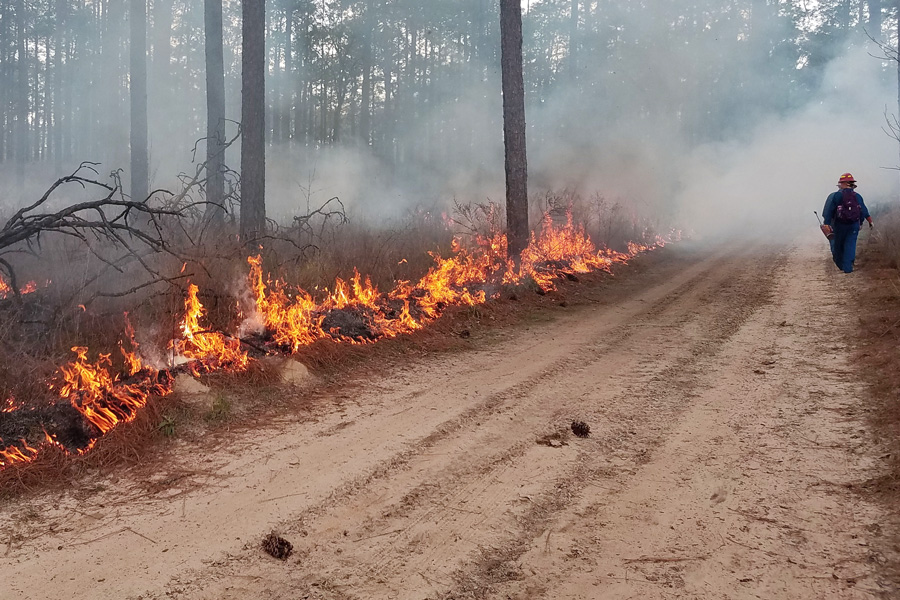
This 220-page Extension publication was written with landowners in mind, presents fire concepts in an easy-to-read manner, and will help you set and meet your burning goals. The diagrams and pictures illustrate and simplify fire concepts from wind direction to atmospheric conditions, firing techniques, and more. This guidebook will take you step-by-step through the processes involved in planning, preparing for, and conducting a prescribed burn on your land. The Guidebook’s four action chapters (Getting Started, Planning, Conducting, and Evaluating) start with checklists full of action items followed by detailed information on each item. In the Guidebook’s four informational chapters, you can take a deeper dive into key prescribed burning concepts including weather, smoke management, fuel, and fire behavior. Collaborators include NC State University and Auburn University.
|
-

AP 130-2-13
Timber Situation and 2024 Outlook
1. Demand for softwood lumber and structural panels is expected to improve as interest rates drop and single-family housing starts resume their long-term trajectory.
2. Increased softwood lumber mill capacity across the South adds upward pressure on pine sawtimber prices; however, the region’s oversupply of sawtimber trees on the stump is expected to exert strong downward pressure on prices.
3. Pulpwood prices are expected to decline (at a slower pace) and stabilize in the second half of 2024.
Forecast by Yanshu Li, UGA, Associate Professor and Forest, Economics, and Taxation Specialist; Joe Parsons, UGA, Director of the Harley Langdale, Jr. Center for Forest Business; Amanda Lang and Pat Jolley, Forisk Consulting|
-

AP 130-1-11
Timber Situation and 2023 Outlook
1. Inflation remains a persistent
challenge.
2. Housing activity is beginning
to moderate.
3. U.S. South softwood lumber
market share is increasing
along with production
capacity. Plentiful
timber supplies and capital
expenditures are positives. Authors of this section are Tyler Reeves and Amanda Lang, Forisk Consulting; and
Joe Parsons and Yanshu Li, Harley Langdale Jr. Center for Forest Business,
Warnell School of Forestry and Natural Resources, University of Georgia|
-

Accidents are common when felling a tree with a chainsaw. Fortunately, most of them can be prevented. Tips for preventing kickback, barber chair, entanglement, setback, and stump jump are presented in this publication, along with techniques for safely releasing spring poles.
|
-

David R. Coyle, A. Brady Self, James D. Floyd, and John J. Riggins
Four species of Ips bark beetles (also commonly known as Ips engraver beetles or Ips beetles) occur throughout pure and mixed pine forests in the southeastern U.S.: the six-spined ips (Ips calligraphus), the pine engraver (Ips pini), the eastern five-spined ips (Ips grandicollis), and the small southern pine engraver (Ips avulsus). Ips beetles appear similar to other bark beetles in this region, including the southern pine beetle (SPB), black turpentine beetle, and red turpentine beetle. These beetles occur throughout the entire southeastern U.S., with the exception of the pine engraver and red turpentine beetle, which are found only in the Appalachian region.
|
-

Private forest owners control most of the southern forest resource and are critical to maintaining forest health in the South. Record droughts, rising temperatures, increased frequency and intensity of wildfires, insect and plant invasions, and more intense storm events all pose threats to the health of Southern forests. Scientists project that increases in temperature and changes in rainfall patterns will cause these disturbances to become more common, occurring with greater intensity or duration. This pamphlet reviews healthy forest strategies and approaches to decrease the risks associated with these disturbances on your forestland.
|
-

J. Holly Campbell and David R. Coyle, Southern Regional Extension Forestry
Littleleaf disease is a forest health concern for several pine species in the southeastern United States. This disease is a particular problem for shortleaf pine (Pinus echinata Mill.) and is one reason why this species is less widely planted compared with other pines. Littleleaf disease results from a combination of biological factors and site characteristics, when combined with a susceptible host tree. Some factors are more important – i.e., they have a primary role in disease formation – while others have a secondary role, and mostly contribute to making disease symptoms worse.
|
-
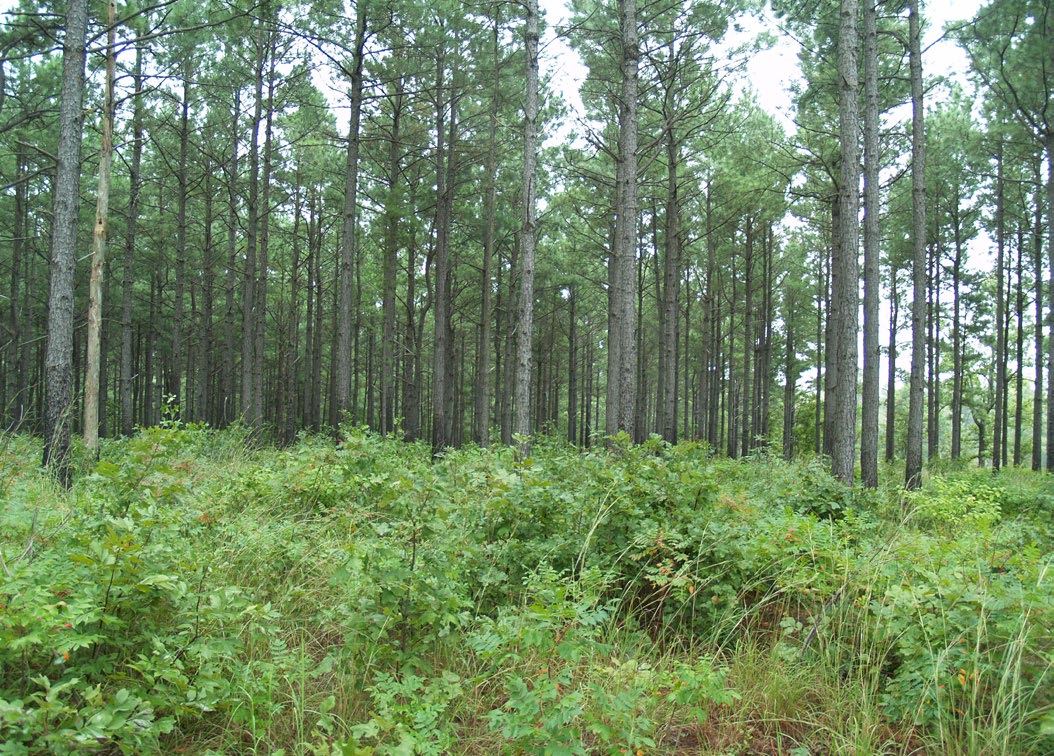
Shortleaf pine and its associated plant communities evolved with fire of varied temperatures, or mixed severity, and a fire return interval, or frequency of 2–18 years. Across its wide range, shortleaf is found growing with blackjack, white, and post oaks; trees that have similar adaptive traits and fire resistance. The high diversity and number of herbaceous understory plants and wildlife found in shortleaf savannahs and woodlands is sustained with frequent prescribed burns. Due to its reliance on fire, foresters and ecologists commonly refer to shortleaf as fire resistant, fire resilient, fire dependent, or fire adapted. However, shortleaf pine is not fire-proof. And while fire provides many benefits there are risks. Some trees, particular seedlings and saplings will be damaged or destroyed from fire. Land managers must base the decision to burn on their overall management goals.
|