
What is a Total Maximum Daily Load (TMDL)?
A TMDL is a calculation of the maximum amount of a pollutant that a water body can receive and still meet applicable water quality standards. TMDLs identify waterbody impairments, the causes of impairments, and the pollutant load reductions needed to meet water quality standards. When a pollutant impairs the integrity of a waterbody, a TMDL is developed to balance the assimilative capacity of that waterbody with pollutant load contributions from all point-sources (PS) and nonpoint sources (NPS) within that waterbody’s contributing watershed. The calculation includes a margin of safety (MOS) to account for uncertainty and ensure that a waterbody will meet and continue to meet water quality standards.
Why might a stream or river need a TMDL?
The goal of the Clean Water Act (CWA) is to “restore and maintain the chemical, physical, and biological integrity of the Nations Waters.” Section 303(d) of the Clean Water Act requires that all states list waters not meeting water quality standards. The Georgia Environmental Protection Division (EPD) sets water quality standards and is responsible for listing waters that do not meet these standards in the State of Georgia. If a water body does not support its designated use (drinking, recreation, fishing, wild/scenic rivers, or coastal fishing), it is considered “impaired” and is a candidate for TMDL development. Each impaired water body can have multiple TMDLs, one for each water quality standard violated. The CWA requires public involvement for TMDL development, which typically includes a period of public comment. Once a TMDL is developed, a TMDL implementation plan or other mechanisms is used to reduce pollutant loads and restore water quality so that a steam supports its designated use. The current list of impaired streams segments can be found on the EPD website (web address provided in “Contacts and More Information”)
TMDL terminology
Clean Water Act is a series of legislative acts that form the foundation for protection of U.S. water resources. CWA Sections 305(b) and 303(d) deal specifically with water quality assessment and TMDL development.
Nonpoint source (NPS) pollution is any pollution that does not come from a point source. Nonpoint sources are much harder to pinpoint. Runoff from urban areas (parking lots, yards, roads, etc.), construction sites, and agricultural fields are considered to be nonpoint sources.
Point source (PS) pollution loads discharged from a single point or location such as a pipe, outfall or conveyance channel associated with an industrial, or municipal waste treatment facility.
TMDL Implementation Plan is a document detailing the suite of corrective actions needed to reduce pollution and remediate an impaired water body. When fully implemented, the plan should result in a water body that supports its designated use.
Water body refers to a segment of a river, stream, lake, wetland, coastal water, or ocean water that is under the jurisdiction of the United States.
Water Quality is the biological, chemical and physical condition of a water body, and its ability to support beneficial uses.
TMDLs have been conducted in all of Georgia’s major river basins. TMDLs conducted in Georgia over the past six years have focused on fecal coliform bacteria (pathogens), fish consumption guidelines, metals, sediment (biologic integrity) and dissolved oxygen (DO).
Georgia EPD organizes TMDL data by major river basin and posts information on steam reaches with water quality violations, public notices for draft TMDLs, TMDLs, TMDL implementation plans, and tools for watershed planning on their website: https://epd.georgia.gov/tools-total-maximum-daily-load-tmdl-implementation-and-watershed-planning
Establishing TMDLs
The state of Georgia is responsible for developing a schedule for establishing TMDLs and for prioritizing water bodies identified as impaired.
Ideally, a TMDL should be set for a water body within 8 to 13 years of being listed. The schedule takes into account the number of impaired segments; length of river miles, lakes, and other water bodies needing TMDLs; proximity of impaired segments to each other; number and complexity of the TMDL; availability of models and monitoring data; and significance of environmental threat the impairment poses. Another portion of the schedule is the prioritization of the impaired water bodies. Water bodies with severe pollution and water bodies that are often in direct contact (recreation, drinking water) with humans are given higher priority than those with less severe pollution.
How are TMDLs calculated?
Total Maximum Daily Loads are calculated through the use of a mathematical equation. The formula used to calculate the TMDL is:
TMDL = WLA + LA + MOS
Where:
WLA (waste load allocation) = daily load of pollutants permitted as point source discharges
LA (load allocation )= amount of pollution that nonpoint sources can discharge
MOS (margin of safety )= margin of safety
How are WLA, LA, and MOS determined?
WLAs are determined by summing “direct” and “upstream” contributions. Direct contributions are point source loads that directly discharge into the impaired segment. Upstream contributions are point source loads on an upstream segment that are transported to the impaired stream segment. Upstream segments can be the same channel or tributaries.
LAs are calculated using computer models that predict loads from nonpoint sources based on land use, existing water quality, weather data, flow, topography, soils data, etc.
MOSs can be determined by specifying a portion of the TMDL as the MOS.
What information is needed to set a TMDL?
- Maps of watersheds and sub-watersheds
- Impaired streams, rivers and lakes
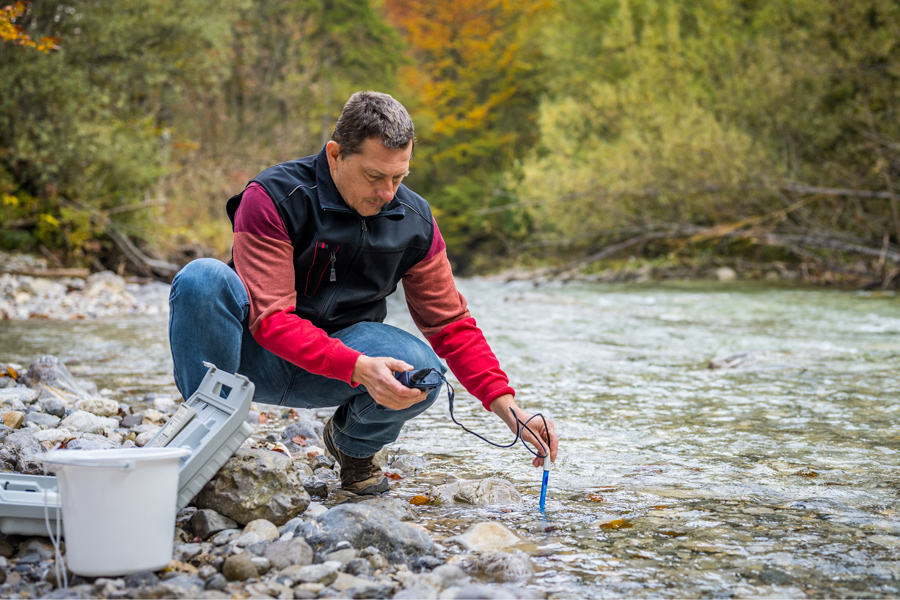
- Data from water quality monitoring stations
- Meteorological information
- Land use within the watershed
- Flow rates for all streams
- Data from permitted point sources
- Topography of the watershed
- Watershed characteristics (septic tanks, roads, agricultural operations)
How Does a TMDL Help Meet Applicable Water Standards?
TMDL implementation plans
The TMDL helps meet applicable water standards through implementation plans. The goal of an implementation plan is to recommend management practices for point and nonpoint source pollution producers to help meet the suggested TMDL for the river or stream in question. Since TMDLs are developed based on water quality standards, it follows that meeting a TMDL for a water body will meet water quality standards and should expedite a stream or river’s removal from Georgia’s List of Impaired Waters.
The preparation of implementation plans is a two-step process: Initial Implementation Plans included in the TMDLs are succeeded by the preparation of more comprehensive Revised TMDL Implementation Plans. The initial generic plans include a list of potential management practices, the BMP implementation demonstration projects, and schedules for the preparation of revised implementation plans. Revised implementation plans may be prepared by the Georgia Environmental Protection Division or regional planning organizations with the participation and support of local governments and stakeholder groups.
Initial TMDL implementation plans
The initial implementation plan is developed by either the EPD or an EPD contractor (normally a local RDC). The initial plan includes:
- Management strategies (best management practices) for controlling nonpoint sources of pollution as they are the primary cause of pollutant loading in most cases. Point source allocations are addressed through effluent limitations in NPDES permits
- Recommendations for best management practices
- Distribution of public information
- A schedule for preparation of revised implementation plans
Revised TMDL implementation plans
A revised implementation plan supersedes the initial implementation plan. The revised implementation plan is developed by either the EPD or an EPD contractor with input from local officials and stakeholders. The following tasks are involved in converting initial plans into revised plans.
- Characterize watersheds (land use, weather info, population, etc.)
- Identify stakeholders
- Verify the present water quality problem (through local monitoring)
- Identify probable sources of pollutants
- Identify potential regulatory or voluntary actions to control pollutants
- Determine measurable milestones of progress
- Develop a monitoring plan
- Complete and submit the revised implementation plan to EPD for approval
How is a river or stream removed from Georgia’s list of impaired waters?
If it is determined, through scheduled monitoring, that a water body is meeting applicable standards when the next list of impaired waters is developed (every two years), the State may remove the water body from the list at that time. Data used to delist a water body must be obtained and evaluated in accordance with a quality assurance plan approved by EPD for this purpose. For more information on submitting data for use by the Georgia EPD in 305(b)/303(d) listing assessments visit the Georgia EPD’s TMDL webpage: https://epd.georgia.gov/sites/epd.georgia.gov/files/related_files/site_page/SQAP-gwf_1.pdf. Or you can contact the EPD Water Protection Branch at 1-404-463-1511.
Public Involvement
How can you get involved in the development of TMDL implementation plans?
The public is provided an opportunity to participate in the development of revised TMDL implementation pans and to comment on them before they are finalized. To see if a TMDL implementation plan is open for comment in your area visit the Georgia EPD’s TMDL webpage: https://epd.georgia.gov/total-maximum-daily-loadings-tmdls
Contacts and More Information
Your County Extension Agent
https://extension.uga.edu
1-800-ASK-UGA1 (This will direct you to the UGA Extension Office where your phone is registered)
Georgia EPD’s TMDL
https://epd.georgia.gov/total-maximum-daily-loadings
1-404-463-4929
U.S. Environmental Protection Agency TMDL Webpages:
https://water.epa.gov/lawsregs/lawsguidance/cwa/tmdl/overviewoftmdl.cfm
https://water.epa.gov/lawsregs/lawsguidance/cwa/tmdl/intro.cfm